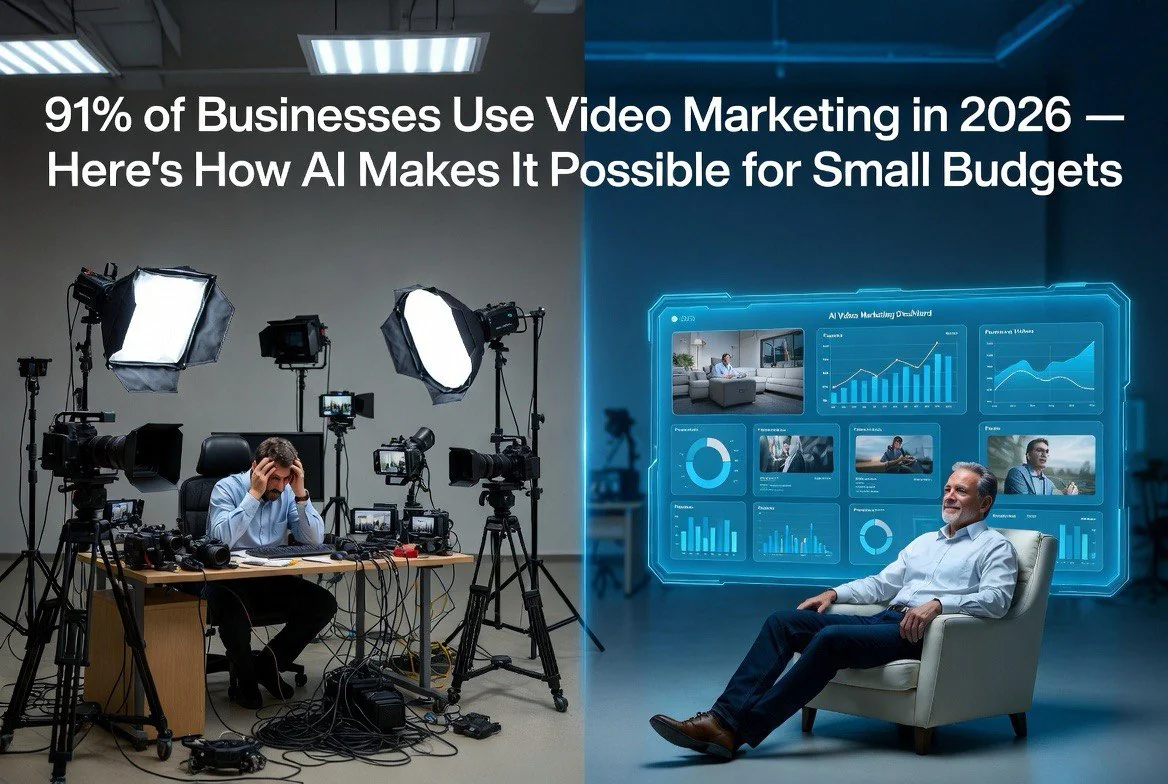
91% of Businesses Use Video Marketing in 2026 — Here’s How AI Makes It Possible for Small Budgets
⚡ Expert Summary: Key Takeaways
- 91% of businesses now use video as a marketing tool — matching the all-time high first set in 2023, according to Wyzowl’s 2026 annual survey.
- 87% of creative professionals use AI tools in their workflows — with 66% using AI for video on a weekly basis (Artlist, 6,500+ creators across 140 countries).
- $203.6 billion — the projected size of the creator economy in 2026, with AI tools powering the majority of content production workflows.
- 68% of marketing leaders say YouTube drives the most business impact of any social platform (Sprout Social).
- AI has eliminated the production bottleneck — small businesses can now produce professional video content for a fraction of the cost and time required just two years ago.
This guide breaks down what the 2026 video marketing data means for small business owners and how AI tools make video production accessible on any budget.
Bottom line: Video is no longer optional for small business marketing, but AI has made it affordable enough that any owner can compete.
Video marketing hit an all-time adoption high in 2026. According to Wyzowl’s annual survey, 91% of businesses now use video as a marketing tool. That number matches the peak reached in 2023 and has held steady through two years of economic uncertainty, platform algorithm changes, and shifting consumer behavior. The signal is clear: video is not a trend — it is the baseline.
For small business owners, this creates a straightforward problem and an even more straightforward solution. The problem: if 9 out of 10 competitors are using video and you are not, your marketing is invisible by comparison. The solution: AI tools have collapsed the cost and time required to produce video, making it accessible to businesses that could never afford a production team.
Here is what the data actually says and how small business owners can act on it in 2026.
The 2026 Video Marketing Landscape — What the Numbers Tell Us
Wyzowl’s survey of businesses across industries found that 91% of companies use video as a marketing tool. That figure has remained remarkably stable since 2023, suggesting video marketing has reached saturation among businesses that were going to adopt it. The gap now separates businesses that use video from those that do not, and that gap directly correlates with growth outcomes.
The same survey found that 96% of marketers say video helps users understand their product or service better. 87% report that video generates leads. 81% say video directly drives sales. These are not aspirational numbers — they are surveyed outcomes from companies already doing the work.
For small businesses specifically, the math works differently than for enterprises. A large company might produce a single commercial for tens of thousands of dollars. A small business needs dozens of video assets — product demos, social clips, customer testimonials, how-to guides — without a dedicated video team. That is where AI changes the equation.
Why AI Makes Video Marketing Viable for Small Budgets
The Artlist Creative Trend Report surveyed 6,500+ creators across 140 countries and found that 87% of creative professionals now use AI tools in their workflows. 66% use AI for video on a weekly basis. For small business owners, these tools are not just for professional creators — they are built for non-technical users who need results fast.
AI video tools handle the three biggest barriers to small business video production: time, cost, and skill. A tool like Synthesia lets you type a script and generate a studio-quality video with an AI presenter in minutes, no camera or actors required. InVideo turns blog posts and articles into marketing videos with AI-driven templates. Descript lets you edit video by editing text — delete a sentence from the transcript and the corresponding footage disappears from the timeline.
The time savings are significant. The same Artlist survey found that creators using AI tools report an average 53.7% reduction in production time. A task that used to take four hours now takes under two. A weekly video newsletter that required a full day of editing now fits into a single morning.
Short-Form Video Dominates — But the Rules Are Expanding
The 2026 landscape for short-form video has shifted. YouTube Shorts now supports videos up to 3 minutes. Instagram Reels allows up to 20 minutes. TikTok permits uploads of up to 10 minutes. Platforms are no longer forcing creators into 15-second boxes — they want both quick hits and deeper content in the same feed.
This benefits small businesses. You no longer need separate strategies for short-form and long-form. A single AI-generated video asset can be exported as a 15-second teaser for Reels, a 90-second explainer for TikTok, and a full walkthrough for YouTube. One piece of source material feeds your entire video marketing pipeline.
The strategic implication is clear: invest in one video production workflow that can produce multiple formats. AI tools that offer multi-format export — like Synthesia and HeyGen — become force multipliers for small teams.
YouTube Remains the Highest-Impact Platform
Despite TikTok’s cultural dominance and Instagram’s feature expansion, 68% of marketing leaders say YouTube drives the most business impact of any social platform, according to Sprout Social data. YouTube’s search functionality gives it longevity that other platforms lack. A video published today can generate traffic for years through Google search results, whereas a TikTok or Reel has a shelf life measured in days.
For small business owners, this reinforces a strategy that too many ignore: post on YouTube first, repurpose everywhere else. AI tools can help you optimize titles, descriptions, and thumbnails for search without hiring an SEO specialist. YouTube’s AI-powered chapters, auto-captions, and thumbnail testing features are built into the platform at no extra cost.
Three AI Video Tools Every Small Business Should Use in 2026
1. Synthesia — Best for AI Avatar Videos
Synthesia lets you create professional presenter videos from a text script. Choose from over 140 AI avatars (or create a custom one), type your script, and the video renders in minutes. Pricing starts at $29 per month for the individual plan. Use it for product demos, internal training, customer onboarding, and sales outreach. No camera, no studio, no actors. Try Synthesia.
2. InVideo — Best for Turning Content Into Video
InVideo converts blog posts, articles, and social media text into video. It has over 5,000 templates and an AI script generator that rewrites your content for video format. The business plan starts at $20 per month. Use it to repurpose a single blog post into 10+ video assets for different platforms. Try InVideo.
3. Descript — Best for AI-Powered Editing
Descript treats video editing like document editing. Upload your footage, Descript transcribes it, and you edit by deleting or rearranging words in the transcript. It also includes AI voice cloning for fixing mistakes without re-recording, AI eye contact correction, and filler word removal. Pricing starts at $24 per month. Use it for podcasts, talking-head videos, and any footage that needs fast, text-based editing.
The Creator Economy Is Driving the Tools You Use
The creator economy is projected to reach $203.6 billion in 2026, according to industry projections. That growth is not happening in a vacuum — AI tools are the engine. The same tools built for YouTubers and TikTok creators are now used by small business owners, marketing teams, and solopreneurs.
The overlap between creator tools and business tools has blurred to the point where they are the same products. A tool designed for a creator filming a YouTube review is the same tool a small business owner uses to record a product demo. The pricing, features, and output quality are identical. The only difference is the use case.
This convergence means small business owners benefit from the rapid innovation cycle of the creator economy. Tools that creators demand — faster rendering, better AI avatars, multi-platform export, improved voice cloning — roll directly into the tools businesses use.
How to Build a Video Strategy on a Small Business Budget in 2026
Start with one tool and one platform. Pick Synthesia or InVideo based on whether you need presenter videos (Synthesia) or content repurposing (InVideo). Commit one hour per week to producing one video asset. Publish it on YouTube and repurpose clips for Instagram and TikTok.
After four weeks, measure: how many views, how many inquiries, whether any new customers mentioned the video. Adjust your format based on what works. Expand to a second tool if your volume justifies it. The goal is not perfection — it is consistency.
AI tools have made video production cheap and fast enough that the only barrier left is deciding to start. The data shows 91% of your competitors already have.
Frequently Asked Questions
How much does AI video production cost for a small business?
AI video tools range from free tiers to professional plans. Synthesia starts at $29/month, InVideo at $20/month, and Descript at $24/month. Most small businesses can get started with one tool for under $30 per month and produce multiple videos per week.
Do I need professional equipment to use AI video tools?
No. AI avatar tools like Synthesia require no camera or microphone. AI editing tools like Descript work with footage from any smartphone. The tools are designed for non-technical users with no production experience.
Is AI video content good enough for marketing in 2026?
Yes. The Artlist 2026 report found that 63% of creators now prioritize commercial rights and strategic viability over pure production quality. AI-generated video has reached a quality threshold where audiences focus on the message, not the production method.
Which social platform should small businesses prioritize for video?
YouTube. 68% of marketing leaders say YouTube drives the most business impact of any social platform. YouTube’s search functionality gives your content long-term visibility, whereas short-form platforms prioritize recency and virality.
Can AI video tools replace a human video editor entirely?
For most small business use cases — product demos, social media clips, talking-head videos, customer onboarding — yes. AI tools can handle the entire production pipeline from script to final export. For complex, narrative-driven content, a human editor still adds value on pacing and storytelling.