Get The Solo Business OS — Free
The AI workflow that replaces a part-time employee for solo operators and small business owners.
Google Gemini Can Now Call Your Customers — What Small Business Owners Should Know
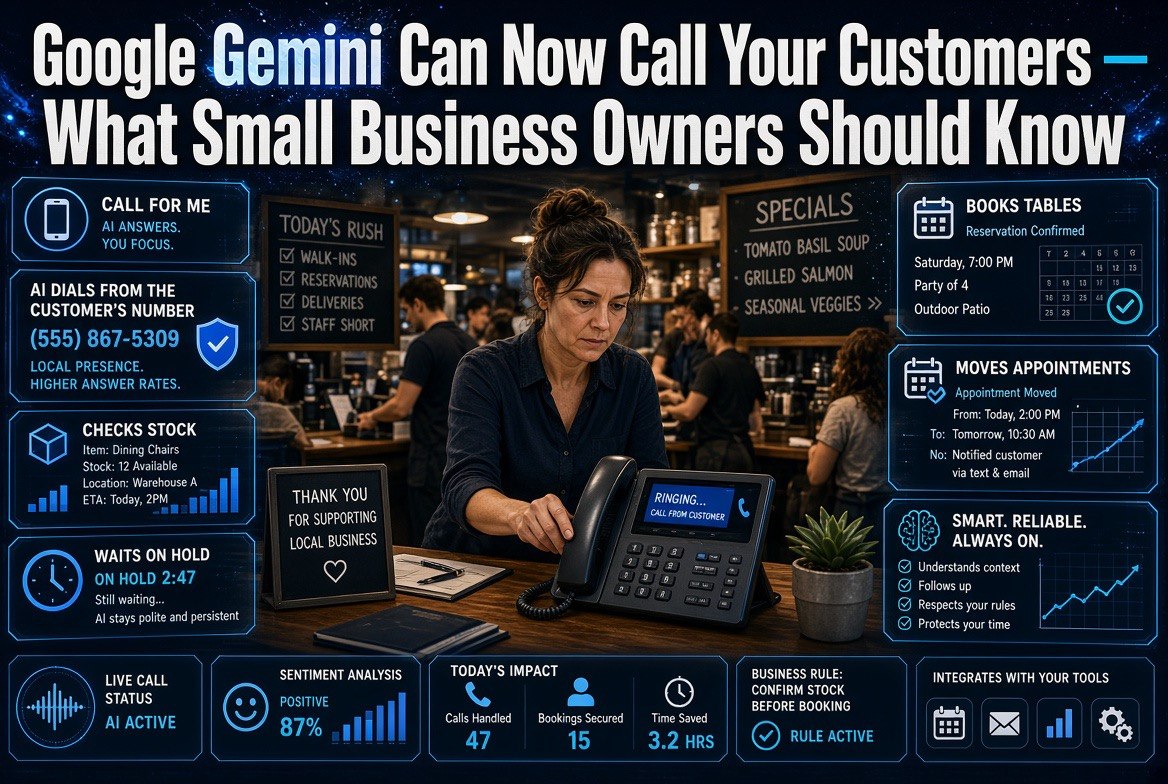
⚡ Expert Summary: Google is testing Gemini‘s “Call for Me” feature, which lets the AI phone a business on a customer’s behalf — checking stock, booking tables, moving appointments, navigating phone menus and waiting on hold. Right now it is limited to US Pixel 11 owners on a Gemini subscription running the beta Phone app. The operator-side takeaway is blunt: an increasing share of inbound calls will be answered by, or placed by, a machine. If your phone number rings into a menu tree that dead-ends, a voicemail box nobody checks, or a booking flow that only a human can navigate, you lose the booking — and you never hear about it.
Nobody calls your restaurant, salon, dental office, or auto shop to admire your brand. They call because they want one thing — is it in stock, can I get in at 7, can I move Tuesday to Thursday — and they want it settled in under two minutes. For the last decade, the biggest silent leak in small business has been the phone: calls that ring out during a rush, calls that land in a voicemail box checked once a day, calls that hit a phone tree with four options and no human at the end of any of them. The numbers on missed calls are ugly and well documented, but at least the person on the other end was a person who might call back.
That last part just changed. On September 24, 2026, Google began testing a feature called “Call for Me” that lets Gemini place real phone calls to businesses on a user’s behalf. The AI dials from your own phone number, introduces itself, navigates the automated menu, waits on hold, and handles the conversation on the other end. It can share personal details the user has approved, and the user can watch a live transcript and take over mid-call. The rollout is deliberately small — US Pixel 11 owners with a Gemini subscription, running the beta version of Google’s Phone app — because, as Google put it, “real-world conversations are nuanced.”
What Google Actually Shipped With Call for Me
Google is not new to AI-assisted calling. The famous 2018 demo of Google Assistant booking a hair salon — complete with the little “umm’s” and “ahh’s” — was the opening shot. “Hold for Me” and “Talk to a Live Rep” followed on Pixel, then “Direct My Call” to read out phone-tree options, then “Ask for Me” to check pricing and availability. Each one chipped away at a different piece of the phone problem. Call for Me is the first version that strings all of them together into one agentic action.
What is materially different this time is scope and agency. Earlier features were queries — the assistant asked a question and reported back. Call for Me takes actions. Google’s own examples: calling a store to check if a product is in stock, making a restaurant reservation, moving an existing appointment to a different date, and placing items on hold. That is a shift from information retrieval to transaction execution, and it happens on a live phone line with a human employee on the other end.
The mechanics matter for operators too. The call comes from the customer’s own number, not a Google-owned line, so your caller ID shows a real person. The AI announces itself, handles the IVR, and holds. The user can take over at any time from a live transcript. That combination — announced AI, real number, human takeover available — is the shape of the calls you are going to be answering.
Who Is Dialing Whom Now
The framing that most small business owners have absorbed is backwards. The story is not “AI calls customers to sell them things.” The story is that your customer’s AI assistant now calls you, and the volume of those calls is going to rise with the installed base of the assistants.
Google’s move is not happening in a vacuum. Meta has shipped agents that can make calls on users’ behalf, and other assistants are following. Whoever’s assistant a consumer happens to use, the direction of travel is identical: routine phone errands get delegated to software. Consumer reporting in mid-2025 documented restaurants and reservation platforms already wrestling with AI voice agents calling to place orders and book tables, and some platforms responding by cracking down on automated traffic.
That creates a three-way call pattern that did not exist two years ago, and it is worth mapping plainly.
| Call Type | Who Is On The Other End | What Breaks It | What To Do About It |
|---|---|---|---|
| Human to human | Customer and your staff | Nobody free to pick up during service; hold times | Keep the human path fast and obvious; staff your known peaks |
| AI to your staff | Customer’s assistant and a person | Staff confusion about what the caller is; inconsistent answers | Brief staff on AI callers; give them one script for hours, stock, and bookings |
| AI to your AI | Customer’s assistant and your phone system | IVR loops, no structured data, no machine-readable availability | Flatten the menu tree; publish hours and inventory; accept structured booking |
| AI to voicemail | Customer’s assistant and a dead end | The agent hangs up and books with your competitor instead | Replace voicemail-first with an answering layer that can answer and book |
Read the last two rows again. Those are the ones that cost you money without ever showing up on a report. A human who reaches voicemail will usually call back. A software agent that reaches voicemail has completed its task with a null result, reports that to the user, and the user moves to the next business on their list. There is no follow-up call, no voicemail message left in your box, no signal at all on your end.
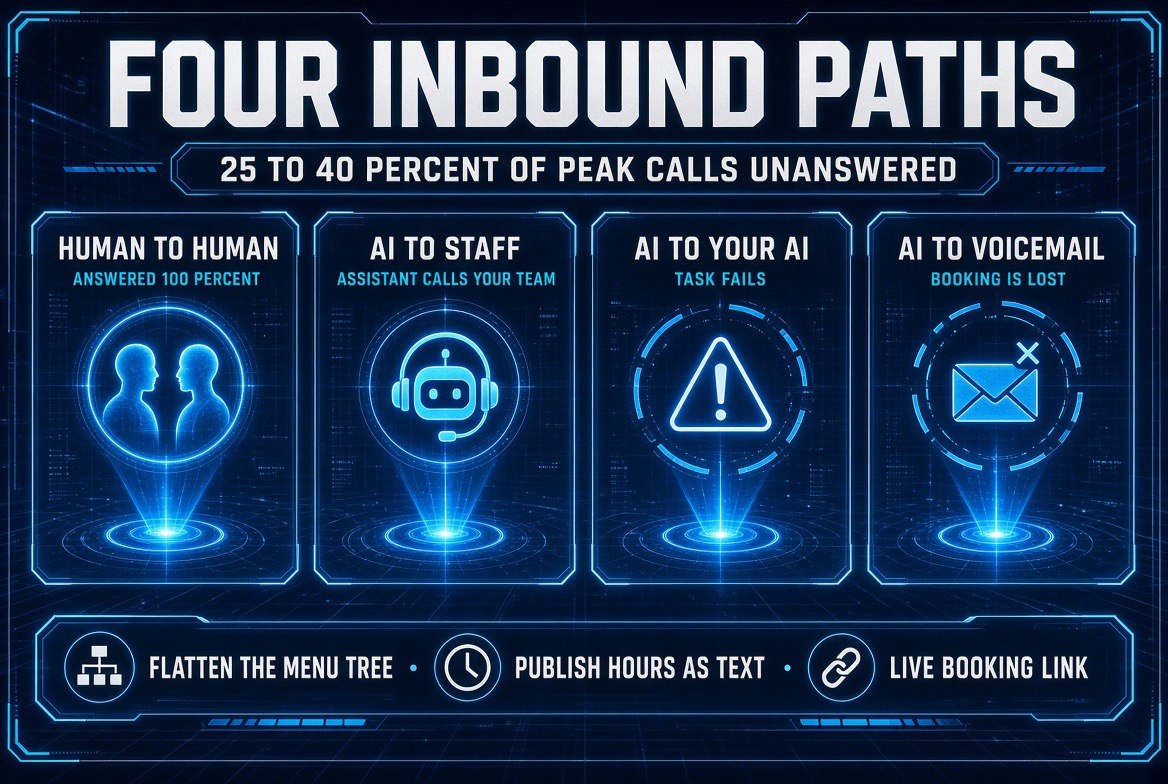
Four inbound paths, four different failure modes. Only the last one costs you the booking silently — the customer’s assistant reports a dead end and dials the next business on the list.
Why the Phone Is the Most Expensive Door You Own
Consider what a phone call is worth. In a restaurant, an average table check for two runs somewhere in the range of $60 to $110 depending on market and concept, according to National Restaurant Association operating data. A denied booking at 7:00 PM on a Friday is not a lost sale — it is a lost sale that was already sold, then reversed. In a salon or clinic, a moved appointment is a hole in a schedule that someone is still being paid to stand next to.
Now multiply that by the share of calls that arrive during your busiest window, which is exactly when nobody can answer. Industry benchmarking on missed calls is remarkably consistent across service verticals: for small service businesses, a meaningful minority of inbound calls — frequently cited in the 25 to 40 percent range during peak hours — go unanswered. Every one of those was a person with a need and a phone.
The reason this matters more in 2026 than it did in 2024 is that the unanswered call no longer dies quietly. It gets handed to an AI that will immediately try someone else. Research from MIT and the National Bureau of Economic Research on AI adoption has made the point that automation value concentrates where tasks are repetitive and where a failed handoff is invisible. Inbound phone handling is the textbook case: repetitive, high-frequency, and invisible when it fails.
There is a second-order effect too. Once customer-side agents are doing the dialing, the businesses with the cleanest machine-readable information win the calls that used to be won by whoever had the friendliest receptionist. Your hours, your stock levels, your booking availability, and your service list stop being marketing copy and become infrastructure. If they are locked in a PDF, an image, or a phone tree, the agent cannot use them.
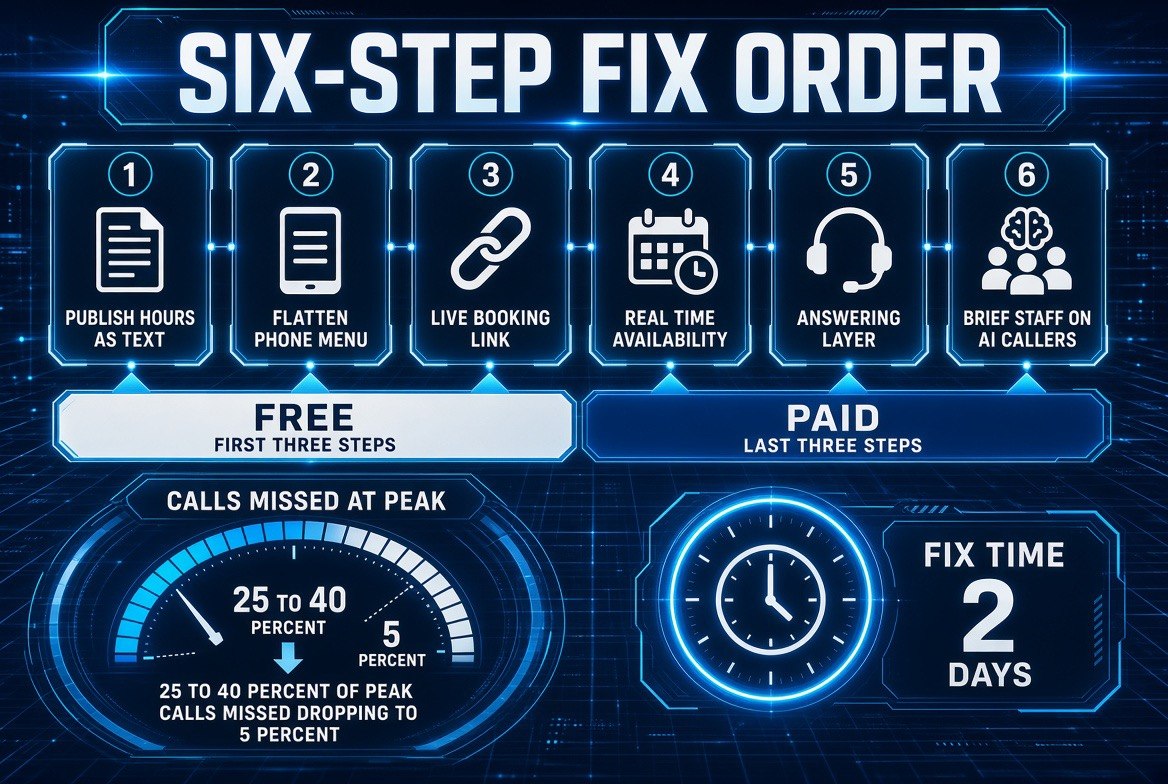
The fix order matters more than the tool. The first three steps cost nothing but an afternoon and remove most of the pain; only then is a paid answering layer worth buying.
How to Make Your Business Answerable by an AI Agent
You do not need to buy anything to get most of the way here. You need to remove friction that only exists because humans used to be on both ends of the line. Work through these in order — the first three are free, and they cover the majority of AI-agent calls.
Step 1 — Publish your hours, address, phone, and service list as text, not images. This sounds trivial and it is the single most common failure. If your hours live in a JPEG on your homepage, both the customer’s assistant and the AI search layer behind it are working blind. Plain HTML text is machine-readable; a graphic is not.
Step 2 — Flatten your phone menu. Press-one-for-hours, press-two-for-bookings, press-three-for-directions is a wall built for humans with patience. A voice agent can navigate it, but every extra layer increases the chance it gives up and dials elsewhere. Put a human or a capable answering layer on the first branch, and publish the same information on a page the agent can read before it ever dials.
Step 3 — Make booking available without a phone call wherever possible. If your OpenTable, Toast, or Square booking link is crawlable and current, a large share of would-be calls never happen. That is the cheapest outcome available to you: the call that was never needed.
Step 4 — Show live availability, not a request form. A form that says “we’ll get back to you” is a dead end for an agent acting on a user’s behalf in the moment. Real-time slots close the loop in the same interaction.
Step 5 — Replace voicemail-first with an answering layer that can actually resolve things. Whether that is a human answering service, a hybrid, or an AI receptionist, the requirement is the same: it must be able to confirm hours, confirm stock, and take or move a booking. A voicemail box fails all three.
Step 6 — Brief your staff on AI callers. Your team will start encountering callers who announce themselves as an assistant. They need one consistent script: hours, stock policy, booking policy, and a clean handoff if the request falls outside it. Inconsistency is what turns a resolvable AI call into a dropped one.
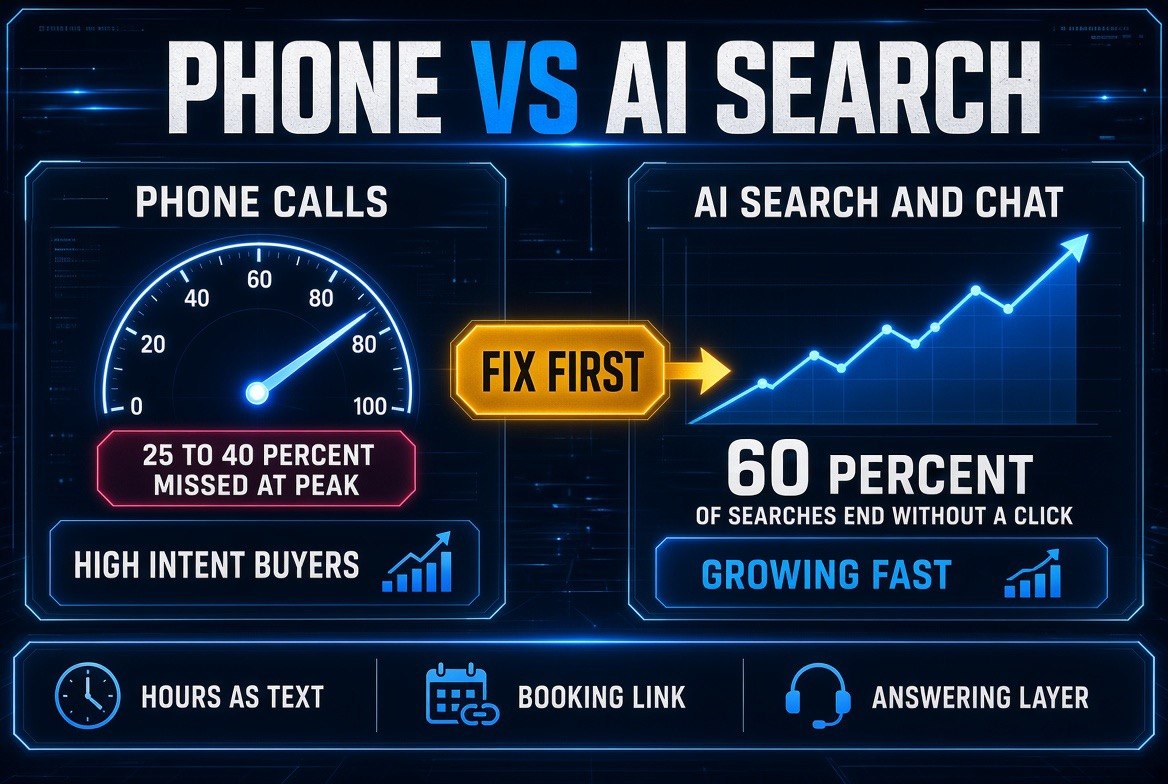
Two inbound channels, two different failure rates. The phone still carries your highest-intent buyers, which is exactly why every missed ring costs more than a missed impression.
Sight vs. Sound: Which Inbound Channel Deserves Your Fix First
Most owners have one budget line for “get found” and nothing at all for “get answered.” That is the wrong split in 2026. AI search and agentic calling attack the same funnel from opposite ends, and they are not interchangeable — they fail in different ways and need different fixes.
| Factor | AI Search Visibility | AI Phone Answering |
|---|---|---|
| Where it fails | You never enter the consideration set | You enter it, then drop the ball on contact |
| What it costs you | Lost top-of-funnel demand you never see | Bookings already in hand, reversed at the last step |
| Time to fix | Weeks — content, schema, structured data | Days — phone tree, hours text, booking link |
| Cost to fix | Ongoing content work or agency retainer | Mostly free; paid only if you add an answering layer |
| Visibility of the problem | Partially measurable via impressions and referrals | Almost entirely invisible today |
| Who should do it | Any business competing for local or category demand | Every business that takes inbound calls — which is all of them |
The verdict is not close. Fix phone answering first, because it is cheaper, faster, and protects revenue you have already won. Then work on visibility, because that is where the growth comes from. Doing them in the other order is how owners spend five figures on content while losing bookings to a phone tree.
What This Means for US Small Businesses Right Now
Take the rollout constraints seriously before you panic or spend. As of late September 2026, Call for Me is a US-only experiment, gated behind a Pixel 11 and a paid Gemini subscription, and it requires the beta Phone app. The population of callers using it today is small. Google said explicitly that it is starting small because real-world conversations are nuanced. If you run a business in the United States, you are in the first market this lands in, and the installed base will grow with every Pixel and subscription renewal.
That gives you a window that most technology shifts do not offer: the change is public, the direction is certain, and the volume is still low enough that you can fix your contact layer without a fire drill. The owners who use this window will be the ones whose phones simply work when an assistant dials. The owners who do not will keep losing calls they never knew were placed.
And keep the economics in view. You are not investing in AI to answer AI. You are fixing a phone line that was already losing you bookings during every Friday rush, every lunch peak, and every holiday weekend. The fact that the caller on the other end is now sometimes software just makes the leak visible enough to finally fix.
The phone is the oldest piece of technology in your business and, right now, the one changing fastest. Answer it like it matters — because from here on, the thing on the other end is keeping score.
Frequently Asked Questions
What is Google’s “Call for Me” feature?
Call for Me is a Gemini feature that lets the AI place real phone calls to businesses on a user’s behalf. It dials from the user’s own number, introduces itself as an assistant, navigates phone menus, waits on hold, and handles the conversation — including complex tasks like checking stock, booking a table, or moving an appointment. Google announced the test on September 24, 2026.
Who can use Gemini Call for Me today?
It is rolling out to a limited group: US owners of the Pixel 11 who pay for a Gemini subscription and are running the beta version of Google’s Phone app for Android. Google says it is starting at a small scale because real-world conversations are nuanced.
Will my small business start getting AI calls?
Possibly, and the share will grow. The calls come from the customer’s own phone number, so your caller ID looks normal, but the caller may be an AI assistant acting for that customer. Any business that takes inbound calls — salons, clinics, restaurants, repair shops, retail — should assume a rising percentage of inbound calls are agent-initiated.
What happens if an AI agent reaches my voicemail?
It usually ends the task. Unlike a human, an AI assistant reports a null result to its user, who then moves on to another business. There is no callback, no voicemail left in your inbox, and no visible signal that you lost the booking. That is why voicemail-first phone handling is the single most expensive setting in your contact layer.
Do I need new software to handle AI callers?
Not to start. The first three fixes are free: publish hours, service lists, and addresses as plain HTML text; flatten your phone menu; and expose a working booking link through your existing reservation or POS provider. Only when you want calls answered around the clock should you consider a human answering service or an AI receptionist.

About Barak Schurr
Barak Schurr built and sold a major ticketing platform, ran global nightlife operations at Eventbrite, and now spends his time figuring out which AI tools actually move the needle for independent business owners — and which ones are just noise. No hype. No fluff. Just what works.
Email: [email protected]
More AI Resources for Your Business