Get The Solo Business OS — Free
The AI workflow that replaces a part-time employee for solo operators and small business owners.
Wix Symphony: AI Agent Platform for Small Business
⚡ Expert Summary: Symphony by Wix is a standalone AI agent platform for small businesses — not a website builder with AI bolted on. A central orchestrator agent called Maestro assembles a team of specialist agents (outreach, marketing, scheduling, research, finance, design), runs a daily briefing, and takes action across the tools you already pay for: calendar, inbox, CRM, payments, Slack. It works without a Wix website, runs on iOS and Android, and Wix says it has a free tier. For a US small business owner, the real shift is that this is the first mainstream platform selling an AI workforce rather than an AI feature — and the pricing, approvals, and failure modes are what actually decide whether it saves you money.
Every small business owner in America has heard the same pitch for three years: AI will give you leverage you can’t afford to hire. Then you sign up, and you get a chatbot in a sidebar that writes a mediocre email and forgets your name by Thursday. That gap — between the promise of an AI team and the reality of a chatbot with amnesia — is the single most expensive disappointment in small business software right now. You don’t lose money on the subscription. You lose it on the six weeks you spent trying to make the thing useful.
So when Wix — a company with 300 million businesses’ worth of accumulated data and two decades of watching small operators succeed and fail — launched an agent platform that runs without a Wix website, that got my attention. Wix Symphony is the most direct attempt yet at selling a US small business owner an actual digital workforce rather than another assistant.
What Wix Symphony Actually Is
Symphony by Wix is a standalone AI agent platform built for small and medium-sized businesses. It launched in August 2026 and Wix has been pushing it hard since — including through developer and enterprise channels, which is why it resurfaced in legal and business press in late September. The important detail: it is not a feature inside the Wix editor. You do not need a Wix website. It is an app.
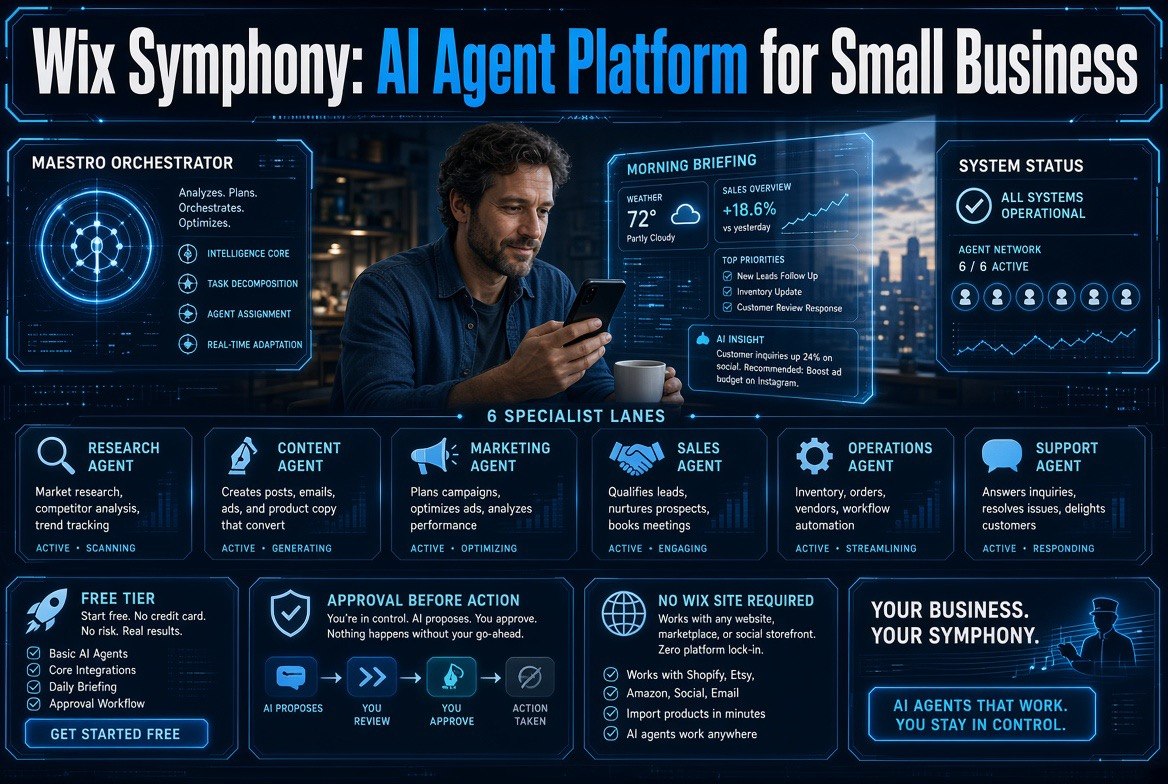
At the center sits Maestro, the orchestrator agent. Maestro’s job is not to do the work — it is to understand what is happening across your business, decide what needs attention next, and route each task to the right specialist agent. Wix describes Maestro as the thing that “understands what is happening across the business, identifies what needs attention next, and coordinates the right agent for each job.”
The specialist agents cover six lanes out of the box: outreach, marketing, scheduling, research, finance, and design. Each agent owns its lane and works with the others on shared projects. You can also create and train your own agents — set a name, give it a personality, approve its goals and allowed actions — then let it run.
Then there is the part that actually separates Symphony from a chat window: the morning meeting. Every day, your agents produce a summary through the mobile app covering work completed, what still needs to be done, and new opportunities identified from your business activity, customer behavior, and current trends. That is a status report generated by software, delivered before you have opened your laptop.
How Symphony Compares to the AI Tools You’re Already Paying For
The honest comparison is not “Symphony versus nothing.” It is Symphony versus the stack of point tools already sitting on your card statement, plus the hours you personally spend being the integration layer between them.
| Factor | Wix Symphony | Typical Point-Tool Stack |
|---|---|---|
| Core model | Orchestrated multi-agent team under one central coordinator (Maestro) | Separate single-purpose apps, each with its own AI feature |
| Who integrates | The agents coordinate with each other; you approve actions | You are the integration layer — copying data between tabs |
| Proactivity | Agents propose moves and run approved ones; daily morning briefing | Reactive — nothing happens until you open the app and ask |
| Starts from | A conversation about your business, then agent selection | A blank configuration screen and a template gallery |
| Quality control | Built-in review agent checks work before it reaches you | Whatever the model outputs is what you get |
| Access | Standalone iOS and Android app; no Wix site required | Mix of desktop web apps, browser tabs, and mobile apps |
Read the third row again. That is the whole argument. Every small business owner running a modern tool stack already employs a full-time, unpaid integration specialist: themselves. The value proposition of an orchestrator is not that its agents are smarter than a best-in-class point tool. It is that you stop being the connective tissue between them.
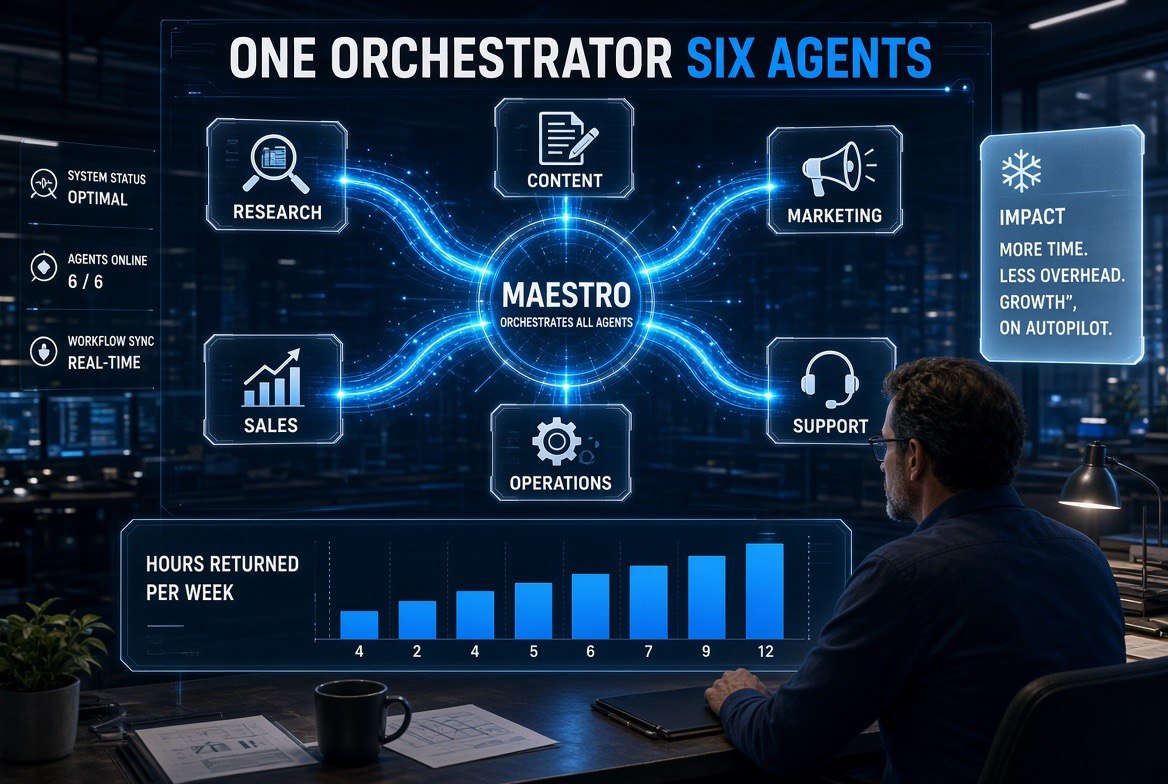
Symphony routes work through one Maestro orchestrator rather than six disconnected tools — the number that matters is hours returned per week, not features shipped.
The Morning Meeting Is the Feature Nobody Talks About
The most underrated thing in Symphony’s design is the daily briefing. It sounds like a gimmick. It is actually the answer to the single most common failure mode in AI adoption: you buy the tool, you use it twice, and it quietly dies.
Point tools die because they are passive. They wait for you to remember they exist. You are running a service business — you have crews to schedule, invoices to chase, a job that went sideways on Tuesday. Of course you forgot the AI subscription you bought in March.
An agent system that shows up every morning with a summary of what got done, what is still open, and what it noticed in your numbers is behaving like a team member, not a tool. That is a materially different relationship with software. Whether it is worth money depends entirely on whether the summaries are accurate — and that is the part you have to test yourself, because no vendor demo will show you their bad days.
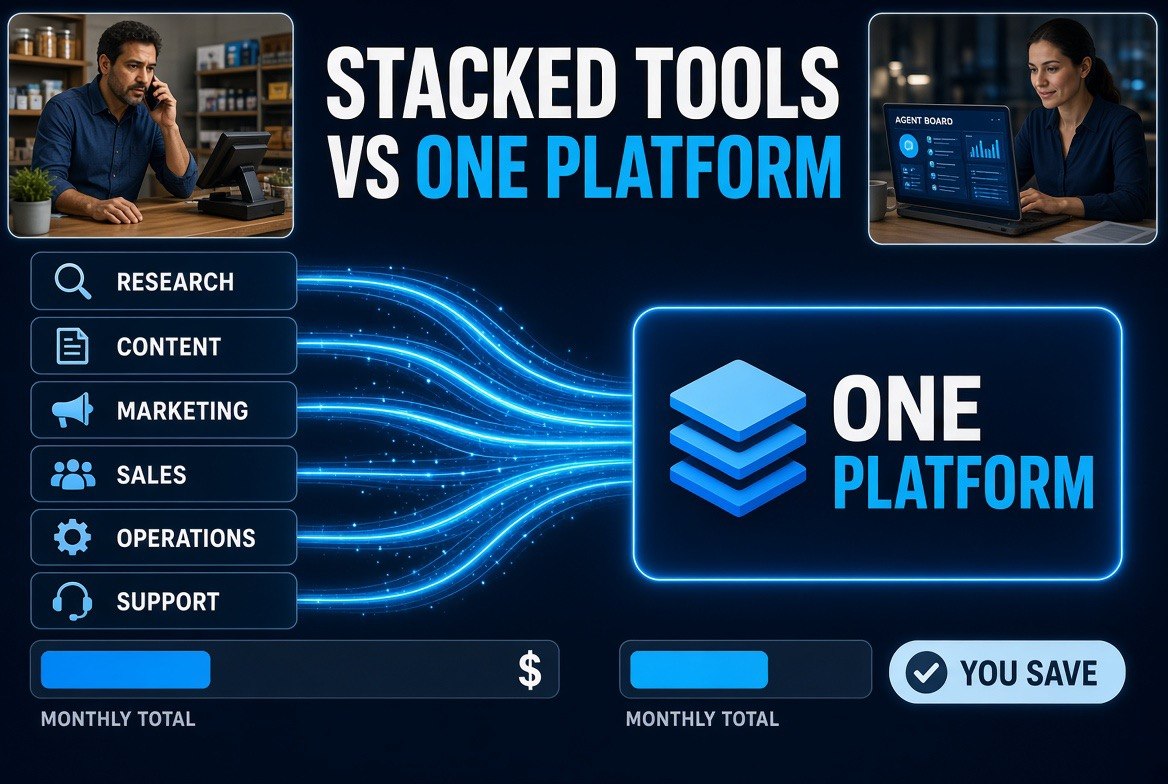
The real cost comparison is not tool versus tool — it is the full stack on your card statement versus one platform, plus the hours you spend being the integration layer between them.
How to Actually Evaluate Wix Symphony Before You Pay
| Evaluation Step | What To Do | What It Proves |
|---|---|---|
| Week 1 — one lane | Turn on the single agent covering your biggest leak (follow-up, collections, or no-shows) | Whether the agent understands your business before it can damage it |
| Week 1 — two systems | Connect calendar + inbox, or CRM + payments. Nothing more | Whether the coordination is real and how wide the blast radius actually is |
| Days 1–14 | Read every morning briefing and score it: accurate, specific, actionable | Whether you have an agent system or a chatbot wearing a suit |
| Month 1 | Keep the approval gate on for finance and outreach | That no agent can email customers or move money unreviewed |
| Day 30 | Count hours returned against subscription plus setup time | Whether you broke even — at $75/hr and 90 min setup, the agents must return ~2 hrs/month |
You should not buy a digital workforce the way you buy a photo editor. Here is the sequence that separates a real evaluation from a demo high.
1. Run it on one lane first. Pick the business function that leaks the most money right now — usually follow-up on quotes, or chasing unpaid invoices, or no-shows. Turn on that single agent. Do not turn on all six. A six-agent deployment across a business you have not yet taught anything is how you get a mess you can’t audit.
2. Connect exactly two systems. Your calendar and your inbox, or your CRM and your payment processor. The value of an orchestrator scales with how much of your business it can see, but so does the blast radius when it gets something wrong. Two connected systems is enough to judge whether the coordination is real.
3. Watch the morning meeting for fourteen days. This is your free trial period doing honest work. If the daily summary is consistently accurate, specific, and actionable by day fourteen, you have something. If it is generic — “you had some customer interactions this week!” — you have a chatbot wearing a suit.
4. Make the agents earn approval before autonomy. Symphony is built around an approval model: agents propose goals and actions, you approve, then they run. Keep that gate on for finance and outreach for the first month. An agent that can email your customers without review is a reputational risk with a credit card.
5. Count the hours, not the features. Compare the hours you actually got back against the subscription cost and the hours you spent configuring. If your hourly rate is $75 and Symphony costs you 90 minutes of setup, the agents need to return roughly two hours a month before you have broken even on setup alone. Everything after that is margin.
What Could Go Wrong — The Failure Modes That Matter
I am not going to pretend a multi-agent platform is risk-free, because the failure modes are specific and they are expensive.
Agent sprawl. Symphony encourages you to create your own agents. Every agent you create is another thing making decisions in your name. The businesses that get burned are the ones that spin up eleven agents in week one and then cannot reconstruct which one sent that email to a client. Start narrow, name your agents clearly, and write down what each one is allowed to do.
Approval fatigue. The approval gate is a safety feature that becomes a tax. If your agents propose forty actions a day and you approve them without reading, you have disabled the safety feature by habit. Review the queue once a day, not once an hour.
Wrong-lane actions. Orchestration means agents hand off work to each other. When a handoff goes wrong, you can end up with a finance agent drafting a marketing email or a scheduling agent touching a customer record. This is precisely why Wix built in a review layer — but the review layer is checking the agent’s own work, not the coordination. Spot-check the handoffs yourself in the first month.
The unquantified subscription. Wix says you can try Symphony for free and upgrade when you want more, with the platform available on iOS and Android. As of writing, Wix has not published a detailed public price-per-tier breakdown in the launch materials I could verify. That matters. Ask for the exact tier pricing in writing before you migrate any real workflow onto it, and know what happens to your agents and their history if you downgrade.

The rollout is the risk control. Stage the deployment, keep the approval gate on, and watch the blast radius rather than the feature list.
Why This Matters for US Small Business Owners Specifically
American small businesses run leaner than almost any comparable market. A US service business with six employees is expected to field sales, scheduling, collections, marketing, and customer service with the same headcount that a European competitor might staff with twelve. That constraint is exactly the market an AI workforce is built for — and it is also the market where a bad tool does the most damage, because there is no spare person to catch what the software drops.
The strategic read is straightforward. Agent orchestration platforms are consolidating the point-tool market from the top. If Symphony, HubSpot, and the rest succeed, the value moves from “which app do I use” to “which orchestrator knows my business.” That is a much stickier position, and it means the switching cost you are taking on today is bigger than the one you took on when you picked a CRM.
So treat the evaluation seriously. Not because Wix Symphony is guaranteed to win — it has real competition and the pricing is not transparent yet — but because the category is going to rearrange your tool stack whether you participate in the decision or not.
For more on how AI agents are reshaping small business operations, see our breakdown of Meta letting AI agents set up WhatsApp Business, and our guide to cutting your AI tool spend by 50% in 2026.
Frequently Asked Questions
Do I need a Wix website to use Symphony by Wix?
No. Symphony is a standalone AI agent platform. Wix states explicitly that it “works as a standalone app” and that you “don’t need an existing Wix website to get started.” It is available as an iOS and Android app, which means you can run it alongside Shopify, Squarespace, WordPress, or no site at all.
How much does Wix Symphony cost?
Wix says you can try Symphony for free and upgrade when you want more. The company has not published a full public tier-by-tier price breakdown in its launch materials. Before you commit a real workflow to it, request the exact pricing for each tier in writing and confirm what happens to your agents and their history if you downgrade.
What is Maestro in Wix Symphony?
Maestro is the central orchestrator agent. It does not do the work itself — it monitors what is happening across your business, determines what needs attention next, and assigns each task to the appropriate specialist agent. Symphony’s specialist agents cover outreach, marketing, scheduling, research, finance, and design.
Which tools does Symphony connect to?
Wix describes Symphony as plugging into the tools a business already uses — calendar, inbox, CRM, payments, Slack, Salesforce, and Monday are named in its marketing — and says connections are made by chatting rather than through a configuration screen. Treat the exact connector list as something to verify against your own stack during your trial, since connector coverage is where orchestration platforms most often fall short.
Is Wix Symphony the same as an AI chatbot?
No. A chatbot responds when you type. Symphony is designed around proactive agents that propose actions, run the ones you approve, coordinate with each other, and deliver a daily morning briefing on completed work, open items, and new opportunities. The difference in practice is that a chatbot waits for you and an agent system initiates.
Should a small business replace its existing tools with Symphony?
Not immediately, and probably not entirely. The strongest pattern is to keep your best-in-class point tools and use Symphony as the coordination layer above them, starting with one business function and two connected systems. Replacing your accounting or CRM in the same month you adopt an agent platform gives you no clean way to tell which change broke something.

About Barak Schurr
Barak Schurr built and sold a major ticketing platform, ran global nightlife operations at Eventbrite, and now spends his time figuring out which AI tools actually move the needle for independent business owners — and which ones are just noise. No hype. No fluff. Just what works.
Email: [email protected]
More AI Resources for Your Business