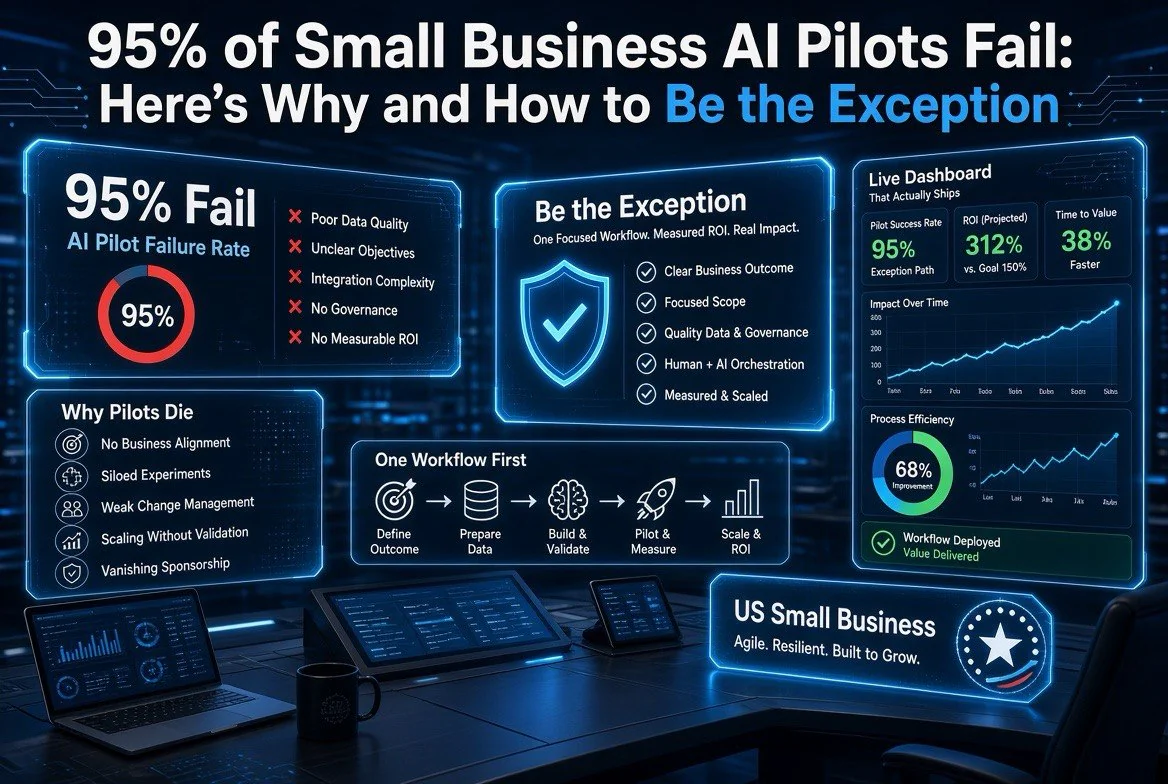
95% of Small Business AI Pilots Fail: Here’s Why and How to Be the Exception
⚡ Expert Summary: A 2026 study by the Global Tech Innovation Alliance (GTIA) found that 95% of small business AI pilots fail to scale into production. The reason isn’t technical—it’s organizational. Skills gaps, unrealistic ROI expectations, and misaligned workflows doom most pilots before they start. The 5% that succeed share three specific traits: they measure the right metrics, they align AI to existing workflows (not rebuild workflows for AI), and they invest in team enablement before rollout.
The GTIA Study: What 95% Failure Actually Means
The Global Tech Innovation Alliance surveyed 1,200+ small businesses (10-500 employees) across retail, hospitality, professional services, and manufacturing between January and August 2026. Their report, “AI Pilot-to-Production Scaling,” dropped a sobering finding: 95% of AI pilots initiated by small business operators never make it past the proof-of-concept phase.
But “failure” here doesn’t mean the AI broke or produced bad results. In most cases, the pilots worked technically. The pilot generated insights, automated tasks, or optimized processes—exactly as promised. The failure was organizational: the pilot solved a single problem for a single team, and the company couldn’t scale it, couldn’t replicate it, and couldn’t sustain it. Six months after the pilot ended, the AI was unused and the team reverted to manual workflows.
This is the signature small business AI trap. Large enterprises have dedicated AI ops teams, change management budgets, and infrastructure to roll out pilots company-wide. Small businesses don’t. A pilot that impresses leadership becomes a pilot that nobody knows how to run at scale—and nobody uses it.
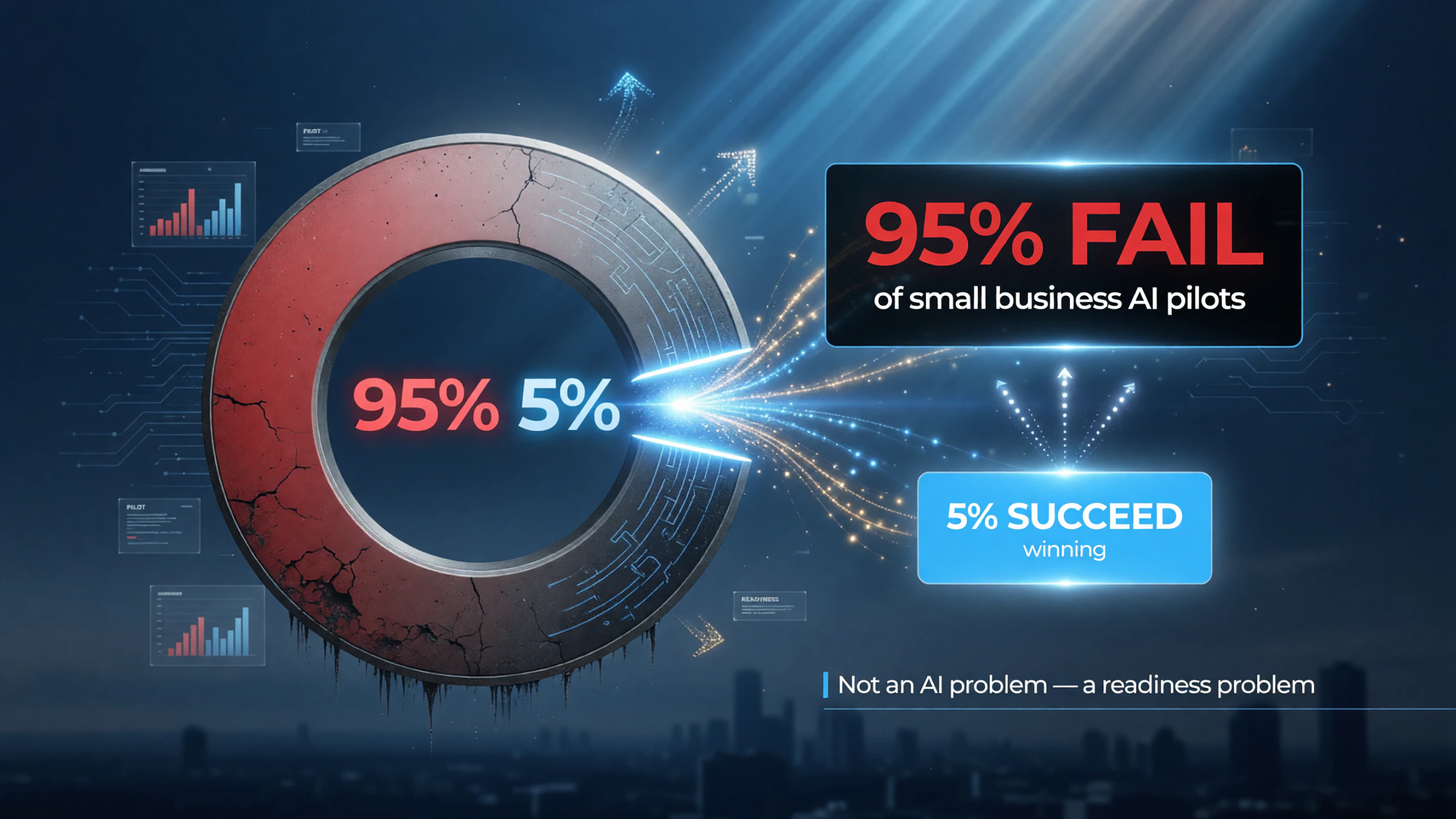
GTIA’s survey of 1,200+ small businesses found 95% of AI pilots never make it past proof-of-concept — not because the AI failed, but because the organization couldn’t scale it.
Why 95% of Pilots Fail: The Three Root Causes
The GTIA report identified three non-technical reasons most pilots fail:
| Failure Category | The Problem | Why It Kills the Pilot |
|---|---|---|
| Skills Gap | The team that ran the pilot doesn’t know how to train others to use it. No one is responsible for adoption or troubleshooting once the pilot ends. | When the pilot team moves on or the tool breaks, nobody knows how to fix it or teach new team members. The tool sits idle. |
| Misaligned ROI Metrics | Leadership expected the pilot to cut costs by 30% or boost revenue by 15%. The pilot delivered real value—but 8% cost savings and 4% efficiency gains. | Perceived as a failure even though it works. Leadership doesn’t fund scaling, and the team loses confidence in the AI. |
| Workflow Mismatch | The pilot was built for an idealized workflow. Real workflows have exceptions, legacy steps, and workarounds that the AI doesn’t handle. | When rolled out, the tool creates friction. Employees bypass it, continue old workflows, or abandon it after a week. |
The GTIA verdict: 73% of failed pilots cited skills gaps as the primary blocker. 61% cited unrealistic ROI expectations. 58% said workflow mismatch made the tool unusable in practice. (Percentages overlap—most pilots had more than one problem.)
The Five Percent Exception: What Successful Pilots Share
The 5% of pilots that scaled to production across the small business sample had three things in common.
1. They measured the right metrics from day one. Successful pilots didn’t set a 30% cost-cut goal. They set specific, achievable metrics tied to the actual problem: time saved per task, error rate reduction, throughput gain, or revenue per customer. When the Owner platform was piloted at 12 restaurants, leadership measured average customer wait time (baseline: 4 minutes, target: 2.5 minutes). The pilot hit 2.7 minutes. That’s a win—not hype, not fantasy. The team funded scaling.
2. They aligned AI to existing workflows, not rebuilt workflows for AI. Successful pilots asked: “How does this team work today, and where is the pain point?” Then they built the AI to fit into that existing workflow. Failed pilots asked: “What’s the ideal workflow for this AI tool?” and tried to change how people work. Employees hate change. AI tools that require new workflows die in adoption.
3. They invested in team enablement before and during rollout. Successful pilots designated one person (or a small team) to own adoption: training new users, documenting workflows, answering questions, troubleshooting errors. This sounds obvious. It’s not. Most small businesses run pilots, leave zero budget for training or ongoing support, and expect adoption to happen by magic.
The Comparison: Successful vs. Failed AI Pilots (What the Data Shows)
Here’s how the 5% successful pilots stack up against the 95% that failed:
| Dimension | Successful Pilots (5%) | Failed Pilots (95%) |
|---|---|---|
| ROI Expectations | 5-15% efficiency gain or cost savings. Realistic and specific. | 30%+ cost cut or revenue lift. Overpromised by vendor or leadership. |
| Team Ownership | Named owner (full- or part-time) for adoption and training. Budget allocated for ongoing support. | No named owner. Pilot team runs it; when they move on, it dies. Zero ongoing support budget. |
| Workflow Integration | AI was adapted to fit existing workflows. Employees use it as a tool within their existing routine. | Workflows rebuilt for the AI. Employees see it as disruptive change, adopt reluctantly or not at all. |
| Pilot Scope | Single team, single problem, 4-8 week timeline. Clear, measurable success criteria before launch. | Broad scope, vague goals, open-ended timeline. Success criteria undefined or moved during the pilot. |
| Training Plan | Documented workflows, hands-on training sessions, ongoing Q&A channel. Users feel supported. | Vendor demos, maybe a Slack channel. No ongoing support. Users feel abandoned. |
| Post-Pilot Adoption Rate | 60-75% of team uses the tool regularly, 6+ months after pilot launch. | Less than 10% of team uses the tool regularly. Most revert to manual workflows within 30 days. |
The pattern is clear: successful pilots are small, well-scoped, owned by someone on the team, and built around realistic ROI metrics. Failed pilots are ambitious, unowned, workflow-disruptive, and oversold.
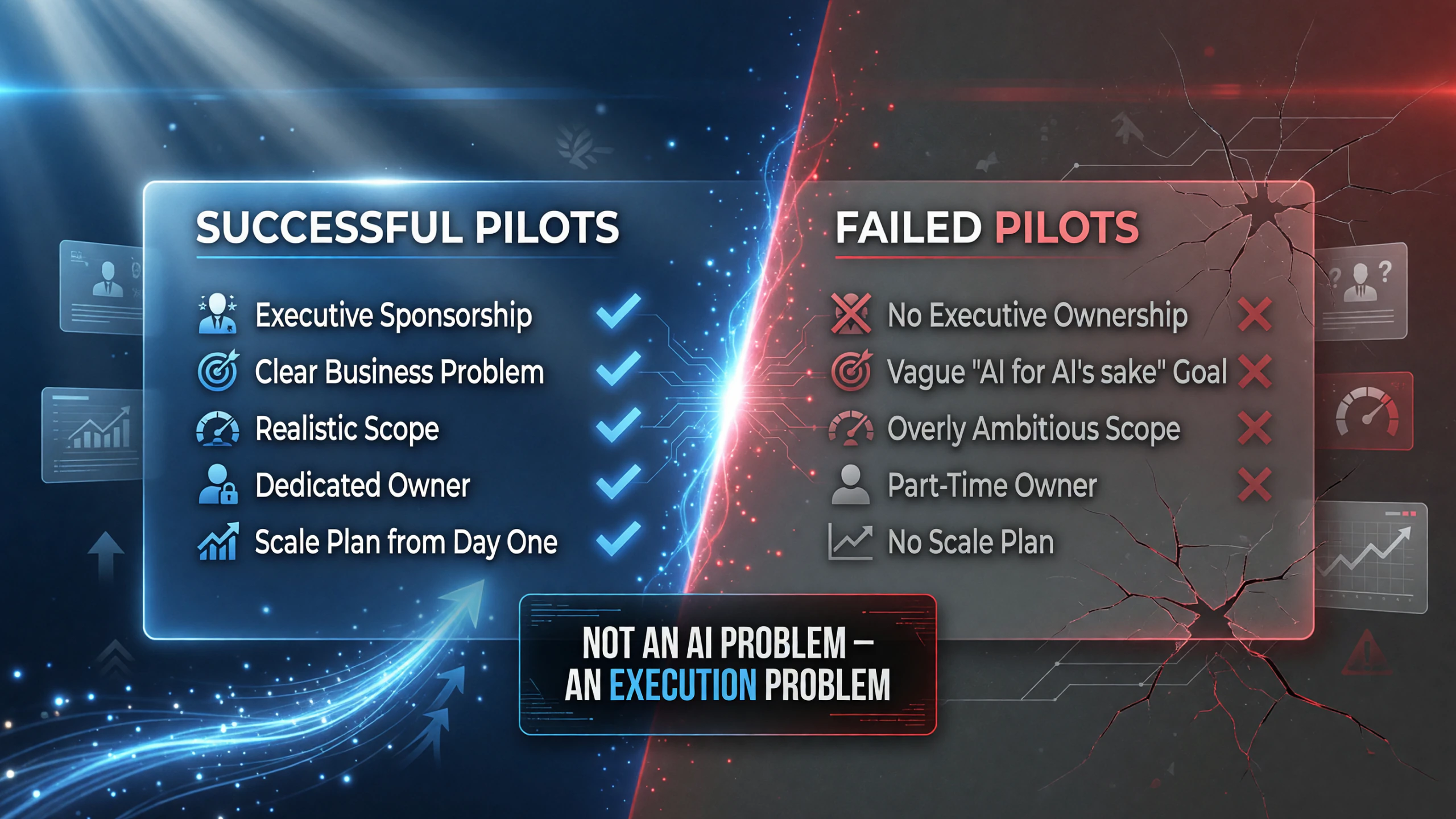
The difference between the 5% that succeed and the 95% that fail comes down to execution, not the technology: sponsorship, clear scope, dedicated ownership, and a scale plan from day one.
How to Run an AI Pilot That Doesn’t Fail
If you’re considering an AI pilot, the GTIA study’s advice is simple: be the 5%, not the 95%.
Start small. Pick a single workflow, a single team, and a single metric. Not “improve our whole customer service operation.” Pick “reduce average response time for refund requests by 20%.” Small is achievable and measurable.
Set realistic ROI. Don’t believe the vendor’s pitch that AI will cut your labor costs by 40%. Assume 5-15% improvement in efficiency, cost, or revenue per workflow touched. If the pilot delivers that, fund scaling. If it doesn’t, you’ve learned what not to do.
Name an owner. The person running the pilot needs to own adoption and training after it ends. They should have explicit time budgeted for this (20-30% of their week during rollout). No owner equals no adoption.
Fit the AI to your workflow, not the reverse. Interview your team. Understand their current workflow, pain points, and workarounds. Then build the AI solution to fit that workflow, not a textbook workflow. Your business is unique. The AI needs to work in YOUR context.
Plan for ongoing support. Allocate budget for training, documentation, and troubleshooting after the pilot ends. The tool needs a champion (the owner) and a support channel (Slack, email, or tickets). Without either, adoption dies within 30 days.
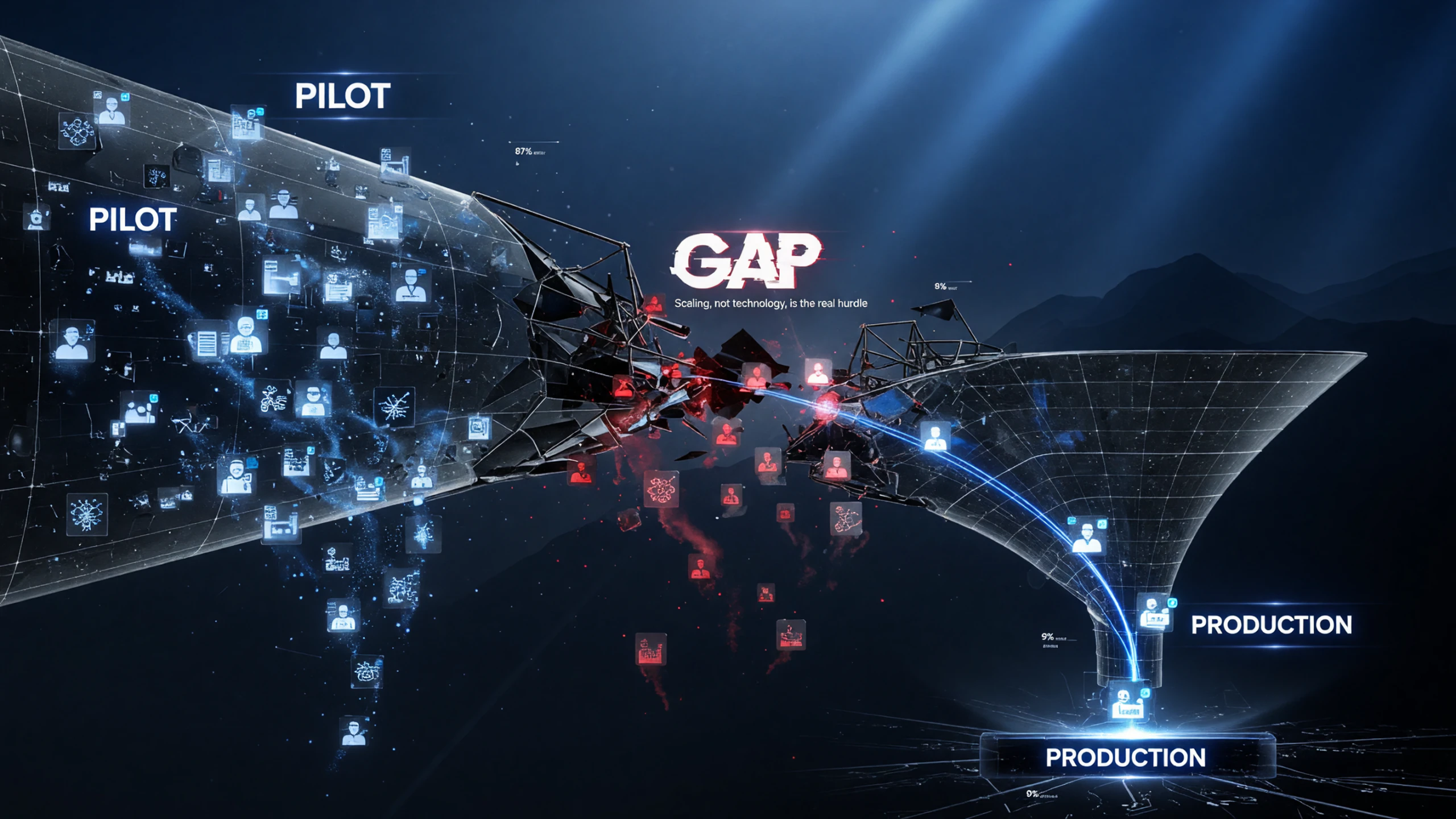
Many pilots enter, few reach production. The gap isn’t the AI — it’s the organization’s ability to scale a working pilot into everyday operations.
The Pilot-to-Production Gap: Why Small Businesses Struggle to Scale
The GTIA report highlights something larger: the organizational gap between running a pilot and running a production deployment.
A pilot is a proof-of-concept. It answers: “Can this tool do the job?” A production deployment is a business system. It answers: “Can our team sustain this tool for 6+ months while delivering value?”
These are different questions with different answers. A pilot can succeed with a small, motivated team, clear success metrics, and vendor hand-holding. Production requires documentation, training, support, and a feedback loop to improve the tool as your team uses it.
Most small businesses stop at the pilot. They don’t invest in the organizational infrastructure needed for production. That’s why 95% of pilots don’t scale.
What Success Looks Like: Real Numbers from Successful Pilots
The small businesses in the 5% successful group achieved measurable wins:
Hospitality: Restaurant group ran a 4-week pilot on AI voice ordering at their drive-thru. Baseline: 3.5-minute average wait. Target: 2.5 minutes. Pilot result: 2.2 minutes. Scaling across 8 locations cut drive-thru labor costs by 8% and improved customer satisfaction scores by 12 points (NPS). Owner: the operations manager. Budget for ongoing training: 5 hours per month.
Professional Services: Accounting firm piloted AI-assisted expense categorization for client submissions. Baseline: 35 minutes per client submission. Target: 25 minutes. Pilot result: 23 minutes, 99.2% accuracy (down from 92% accuracy with manual entry). Adoption: 70% of staff using the tool 6 months post-launch. Owner: the office manager. Budget: 3 hours per month for documentation and troubleshooting.
Retail: Boutique clothing chain tested AI demand forecasting for inventory ordering. Baseline: overstock by 18%, stock-out rate 4%. Target: overstock by 10%, stock-out less than 2%. Pilot result: 12% overstock, 1.8% stock-out. Scaling saved approximately $40,000 in excess inventory per season. Owner: the supply chain manager. Budget: 4 hours per month for continuous optimization.
All three had one thing in common: a named owner, realistic ROI targets, and a training/support plan before and after the pilot launched. This is how the 5% succeed.
The Bottom Line: AI Pilots Fail Because Organizations Aren’t Ready, Not Because AI Doesn’t Work
The GTIA study doesn’t question whether AI works. It answers why most small businesses can’t make it stick.
The answer is organizational, not technical. You need to pick the right problem, set the right metrics, own the rollout, fit the AI to your workflow, and budget for ongoing support. Do those five things, and you’re in the 5% that succeeds. Skip any one of them, and you’re likely in the 95%.
The good news: this is all in your control. You don’t need a big vendor, a big budget, or a big team. You need clarity on the problem, realism about the ROI, and commitment to adoption. The GTIA study proves small businesses CAN succeed with AI pilots—but only if they plan for production from day one.
Frequently Asked Questions
What counts as a “successful” pilot?
According to GTIA, a successful pilot is one where the tool is actively used by 60%+ of the target team 6+ months after launch. Usage should be tied to measurable value (cost savings, time savings, accuracy improvement, or revenue lift).
How long should a pilot take?
GTIA recommends 4-8 weeks for small business pilots. Longer than 8 weeks and you lose momentum; shorter than 4 weeks and you don’t have enough data to measure success.
Should we hire a consultant to run our pilot?
Not necessary. The 5% successful pilots were run by internal teams (operations managers, office managers, team leads). External consultants can help design the pilot, but internal ownership is critical for post-pilot adoption. The person running the pilot needs to be on your payroll.
What’s the average ROI from a successful AI pilot?
GTIA found that successful pilots delivered 8-12% cost savings or efficiency gains in their first 12 months of production. Revenue-focused pilots delivered 5-8% incremental revenue. These aren’t game-changing numbers, but they’re sustainable and real.
If our pilot fails, can we try again?
Yes, but learn from the failure first. Analyze which of the three root causes (skills gap, misaligned ROI, workflow mismatch) sank your first pilot. Fix that specific problem before launching a second pilot. Most successful teams in the GTIA study had run at least one failed pilot before getting it right.
What AI tools are most likely to scale in small businesses?
GTIA didn’t rank specific tools, but the successful pilots targeted narrow, repeatable workflows: data entry (expense coding, form filling), customer communication (email responses, chatbot replies), scheduling (appointment optimization, staff rostering), and forecasting (demand, inventory, revenue). Avoid AI pilots for unstructured, one-off decisions; start with the routine stuff.

About Barak Schurr
Barak Schurr built and sold a major ticketing platform, ran global nightlife operations at Eventbrite, and now spends his time figuring out which AI tools actually move the needle for independent business owners — and which ones are just noise. No hype. No fluff. Just what works.
Email: [email protected]
More AI Resources for Your Business