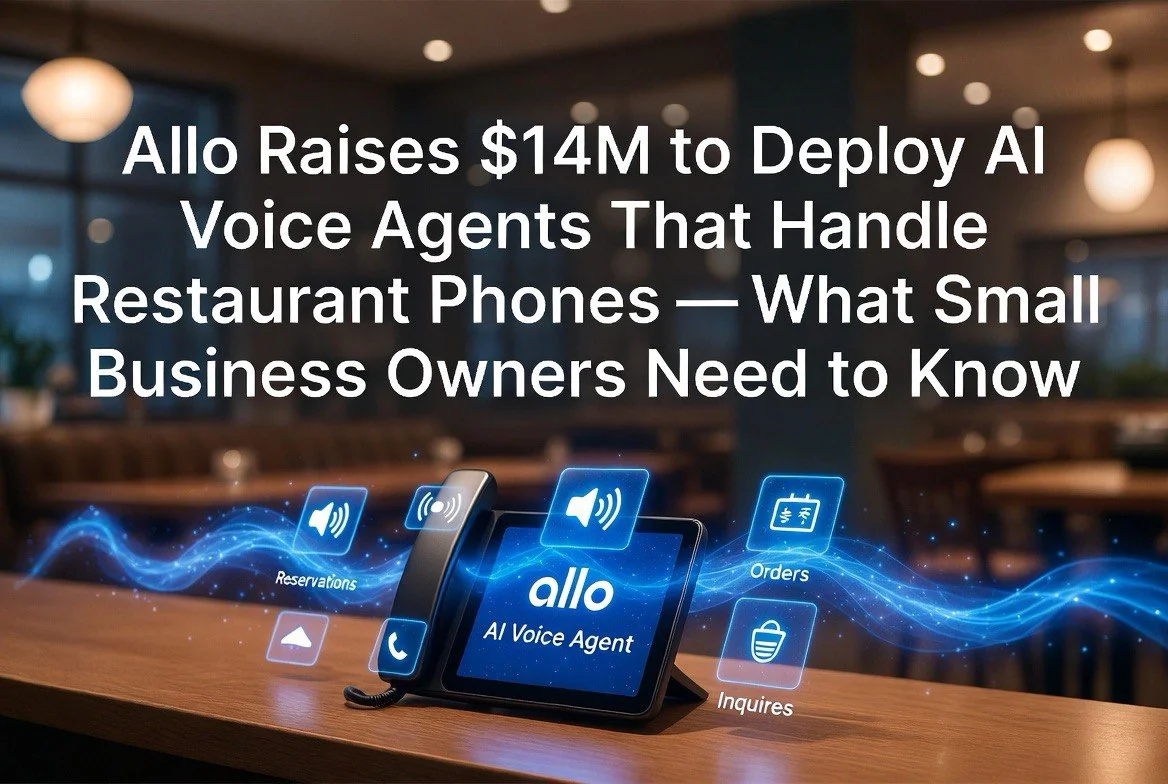
allO Raises $14M to Deploy AI Voice Agents That Handle Restaurant Phones — What Small Business Owners Need to Know
A Munich-based startup just raised $14 million to build what it calls the first AI-native operating system for restaurants, and the first product is something every small business owner has wished for at 7 PM on a Saturday night: an AI that answers the damn phone.
What allO Actually Built
allO isn’t another POS add-on or a chatbot slapped onto an existing system. The company started from scratch building an operating system designed around AI agents instead of human-operated workflows. Think of it like a restaurant’s digital staff — AI agents that don’t need shifts, breaks, or overtime pay.
The first agent launched alongside the funding is a voice AI system that handles inbound calls. When a customer calls, the AI takes reservations, processes takeaway orders, answers questions about hours and menu items, and pushes everything directly into the restaurant’s system. No human touch required unless the call escalates.
According to TechFundingNews and EU-Startups reporting on the May 2026 Series A round, the company plans to release over 10 additional agents over the next 12 to 18 months, covering inventory management, menu updates, supplier communication, and back-office operations.
The round was led by Zigg Capital with participation from LifeX Ventures, Aperture Capital, Wecken & Cie., and continued backing from 20VC and Keen Venture Partners, bringing allO’s total funding to roughly $20 million.
Why This Matters Beyond Restaurants
If you don’t run a restaurant, you might be tempted to skip this story. Don’t. The same technology stack allO is building for restaurants is coming for every category of small business that relies on phone calls.
Here’s why: the voice AI technology in allO’s platform isn’t restaurant-specific under the hood. The restaurant-specific part is the workflow — understanding that a reservation needs table capacity logic, that a takeout order needs timing against current kitchen load, that a cancellation needs to update the availability in real time. The voice recognition and natural language processing underneath is the same tech that will power AI phone agents for dental offices, auto repair shops, salons, and law firms.
The pattern is already visible. The same week allO announced its funding, the National Restaurant News reported that 34% of restaurants have already adopted some form of voice AI for phone handling. That’s up from roughly 12% in early 2025. The adoption curve is accelerating because the technology finally works well enough that customers don’t realize they’re talking to an AI — and operators save an estimated 15 to 25 hours per week on phone management alone.
What This Means for Small Business Owners Evaluating AI Phone Systems
If you’re a small business owner watching the AI phone space in 2026, a few things are becoming clear:
The dedicated AI phone system is replacing the generic IVR. Traditional interactive voice response systems (press 1 for reservations, press 2 for takeout) frustrate customers and lose business. Modern AI voice agents understand natural language, handle complex requests, and transfer to a human only when necessary. The difference is the difference between a machine and an employee.
Vertical-specific AI wins over general-purpose. allO’s restaurant focus isn’t a limitation — it’s a feature. A general-purpose AI answering service doesn’t know that a call asking “can I get a table for four at 7:30?” needs to check table availability, calculate estimated dining time, check if the caller has been blacklisted for no-shows, and confirm a credit card to hold the reservation. A restaurant-specific AI knows all of that automatically. The same principle applies to any vertical: the AI that knows your industry beats the AI that knows everything vaguely.
The pricing model is shifting. Early AI phone systems charged per-minute or per-call, which made costs unpredictable for high-volume businesses. allO and competitors like Allo, CloudTalk, and Dialpad are moving toward flat monthly pricing per location — typically $150 to $400 per month depending on call volume. That’s predictable enough to budget for and cheap enough to test without commitment.
The Small Business AI Phone Landscape in Mid-2026
The voice AI space for small businesses has fragmented into three tiers:
General-purpose AI receptionists like Alyssa and Goodcall work across industries and cost $150 to $300 per month. They handle basic call routing, message taking, and appointment booking. Good for simple operations, frustrating for businesses with complex workflows.
Vertical-specific AI platforms like allO (restaurant), Flourish (salons and spas), and TARA (dental and medical) cost $200 to $400 per month but understand industry-specific workflows out of the box. Higher upfront cost, lower setup time, better customer experience.
Enterprise-grade systems adapted for SMBs like Dialpad’s AI Contact Center and CloudTalk’s AI Agent are general-purpose but configurable enough to handle specific industries. They cost $150 to $500 per month but require more setup effort. The tradeoff is scalability — these systems handle higher call volumes and more complex routing.
For most small businesses in 2026, the vertical-specific option is the right call unless you need enterprise-scale call handling. The setup time difference matters: a vertical-specific AI can be configured in an afternoon. A general-purpose system tuned to your specific workflows takes three to five days.
What Allo’s $14M Says About Market Direction
The Series A raise signals that investors see AI phone agents as a category with serious growth ahead. Zigg Capital doesn’t write checks for experimental tech — they invest in infrastructure that has clear revenue models and proven unit economics.
allO’s approach of building an entire operating system around AI agents rather than adding AI to an existing platform is the more ambitious bet. It’s also the right one if their thesis holds that restaurants (and by extension, other verticals) will eventually run on AI-native systems rather than human-operated software with AI bolted on.
For small business owners, the takeaway is practical: if you’re still handling phone calls manually or relying on a clunky IVR system, the window for getting ahead of competitors on this is narrowing. Voice AI adoption hit 34% in restaurants alone in early 2026, and the cost of entry is low enough that the question isn’t whether to adopt — it’s which platform fits your specific workflow.
The allO round also validates a broader trend: the AI phone agent market is maturing fast enough that the best choice for a small business in 2026 is a platform built for your specific industry, not a generic solution trying to serve everyone.
Frequently Asked Questions
How much does an AI phone agent cost for a small business?
Monthly pricing ranges from $150 to $400 for most small businesses, depending on call volume and industry specificity. Vertical-specific platforms like allO cost more than general-purpose alternatives but require less setup time.
Can AI phone agents handle complex customer requests?
Modern AI voice agents handle most routine calls — reservations, orders, hours, menu questions — without human intervention. Complex requests or escalated calls transfer to a human seamlessly. The key is choosing a platform built for your specific industry so the AI understands the workflows automatically.
What’s the difference between an AI voice agent and a traditional IVR system?
Traditional IVR systems require customers to navigate menu trees using numbers or keywords. AI voice agents understand natural language — customers speak normally and the AI interprets the request, pulls the relevant information, and completes the task without requiring the caller to follow a script.
Do customers mind talking to AI instead of a human?
According to the National Restaurant News 2026 survey, 68% of customers couldn’t tell the difference between an AI voice agent and a human for routine calls. For complex issues, customers prefer being transferred to a human — which modern AI systems do automatically.
Is allO available outside Europe?
As of June 2026, allO is primarily serving European markets following its $14M Series A. US expansion is expected within 12 months. North American small business owners should evaluate alternatives like Alyssa or Goodcall for immediate deployment.

Barak Schurr
Self-taught technologist and operator. I break down AI tools and business technology for small business owners who don’t have time to chase every update. Less noise. More output.
Contact him at [email protected]
More AI Resources for Your Business