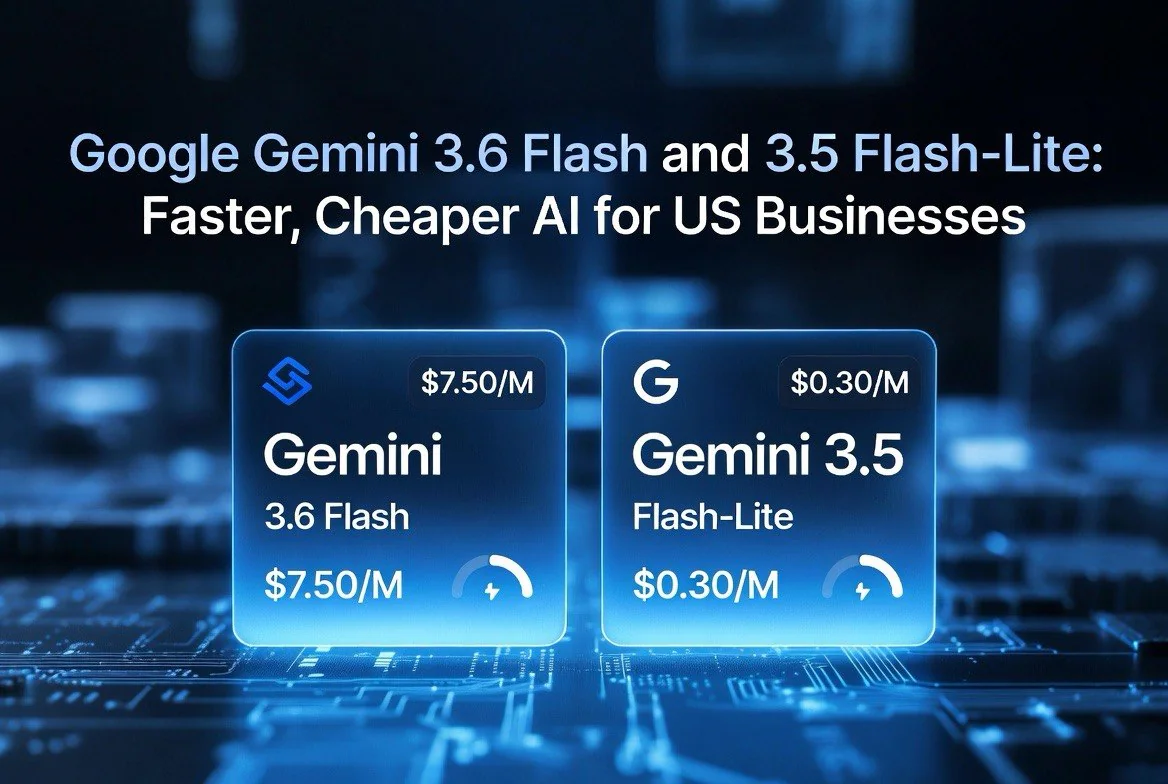
Google Gemini 3.6 Flash and 3.5 Flash-Lite: Faster, Cheaper AI for US Businesses
⚡ Expert Summary: Google released Gemini 3.6 Flash and Gemini 3.5 Flash-Lite on July 21, 2026 — two production-ready lightweight models that dramatically cut costs and latency for AI-powered business applications. 3.6 Flash delivers 17% fewer output tokens per task at $7.50 per million output tokens (down from $9.00 on the previous generation), while 3.5 Flash-Lite handles high-volume agentic and data processing work at just $0.30 per million input tokens. These are the models that power the AI tools small and medium US businesses actually use every day.
Google released three new Gemini models on July 21, 2026: the workhorse Gemini 3.6 Flash, the cost-efficiency champion Gemini 3.5 Flash-Lite, and a specialized Gemini 3.5 Flash Cyber variant for security use cases. The flagship Gemini 3.5 Pro remains delayed. For US small and medium businesses, the two Flash models matter more than any premium flagship because they are the models that power the AI tools you actually interact with — AI assistants, automation workflows, customer service agents, and content generation pipelines.
The headline numbers tell the story. Gemini 3.6 Flash uses approximately 17% fewer output tokens per task compared to its predecessor while cutting output pricing from $9.00 to $7.50 per million tokens. Response latency drops significantly — roughly half the wall-clock time in some benchmark measurements. Meanwhile, 3.5 Flash-Lite operates at $0.30 per million input tokens and supports approximately 350 output tokens per second, making it the fastest and cheapest model Google has ever offered through the Gemini API.
These numbers matter because the cost per token and latency per response are the two metrics that determine whether an AI-powered business tool is viable at scale. A customer service agent handling 10,000 conversations per month at 3.6 Flash pricing costs significantly less to run than the same agent on the previous generation. A data processing pipeline running 500,000 API calls per month on Flash-Lite becomes economically viable at a fraction of what enterprise-scale processing previously cost.
What Gemini 3.6 Flash Brings to the Table
Gemini 3.6 Flash is positioned as Google’s new mid-tier workhorse model, replacing Gemini 3.5 Flash as the default recommendation for most production workloads. Its improvements fall into three categories that directly impact US business users:
Token Efficiency: The model produces approximately 17% fewer output tokens per task while maintaining or improving quality. For a business running AI-powered customer support, this means lower API costs per interaction without compromising response quality. A monthly bill of $500 on the previous generation drops to roughly $415 on 3.6 Flash — savings that compound across every workflow.
Latency Reduction: Wall-clock response times are roughly halved compared to Gemini 3.5 Flash in many measurement categories. For interactive use cases like AI chat agents, voice assistants, and real-time customer support, this cuts the wait time from noticeable to imperceptible. Faster responses mean higher customer satisfaction scores and less abandonment on automated support channels.
Coding and Agentic Improvements: Benchmarks show significant gains on coding and agentic reasoning tasks — including a reported 12-point improvement on DeepSWE agentic coding evaluations. For US businesses building custom AI agents or automating software workflows, 3.6 Flash handles multi-step planning and tool use more reliably than its predecessor. This is the model that powers the next generation of AI agents that autonomously execute business processes.
Pricing is straightforward: $1.50 per million input tokens and $7.50 per million output tokens through the Gemini API.
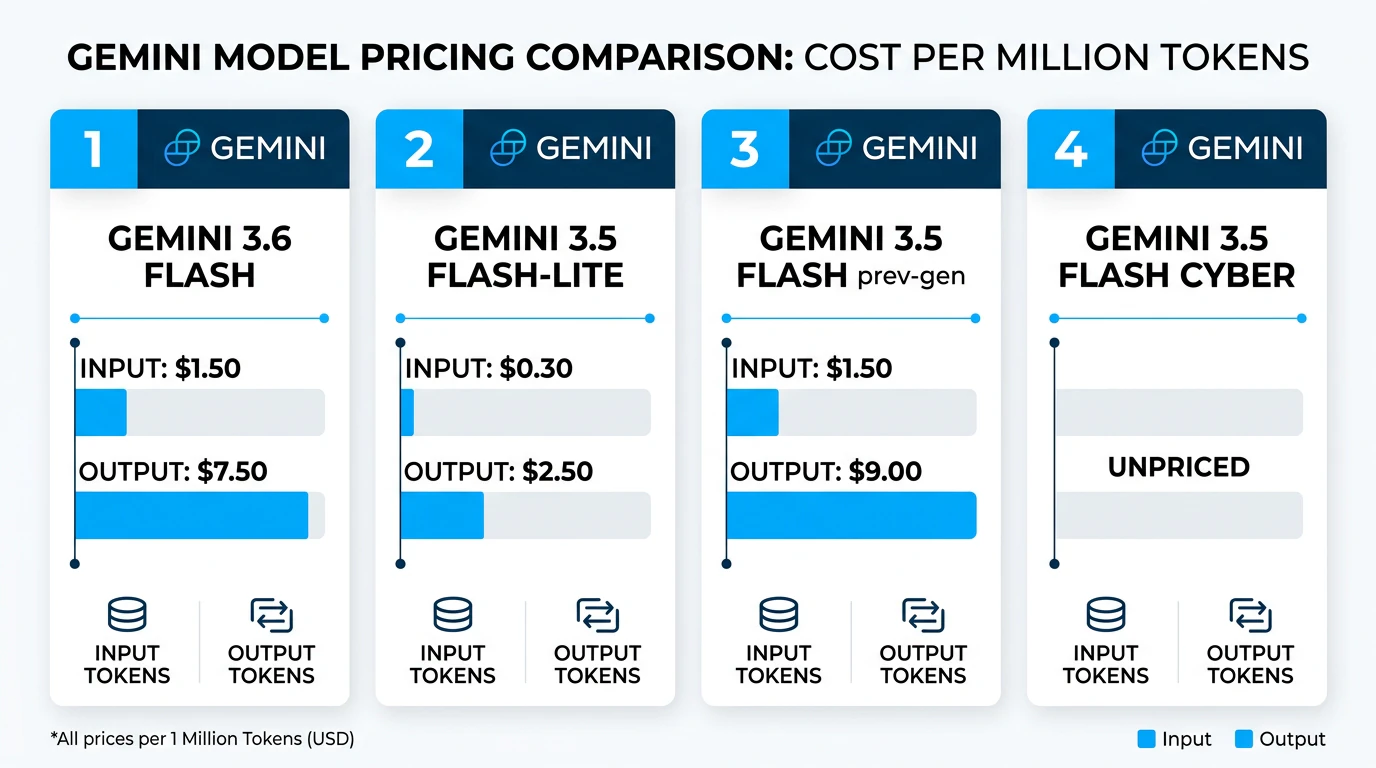
Gemini 3.6 Flash cuts output pricing 17% from the previous generation at $7.50 per million tokens while Flash-Lite operates at $0.30 input — making AI economically viable for high-volume business workloads.
Context caching, a feature that significantly reduces costs for repeated data patterns, operates at even lower rates.
When to Use Gemini 3.5 Flash-Lite
Gemini 3.5 Flash-Lite is Google’s most cost-efficient model, designed for the highest-volume workloads where speed and throughput matter more than reasoning depth. It is not a downgraded version of 3.6 Flash — it is a different tool optimized for a different job.
The model supports approximately 350 output tokens per second, making it the fastest option in Google’s current lineup. It handles multimodal inputs (text, images, video, audio) and supports a context window of up to 1 million tokens. Output pricing at $2.50 per million tokens and input pricing at just $0.30 per million tokens make it economically viable for workloads that would be prohibitively expensive on larger models.
Flash-Lite is best suited for three categories of business work:
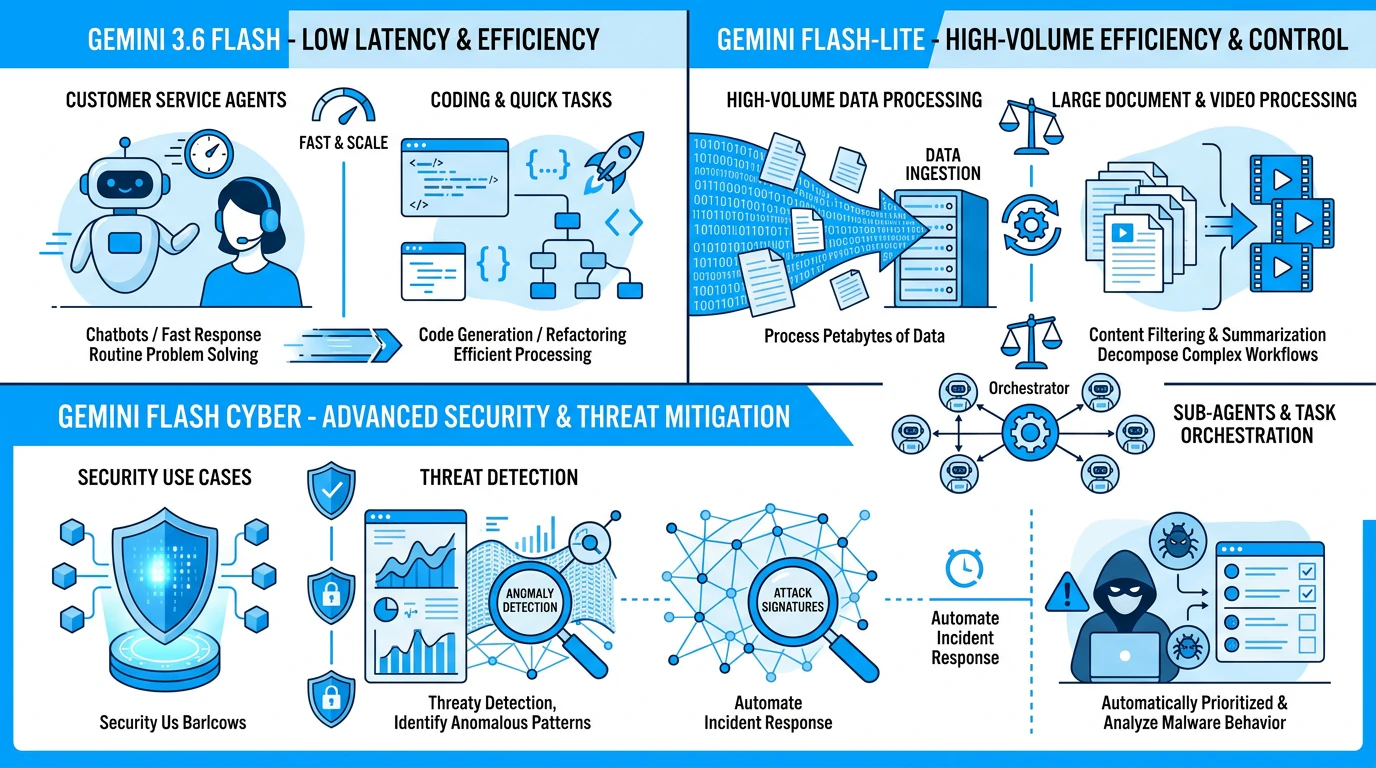
Each Gemini Flash model targets a specific workload type. 3.6 Flash handles interactive customer-facing work while Flash-Lite processes batch data at 350 tokens per second for a fraction of the cost.
| Workload Type | Why Flash-Lite Fits | Estimated Cost at 1M Calls/Month |
|---|---|---|
| High-Volume Data Processing | Batch summarization, document classification, entity extraction — tasks that need speed more than deep reasoning | ~$300-$500 (vs $1,500+ on 3.6 Flash) |
| Sub-Agents in Multi-Agent Workflows | Lightweight agents that handle specialized sub-tasks within a larger AI workflow — language translation, simple lookups, format conversions | ~$0.30-$2.50 per sub-agent per 1M tokens |
| Real-Time Translation and Transcription | 350 tokens/sec throughput makes it viable for live multilingual customer support and content localization | ~$200-$400 per 1M interactions |
The key insight for US business owners: Flash-Lite makes AI economically viable for workloads that simply were not worth automating before. A batch data processing task that would cost $1,500 per month on a mid-tier model becomes a $300-500 line item on Flash-Lite — and at 350 tokens per second, the processing completes faster.
How the Models Compare
Understanding where each model fits in Google’s current lineup helps US businesses choose the right tool for each specific workload:
| Model | Input Price per 1M Tokens | Output Price per 1M Tokens | Best For |
|---|---|---|---|
| Gemini 3.6 Flash | $1.50 | $7.50 | Customer service agents, coding assistants, AI chat, content generation, agentic workflows |
| Gemini 3.5 Flash-Lite | $0.30 | $2.50 | High-volume data processing, sub-agents, translation, simple classification, batch summarization |
| Gemini 3.5 Flash (Previous Gen) | $1.50 | $9.00 | Now superseded by 3.6 Flash. Retired for new projects. |
| Gemini 3.5 Flash Cyber | Not publicly priced | Not publicly priced | Security-specific. Limited access. Not relevant for SMB workloads. |
The pricing trajectory is worth noting. Google’s previous generation 3.5 Flash launched at $1.50 input and $9.00 output. The 3.6 Flash maintains the same input price while cutting output by 17%. Flash-Lite operates at 80% lower input cost and 72% lower output cost than 3.6 Flash. The trend is clear: models are getting cheaper and faster simultaneously, and the pace of improvement is accelerating.
What This Means for US Small Businesses
These models do not run in a vacuum. The Gemini API powers a growing ecosystem of third-party AI tools, SaaS platforms, and business applications that US small and medium businesses use every day. When Google cuts API pricing by 17-80%, those savings flow through to the tools built on top of them.
For businesses running AI customer service: Gemini 3.6 Flash’s latency reduction means conversations that felt robotic or delayed on the previous generation now flow naturally. The cost savings per interaction mean businesses can afford wider deployment across more channels without increasing their AI budget.
For businesses processing data at scale: Gemini 3.5 Flash-Lite makes batch document processing, invoice classification, email categorization, and content summarization economically viable at volumes that would have been prohibitive six months ago. An accounting firm processing 10,000 invoices per month on Flash-Lite spends roughly $300-500 on AI processing. The same workload on the previous generation cost $1,500+.
For businesses building custom AI agents: The agentic reasoning improvements in 3.6 Flash mean agents can reliably handle multi-step tasks like “check inventory → verify customer credit → create order → schedule shipping” without breaking down on intermediate steps. The 12-point improvement on agentic coding benchmarks translates directly to fewer errors in production agent workflows.
Why No Pro Model Matters Less Than It Seems
Google has not released a Gemini 3.5 Pro model. The company teased work on Gemini 4 but remains vague on timelines. Industry observers have noted the delay, and some interpret it as a sign that Google’s premium model development is behind schedule.
For US small businesses, however, the Pro delay is effectively irrelevant. The Flash and Flash-Lite models handle the workloads that SMBs actually run — customer support, data processing, content generation, workflow automation. Premium models like GPT-5.6 and Claude 4 Opus already serve the use cases that require deep reasoning, complex document analysis, and specialized expertise. The absence of a Google Pro model does not create a gap in the market.
What matters is that Google has delivered production-ready, cost-efficient models that are immediately available through a stable API with well-documented pricing. That is what US businesses building on AI need — not a benchmark champion, but a reliable workhorse that makes the unit economics of AI automation work at scale.
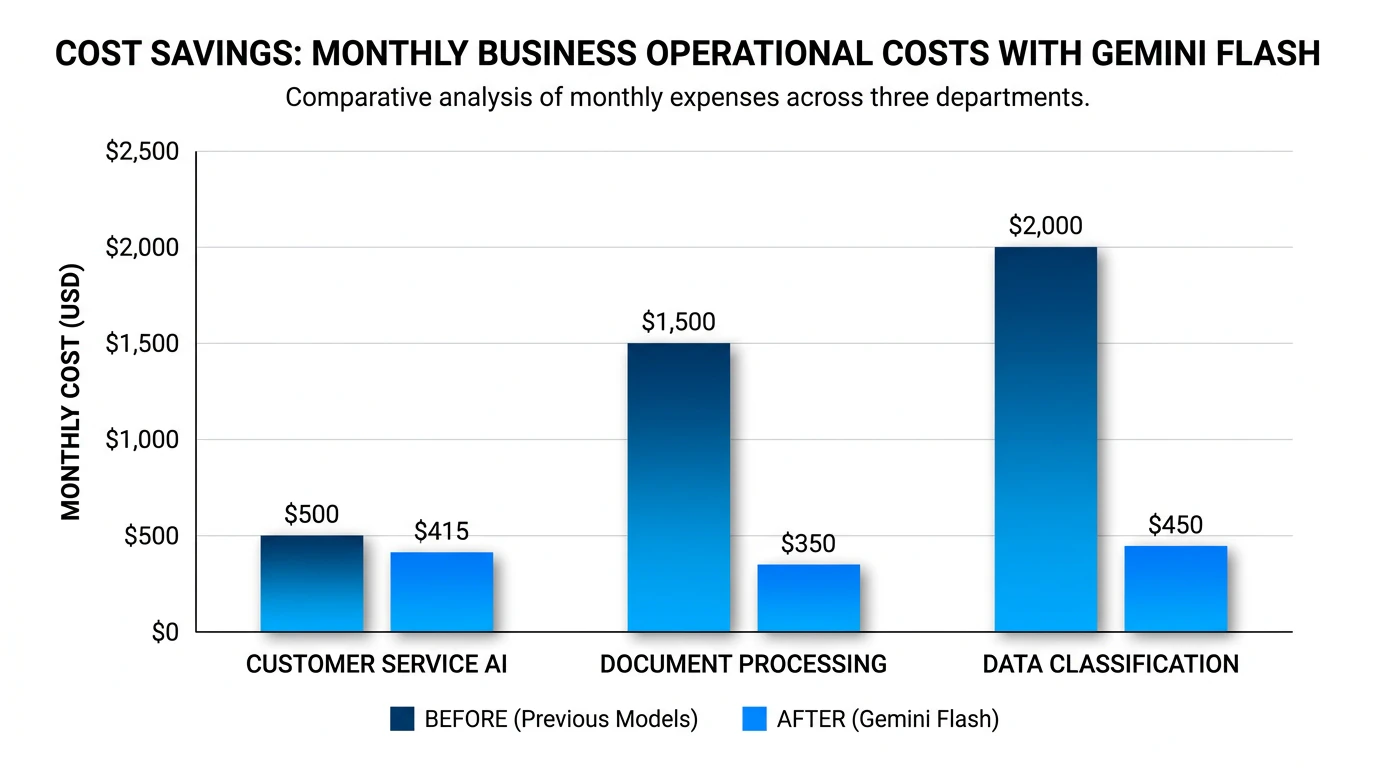
Businesses switching to Gemini Flash models see dramatic cost reductions — document processing workloads drop from $1,500 to $350 per month on Flash-Lite pricing.
The Bottom Line
Gemini 3.6 Flash and 3.5 Flash-Lite are the models that power the AI tools US businesses actually use. The 17% output token efficiency improvement on 3.6 Flash and the $0.30 per million input token pricing on Flash-Lite are not abstract benchmark numbers — they are the difference between AI being a cost center and AI being a profit driver.
Any US business currently running AI workloads on the Gemini API should evaluate migrating to 3.6 Flash immediately for interactive use cases and to Flash-Lite for any batch or high-volume processing. The cost savings are immediate, the latency improvements are noticeable, and the performance quality is equivalent or better on every meaningful metric.
Businesses that have not adopted AI because the per-interaction cost was too high should re-examine their math with Flash-Lite pricing. At $0.30 per million input tokens, workloads that were economically marginal at previous pricing tiers now pencil out clearly.
The models keep getting faster and cheaper. The decision to adopt AI becomes easier with every release.
Frequently Asked Questions
When was Gemini 3.6 Flash released?
Google released Gemini 3.6 Flash on July 21, 2026, alongside Gemini 3.5 Flash-Lite and Gemini 3.5 Flash Cyber. It became available immediately through the Gemini API, Google AI Studio, and the Gemini app.
How much does Gemini 3.6 Flash cost?
Gemini 3.6 Flash costs $1.50 per million input tokens and $7.50 per million output tokens through the Gemini API. This is a $1.50 per million output token reduction from the previous Gemini 3.5 Flash pricing of $9.00 per million output tokens.
What is Gemini 3.5 Flash-Lite?
Gemini 3.5 Flash-Lite is Google’s most cost-efficient model, priced at $0.30 per million input tokens and $2.50 per million output tokens. It supports approximately 350 output tokens per second, multimodal inputs, and a context window of up to 1 million tokens. It is designed for high-volume agentic tasks, simple data processing, and sub-agents in multi-agent workflows.
How does Gemini 3.6 Flash compare to GPT-5.6?
Gemini 3.6 Flash and GPT-5.6 serve different positioning tiers. GPT-5.6 offers tiered models (Sol, Terra, Luna) with premium pricing starting at $15 per million input tokens for the top tier. Gemini 3.6 Flash competes in the mid-tier workhorse category at $1.50 input and $7.50 output per million tokens. Flash is significantly cheaper but targets less complex reasoning workloads.
Is Gemini 3.5 Pro available?
No. As of July 2026, Google has not released Gemini 3.5 Pro. The flagship model remains delayed. Google has teased work on Gemini 4 but has not announced a release timeline. The available models are Gemini 3.6 Flash, Gemini 3.5 Flash-Lite, and the specialized Gemini 3.5 Flash Cyber for security use cases.
Can Gemini 3.6 Flash handle images and video?
Yes. Gemini 3.6 Flash supports multimodal inputs including text, images, video, and audio. It accepts up to 1 million tokens of context, allowing processing of full video files, large document collections, and extended conversations without truncation.

About Barak Schurr
Barak Schurr is the founder and former president of the nightlife ticketing platform Wantickets and former Global Director of Dance and Nightlife at Eventbrite. He currently focuses on AI research and writes about practical AI for independent business owners that actually moves the needle — no hype, no corporate fluff. More at topnotchaitools.com.
Contact: [email protected]
More AI Resources for Your Business