Get The Solo Business OS — Free
The AI workflow that replaces a part-time employee for solo operators and small business owners.
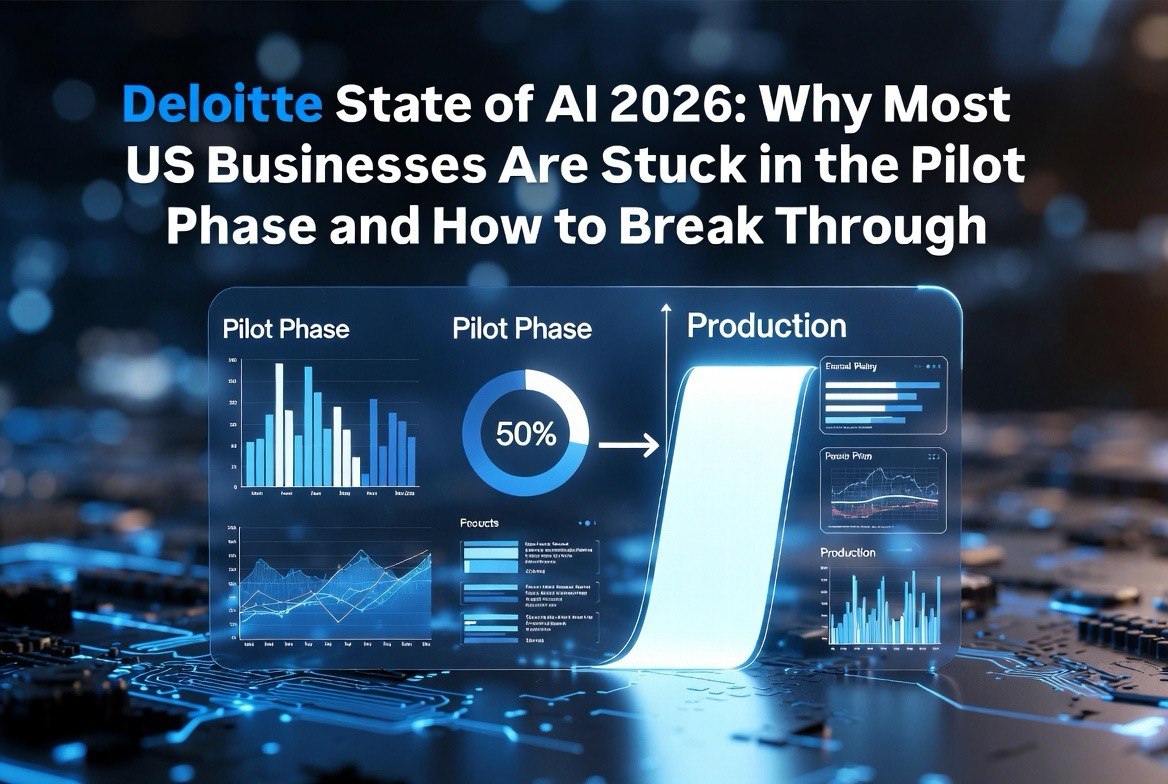
Deloitte State of AI 2026: Why Most US Businesses Are Stuck in the Pilot Phase and How to Break Through
⚡ Expert Summary: Deloitte’s State of AI in the Enterprise 2026 report surveyed 3,235 executives across 24 countries and found a brutal truth: only 25% of organizations have moved more than 40% of their AI experiments into production. Even worse, 84% haven’t redesigned a single job or workflow around AI capabilities. The gap between piloting and payoff is widening, but the fix isn’t more tools — it’s measuring the right things. This article breaks down what the data means for US small business owners and the exact playbook to skip the proof-of-concept trap.
The numbers are stunning. Deloitte’s “State of AI in the Enterprise 2026: The Untapped Edge” report, based on a survey of 3,235 director- to C-suite leaders across 24 countries and six industries, found that workforce access to sanctioned AI tools grew roughly 50% in 2025 alone — from under 40% of workers to about 60%. More employees have access to AI than ever before.
But access is not the same as impact.
Here is the number that should keep every US business owner up at night: only 25% of organizations have moved 40% or more of their AI experiments into production. That means three out of four businesses are sitting on a pile of pilot projects, proofs of concept, and half-finished integrations that cost money to build but deliver nothing back.
Why US Businesses Get Stuck in the AI Pilot Phase
Deloitte’s research identifies three distinct levels of AI adoption across the organizations surveyed:
– Surface level (37%): Using AI tools with little to no change in existing processes. The tool is added on top of how work already happens.
– Process redesign (30%): Redesigning key processes around AI capabilities, changing how work flows from one step to the next.
– Deep transformation (34%): Creating new products, services, or reinventing core business models around AI.
The problem is obvious: nearly two-thirds of adopters are either making superficial changes or no changes at all. They are buying the tools without changing the workflows the tools are supposed to improve.
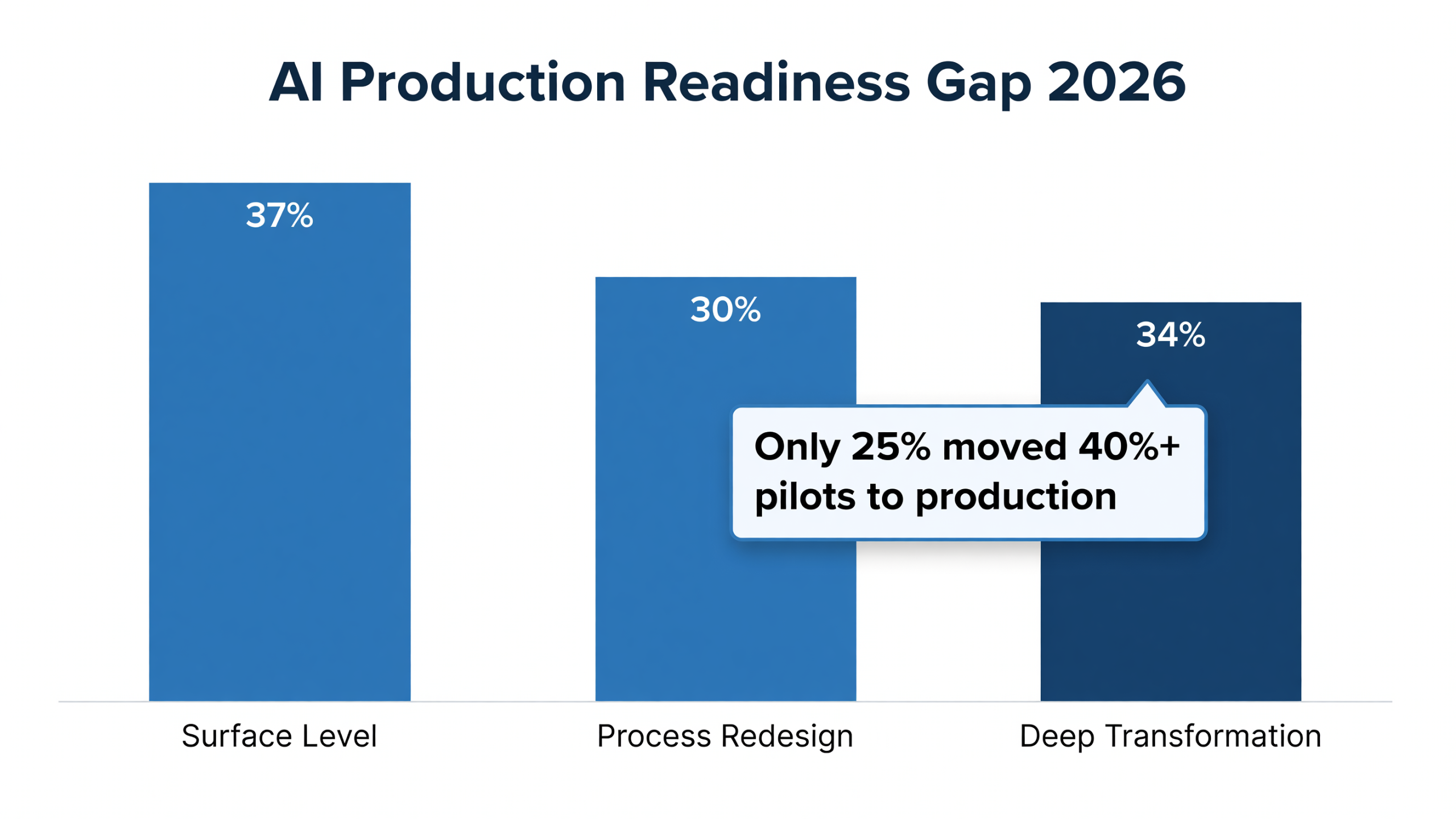
Deloitte’s 2026 data shows 75% of organizations are stuck below the production threshold — Surface Level adoption means bolting AI onto old workflows without redesigning how work actually happens.
For US small business owners, this is both a warning and an opportunity. Large enterprises are drowning in governance committees, compliance reviews, and change management processes. A small business with 10 employees can redesign a workflow in a week — not a quarter.
What the Winners Measure That Everyone Else Misses
Deloitte found that the most successful organizations are shifting their metrics away from traditional adoption numbers — how many employees have access, how many copilots are deployed — and toward outcome-based measurements:
– Cycle time: How long does it take to complete a core business process end to end?
– Decision quality: Are decisions better with AI assistance than without?
– Output quality: Is the work product measurably improved?
– Role-level productivity: Are specific roles producing more in the same time?
The report highlights that leading organizations are tracking how AI changes these metrics at the workflow level — not at the tool level. A chatbot that saves 30 seconds per inquiry is table stakes. A redesigned customer onboarding flow that cuts time from two days to two hours is transformation.
The 84% Trap: Why Job Redesign Matters More Than Tool Selection
Here is the stat that stopped me cold: 84% of companies have not redesigned a single job, role, or the nature of work around AI capabilities. The most common talent adjustment? Education and AI fluency training — which 53% of organizations are doing.
Training without structural change is like teaching someone to drive and then making them walk everywhere. The training helps, but the real gain comes from actually using the vehicle.
Deloitte’s analysis recommends that organizations start with one end-to-end workflow — not the whole business, not every department, just one complete process. Redesign how that workflow works with AI, measure the change in cycle time and decision quality, and use that proof to scale to the next workflow.
For a small business, this might mean picking one process: responding to customer inquiries. Instead of asking “what AI tool should I buy,” the question becomes “how should the inquiry-to-resolution workflow change now that AI can draft responses, route complex issues, and learn from past resolutions?”
Why Small Businesses Can Win Where Enterprises Stall
The Deloitte report exposes a fundamental advantage that small US businesses hold over their enterprise counterparts. Large organizations require cross-functional alignment across legal, IT, HR, operations, and compliance teams before changing any workflow. The governance requirements alone can take six months.
Small businesses face none of these constraints. With fewer than 50 employees, a business owner can observe a workflow on Monday, identify the AI opportunity on Tuesday, test it on Wednesday, and deploy it on Thursday. The entire cycle takes one week.
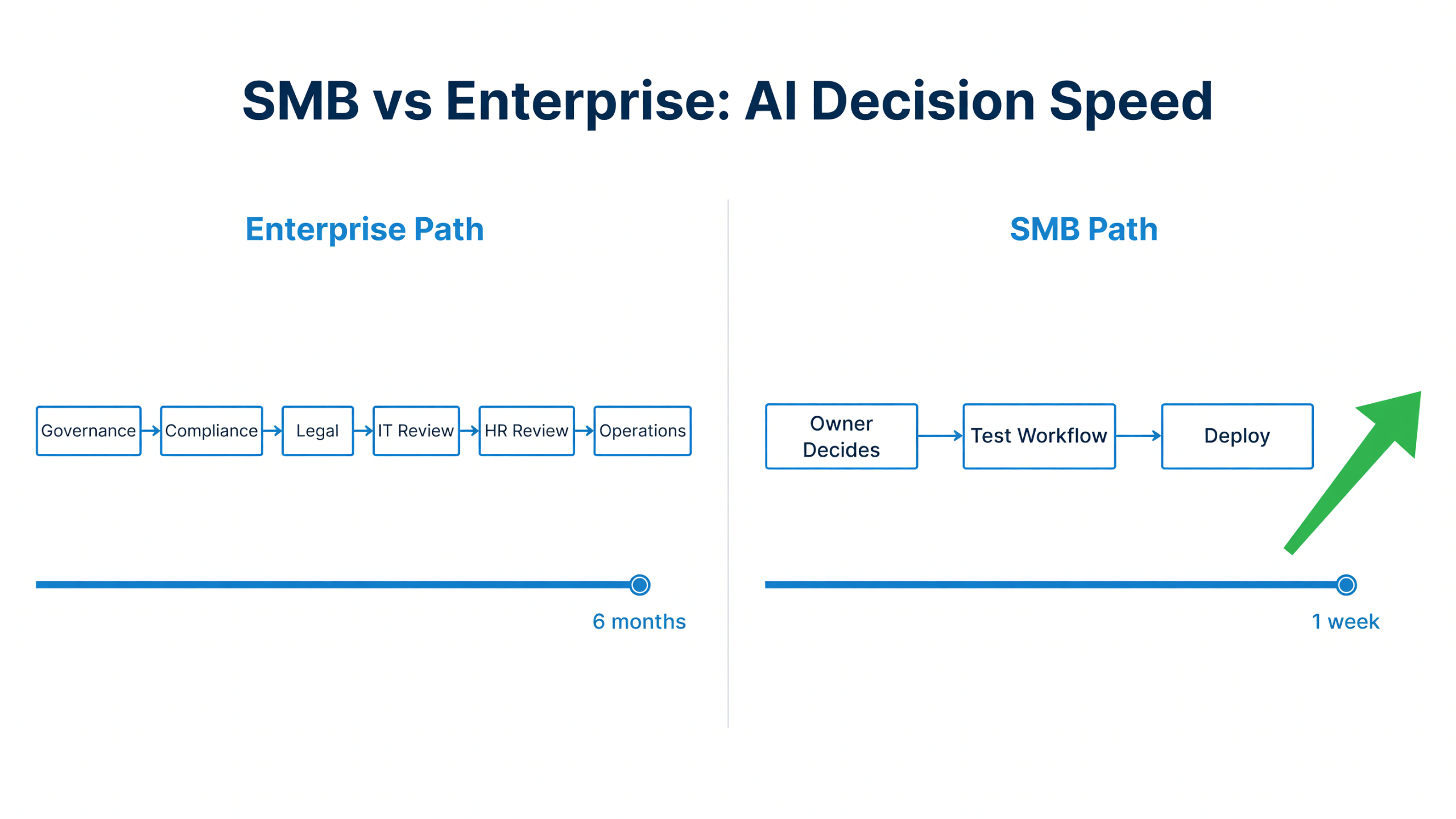
Enterprise AI governance requires cross-functional sign-off across 6 departments before any change reaches production. Small businesses can observe, test, and deploy the same workflow improvement in days — not months.
The data backs this up. A separate analysis by SwiftAhead found that small businesses adopting AI-first workflows report an average 3.7x return on their AI investment and over seven hours saved per employee per week. The returns are higher because the decision cycle is shorter.
But here is the warning buried in the Deloitte data: small businesses are also more likely to be in the “surface level” category. Buying a ChatGPT subscription and asking employees to “use AI” is not transformation. It is the equivalent of giving everyone a calculator and hoping math problems solve themselves.
The Three-Step Playbook to Skip the Pilot Trap
Deloitte’s research points toward a repeatable approach for businesses that want to skip the proof-of-concept trap entirely.
Step 1: Pick one workflow. Do not try to AI-transform your entire business at once. Pick a single end-to-end process that touches customers, generates revenue, or consumes significant labor hours. Document the current cycle time, error rate, and labor cost.
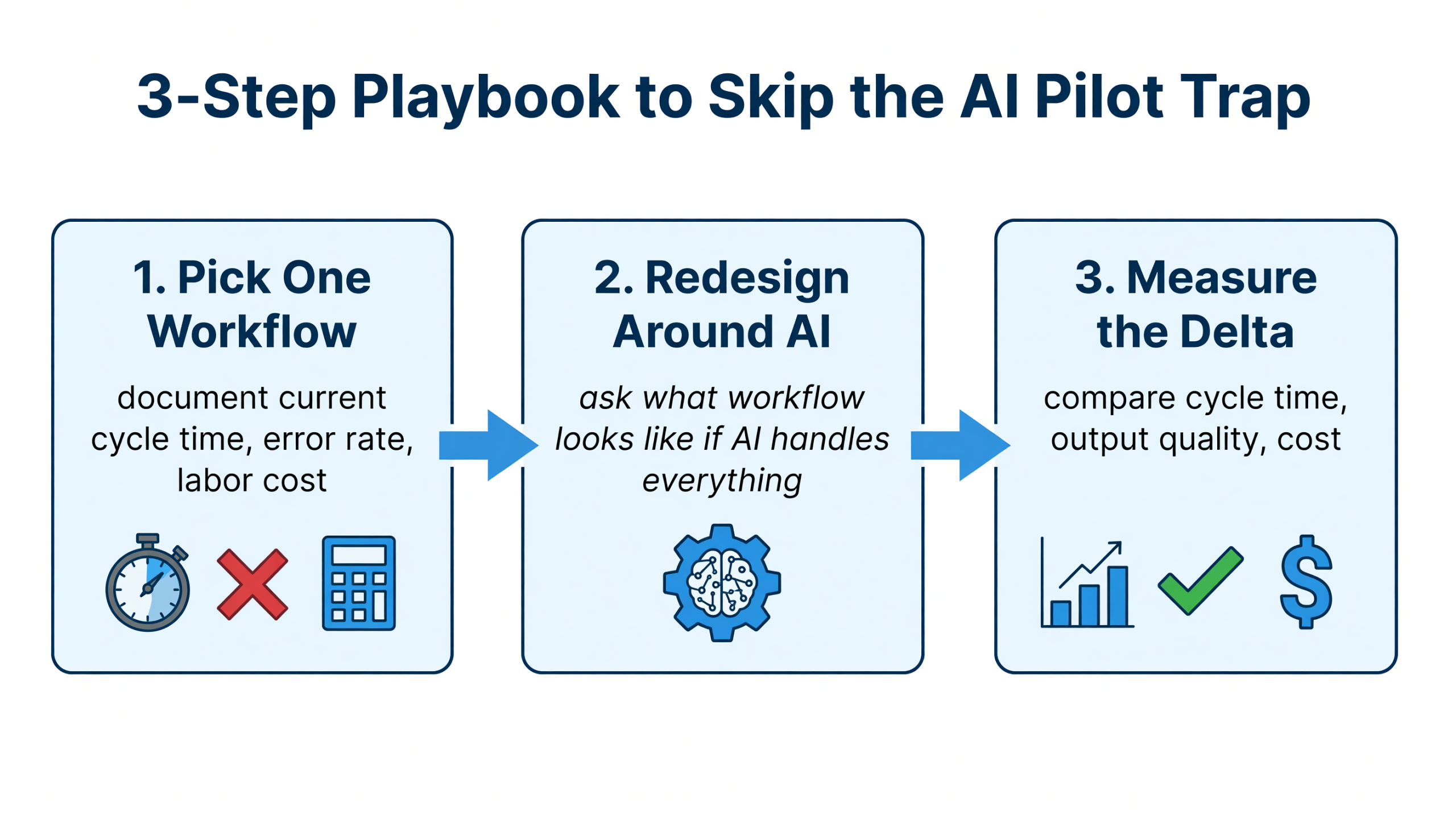
The three-step playbook to skip the pilot trap entirely — pick one workflow, redesign it around AI capabilities, then measure whether cycle time, output quality, and cost actually improved.
Step 2: Redesign around AI, not alongside it. Do not ask “which AI tool automates this step.” Ask “if AI could handle every step in this workflow, what would the workflow look like?” Then work backward to what the current AI tools can actually do. This forces real redesign rather than add-on automation.
Step 3: Measure the delta. Run the redesigned workflow for two weeks alongside the old one. Compare cycle time, output quality, and cost per completion. If the new workflow beats the old one on all three metrics, the redesign is validated. Lock it in, document the playbook, and move to the next workflow.
The organizations that follow this pattern are the ones Deloitte identifies as “the untapped edge” — the businesses that are not just using AI but being changed by it.
Where AI Agent Governance Fits Into the Picture
Deloitte’s report also flags the governance gap around agentic AI — autonomous AI agents that can trigger transactions, make decisions, and take actions without human intervention. While 40% of enterprise applications are expected to include task-specific AI agents by the end of 2026, most organizations remain cautious, limiting agents to low-autonomy or reversible actions only.
For US small business owners, this matters because agentic AI is the fastest path to the ROI numbers Deloitte tracks. An AI agent that can handle customer inquiries, trigger follow-up emails, update CRM records, and schedule appointments runs a complete workflow without human intervention. But that same autonomy requires guardrails — what the agent can do, what it cannot do, and where it must escalate to a human.
The good news for small businesses: your guardrails are simpler. A ten-person company does not need a 50-page AI governance policy. A one-page framework that defines what the AI can approve, what requires a manager, and what must never happen is sufficient.
The Real Bottom Line for US Business Owners
The Deloitte State of AI in the Enterprise 2026 report delivers one clear message for American small business owners: the window for capturing competitive advantage from AI is open, but it is closing fast. The businesses that redesign workflows around AI today will be the ones with lower costs, faster cycle times, and better decision quality two years from now. The businesses that stay in pilot mode — testing tools without changing how work gets done — will find themselves competing against AI-native operators they cannot catch.
The good news is that small businesses can move faster than enterprises. The bad news is that most are not moving at all.
Frequently Asked Questions
What is the Deloitte State of AI in the Enterprise 2026 report?
The Deloitte “State of AI in the Enterprise 2026: The Untapped Edge” report is a survey of 3,235 business leaders across 24 countries and six industries, fielded in August-September 2025 and released in January 2026. It measures how organizations are adopting AI, where they are succeeding, and where they are stuck in pilot phases without production deployment.
What percentage of businesses have moved AI into production?
Only 25% of organizations have moved 40% or more of their AI experiments and pilot projects into production. The remaining 75% are still in the proof-of-concept phase, with AI pilots that deliver results in controlled settings but fail to scale across the organization.
How many companies have redesigned jobs around AI?
Deloitte found that 84% of companies have not redesigned a single job, role, or the nature of work around AI capabilities. The most common response to AI adoption is offering training to existing employees (53% of organizations) rather than redesigning how work actually happens.
What metrics should businesses track for AI ROI?
The successful organizations tracked by Deloitte measure cycle time (how long processes take), decision quality (are outcomes better?), output quality (is the work product improved?), and role-level productivity. These outcome-based metrics replace older measures like number of tools deployed or employee access counts.
How can small businesses avoid the AI pilot trap?
Pick one end-to-end workflow, redesign it around AI capabilities rather than bolting AI onto existing steps, and measure the delta in cycle time and output quality. Small businesses have a structural advantage here — they can redesign and deploy a workflow in a week, while enterprises take months to navigate governance and compliance requirements.

About Barak Schurr
Barak Schurr is the founder and former president of the nightlife ticketing platform Wantickets and former Global Director of Dance and Nightlife at Eventbrite. He currently focuses on AI research and writes about practical AI for independent business owners that actually moves the needle — no hype, no corporate fluff. More at topnotchaitools.com.
Contact: [email protected]
More AI Resources for Your Business