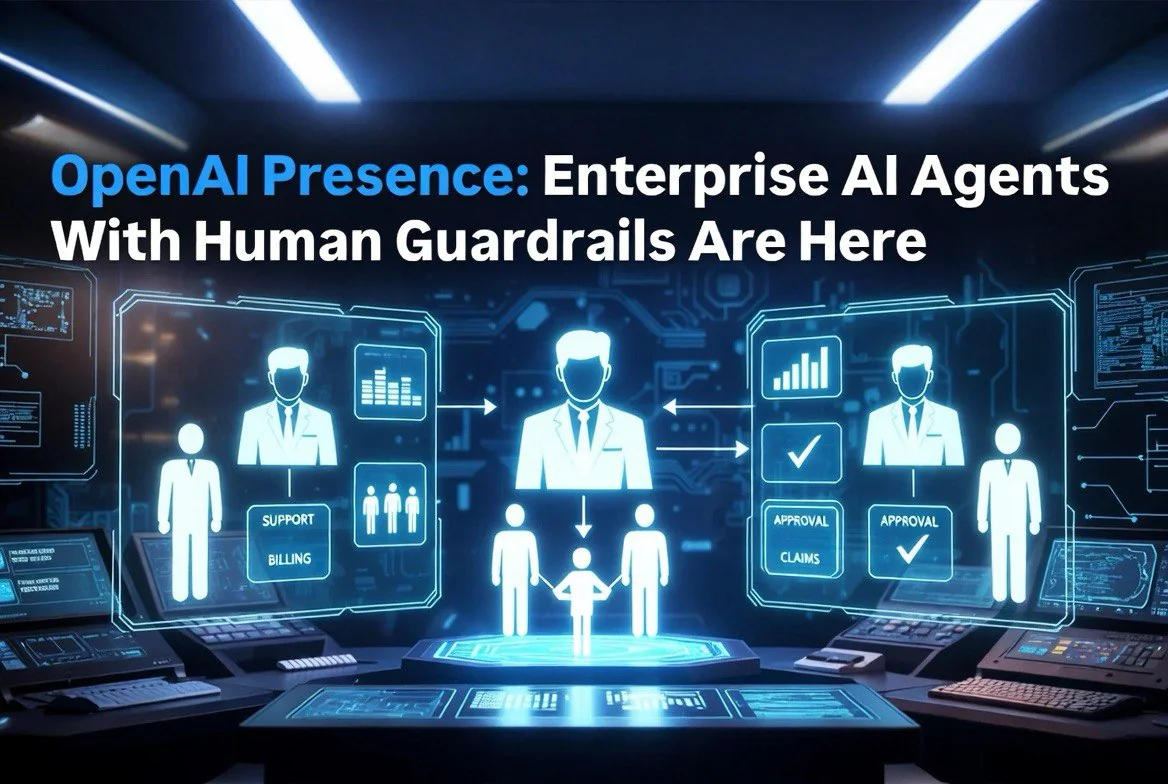
OpenAI Presence: Enterprise AI Agents With Human Guardrails Are Here
⚡ Expert Summary: OpenAI launched Presence on July 22, 2026 — a managed enterprise platform for deploying governed AI agents that handle billing, support, claims, and IT workflows through voice and chat. It is enterprise-only for now, but the guardrails, evaluation frameworks, and continuous improvement loops it introduces will define how AI agents work in production and eventually reach the tools small businesses use. Here is what Presence does, who is using it, and why US business owners should pay attention.
On July 22, 2026, OpenAI launched Presence, an enterprise-grade platform for deploying governed AI agents in production. Unlike ChatGPT or the API, Presence is a fully managed service that handles the integration, testing, monitoring, and continuous improvement of agents that handle real customer interactions and internal workflows. It is not a chatbot. It is an operational system designed for high-volume, high-stakes work.
OpenAI has been quietly testing this approach for years. The company’s own English-language phone support channel (1-888-GPT-0090) now runs on Presence and resolves approximately 75% of inbound issues without human assistance, meeting or exceeding the benchmarks used to grade frontline human support quality. A Codex-powered improvement loop cut human handoffs by 15 percentage points in just 10 days. These numbers are not marketing claims — they are production results from millions of real customer interactions.
Understanding Presence matters because the guardrails, evaluation frameworks, and deployment patterns it introduces will define how AI agents work in production for years to come. The enterprise tier of any technology always shapes what eventually reaches small businesses, and Presence is the most sophisticated agent governance system OpenAI has ever shipped.
What OpenAI Presence Actually Does
Presence is not a self-serve product. Each deployment is scoped for a specific workflow — resolving billing issues, handling insurance claims, providing IT support, managing customer service calls, or processing HR requests. The agent receives only the knowledge and system access required for that specific job, nothing more.
The platform brings together five components that make enterprise AI agents production-ready:
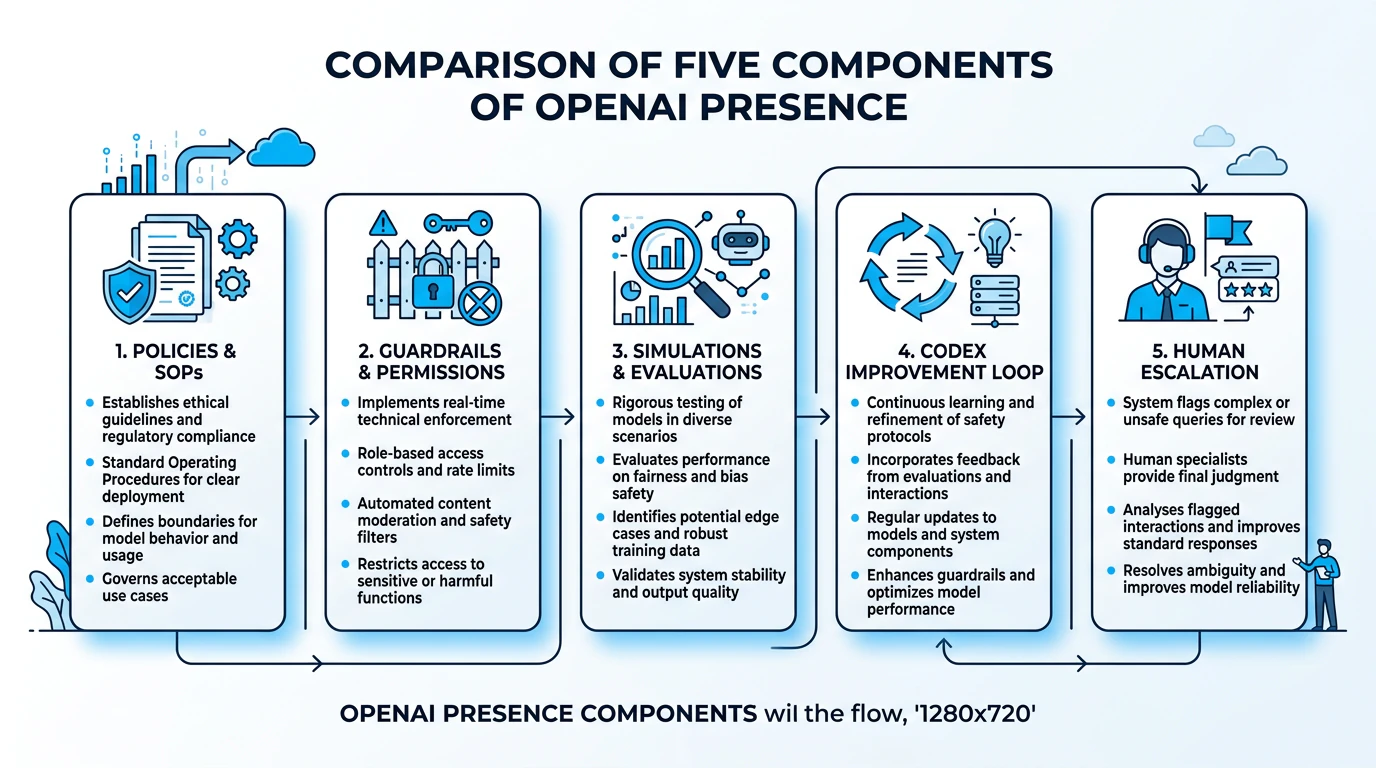
OpenAI Presence consists of five core components that together form a complete governance system for production AI agents. Each component handles a distinct layer of agent management, from defining behavior policies to structured human escalation.
| Component | What It Does |
|---|---|
| Policies and SOPs | Defines what the agent can do, when it needs approval, and when a human should take over. Enforced at the company level, not the model level. |
| Guardrails and Permissions | Intervenes when interactions move outside approved boundaries. Identity verification, scoped API access, approval steps for sensitive actions. |
| Simulations and Evaluations | Tests agents against common requests, edge cases, and high-risk scenarios before launch. Graders check outcomes, policy compliance, tool use, and escalation accuracy. |
| Codex-Powered Improvement Loop | Analyzes production sessions, escalations, and quality signals. Suggests updates that teams test and approve for controlled rollout. Agents improve without organizations losing control. |
| Human Escalation | Structured handoff with full context when an agent cannot resolve an issue. Policies, risk rules, and workflow complexity determine escalation triggers. |
These five components work together to solve the problem that has kept AI agents out of production environments: the inability to trust that an agent will behave correctly across every edge case. Presence replaces blind trust with a governance system that tests, monitors, and improves agent behavior continuously.
Who Is Using Presence and How
Three enterprises have publicly disclosed Presence deployments, and each reveals a different pattern for where governed agents deliver the most value:
BBVA is exploring AI-powered voice support for everyday banking needs in Mexico. The bank serves over 80 million customers globally and sees Presence as a way to handle high-volume routine inquiries for standard banking operations without scaling support teams linearly. Banking is heavily regulated, which makes the guardrails and escalation framework particularly relevant.
SoftBank is testing natural Japanese-language customer conversations. Japan faces a severe labor shortage in customer service, and SoftBank is evaluating whether Presence can maintain conversation quality while reducing reliance on human agents operating in a competitive market. The language aspect is notable — Presence handles nuanced, non-English conversations at enterprise scale.
IAG (Insurance Australia Group) is exploring timely support during high-demand events such as severe weather. Insurance claims spike unpredictably in the context of specific events, making the ability to scale agent capacity on demand particularly valuable. IAG’s deployment shows how Presence handles demand surges that would require months of human hiring and training lead times.
These deployments follow a consistent pattern: high-volume, repeatable workflows where consistency matters, errors are costly, and the cost of human agents creates significant savings potential. OpenAI’s internal deployment resolves 75% of inbound issues without human help. That resolution rate covers the range of standard customer interactions — billing questions, account changes, product support. The remaining 25% escalate to human agents who receive full conversation context, allowing them to resolve complex issues faster.
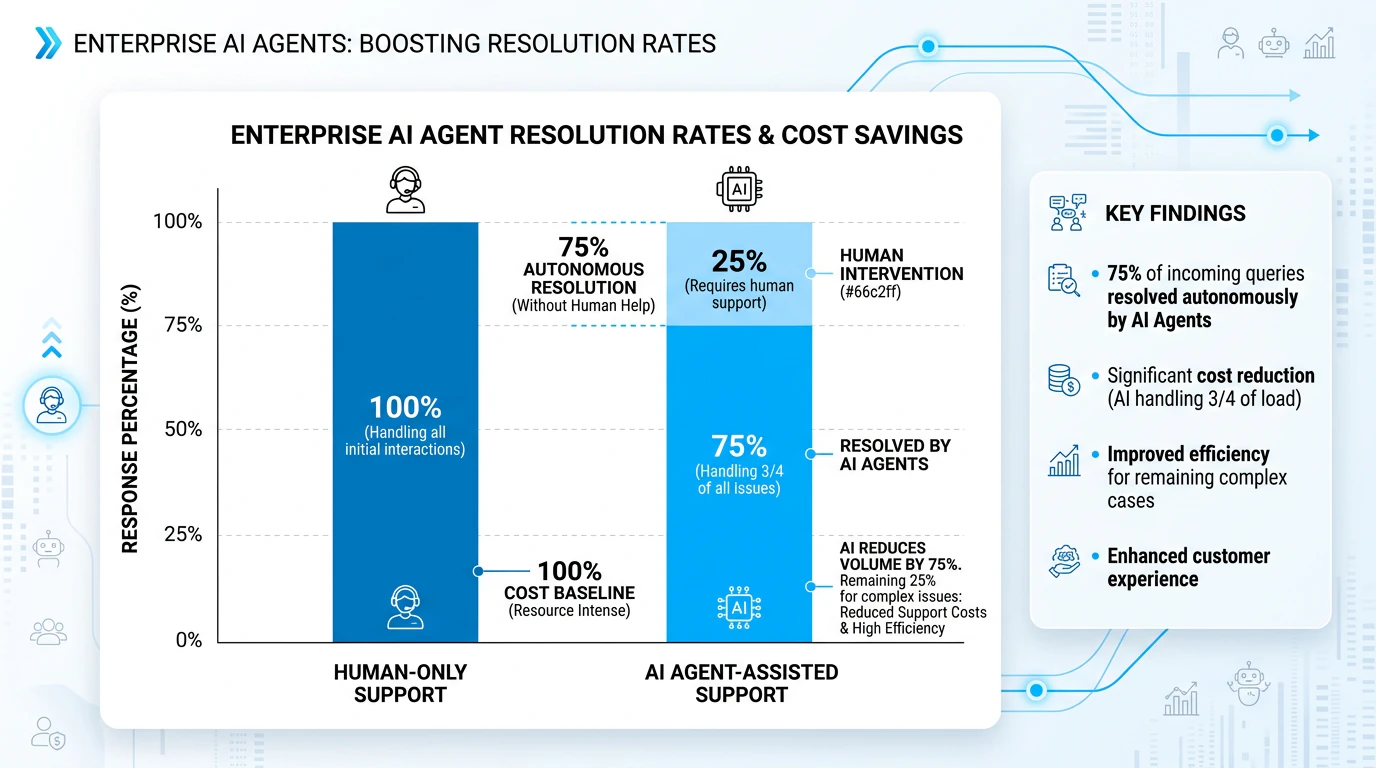
OpenAI’s internal Presence deployment resolves approximately 75% of inbound support issues without human assistance. The remaining 25% escalate with full context to human agents, allowing faster resolution of complex cases.
Why US Small Business Owners Should Pay Attention
Presence is not available to small businesses today. It is enterprise-only, requires an OpenAI Forward Deployed Engineer or select systems integrator to implement, and pricing is negotiated per deployment. That does not mean it is irrelevant to US small business owners.
Three reasons SMBs should care about Presence:
1. The guardrails framework will trickle down. The governance model Presence introduces — policies, guardrails, simulations, escalation rules — is what has been missing from AI agents for practical business use. When OpenAI or competitors bring this capability to self-serve tiers, small businesses will benefit from years of enterprise hardening. The guardrails marketplace could become as important as the model marketplace.
2. Customer expectations will rise across the board. When large enterprises deploy AI agents that resolve 75% of issues without human help, customers will expect similar response quality from every business they interact with — including the local contractor, the regional retailer, and the service provider they call for support. The gap between enterprises running Presence and SMBs relying on email or phone menus will become visible within 18-24 months. Small businesses that adopt AI customer service tools early will maintain competitive parity.
3. The improvement loop is the real innovation. Presence’s Codex-powered loop that analyzes production sessions and suggests improvements — then lets teams test and approve changes — is a significant advance over deploying a static chatbot. This continuous improvement pattern will likely appear in small business AI tools within 12-18 months. Understanding it now means being ready when it arrives. Static AI agents that never improve will quickly become obsolete.
What Exists for SMBs Right Now
While Presence is enterprise-only, OpenAI has been expanding access for smaller businesses through other channels that serve as practical alternatives today:
- ChatGPT Workspace Agents — Available in ChatGPT Enterprise and Business tiers. These agents operate within ChatGPT and Slack workspaces for internal tasks like research, summarization, and content creation. They lack the deep integrations and governance of Presence but are immediately accessible at a price point small businesses can afford.
- Small Business Program — OpenAI launched a dedicated small business initiative offering workshops, workflow guides, and partner integrations with tools like Shopify, Intuit, and Slack. This program is designed for businesses that cannot justify an enterprise deployment.
- ChatGPT Work — An AI agent tier for small business released earlier in 2026. Handles email, Slack, and calendar management without requiring custom integrations or IT support.
- OpenAI API — Developers and technical founders can build custom agents using OpenAI models and API tools, though they must build governance and escalation logic themselves.
The gap between Presence and these options is narrowing. The enterprise deployment patterns OpenAI is validating with Presence will directly inform the next generation of self-serve agent tools.
How the Guardrails Model Compares to Competitors
Presence enters a crowded enterprise agent market, but its approach to governance stands apart from alternatives available to US businesses:
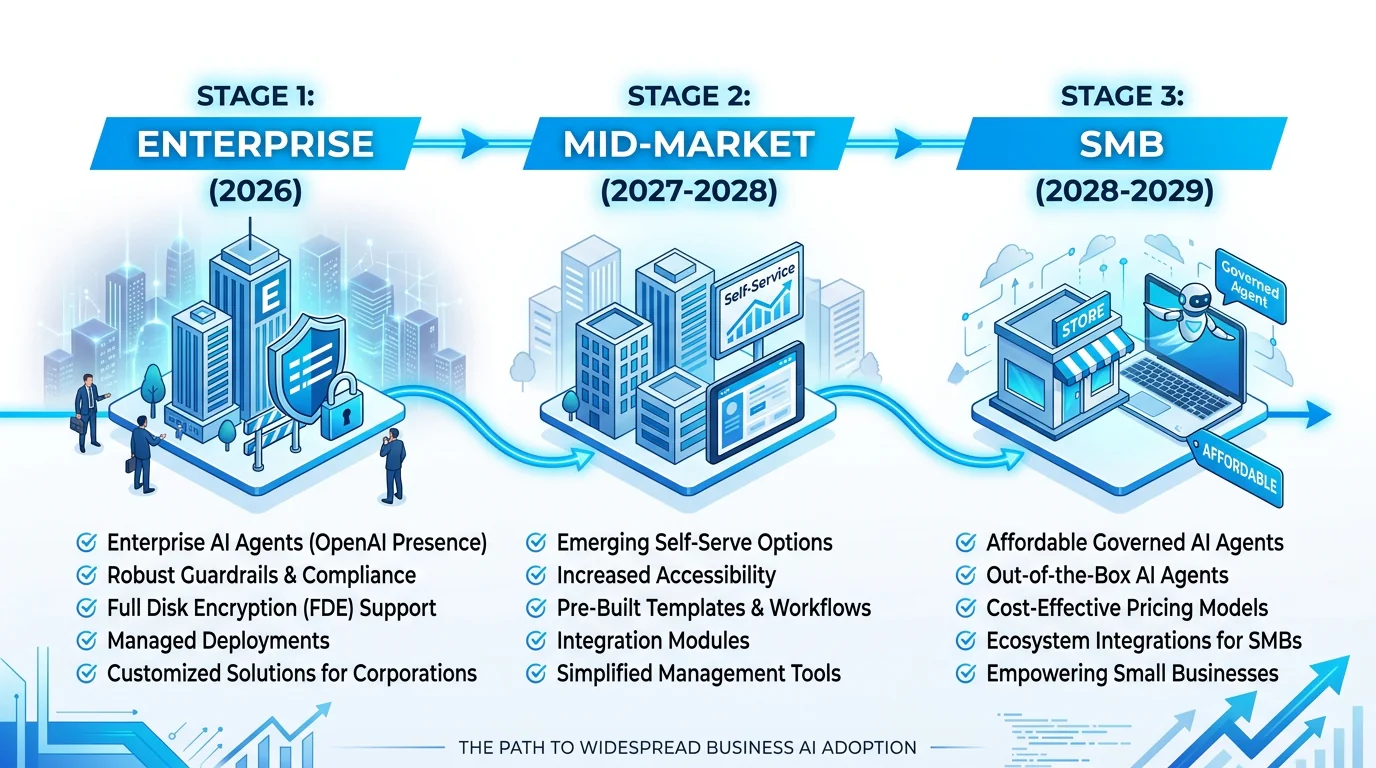
The enterprise governance patterns OpenAI is validating with Presence will trickle down to self-serve tiers over the next 18-24 months. Small businesses that start using available agent tools now will be ready when governed agents reach SMB pricing.
| Platform | Approach | Governance Model | SMB Access |
|---|---|---|---|
| OpenAI Presence | Managed deployment | Company-defined policies, guardrails, simulations, Codex improvement loop | Enterprise only |
| Claude Work and Tag | Desktop and mobile plus Slack agent | User-defined permissions, no pre-launch simulations | Self-serve, $20-50 per month |
| Meta Business Agents | WhatsApp-native | Platform-level moderation, no custom guardrails | Free with WhatsApp Business |
| Microsoft Copilot Studio | Low-code agent builder | Azure-based governance, limited guardrail customization | Included with E3/E5 |
| ChatGPT Workspace Agents | ChatGPT-native | Workspace-level permissions, no evaluation framework | ChatGPT Business and Enterprise |
What sets Presence apart is not the quality of the underlying model — it is the operational layer that makes agents safe to deploy at scale. The simulations, the evaluation graders, the Codex improvement loop, and the structured escalation path are features that enterprise customers have demanded for years and that Presence is the first OpenAI product to deliver in a unified package.
The Bottom Line for US Small Business Owners
OpenAI Presence is not for you today. But it is one of the most important AI product launches of 2026 because it proves that governed, production-grade AI agents can handle high-stakes customer interactions at scale. The 75% resolution rate OpenAI reports is not a marketing number — it is a benchmark that competitors will need to match and that small business tools will eventually need to approximate.
What US small business owners should do now: start using whatever agent tools are available today — ChatGPT Work, Claude Work, or simple API-based agents — so that when guardrails and improvement loops arrive in self-serve tiers, you already understand the workflows, integration points, and policy requirements that make agents actually useful. The businesses that have been running AI agents for a year will have a significant competitive advantage when the enterprise-grade governance layer becomes available at SMB pricing.
The agents are coming. Presence proves they can work in production. The question is how quickly the governance and reliability Presence introduces reaches the tools small businesses actually use in the United States market.
Frequently Asked Questions
What is OpenAI Presence?
OpenAI Presence is a managed enterprise platform for deploying, operating, and continuously improving governed AI agents that handle high-volume customer-facing and internal workflows through voice and chat channels. It launched on July 22, 2026.
How is OpenAI Presence different from ChatGPT?
Presence is a separate managed enterprise product designed for production workflows that require custom integrations, pre-launch testing, guardrails, monitoring, and ongoing improvement support. ChatGPT Workspace Agents are created and managed within ChatGPT and Slack workspaces for lighter internal tasks.
Can small businesses use OpenAI Presence?
No. Presence is currently available only to eligible enterprise customers through a limited general availability program. Deployments are led by OpenAI Forward Deployed Engineers or select systems integrators. Pricing and implementation scope are negotiated per deployment.
What can a Presence agent do?
A Presence agent follows approved instructions and policies, connects to business systems through scoped APIs, retrieves and updates information, communicates through voice or chat, and escalates to humans when a policy or risk requires human judgment. Exact capabilities are defined per deployment.
Which companies are using OpenAI Presence?
BBVA, SoftBank, and IAG have publicly disclosed Presence deployments. OpenAI also uses Presence internally to power its own English-language phone support, which resolves approximately 75 percent of inbound issues without human assistance.
How much does OpenAI Presence cost?
Pricing is not publicly available. Presence is sold as a managed project rather than a self-serve product, with costs determined per deployment based on scope, workflows, integrations, and service commitments. Businesses must contact their OpenAI account team for pricing details.

About Barak Schurr
Barak Schurr is the founder and former president of the nightlife ticketing platform Wantickets and former Global Director of Dance and Nightlife at Eventbrite. He currently focuses on AI research and writes about practical AI for independent business owners that actually moves the needle — no hype, no corporate fluff. More at topnotchaitools.com.
Contact: [email protected]
More AI Resources for Your Business