Get The Solo Business OS — Free
The AI workflow that replaces a part-time employee for solo operators and small business owners.
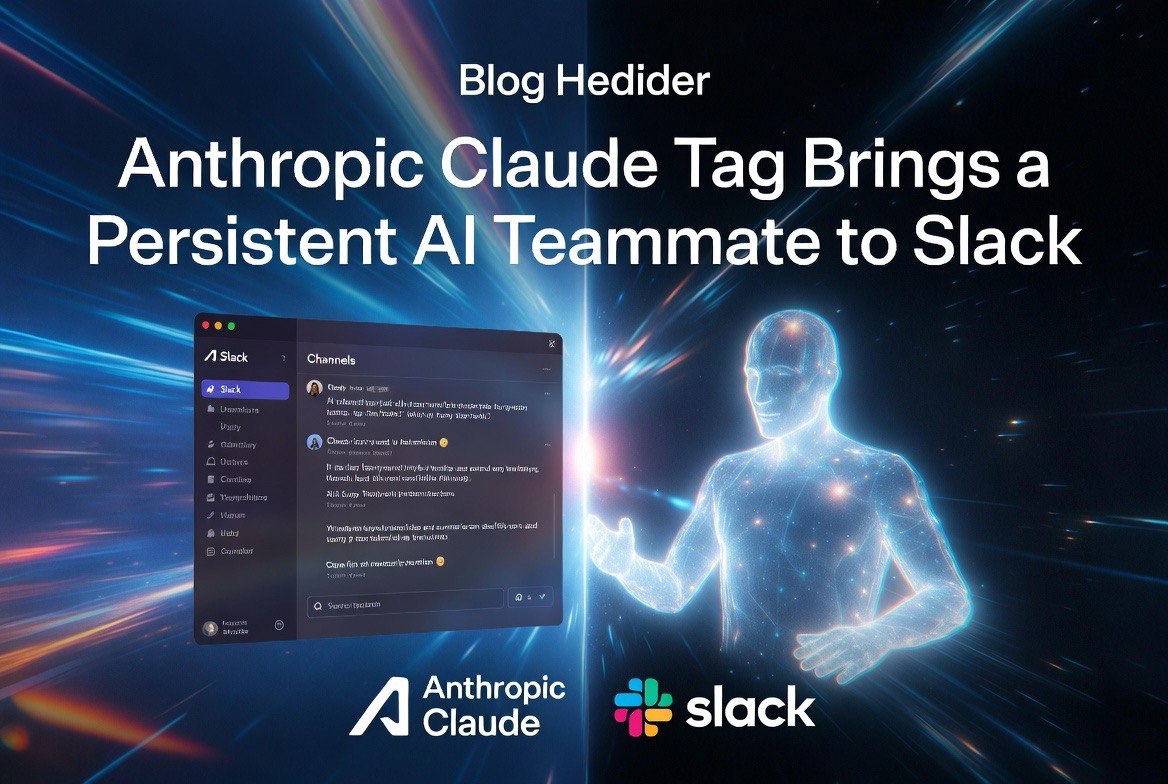
Anthropic Claude Tag Brings a Persistent AI Teammate to Slack
⚡ Expert Summary: Anthropic just dropped Claude Tag — a persistent AI teammate that lives inside your Slack channels. It learns your company’s institutional knowledge, monitors conversations, assigns tasks, and answers questions without being @-mentioned. For small and mid-size businesses in the United States, this is the easiest AI adoption play yet: deploy it in minutes, get a 24/7 employee that already knows your business.
You know what’s worse than not using AI? Watching your team spend $5,000 a month on AI subscriptions and getting nothing but generic ChatGPT answers and awkward Slack integrations that need prompting every five seconds.
Anthropic just fixed that.
Claude Tag isn’t another AI bot you ping when you need a summary. It’s a persistent AI teammate that lives in your Slack workspace. It reads your channels. It learns your company’s context. It assigns itself tasks based on what it sees. It answers questions you didn’t even ask yet.
This is the kind of AI that makes your business faster without making your people work harder.
What Is Claude Tag?
Claude Tag replaces the old Anthropic Slack app. It’s available in beta for Claude Enterprise and Team customers, and it represents a fundamental shift in how AI integrates into workplace communication.
Instead of a passive bot that waits for a command, Claude Tag is always on. It monitors designated Slack channels. It builds a running understanding of how your company operates — the projects, the terminology, the people, the unwritten rules. And then it starts contributing.
VentureBeat called it “Anthropic’s most aggressive move yet to colonize the enterprise collaboration layer.” That’s accurate, but for SMBs it means something more practical: you’re getting an always-on team member who knows your business for a flat subscription fee. No implementation consultants. No months of training. No custom development.
What Makes Claude Tag Different?
Most AI Slack tools work the same way: you type a command, the bot responds, you forget it exists until you need it again. Claude Tag flips that model entirely.
It monitors, not waits. Claude Tag watches your channels. When it sees a question it can answer, it answers. When it spots a task that needs tracking, it tracks. It doesn’t need a prompt or a mention. A team member posts “Has anyone followed up with the Johnson account?” — Claude Tag checks the CRM integration, finds the status, and posts the update without anyone asking it to.
It learns your company, not the internet. The standard Anthropic Claude model is already one of the most capable AI systems on the market. Claude Tag adds a persistent layer of organizational context on top. Slack message history isn’t just chat history — it’s institutional knowledge. Every decision, every handoff, every “does anyone know how to…” question builds a record that Claude Tag indexes and uses.
It automates workflows autonomously. Claude Tag doesn’t just answer questions. It can assign tasks to team members, set reminders, track project status, and escalate issues — all based on the context it gathers from the channels it monitors. If your operations channel discusses a recurring bottleneck, Claude Tag can create a tracker and assign ownership before anyone thinks to do it.
Why This Matters for SMBs
Large enterprises have dedicated AI teams, custom integrations, and budgets for building internal tools. Small businesses don’t. The gap between what AI can do and what most SMBs actually implement is huge.
Claude Tag closes that gap by working through Slack. Slack is where your team already collaborates. There’s no new platform to learn, no onboarding, no training. You install the integration, configure your channels, and Claude Tag starts contributing within hours.
The impact compounds over time. Day one, Claude Tag can answer basic questions about your company. Day thirty, it knows your project history, your customer terminology, your internal processes. Day ninety, it’s catching things your team would miss — and flagging them before they become problems.
TechCrunch reported that “Claude Tag brings an always-on AI teammate to Slack.” The key word is always-on. This isn’t a tool you think to use. It’s a tool that works in the background, every minute your team is communicating.
For American SMBs running lean teams, this is the difference between “we should use AI” and “AI is making us faster every single day.” No training required, no new workflows to learn, no culture change to manage. Just drop it in and let it run.
How to Deploy Claude Tag in Your Business
Getting started takes less than 15 minutes. Here’s the exact playbook:
Step 1: Ensure your team is on a Claude Enterprise or Team plan. Claude Tag requires one of these tiers. If you’re still on Claude Pro ($20/month per person), you’ll need to upgrade to Team ($30/user/month).
Step 2: Install the Claude Tag integration from the Slack App Directory or through Anthropic’s admin console. Authorize the Slack channels you want Claude Tag to monitor.
Step 3: Configure permissions. Define what Claude Tag can do autonomously — answer questions, assign tasks, set reminders. Set boundaries for sensitive channels that shouldn’t be monitored.
Step 4: Let it run. Claude Tag learns from the conversation flow. The more your team communicates in Slack, the smarter Claude Tag gets about your specific business context. The first week is baseline learning. By week three, it’s connecting dots your team didn’t know existed.
Step 5: Review and refine. After a week, check what Claude Tag is catching and where it’s missing context. Adjust channel monitoring permissions and autonomy settings. This is a 10-minute conversation with your team, not a recurring project.
Real Use Cases for Small Businesses
Claude Tag isn’t theoretical. Here’s how it works across different SMB contexts:
Client services. A 15-person agency can set Claude Tag to monitor client project channels. It tracks deadlines, flags overdue deliverables, and surfaces client requests that fell through the cracks. The agency owner doesn’t need to check every channel — Claude Tag reports the critical items. One agency founder told TechCrunch it saved them two hours per day of project management overhead.
E-commerce operations. A direct-to-consumer brand with 30 employees uses Slack for every team — support, fulfillment, marketing. The support team posts about recurring customer issues, the fulfillment team shares inventory updates, the marketing team discusses campaigns. Claude Tag cross-references all of it. When the support team flags a spike in complaints about a specific product, Claude Tag notifies the fulfillment and marketing teams automatically.
Professional services. A boutique law firm with 8 attorneys uses Slack for case coordination. Claude Tag monitors channels for filing deadlines, client questions, and research requests. It assigns follow-up tasks to the responsible attorney and keeps the team on track without a partner having to chase down everyone individually. For firms billing by the hour, that recovered time goes straight to the bottom line.
Remote-first teams. A distributed team of 25 across the United States uses Claude Tag as their asynchronous communication backbone. When the East Coast team wraps up, Claude Tag summarizes key decisions for the West Coast team. No meetings required to bridge time zones.
What Claude Tag Costs
Claude Tag comes bundled with Claude Enterprise and Team plans. The Team plan is $30 per user per month. The Enterprise plan requires a conversation with Anthropic’s sales team and scales based on organization size and needs.
For a 10-person business, that’s $300 per month to add a persistent AI teammate that never sleeps, never forgets, and never asks for a raise. Compare that to the productivity drain of your team spending 25 minutes per day searching for information they know exists somewhere in Slack.
Research consistently shows that knowledge workers lose 20-30% of their day to information retrieval. For a 10-person team at an average blended cost of $50/hour, that’s $1,000-$1,500 per week in lost productivity — just from people hunting for information that already exists in their own company. Claude Tag eliminates that waste entirely.
How Claude Tag Compares to Microsoft Copilot in Teams
Microsoft Copilot in Teams offers similar functionality but with a different architecture. Copilot relies on Microsoft Graph and your tenant’s existing data. Claude Tag builds its context from Slack conversation history specifically.
The practical difference: if your business runs on Slack — and most SMBs do — Claude Tag works with the tool your team already uses. You don’t need to migrate to a new platform or train your team on new workflows. Copilot requires the full Microsoft environment. Claude Tag requires Slack and a Claude plan.
There’s also a philosophical difference. Microsoft Copilot is designed to enhance the Microsoft ecosystem. Claude Tag is designed to learn your specific company context. If your business knowledge lives in Slack conversations, Claude Tag is the more natural fit. If you’re a Microsoft-first shop running Teams, Copilot makes more sense.
Both tools are capable, but the one that works where your team already communicates is the one that will actually get used. Most SMBs choose Slack over Teams by a significant margin. Claude Tag chose Slack. That alignment matters.
Privacy and Data Considerations
Anthropic has positioned Claude Tag with enterprise-grade privacy controls. The model processes Slack messages within your workspace boundary. Anthropic’s published policy states that your conversation data is not used for training the public Claude model. For US-based SMBs concerned about data sovereignty, this matters — your company’s internal Slack discussions stay within your controlled environment.
Channel-level permissions let you exclude sensitive conversations. Legal discussions, HR matters, and financial planning can stay off-limits while allowing Claude Tag to work across operational channels. You decide the balance between capability and privacy.
The Integration Ecosystem
Claude Tag doesn’t work in isolation. Anthropic has built integrations that let Claude Tag pull data from tools your team already uses — CRMs like HubSpot, project management tools like Asana or Linear, and file storage like Google Drive. When a client asks about project status, Claude Tag can check the CRM for open tickets, scan Asana for task completion, and summarize it in Slack without anyone switching apps.
For SMBs running a stack of 5-10 SaaS tools, this integration layer is where the real value lives. Claude Tag becomes the connective tissue between tools that don’t talk to each other. That’s not a feature — that’s the entire productivity problem that most SMBs can’t solve because they can’t afford a full-time integration engineer.
FAQ
What is Claude Tag?
Claude Tag is Anthropic’s persistent AI teammate for Slack. It monitors designated channels, learns your company’s institutional knowledge, and autonomously answers questions, assigns tasks, and tracks project status.
Is Claude Tag free with existing Claude subscriptions?
Claude Tag is available in beta for Claude Enterprise and Team plans. The Team plan costs $30 per user per month and includes Claude Tag access.
Can Claude Tag access all my Slack channels?
No. You configure which channels Claude Tag can monitor. Sensitive channels can be excluded from its access.
How long does it take for Claude Tag to learn my company’s context?
Claude Tag starts contributing immediately upon installation. Its understanding of your company improves over the first several weeks as it processes more conversation history and interaction patterns.
Does Claude Tag work with tools other than Slack?
Claude Tag integrates with CRMs like HubSpot, project management tools like Asana, and file storage like Google Drive, pulling data from across your tech stack.