Get The Solo Business OS — Free
The AI workflow that replaces a part-time employee for solo operators and small business owners.
Amazon’s AI Title Rewriting: 75 Characters That Decide Your Product’s Future
⚡ Expert Summary: Amazon is now using AI to automatically rewrite sellers’ product titles to a strict 75-character limit, giving brands a finite review window before the change goes live. For US small business owners selling on Amazon, this is not a cosmetic tweak — it is a ranking and demand rule change that directly impacts discoverability, ad performance, and sales. Sellers who audit their listings now and align titles with how shoppers actually search will protect their placement; sellers who ignore the deadline risk losing ground to AI-optimized competitors.
Why Amazon’s 75-Character AI Title Rule Matters Right Now
If you sell on Amazon, the product title is the single most searched string attached to your listing. It is what the search engine reads first, what shoppers scan first, and what decides whether your product appears when someone types “wireless earbuds for running with microphone” into the search bar. For years, sellers stuffed titles with keywords as a ranking trick — sometimes 200 characters or more of repeated phrases, brand names, and filler. That era just ended.
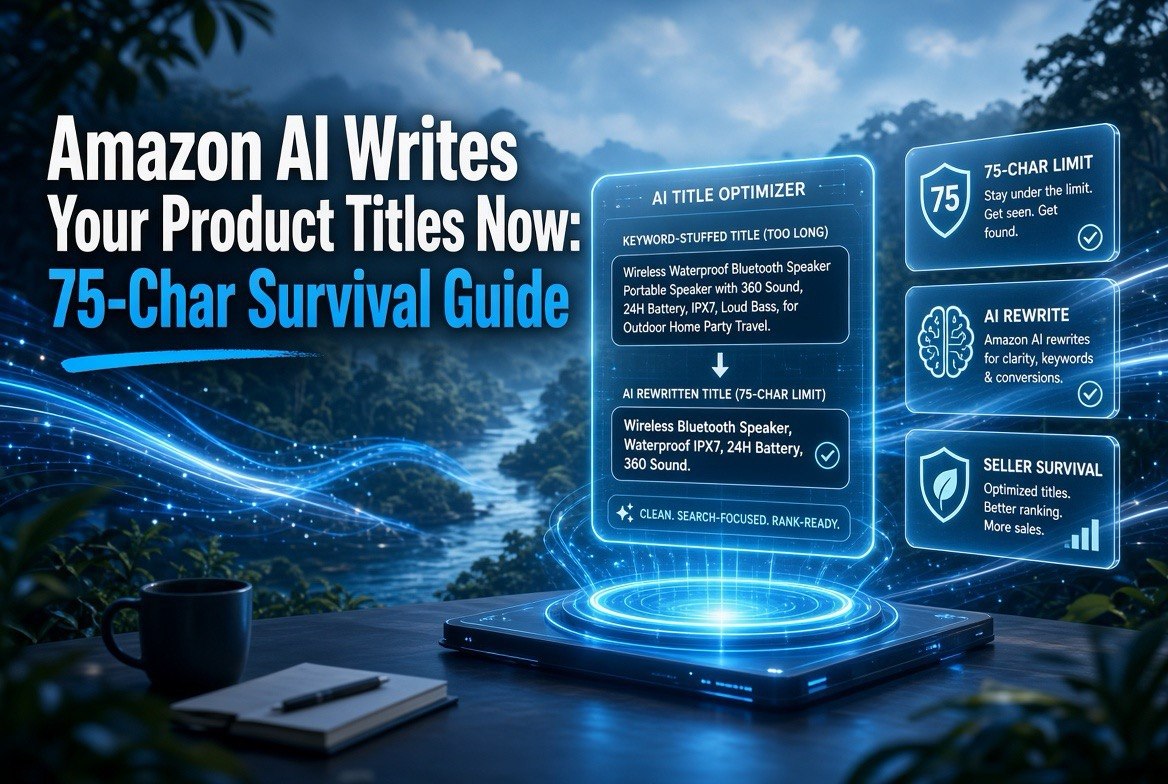
In late July 2026, Amazon began rolling out an AI-driven title rewriting system that condenses product titles to a 75-character limit. The mechanic is straightforward: Amazon’s model analyzes your current title and product details, then generates a tighter version that fits the 75-character cap. It does not delete your listing or your keywords outright — it gives you a review window to approve, edit, or revert the change before it becomes the live title. If you do nothing, the AI version eventually becomes your public-facing title.
This matters to US small business owners more than to enterprise brands, because independent sellers typically do not have a full-time listing-optimization team reviewing every catalog change. You have a handful of products, a rising cost structure, and a few hours a week for “admin.” A machine rewriting your titles in the background, with a deadline attached, is exactly the kind of silent change that erodes your discoverability if you are not watching.
| What Changed | Old Sellers’ Strategy | New AI Reality |
|---|---|---|
| Title length | 150-200+ characters (keyword stuffing) | Hard 75-character cap via AI rewrite |
| Who writes the title | Seller controls every word | Amazon’s AI drafts it; seller reviews |
| Review window | N/A | Finite window before AI version goes live |
| Keyword placement | Front-load keywords, repeat variants | Front-load the strongest search phrase only |

Amazon condenses padded 150-200 character titles into tight 75-character keyword-first versions that AI search can match.
How the AI Title Rewriting Actually Works
Amazon’s new system sits inside the standard listing management workflow, so you do not need to install anything or change platforms. When Amazon’s model flags a title as over-length or poorly structured, it generates a replacement that fits within 75 characters. The system is designed to preserve the core identifying information — the key descriptor shoppers search for — while cutting the promotional filler that used to pad out long titles.
Here is the operational sequence a seller goes through:
- Flag: Amazon identifies listings with titles longer than the new limit or with redundant keyword patterns.
- Draft: The AI produces a condensed title, typically 75 characters or fewer, based on your existing product details and attribute data.
- Notify: You receive a notice in Seller Central with a review window, usually giving you a set number of days to act.
- Decision: You can accept the AI version, edit it further, or revert to your original title.
- Live: If you do not act, the AI-generated title becomes the live, publicly visible title after the window closes.
The key strategic point is that this is not a suggestion. It is a default action with an expiry. Sellers who treat the notice as optional and let the window lapse are opting into whatever title Amazon’s model decided — which may or may not include your best-converting search phrase.
The Real Risk: Losing Your Best Search Ranking Phrases
The danger for a small business is not that the AI writes a bad title. It is that the AI writes a shorter title that silently drops the exact phrase your customers use to find you. Consider a real pattern from seller forums: a title like “Stainless Steel Water Bottle 32oz Insulated Leakproof for Gym Sports BPA Free” was condensed to “Insulated Stainless Steel Water Bottle 32oz”. Shoppers searching “BPA free water bottle” may no longer match that listing as strongly, because “BPA free” disappeared from the visible title field.
Amazon’s search algorithm relies heavily on the title as a match signal. When a keyword is removed from the title, the listing loses a strong relevance signal for that term, even if the keyword still appears in your backend search terms. That can translate directly into fewer impressions, a lower click-through rate, and weaker ad match quality — all of which compound into lost sales.
What US Small Business Sellers Should Do This Week
Step 1: Audit Every Active Listing Now
Before you touch anything else, pull your full active inventory from Seller Central and list every product with a title. Flag any title over 80 characters, any title with repeated keywords, and any title where the primary search phrase is not in the first few words. These are the listings Amazon’s AI is most likely to rewrite. Do this even if you have not yet received a notification, because the roll-out appears to be staggered across accounts and categories.
Step 2: Identify Your Single Most Valuable Search Phrase per Product
For each product, decide which one search query drives the most sales. That phrase must be the first thing in your 75-character title. A good 75-character title is: primary keyword first, then the strongest descriptor, then any essential qualifier that fits. Leave the rest to your bullets, description, and backend search terms, where Amazon still indexes them.
Step 3: Prepare Your Own 75-Character Version Before Amazon Does
Do not wait for Amazon’s AI to draft first. Write your own tight title that fits the limit and leads with your best phrase. If Amazon flags your listing, you can approve a version close to your own — and if Amazon’s draft drops your primary phrase, you are prepared to edit it in the review window instead of scrambling.
Step 4: Set a Calendar Reminder for Every Review Window
The single most common mistake will be letting the review window lapse. Treat each AI title notice like a deadline, not a suggestion. Check Seller Central notices daily for the next few weeks, and act on any title-rewrite notification the same day. An unclaimed window is a default decision made for you, and default decisions rarely protect your best keywords.
Step 5: Watch Performance After the Change
After a title change goes live — yours or the AI’s — monitor your search term report for that ASIN over the following two to three weeks. If impressions or clicks on your primary keyword drop, revise the title again. Algorithm changes are not one-shot events; they are something you actively manage.
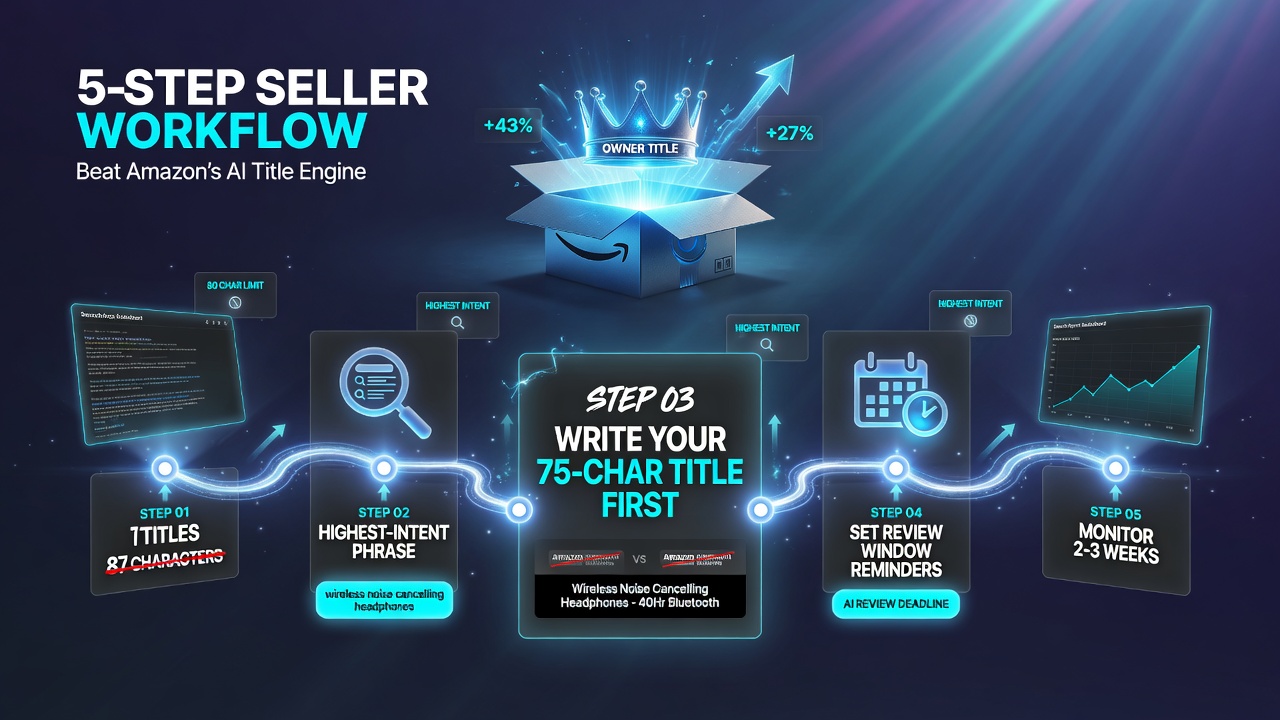
Audit listings, pick your primary phrase, and write a 75-character title before Amazon’s AI does it for you.
The same keyword-first discipline now applies across all AI search surfaces.
How This Fits the Broader AI Search Shift for Small Business
Amazon’s title rewriting is part of a larger pattern that every small business owner needs to internalize in 2026: AI is now writing the content that shoppers see, and it is being written for how AI-powered search and AI-assisted shopping platforms match queries, not for how humans used to scan a page.
Parallels are everywhere. Google’s AI Overviews now summarize product and local answers above traditional results. ChatGPT Search and Perplexity pull concise, structured answers directly into chat. And now Amazon — the single largest product-search surface in the US — is condensing titles so they match the short, specific queries shoppers and AI assistants actually type.
For the owner of a small e-commerce brand, the practical takeaway is that the era of padding titles with keywords is over. The winning approach is now constraint-driven: fewer, sharper, higher-intent keywords placed where the algorithm reads them first. The same discipline that protects your Amazon placement — audit, pick one primary phrase, lead with it, monitor results — is the discipline that will serve your website, your Google Business Profile, and your ad copy as AI search keeps spreading.
According to research on retail search behavior cited by e-commerce industry analysts, the majority of shoppers never look beyond the first page of results, and a product’s title is one of the strongest determinants of whether it appears there. Jumpshot’s widely cited click-through data and more recent retail search studies consistently find that title relevance is a top ranking factor on Amazon’s marketplace. When the ranking factor itself is being rewritten by AI and capped at 75 characters, reclaiming control of that factor is the single highest-leverage task available to an independent seller this quarter.
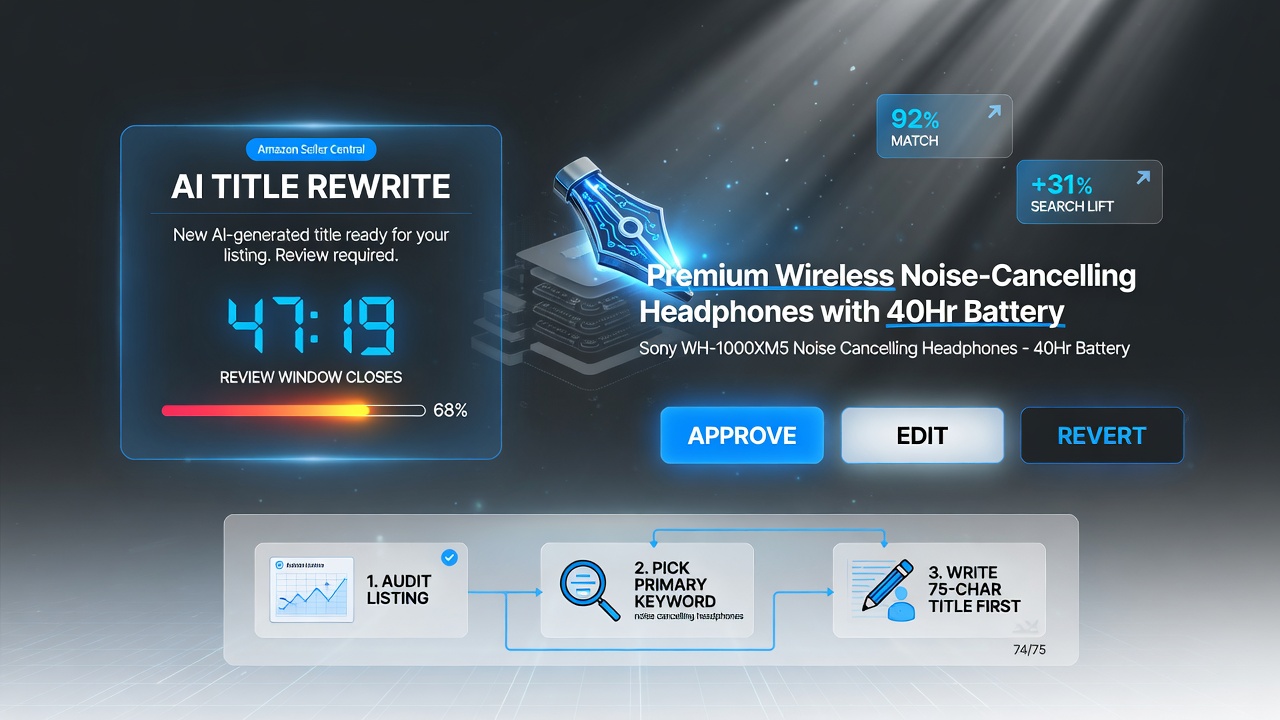
Every rewrite comes with a finite review window — act before it lapses or Amazon’s AI version becomes your live title.
Why This Is a Good Thing for Sellers Who Plan Ahead
It is worth stating the upside, because an AI-driven title change is not purely a threat. The 75-character constraint forces a level of discipline that most independent sellers never applied. When you are forced to pick one primary phrase and lead with it, you stop scattering your relevance across five mediocre keywords and concentrate it on the one that actually converts. That concentration is exactly what Amazon’s ranking system rewards, and it is what an AI-assisted shopper — one asking a voice assistant or a chat interface for “a durable 32oz water bottle” — is most likely to match.
Shorter, sharper titles also read better in the search results themselves. A 75-character title renders cleanly on mobile, does not get truncated with an ellipsis, and gives shoppers the core information at a glance. In retail search studies, listings with clear, front-loaded titles consistently earn higher click-through rates than padded ones, because shoppers can parse the product’s value in under two seconds. The sellers who treat this change as a chance to clean up their catalog, rather than as an attack on their keywords, will come out ahead of the sellers who resist it reflexively.
What to Do If Amazon Already Rewrote Your Title
If a notice lapsed and the AI version is already live, you are not locked out. You can still edit the title manually in Seller Central back to a 75-character version that leads with your best phrase. Amazon does not permanently freeze titles at the AI draft; the AI version is simply the default that got applied. Editing it back is allowed and common.
The practical fix is to compare the live AI title against your primary keyword, add the primary phrase back into the first position if it was dropped, trim any filler, and save. Then monitor the search term report to confirm your primary term recovers its impressions and click-through. In most cases a deliberate, keyword-first 75-character title outperforms both the long padded version and the generic AI condense, because you are choosing the phrase with the most commercial intent rather than the phrase the model happened to prioritize.
Frequently Asked Questions
Is Amazon automatically rewriting my product titles with AI?
Yes. As of late July 2026, Amazon began rolling out an AI-driven system that condenses over-length product titles to a 75-character limit and gives sellers a finite review window before the change goes live. If you do not act, the AI-generated title becomes the live title.
What exactly is the 75-character title limit?
Amazon’s new AI title rewrite targets a strict 75-character ceiling. The AI generates a condensed title that fits the cap, dropping promotional filler and repeated keywords while trying to preserve the core descriptor shoppers search for.
Do I have to approve the AI title rewrite?
You get a review window and can accept, edit, or revert the AI draft. But the window is finite. If you do nothing by the deadline, the AI-generated title is applied as the default and becomes your live title.
Will a shorter title hurt my search ranking?
It can, if the AI drops the exact phrase your customers use to find you. Amazon’s search engine uses the title as a strong relevance signal, so removing a key phrase from the title can reduce impressions and clicks for that term even if it still appears in backend search terms.
How do I protect my best keywords in a 75-character title?
Lead with your single highest-intent search phrase, then add the strongest descriptor and one essential qualifier if space allows. Push anything that does not fit into your bullets, description, and backend search terms, which Amazon still indexes.
Can I fix a title that Amazon already rewrote?
Yes. You can manually edit the live title back in Seller Central to a 75-character version that leads with your primary phrase. Compare the AI title against your best keyword, add it back to the first position, trim filler, and save, then monitor your search term report.

About Barak Schurr
Barak Schurr is the founder and former president of the nightlife ticketing platform Wantickets and former Global Director of Dance and Nightlife at Eventbrite. He currently focuses on AI research and writes about practical AI for independent business owners that actually moves the needle — no hype, no corporate fluff. More at topnotchaitools.com.
Contact: [email protected]
More AI Resources for Your Business