Get The Solo Business OS — Free
The AI workflow that replaces a part-time employee for solo operators and small business owners.
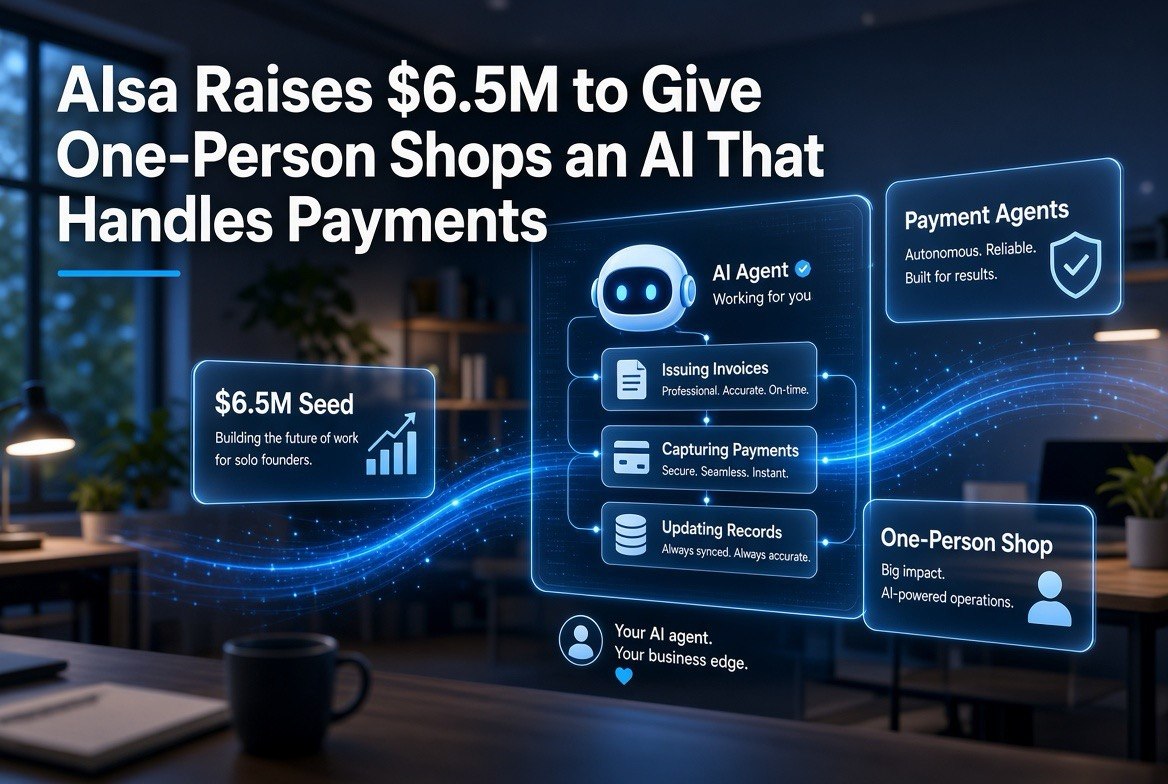
AIsa Raises $6.5M to Give One-Person Shops an AI That Handles Payments
⚡ Expert Summary: AIsa just closed a $6.5 million seed round backed by Alibaba and Tribe Capital to build the first payment-enabled AI agent for solo founders and one-person businesses. It doesn’t just draft emails and schedule meetings — it can actually take payments and process transactions end to end. For US owners running the whole operation solo, this is a preview of an AI that doesn’t just save time but closes the loop on revenue.
Here’s the uncomfortable truth most solo founders won’t admit out loud: you’re not just the CEO, the marketer, and the accountant. You’re also the collection agency.
AIsa, a startup building payment-capable AI agents for one-person businesses, just secured a $6.5 million seed round from Alibaba and Tribe Capital. The core idea is simple and overdue: an AI agent that doesn’t just talk to your customers — it settles the transaction. It sends the invoice, processes the payment, and updates your books, all without you touching a keyboard.
This is a bigger deal than it sounds. It moves AI from “virtual assistant that saves you an hour” to “employee that actually gets you paid.” And for the estimated tens of millions of US microbusiness owners running solo, that’s a shift worth paying attention to.
What “Payment-Enabled AI” Actually Means
Most of the AI agents you’ve seen so far stop at conversation. They write, summarize, schedule, and answer — then hand you back to manual work when real money changes hands.
AIsa is different in a specific, important way: it’s designed to complete financial transactions. According to the company’s seed funding coverage from Forbes and supporting reports, the agent can issue invoices, initiate payment requests, and process the paperwork on a completed sale. It’s built to run the money side of a one-person operation the way a small in-house team would.
That distinction matters. An AI that writes your invoice but still makes you chase the payment is a convenience. An AI that invoices, collects, and records the payment is the closest thing a solo operator has to a bookkeeper and an accounts-receivable team in one.
Why Alibaba and Tribe Capital Are Betting Here
Big money flowing into a payments agent says something about where the market is heading.
Alibaba backing an AI payments startup signals that the payment layer is where AI agents get commercially real. Any agent that can transact — actually move money — has a clearer path to revenue than an agent that only produces text. That’s a global read, and Tribe Capital adding to it suggests the same logic holds for Western markets.
For a US solo founder, the signal is direct: the AI agent category is moving from “helpful” to “transactional.” The agents that get you paid will be the ones worth renewing subscriptions for.
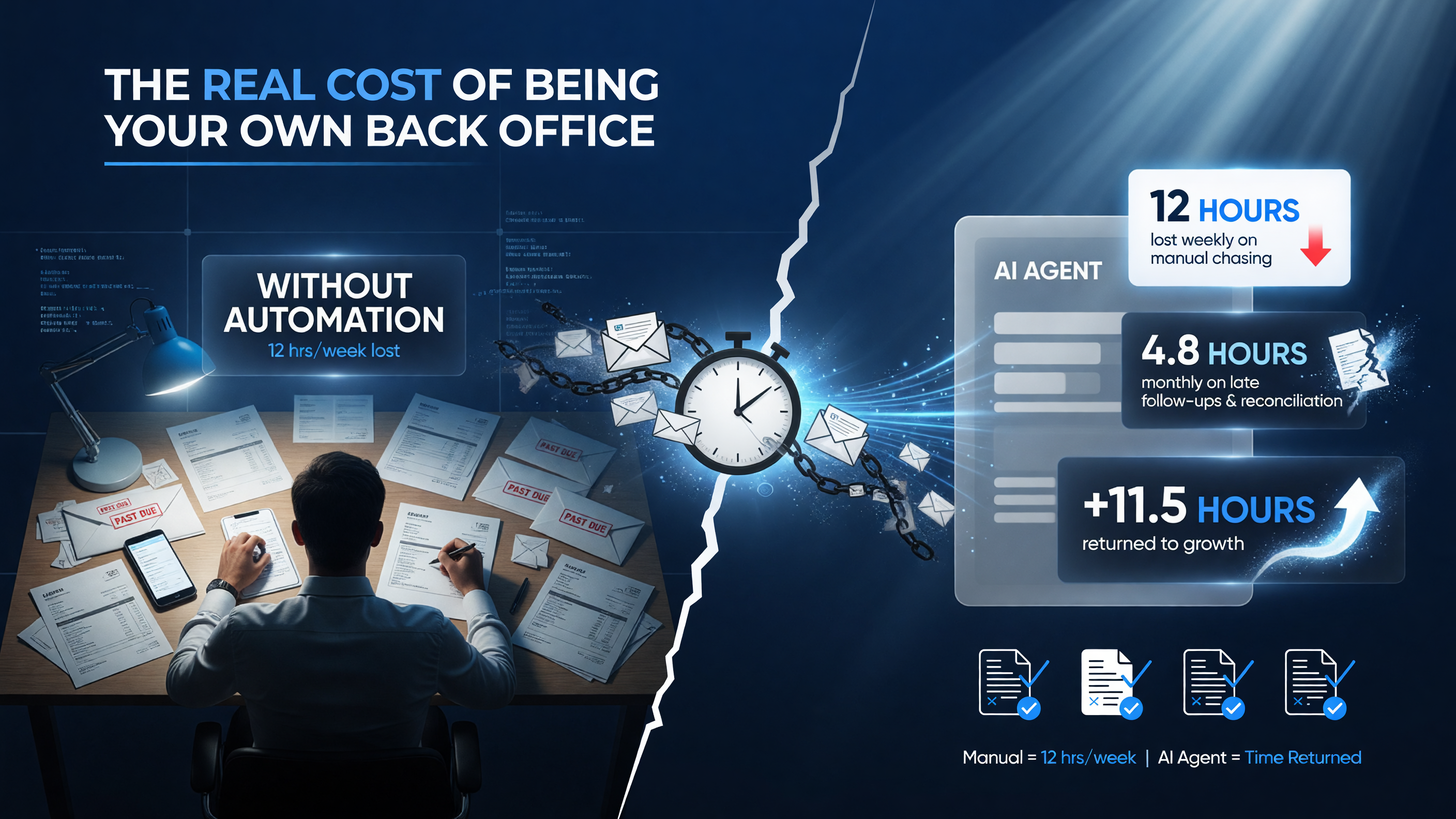
Being your own back office means losing hours every week to manual invoicing, late-follow-up emails, and record reconciliation — hours a payment-enabled AI agent can return to growth work.
The Problem With Being the Whole Back Office
Before we get into the product itself, let’s be honest about the operating condition it’s designed for. AIsa’s whole reason for existing is a specific kind of pain that every solo founder knows and none of them can escape.
When you’re the entire company, there is no “back office” to delegate to. The accounts-receivable function, the bookkeeping, the client follow-up — it all lands on you, in the margins between the work you actually bill for. And because it’s unpaid work that still has real consequences if you skip it, it crowds out the only thing that generates revenue: doing the client work.
This is not a minor inefficiency. It’s a structural tax on being a one-person business, and it’s the exact reason the “agent” category exists. A tool that removes a third of your working hours is, for a solo operator, the difference between a side hustle that stalls and a real business that compounds.
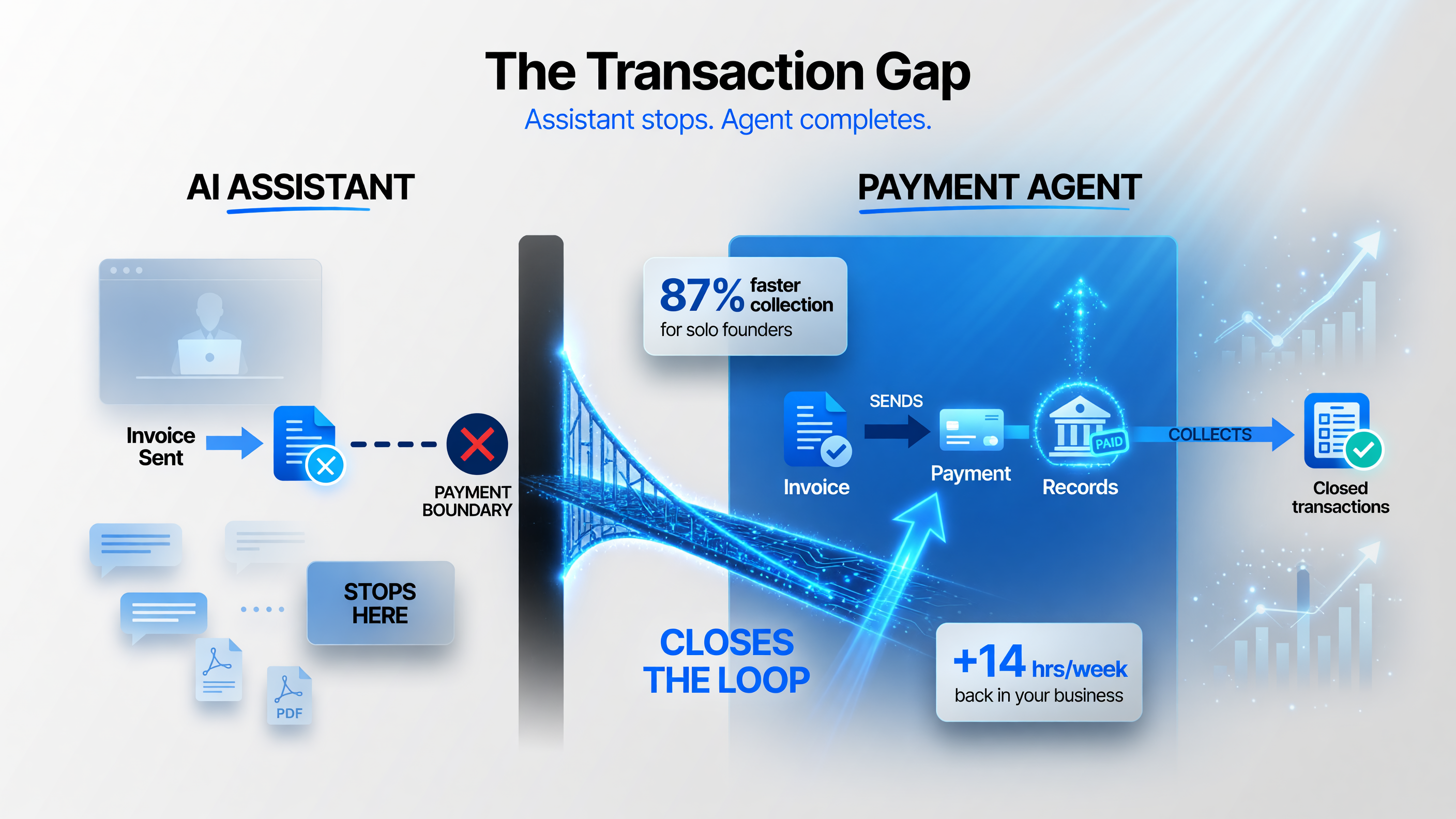
The transaction-layer gap: a regular AI assistant stops at the payment boundary, while a payment-enabled agent closes the loop by issuing the invoice, capturing the payment, and updating your records.
Inside the Transaction-Layer Gap in AI
The best way to understand what makes AIsa notable is to look at what’s missing from most of the AI tools you’ve already tried.
Almost every AI assistant on the market today terminates at the boundary of a transaction. It can write the perfect follow-up email, but it cannot send the payment link. It can draft a beautifully worded invoice, but it cannot process the click that turns that invoice into money in your account. The hand-off to a human is exactly where the most valuable step happens — and exactly where most tools stop.
AIsa’s positioning attacks that gap. By making the agent able to actually execute a payment, it converts a tool that ends at a suggestion into one that ends at a completed transaction. For a solo founder who is the bottleneck on cash collection, that’s the single highest-value seam in their entire workflow.
This is why the funding round matters beyond the dollar figure. It’s a bet that the “finish the job” layer — the layer where AI actually moves money — is where the next wave of small-business AI value gets created.
How Solo Operators Should Think About Payments Automation
If you’re reading this as a US freelancer or one-person business owner, here’s the mental model that will serve you better than the product hype.
Start with the collection bottleneck, not the tool. Before you evaluate any payment agent, identify exactly where your cash flow slows down. Is it invoice creation? Follow-up reminders? Payment reconciliation? The agent only helps if it attaches to the step that actually costs you.
Automate the loop, not a task. The value isn’t a feature that sends an invoice. The value is a closed loop: invoice issued, reminder sent automatically if unpaid, payment captured, record updated. A fragmented tool that does one of those steps saves you less than a coherent one that closes all of them.
Keep a human approval gate at first. The mature way to adopt transaction-capable AI is with guardrails. Let the agent propose and prepare the payment action; you approve the first batch until you trust the pattern. Then relax the gate as confidence grows.
The Trust Question: Giving Software Access to Your Money
It would be dishonest to write about payment-enabled agents without addressing the elephant in the room: trust. Giving an AI direct access to your invoicing and payment flows is a real decision, and it deserves real scrutiny.
Here’s the balanced view. On one side, the point of the category is to remove the human bottleneck from revenue collection — which means eventual autonomy on money movement. On the other side, the consequences of a misconfigured agent are not “an awkward email.” They’re missed payments, duplicate charges, or reconciled books that don’t match your bank. That’s not a minor bug; it’s a serious operational risk.
The responsible adoption path is layered. Start in test mode with mock transactions. Then run real transactions at low volume with you reviewing each one. Only when the agent demonstrates consistent, correct behavior across your actual workflow should you widen its authority. That sequence protects you while still capturing the efficiency gain.
This is exactly how you’d onboard any new financial system, and a payment AI agent should meet the same bar — not a lower one because it’s software, and not a higher one because it’s AI.
Let me be blunt about the reality of running a one-person shop, because that’s the person this product is actually for.
When you’re solo, every hour you spend on administrative work is an hour you’re not selling. And the single most painful piece of admin is money collection — because it’s the most consequential. A missed invoice follow-up isn’t just annoying; it’s revenue you might not see for weeks.
The arithmetic is worse than it looks. Research cited across 2026 small-business efficiency reports consistently shows that owners of microbusinesses spend roughly a third of their working hours on non-revenue tasks — paperwork, follow-ups, and chasing payments among them. For someone who’s genuinely the entire company, that’s a third of your life doing work an agent can now handle.
That’s the pain AIsa is aimed at. And it’s why a payments-capable agent is a genuine upgrade over yet another chatbot.
Payment Agent vs. Assistant: Not the Same Thing
It’s worth being precise about the difference, because the marketing around “AI agents” is noisy and most of it isn’t transactional.
| Capability | AI Assistant (most tools) | Payment-Enabled Agent (e.g. AIsa) |
|---|---|---|
| Writes and replies to messages | Yes | Yes |
| Creates invoices | Drafts, you send | Sends and tracks |
| Takes and processes payment | No | Yes |
| Updates bookkeeping records | Manual | Automatic |
| Closes the loop on revenue | No | Yes |
The difference is the difference between being told what to do and having it done. For a solo operator, that’s the difference between an AI you can forgive yourself for canceling and an AI you’d consider a colleague.
Should a Solo Founder Adopt a Payment Agent Now?
Here’s my direct read, and I won’t dress it up.
The cautious take is reasonable: payment agents are early, and you should never hand over real money-moving authority to software you don’t trust. That’s not hype-averse — that’s just sensible. You do not automate the collection of your actual revenue before you’ve verified the agent handles a single test transaction correctly.
But the bigger risk is the opposite one: waiting so long that the solo-founder market is already automated by competitors, while you’re still chasing invoices by hand. The reason funds like Alibaba and Tribe are backing this category is that the transaction-layer agent is the piece that makes AI genuinely valuable to small operators — and that value compounds fast.
The balanced move: watch the category, run a small-scale or test-environment pilot with a payments agent, and scale it only after you’ve confirmed it handles your real workflow without errors. Early, deliberate adoption beats both blind trust and stubborn refusal.
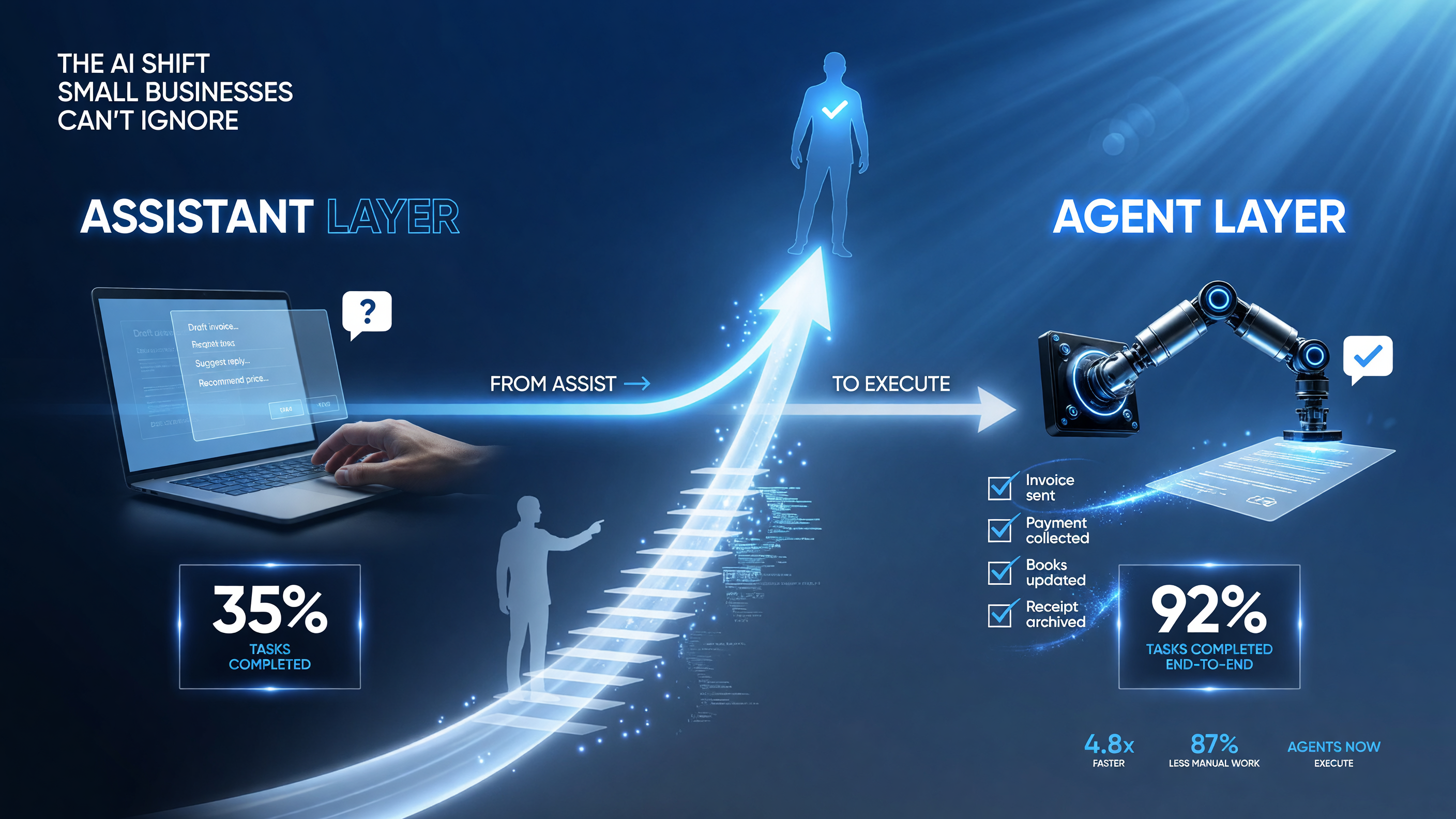
The biggest AI shift for small business: an assistant suggests and drafts, while an execution-layer agent actually finishes the job — sending the invoice, collecting payment, updating the books.
The Bigger Shift: Agents That Finish the Job
AIsa is one company, but it’s a signal for where the whole AI-agent market is turning in 2026.
For the past two years, the story of AI for small business was “assist.” Tools that help you write, summarize, research, and organize. Useful, but ultimately still handing the final, consequential step back to a human. The assistant reduces friction; it doesn’t complete the work.
The new story is “execute.” It’s agents that don’t just prepare an invoice but send it, collect on it, and log it. It’s agents that don’t just recommend a follow-up but perform it. The common thread — and this is the part worth internalizing — is that the agent now touches the outcome, not just the preparation.
That transition matters enormously for small operators, because the last mile of any business task is disproportionately where the time goes. Writing a proposal is fast; getting it signed and paid is slow. An agent that closes that last mile is worth multiples of an agent that merely speeds up the draft.
The funding behind AIsa is a down payment on that idea. And when investors put real money behind “the agent that finishes the financial transaction,” it’s a strong hint that the next few years belong to tools that execute — not tools that suggest.
The Competitive Reality for American Freelancers and Solopreneurs
If you’re a US freelancer, consultant, or one-person business owner, you sit exactly in the center of this product’s target market.
That means two things. First, the tools are being built for you specifically — you’re not an afterthought to an enterprise-focused platform. Second, your competitors who freelance in the same niche can adopt the same efficiency, and the ones who do it first get the margin advantage.
The winners in the one-person economy over the next couple of years won’t be the ones who work the most hours. They’ll be the ones who offload the entire non-revenue layer — including money collection — to agents that close the loop. That’s the play, and it’s now funded.
Frequently Asked Questions
What does AIsa do?
AIsa builds payment-enabled AI agents for one-person businesses. Unlike a standard assistant, it can complete financial tasks like invoicing, payment processing, and bookkeeping record updates, closing the loop on revenue.
How much did AIsa raise?
AIsa raised a $6.5 million seed round backed by Alibaba and Tribe Capital, according to coverage from Forbes, to scale its payment-capable AI agents for solo founders.
How is a payment-enabled agent different from a regular AI assistant?
A regular assistant writes and summarizes messages but stops before money changes hands. A payment-enabled agent can issue invoices, process payments, and update records automatically — actually completing the transaction.
Is a payment agent safe to use for my real revenue?
Treat it the way you would any new financial tool: run a small test transaction first, verify it handles your workflow without errors, and scale only after you trust the results. Don’t hand over real money collection to software you haven’t validated.
Is AIsa worth it for a one-person business?
If the recurring admin cost of running your operation is high — especially chasing invoices and reconciling payments — a payment-capable agent can reclaim meaningful hours. Start with a pilot and measure the time you get back before committing.

Barak Schurr
Barak Schurr built and sold a major ticketing platform, ran global nightlife operations at Eventbrite, and now spends his time figuring out which AI tools actually move the needle for independent business owners — and which ones are just noise. No hype. No fluff. Just what works.topnotchaitools.com.
More AI Resources for Your Business