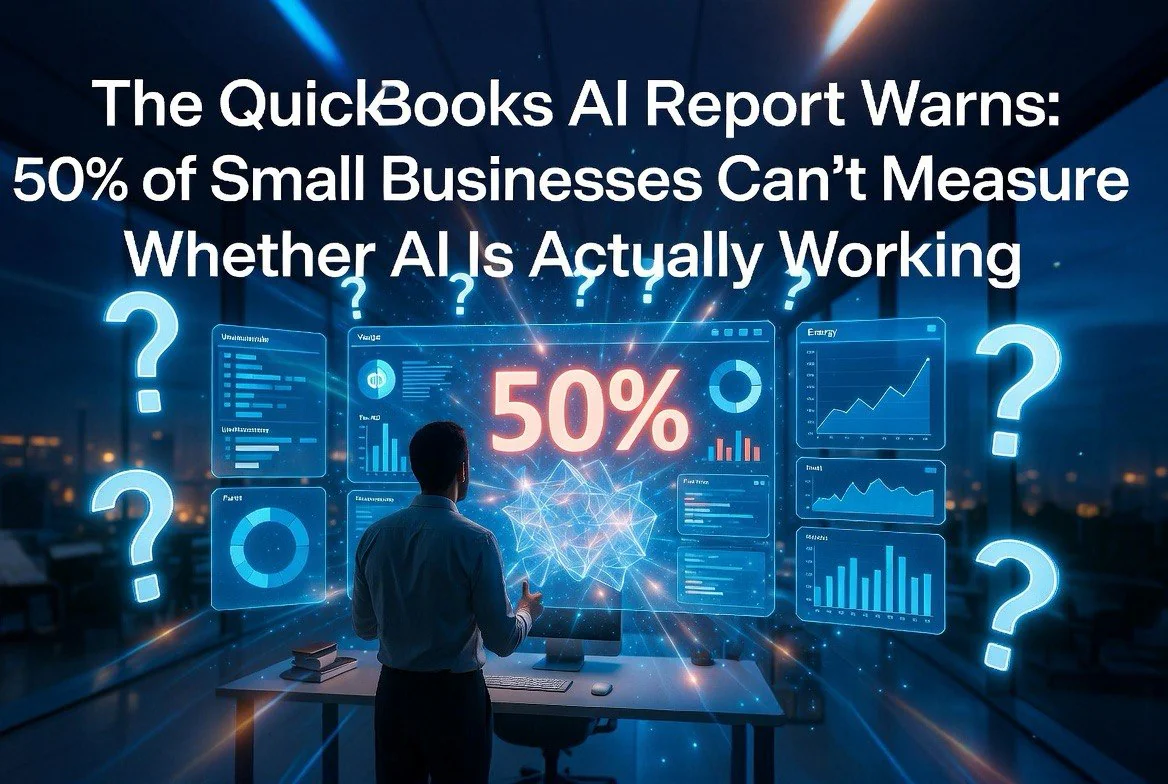
The QuickBooks AI Report Warns: 50% of Small Businesses Can’t Measure Whether AI Is Actually Working
⚡ Expert Summary: A new Intuit QuickBooks AI Impact Report—surveying 34,000 small businesses in partnership with the University of Chicago—reveals that 77% of SMBs now use AI regularly, up from 48% in 2024. But here’s the catch: over 50% of businesses can’t actually measure whether their AI investments are paying off. They rely on vague feelings of improvement rather than tracked metrics like time baselines, revenue attribution, or conversion rates. With global AI spending projected to hit $2.52 trillion in 2026, this measurement gap is a ticking time bomb for business owners who are spending money without knowing their real return.
The numbers coming out of the 2026 Intuit QuickBooks AI Impact Report sound like a victory lap for artificial intelligence adoption. On paper, they’re stunning: 77% of small businesses now use AI on at least a regular basis, 41% report revenue increases they attribute to AI, and 74% say their productivity has improved.
But Forbes business technology analyst Teri Dawn DeBoe took a closer look at the fine print, and what she found should make every business owner pause before signing another AI subscription.
“When the researchers asked about how businesses were measuring the improvements from these gains, the answers became quite vague,” DeBoe wrote in her May 29 analysis. “More than 50% stated a general feeling that their business was better. Less than half of respondents reported tracking specific metrics.”
This isn’t just a statistic. It’s a warning sign that small businesses are pouring money into AI tools without the infrastructure to know if that money is well spent. With global AI spending projected to hit $2.52 trillion in 2026 according to Gartner, a large portion of that investment is going in blind.
The Measurement Problem: Why Most Businesses Can’t Track AI Results
The report, conducted in partnership with the University of Chicago, surveyed 34,000 small businesses across the United States. On the surface, the adoption numbers are genuinely impressive. The jump from 48% to 77% regular AI usage in under two years represents one of the fastest technology adoption curves in small business history.
But the study’s methodology reveals a deeper issue. The productivity numbers were based on self-reporting, not controlled time studies. Revenue attributed to AI was based on correlation, not controlled measurement. When business owners said AI was working, they often couldn’t point to what “working” actually meant.
The problem breaks down into two fundamental issues:
1. Missing Baseline Data
Most small businesses don’t have baseline data for the tasks they’re handing off to AI. How long does it actually take a human to write a product description? What’s the average conversion rate on a human-written email campaign? Without these baselines, there’s simply no way to measure whether AI is saving time or improving outcomes.
This isn’t a technology problem. It’s a measurement problem. The AI isn’t failing. The system around the AI is failing.
2. Attribution Confusion
Even when results improve, businesses struggle to assign credit. If you deploy an AI system for customer emails and also hire a new salesperson during the same period, how do you know which change drove increased revenue? Seasonality, market shifts, competitor moves — all of these factors muddy the water.
For a business to accurately measure AI ROI, it needs controlled experiments or at minimum clear attribution models. Most small businesses have neither.
The U.S. Chamber Weighs In: 58% Using Generative AI
Separate data from the U.S. Chamber of Commerce reinforces the trend. Their research shows 58% of small businesses are now using generative AI tools, with 93% expecting business growth in 2026. But the Chamber also notes that most businesses are still in early integration stages and need more training to fully harness the technology.
Goldman Sachs released similar findings earlier in 2026, showing high positive impact reports from SMBs but again emphasizing that most businesses lack the frameworks to systematically evaluate their AI investments.
The pattern across all three major surveys is consistent: adoption is real, and reported satisfaction is high, but the rigor behind those satisfaction numbers is questionable.
The QuickBooks AI Features: A New Way to Track
Interestingly, the report itself comes from Intuit — the company behind QuickBooks, which has been aggressively embedding AI features into its platform. The company is promoting AI-powered bookkeeping, automated categorization, financial insights, and cash flow forecasting as tools that can help businesses do more with less.
This creates a bit of a circular dynamic. The company selling AI tools is also publishing the report showing those tools are being adopted. But the University of Chicago partnership adds academic credibility, and the measurement findings are actually counterproductive to Intuit’s marketing — they essentially tell customers they need to be more rigorous about tracking results.
That honesty is worth noting. Intuit could have buried the measurement gap. Instead, they highlighted it, and Forbes ran with it.
What This Means for Your Business Right Now
If you’re a small business owner who’s already invested in AI tools, the key takeaway isn’t that you should stop using them. It’s that you should start measuring them.
Here’s what the data suggests you need to do this week:
Establish baselines. Before you hand any recurring task to AI, time how long it takes a human to complete it. Track the output quality. Measure the conversion rate. You need a before number to compare against an after number.
Run controlled tests. If possible, split your workflows. Use AI for half your email campaigns and humans for the other half. Compare results over a meaningful period — not a single send, but a month or a quarter.
Track cost-per-outcome. Your AI subscriptions cost real money. Don’t just ask “is this tool good?” Ask “does this tool deliver results cheaper than my alternatives?” The answer changes how you budget.
Audit your AI stack quarterly. The 77% adoption number cuts both ways. If everyone’s using AI, it’s no longer a competitive advantage by itself. It’s table stakes. The advantage goes to the businesses that use it smarter, not just more.
Real-World Examples of the Measurement Gap
To understand why the measurement gap matters in practice, consider three common scenarios that played out across the businesses surveyed:
The Email Campaign Case. A retail business deployed ChatGPT to write weekly promotional emails. Revenue went up 12% in the first quarter. The owner attributed the gain to AI and expanded the tool’s use across all marketing. What they didn’t track: they’d also launched a new product line with better margins, Facebook had updated its algorithm to favor their content, and a competitor had gone out of business. When they later paused the AI email tool, revenue stayed flat. The AI wasn’t driving the increase — it was just running alongside real growth drivers.
The Customer Service Bot Case. A service business installed an AI chatbot to handle common customer questions. Average response time dropped from 4 hours to 30 seconds. The owner declared it a win and paid for the annual plan. What they didn’t track: customer satisfaction scores actually dropped 8% because the bot couldn’t handle nuanced questions, and those customers were routed back to humans anyway — just slower than before. The faster response numbers looked good on paper but masked a worse experience.
The Content Production Case. A consulting firm started using AI to draft blog posts and social media content. Output volume tripled. Impressions went up 200%. The owner was thrilled. What they didn’t track: engagement rate on AI-generated content was 60% lower than human-written content. More content was reaching fewer engaged readers. The vanity metrics looked great. The business metrics didn’t.
These aren’t hypothetical scenarios from a consultant’s playbook. They’re the exact patterns the QuickBooks report’s fine print reveals at scale. When the researchers dug into the data, they found that the productivity and revenue gains reported by businesses often evaporated under closer examination — not because the AI didn’t work, but because the businesses had no framework to separate AI impact from everything else happening in their operation.
Forrester Research has been warning about this since early 2026, predicting that 55% of AI projects would fail to deliver measurable ROI. The prediction didn’t age well in terms of scale — adoption is higher than Forrester expected — but the warning about measurement remains prescient.
How the Measurement Gap Skews AI Spending
The lack of measurement creates a dangerous feedback loop. When businesses can’t measure whether AI is working, they default to one of two extremes: either they assume it’s working (because they want it to) and keep spending, or they assume it’s not (because they can’t see results) and pull the plug prematurely.
Both extremes are costly. The overspenders pile onto monthly subscriptions for tools that may be delivering marginal or negative returns. The underspenders abandon tools that could genuinely move the needle — they just didn’t know how to check.
The survey data suggests most businesses fall into the first camp. With 77% adoption and global spending projected to hit $2.52 trillion, the default assumption appears to be that more AI equals better business. The researchers found that businesses with higher AI adoption rates also reported higher satisfaction — but those satisfaction scores correlated more strongly with overall business optimism than with specific metric improvements.
In other words, the businesses that were already doing well tended to adopt more AI and report positive results. The businesses that were struggling adopted less AI and reported less satisfaction. The AI may have been a contributor to success, or it may have been a symptom of it.
The report can’t tell the difference. And because most businesses aren’t tracking, neither can they.
The Bottom Line
The QuickBooks AI Impact Report is one of the most important data points on small business AI adoption we’ve seen in 2026. The headline numbers are impressive. The subtext is sobering.
Small businesses are adopting AI at record rates. They’re reporting good results. But most of them can’t prove those results. In an era where global AI spending will hit $2.5 trillion, the businesses that build measurement systems alongside their AI tools will be the ones that actually capture the value.
Everyone else is just paying to feel productive.
Frequently Asked Questions
How many small businesses actually measure AI results?
According to the QuickBooks AI Impact Report, fewer than 50% of small businesses track specific metrics to measure AI performance. Most rely on general feelings of improvement rather than controlled data.
What metrics should I track for AI performance?
Key metrics include time saved per task (with human baseline data), output quality scores, conversion rates for AI-generated vs. human-generated content, error rates, and cost-per-outcome comparisons against both human workers and alternative tools.
Is the QuickBooks AI Impact Report reliable?
The report was conducted in partnership with the University of Chicago and surveyed 34,000 small businesses across the U.S., making it one of the largest studies of its kind. However, as Forbes noted, the measurement methodology relies heavily on self-reporting rather than controlled experiments.
What percentage of small businesses use AI in 2026?
The QuickBooks report found 77% of small businesses use AI on at least a regular basis, up significantly from 48% in mid-2024. The U.S. Chamber of Commerce reports 58% using generative AI specifically.
How can I set up baseline measurements for AI?
Start by tracking time and output quality for human-performed tasks before introducing AI. Use split testing (AI vs. human for the same workflow) where possible. Establish clear KPIs for each task and measure before and after AI implementation with at least 30 days of data.
What AI tools can help me measure ROI?
Tools like QuickBooks’ own AI analytics, Google Analytics 4’s attribution modeling, HubSpot’s AI-powered reporting, and Zapier’s task tracking integrations can provide baseline data. The key is setting up measurement before you deploy the AI, not after.
How often should I audit my AI tools?
At minimum, quarterly. Monthly is better for tools you use daily. The audit should review cost per tool, time saved (with evidence), output quality compared to alternatives, and whether the tool is still solving the problem you bought it for.
Barak Schurr built and sold a major ticketing platform, ran global nightlife operations at Eventbrite, and now spends his time figuring out which AI tools actually move the needle for independent business owners — and which ones are just noise. No hype. No fluff. Just what works.
More AI Resources for Your Business