Get The Solo Business OS — Free
The AI workflow that replaces a part-time employee for solo operators and small business owners.
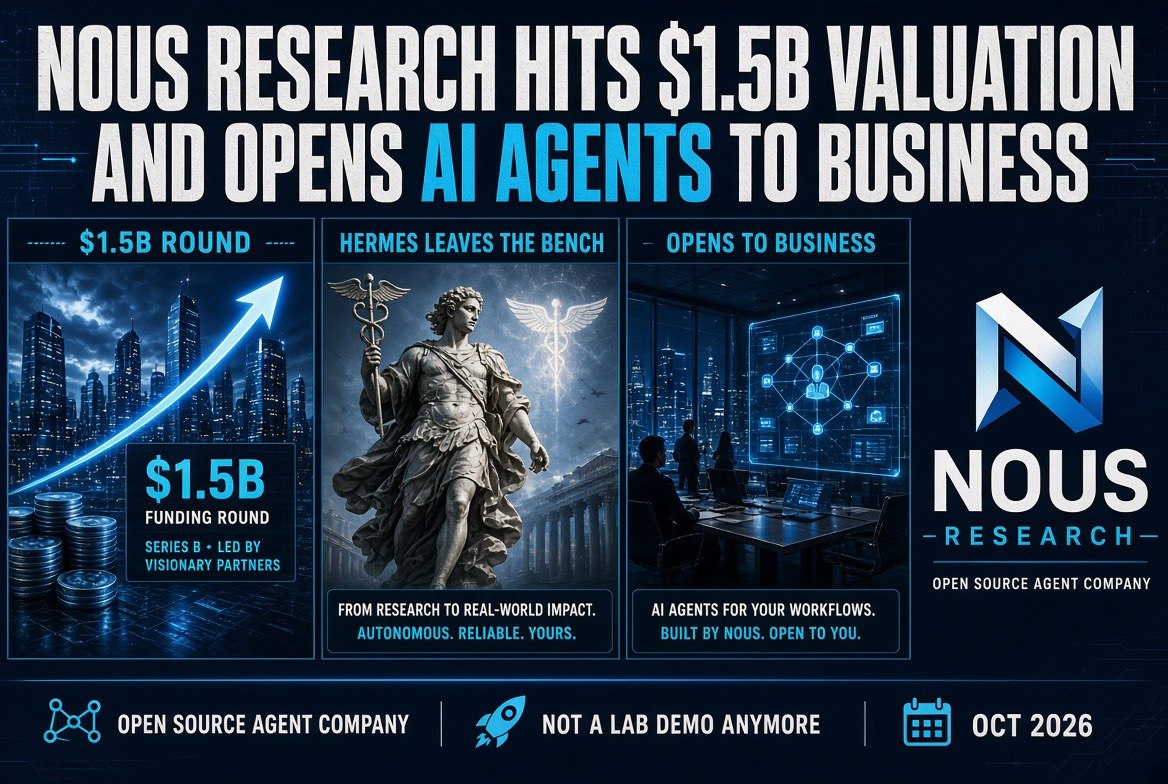
Nous Research Hits $1.5B Valuation and Opens Its AI Agents to Business
⚡ Expert Summary: Nous Research — the open-source lab behind the Hermes Agent — confirmed a $90 million Series B at a $1.5 billion valuation and launched Hermes for Businesses on October 7, 2026. The company reports roughly $36 million in annualized revenue and expects to pass $100 million before year-end. It is the clearest signal yet that open-weights AI has a real commercial ladder, not just a community.
An open-source AI lab just confirmed a $1.5 billion valuation and, in the same announcement, started selling to businesses. If you run a company, that combination matters more than the number.
Nous Research announced a $90 million Series B on October 7, 2026, led by Robot Ventures, with participation from Nvidia, Union Square Ventures, Menlo Ventures, Samsung, and 1789 Capital. The round confirms an earlier TechCrunch report and brings the three-year-old startup to $158 million in total funding.
The part worth your attention is not the valuation. It is what the money is for: a push into the enterprise with Hermes for Businesses, a product that lets companies deploy customized AI agents that run multi-step workflows while keeping their data private.
What Nous Research Actually Built
Nous is not a new name in open-source AI. The Hermes Agent has been cloned more than 24 million times, and the company estimates its models drive roughly 2.5% of global AI token usage — a figure it reports itself and which should be treated as a vendor claim until independently verified.
The revenue trajectory is the more useful number. According to reporting from The Wall Street Journal, Nous was at roughly $36 million in annualized revenue by mid-September 2026 and expects to pass $100 million before the end of 2026.
That is not a research lab looking for a business model. That is a company that found one.
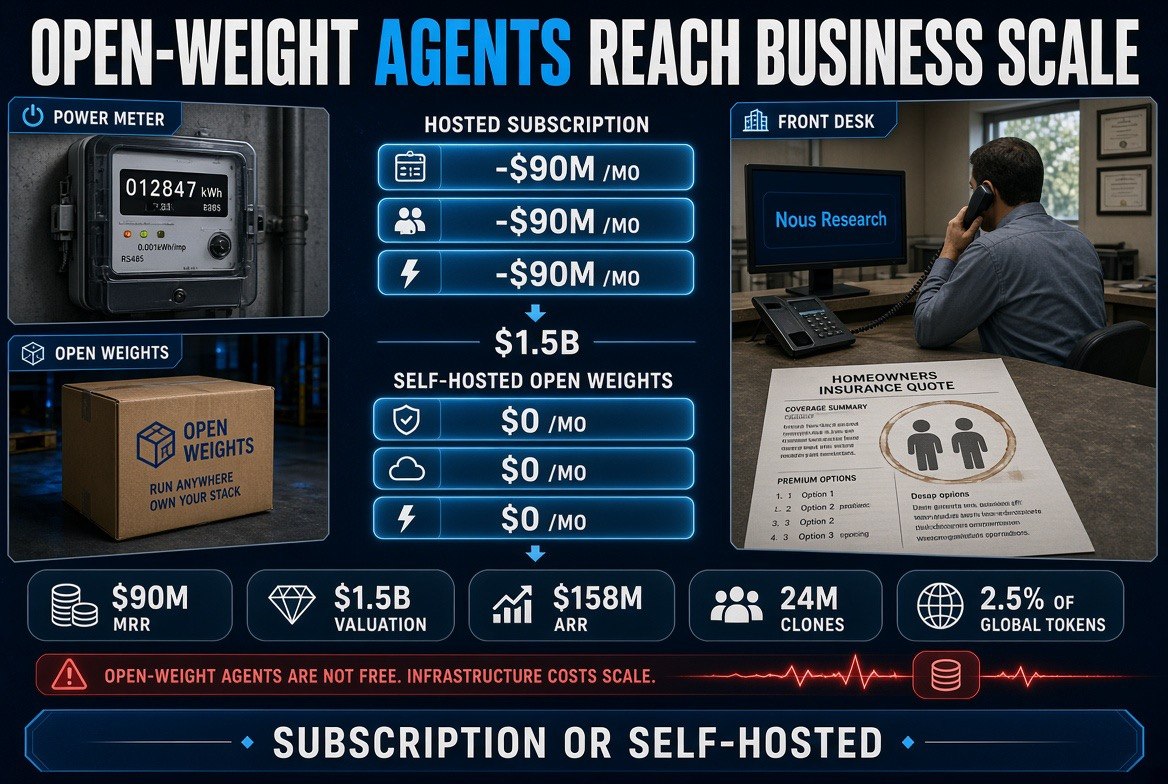
Hosted subscription versus self-hosted open weights: the cost and capability gap an operator actually has to price out.
Why an Open-Source Lab Going Commercial Matters to Operators
For most of the last three years, the practical AI choice for a small business has been between a handful of closed platforms. You get strong models, a clean interface, and no control over where your data sits or what the tool costs next quarter.
Open-weights models changed the technical picture without changing the purchasing picture. Downloading a model is not the same as having a vendor who will support it, secure it, and take a call when something breaks at month-end close.
Hermes for Businesses is an attempt to close that gap. The pitch is straightforward: customized agents that handle multi-step workflows, deployed with the customer’s data staying private.
If that holds up in practice, it gives operators a third option — not a chatbot subscription, not a full enterprise platform contract, but a deployable agent stack built on open foundations.
Open-Weights Agent Versus Closed Platform Agent
The honest comparison for a small operator is not model quality. It is control, cost predictability, and what happens when the relationship ends.
| Factor | Open-Weights Agent (Nous-style) | Closed Platform Agent |
|---|---|---|
| Data residency | Can sit in your own environment. | Vendor-controlled by default. |
| Pricing risk | Lower — you can run it yourself. | Subscription can be repriced any time. |
| Setup effort | Higher — integration is on you. | Lower — managed end to end. |
| Support | Improving, but thinner than enterprise SLAs. | Mature, contracted, expensive. |
| Exit path | Keep the weights, keep the system. | Rebuild from scratch. |
For a business under fifty people, the deciding factor is usually the third row. Open-weighs agents are cheap to own and expensive to set up. Closed agents are the reverse. Which one wins depends entirely on whether you have someone technical in the room.
What Hermes for Businesses Has to Prove
Every agent platform launching in 2026 makes the same three promises. Here is what separates a real product from a press release, and where Nous currently stands.
| Promise | What “Working” Looks Like | What to Watch For |
|---|---|---|
| Multi-step workflows | Agent completes a full process end to end. | Silent failure in the middle steps. |
| Data privacy | Your data stays in your environment. | Telemetry and logging by default. |
| Customization | Tuned to your process, not a template. | “Custom” means prompt engineering. |
| Cost at scale | Predictable per-task cost you can model. | Token spend that creeps up quietly. |
The open-source lineage is an advantage here. Twenty-four million clones means the failure modes are documented in public, by people who did not have a marketing reason to hide them.
What This Means for Small Business Owners
Nothing about this announcement requires you to act this week. It does change the shape of the decision you will be making over the next twelve months.
First, the open-weights option is now commercially supported. The reason most operators avoided it — no vendor, no support, no accountability — is being addressed by exactly this kind of round.
Second, pricing pressure is coming to the closed platforms. When a viable open alternative is funded and shipping, subscription prices stop floating upward unchecked.
Third, the integration cost is now the real question. Every agent platform, open or closed, requires someone to map your actual processes into something a model can execute. That work is not going away, and it is the single biggest predictor of whether AI saves you money or costs you more.
The realistic move for a business under fifty people is not to migrate anything. It is to pick one multi-step process you already document — invoice approval, onboarding, weekly reporting — and test whether an agent platform can execute it end to end. That test costs you a week and tells you more than any vendor evaluation will.
The Broader Read
Nous Research’s round is the clearest evidence yet that the open-weights ecosystem has a commercial path. The labs that treat open models as a loss leader and the labs that treat them as a product are now competing for the same enterprise budget.
For operators, that competition is good news regardless of which side wins. More vendors means more pressure on price, more integration options, and more reason for every platform to actually solve your process instead of assuming you will change yours to fit the software.
If you want the wider context on how these systems fit into an operating stack, AI Table Review covers vertical-specific deployments in restaurants, and AI Video Advisor tracks the content generation side of the same market.
The primary source for this story is TechCrunch’s report on the Nous Research Series B. Revenue figures attributed to reporting by The Wall Street Journal should be treated as vendor-reported.
The Numbers Behind the Round
Four figures tell the story better than the headline valuation does, and each one points at a different part of the business.
$90 million raised. The Series B was led by Robot Ventures, with Nvidia, Union Square Ventures, Menlo Ventures, Samsung, and 1789 Capital participating. Nvidia’s presence on that list is the detail worth noticing — the company selling the compute is also placing a bet on the layer above it.
$158 million total. That is everything the three-year-old company has raised across its life. For a lab built on open weights, it is a fraction of what the closed frontier labs have burned to reach comparable adoption.
24 million clones. The Hermes Agent has been downloaded and cloned more than 24 million times, per the company. That number matters because it is a distribution channel no amount of marketing spend can buy.
$36 million to $100 million. Annualized revenue was roughly $36 million by mid-September 2026, with the company expecting to pass $100 million before the end of the year, according to Wall Street Journal reporting. A near-tripling inside one quarter is either a genuine inflection or an aggressive projection. Time will settle which.
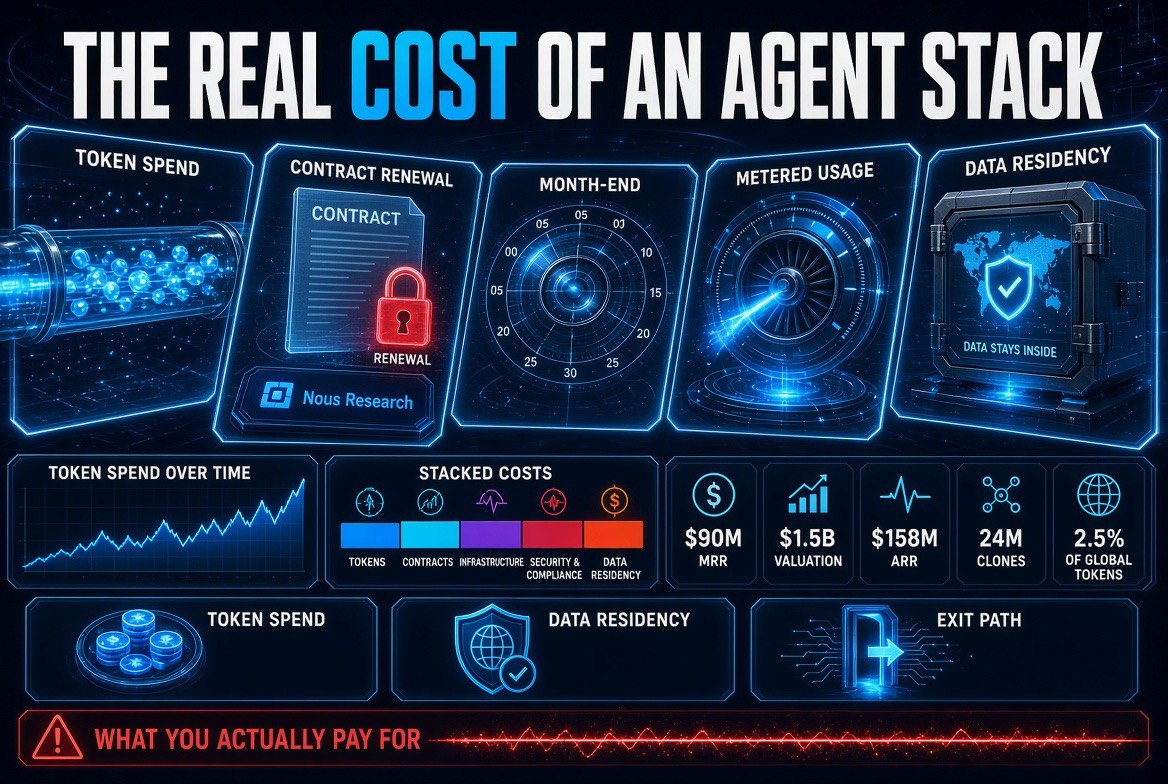
Token spend, renewal terms and data residency: the three lines that decide your real monthly number.
Where the Agent Market Is Actually Heading
Three years into the current wave, the market has sorted into three layers, and every operator buying AI is eventually writing a check into one of them.
The model layer is where the frontier labs compete. It is capital-intensive, it is consolidating, and a small business will never interact with it directly.
The platform layer is where the agents live — the systems that take a model and wrap it in a workflow, a memory, and a set of tools. This is where Nous just planted a flag with Hermes for Businesses.
The application layer is what most small businesses actually buy: a scheduling tool, an invoicing tool, a support widget. It is where the money is closest to the customer and the differentiation is thinnest.
The interesting move in this announcement is a platform-layer company pushing down toward applications by selling directly to businesses. That is the same play every infrastructure vendor makes once its core product matures — and it is usually the moment the pricing for everyone below starts to compress.
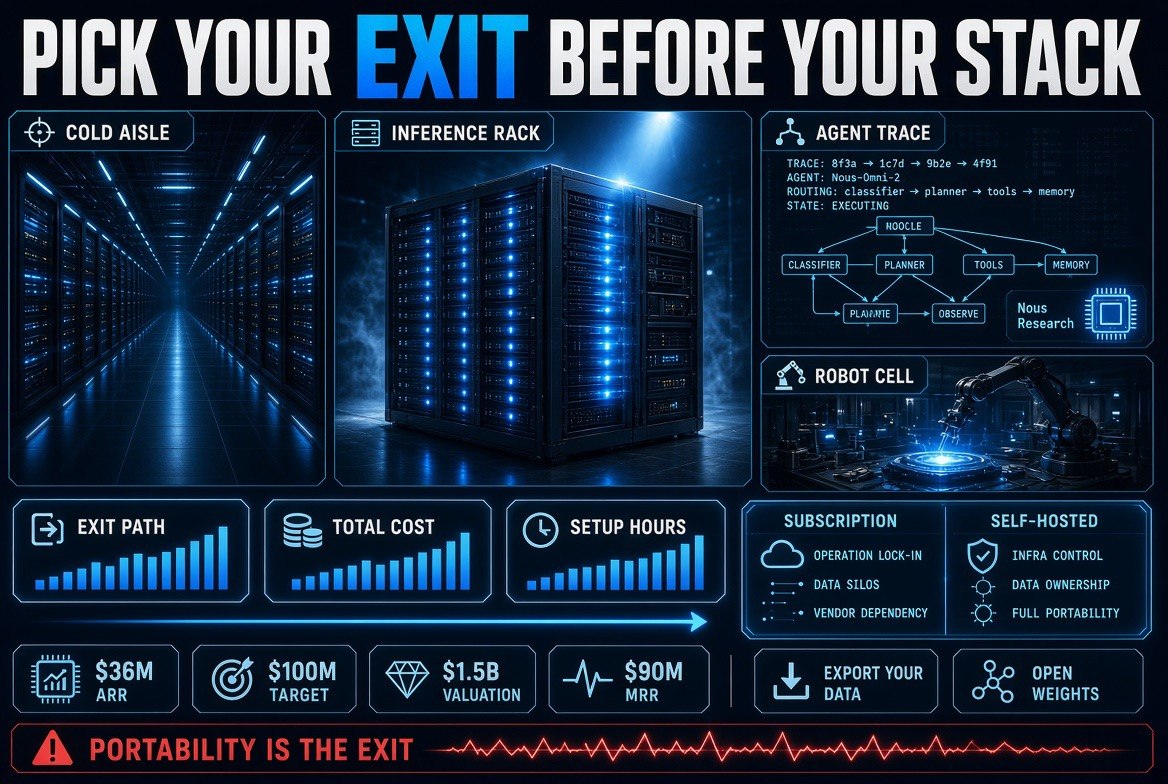
Portability is the exit: what your data can do the day you leave decides what your stack is worth today.
What to Do With This Information
Four practical actions, in the order they make sense for a business under fifty people.
Map one process. Pick the multi-step workflow you already document — invoice approval, vendor onboarding, weekly reporting — and write down every step, every decision point, and every place a human currently has to intervene.
Test an agent against it. One process, one platform, two weeks. Do not buy anything until you have watched an agent attempt the workflow end to end and seen exactly where it fails.
Ask where the data sits. This is the whole reason an open-weights option exists. If the answer to “where does my data live” is vague, the privacy advantage is marketing rather than architecture.
Model the exit. Ask what happens to your workflow if you stop paying. With an open-weights stack you keep a running system. With a closed platform you start over. That difference is worth real money and almost nobody prices it.
None of this requires urgency. It requires a Tuesday afternoon and a written list.
Frequently Asked Questions
Is Nous Research a small business AI company?
Not exclusively. Nous Research is an open-source AI lab best known for the Hermes Agent, and it has just launched Hermes for Businesses aimed at companies that want customizable agents running multi-step workflows with their data kept private. The tools are usable by small operators, but the company’s commercial focus is broader than the small business market.
What is an open-weights AI agent?
An open-weights agent is built on a model whose parameters are publicly available, so it can be downloaded, run on your own infrastructure, and customized without depending on a vendor’s servers. The practical benefit is control over data and cost — you can run it yourself. The practical cost is that integration and maintenance become your responsibility.
Should a small business switch to an open-source AI agent right now?
Not as a wholesale migration. The sensible move is to select one documented, multi-step process — invoice approval, onboarding, weekly reporting — and test an agent platform against it end to end. That test takes about a week and tells you whether the integration work is worth doing before you commit budget to it.
Why did Nous Research get a $1.5 billion valuation?
The round reflects revenue trajectory and adoption rather than a completed product cycle. The company reports roughly $36 million in annualized revenue as of mid-September 2026 and expects to pass $100 million by year-end. Investors including Nvidia, Menlo Ventures, and Union Square Ventures participated in the $90 million Series B.
Does this change how much AI tools will cost for businesses?
It should apply downward pressure over time. When a funded, supported open alternative exists, closed platforms lose the ability to raise subscription prices without justification. That effect shows up in pricing negotiations over the following twelve to twenty-four months, not immediately.

About Barak Schurr
Barak Schurr built and sold a major ticketing platform, ran global nightlife operations at Eventbrite, and now spends his time figuring out which AI tools actually move the needle for independent business owners — and which ones are just noise. No hype. No fluff. Just what works.
Email: [email protected]
More AI Resources for Your Business