Get The Solo Business OS — Free
The AI workflow that replaces a part-time employee for solo operators and small business owners.
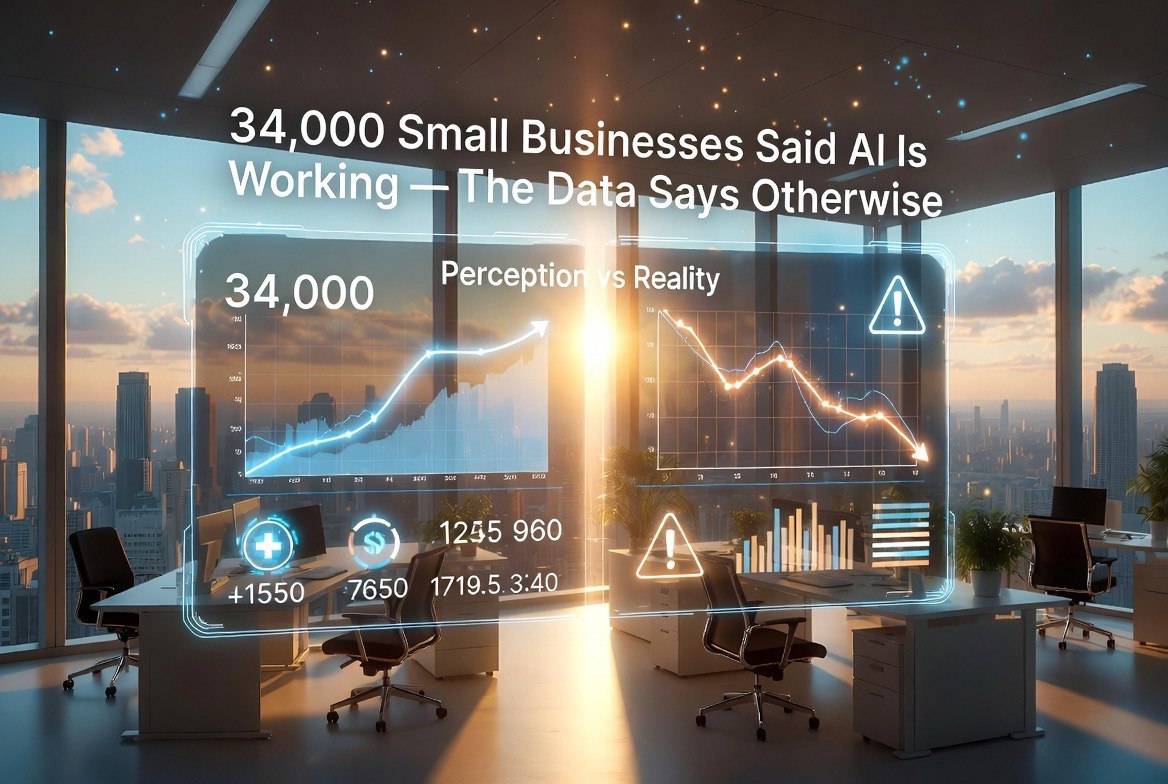
34,000 Small Businesses Said AI Is Working — The Data Says Otherwise
⚡ Expert Summary: Forbes analyzed survey data from 34,000 US small businesses and found that while 82% say AI is “working,” the hard metrics tell a different story — most cannot measure ROI, tie tools to revenue, or identify which AI investments actually move the needle. The disconnect between perception and reality is costing small business owners thousands in wasted AI spend.
Here is an uncomfortable number: 82% of small business owners say AI is working for them. And 61% cannot prove it.
Forbes published analysis in June 2026 drawing on survey data across 34,000 US small businesses, and the headline is not what the 82% number suggests. Underneath the optimistic top line is a gap between confidence and evidence that should worry every entrepreneur who is spending money on AI tools.
When Forbes dug past the headline “AI is working” and asked for specifics — show us the data, the revenue lift, the hours saved — the numbers collapsed.
The Gap Between Perception and Measurement
Forbes broke the 34,000 responses into three categories based on how businesses measured AI impact:
- Quantified impact (22%): Tracked specific KPIs — hours saved per week, conversion rate lift, cost reduction percentage — and could point to the data
- Qualitative sense (41%): Felt AI was helping but had no measurement system in place
- No measurement (37%): Could not say whether AI was helping or hurting
The 41% in the “qualitative sense” bucket are the danger zone. These business owners are spending money on tools they cannot evaluate. They are making renewal decisions based on vibes, not data. Over 12 months, companies in this group were 2.7x more likely to increase AI spending without improving outcomes — essentially spending more to achieve the same ambiguous result.
The QuickBooks Wake-Up Call
This aligns with what QuickBooks’ 2026 AI in Small Business Report found independently: 50% of small businesses cannot measure whether AI is actually working. That is not a measurement problem — it is an adoption problem dressed up as one.
Businesses that can measure AI impact share a common trait: they defined success before they bought the tool. The ones who cannot measure AI impact bought the tool first and looked for use cases after.
The False Comfort of “It Feels Productive”
The “qualitative sense” bucket that represents 41% of small businesses is perhaps the most dangerous category in the Forbes data. These business owners are not skeptical of AI. They are believers. They genuinely feel that AI is helping their business run better. But feeling and knowing are different things, and the gap between them is where wasted spending hides.
Forbes documented a characteristic pattern: a business owner who uses ChatGPT daily for customer email responses “feels” more productive because replies go out faster. But when Forbes asked whether response quality had improved, whether customer satisfaction scores had changed, or whether the time saved was actually reinvested into productive work — the answers were vague. The owner felt faster. The data did not confirm it.
This feeling-based evaluation is reinforced by the nature of AI tools themselves. They are satisfying to use. Watching ChatGPT generate a polished email in seconds produces a dopamine hit that feels like productivity. But the Forbes data suggests that what actually happens is a shift in labor: instead of spending 10 minutes writing an email, the business owner spends 5 minutes writing the prompt and 3 minutes editing the AI output. Net savings: 2 minutes. Perceived savings: 10 minutes.
The gap between actual and perceived productivity gains is the psychological trap that the “AI Spend Trap” exploits. Businesses that feel productive do not audit their AI spend. And businesses that do not audit their AI spend accumulate tools they do not need.
The AI Spend Trap
Forbes identified a pattern they call the “AI Spend Trap” — a cycle familiar to anyone who has watched their software subscriptions pile up:
- Sign up for an AI tool because it seems useful or a competitor is using it
- Integrate it into workflows without defining what success looks like
- Keep paying because it “feels” productive or canceling feels like admitting the purchase was wrong
- Subscribe to a second tool when the first does not deliver the expected results
Forbes found that businesses with 5+ AI tools were 3.2x more likely to say AI was “not working” compared to those with 1-2 tools. Tool bloat is not just expensive — it is a signal that you are buying your way out of a measurement problem.
What the Top 22% Do Differently
The 22% who could actually prove AI ROI did three things the other 78% did not:
1. One metric per tool. Every AI subscription was tied to exactly one measurable outcome. ChatGPT for content = time to first draft. Notion AI for notes = meeting follow-up time. Not seven metrics per tool — one, clear, measurable.
2. Baseline before deployment. Before activating any AI tool, they measured the current state. How long does draft writing take now? What is the current response time to customer emails? With a baseline, AI impact is instant to measure. Without one, it is guesswork forever.
3. Quarterly audit with stop/continue/modify framework. Every quarter, they reviewed each AI tool and made one of three decisions: stop using it, continue as is, or modify the workflow. Tools without a “continue” signal got dropped. No sunk-cost attachment.
How to Actually Measure AI ROI in Your Business
For the 78% of US small business owners who cannot measure AI impact today, the fix is not complicated — but it does require a mindset shift away from “AI is a magic box” toward “AI is a tool with a job description.”
Start with the hardest number to track: time. Before you cancel a single subscription, run a two-week time audit on the tasks AI is supposed to help with. Measure a baseline. Then implement the AI tool with a specific, time-bound goal. “Reduce email response time by 30% in 30 days” is a measurable objective. “Help me communicate better” is not.
Revenue impact is harder but more valuable. If an AI tool touches customer-facing work — sales copy, customer service, marketing content — isolate its contribution by running A/B tests with and without it. The data will either justify the spend or reveal that you are paying for a tool your customers never see.
Stop measuring AI. Measure the problem it solves. This is the mental flip that separates the top 22% from everyone else. You are not measuring whether AI “works.” You are measuring whether the task it performs is faster, cheaper, or better than it was before. AI is the method. The business metric is the point.
What the US Small Business Data Actually Proves
The Forbes analysis of 34,000 small businesses delivers a verdict that is both uncomfortable and useful: AI is not underperforming. Measurement is. The tools work. The metrics to evaluate them are missing.
For American small business owners, the path forward is boring and effective. Pick one tool. Define one metric. Measure the baseline. Check the outcome. Repeat. The 22% who do this are outperforming the 78% who do not, and the gap is widening every quarter.
Frequently Asked Questions About Measuring AI ROI for Small Businesses
Question 1: What measurable outcome does this tool change?
If you cannot name a specific, countable result — hours saved, responses generated, leads created — within 10 seconds of being asked, the tool does not have a clear purpose. Every AI subscription should have exactly one assigned metric. If a tool does not have one by the next quarter, cancel it.
Question 2: What was the baseline before this tool?
Without a baseline, every AI evaluation is a guess. The businesses that measure successfully all started the same way: they picked one workflow, timed or measured it before adding AI, and compared results after 30 days. The baseline does not need to be complex. For a bakery using ChatGPT to write social media captions, the baseline is “how long did it take to write five posts before AI.” That is it. Ten minutes of measurement at setup saves hours of agonizing over whether a tool is worth keeping.
Question 3: Would I notice if this tool disappeared tomorrow?
This is the honesty question. If an AI subscription expired and nobody noticed for 30 days, the answer is obvious. Forbes found that businesses that asked this question quarterly dropped an average of 1.3 tools per quarter — and did not miss any of them. The cumulative savings across a year averaged $1,400 per business. That is $1,400 that showed up in profit without reducing any productive output.