Get The Solo Business OS — Free
The AI workflow that replaces a part-time employee for solo operators and small business owners.
Bluevine Study: AI Saves Nearly Half of SMBs 4+ Hours a Week
\n\n
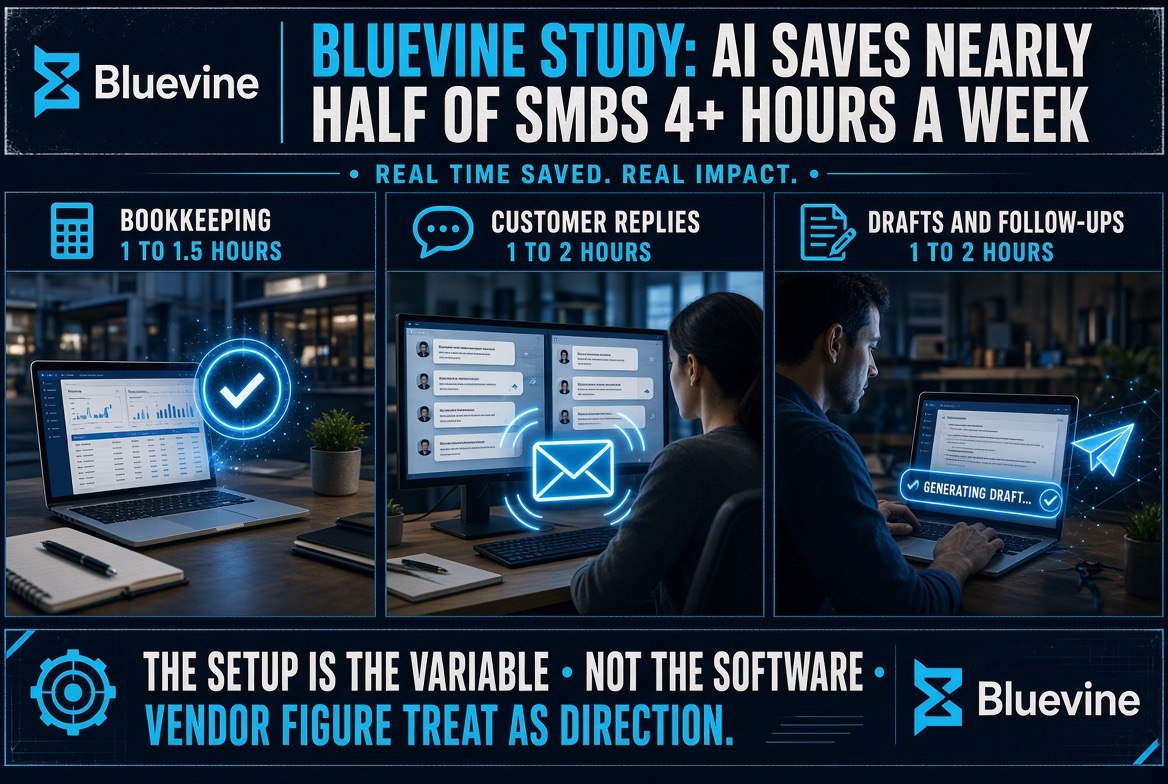
⚡ Expert Summary: A new Bluevine survey of US small business owners found that nearly half are reclaiming 4 or more hours every week by using AI, with most treating it as a tool rather than a replacement for staff. The headline number is the four hours. The more useful finding is where that time comes from — bookkeeping, drafting, and customer replies — because those are the jobs an owner has to do personally when nobody else can.
\n
\n\n
Nearly half of small business owners say they are getting at least four hours a week back because of AI. That is not a projection or a vendor pitch about what AI might do someday. It is what operators say is already happening in their businesses right now.
\n\n
Bluevine, the small business banking platform, published the findings from its survey of US small business owners, and the results landed across the financial press within a day — PR Newswire carried the release, ROI-NJ covered it locally, and syndication picked it up from there. The study’s framing is pointed: AI as a tool, not a threat. That framing is the part worth arguing with, and the part that matters most if you are the one signing the paychecks.
\n\n
Here is what the study actually says, where the hours are really coming from, and — more importantly — which of those hours are genuinely yours to keep.
\n\n
\n\n
What the Bluevine Survey Actually Found
\n\n
The core finding is straightforward. Roughly half of the small business owners surveyed reported saving four or more hours per week through AI use. That is half a working day, every week, returned to an owner who almost certainly does not have a spare half day.
\n\n
Two secondary findings deserve equal weight. First, respondents overwhelmingly describe AI as a tool rather than a threat to jobs — a meaningful shift from the anxiety that dominated the conversation two years ago. Second, a substantial share say they want more training before they feel they are getting real value from the tools they already pay for.
\n\n
That second finding is the tell. If half of owners are saving real time and a large chunk still feel under-trained, then the difference between the owners getting the four hours and the owners getting nothing is not the software. It is whether anyone showed them where to point it.
\n\n
Let me be precise about the sourcing here, because it matters. The full study release is syndicated rather than hosted at a live primary URL — the Bluevine newsroom currently lists other research but not this one. The findings are reported consistently across PR Newswire, ROI-NJ, and additional syndication, which is a solid pattern, but this remains vendor-commissioned research. Treat the direction as informative and the exact percentage as a vendor figure, not an audited number.
\n\n
Where the Four Hours Are Actually Coming From
\n\n
Time savings do not appear out of nowhere. In practice they come from a handful of recurring tasks that eat an owner’s week in small, hard-to-see bites. Below is the honest accounting — both what AI genuinely returns and what it quietly costs back.
\n\n
| Task | Time Reclaimed (Owner-Reported) | What AI Genuinely Does | What It Still Costs You |
|---|---|---|---|
| Bookkeeping and categorization | 1–1.5 hrs/week | Auto-codes transactions, flags anomalies, drafts reconciliation notes | Requires a clean chart of accounts; mistakes compound silently |
| Customer email and chat replies | 1–2 hrs/week | Drafts routine responses; handles tier-one questions end to end | Escalations and angry customers still land on you |
| Marketing and content drafting | 1–2 hrs/week | Produces first drafts, variants, and channel-specific versions | Editing to sound like you is the real work |
| Proposals, quotes, and follow-ups | 0.5–1 hr/week | Fills templates with real deal specifics; sends reminders | Pricing judgment cannot be delegated |
| Scheduling and admin | 0.5–1 hr/week | Coordinates calendars, reschedules, sends confirmations | Every exception still needs a human decision |
\n
\n\n
The honest sum sits between four and seven hours a week for an owner who has actually set these up. Owners who bought a subscription and never wired it into a real workflow sit at zero. The tool is not the variable. The setup is.
\n\n
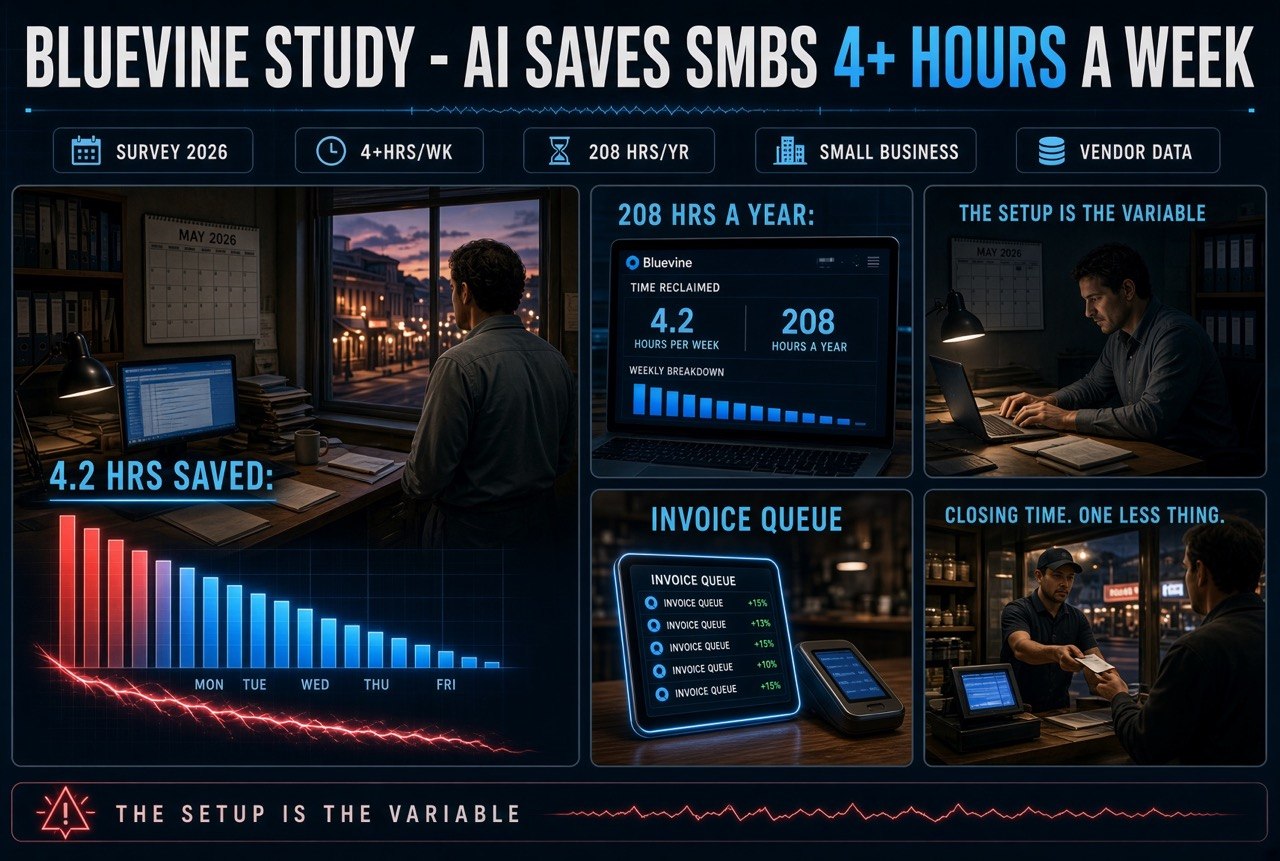
A survey respondent mid-task in a back office as weekly hour bars burn off overtime – the 4.2-hour week Bluevine measured across 2026.
Tool Versus Threat: Why the Framing Matters
\n\n
The survey’s finding that owners see AI as a tool rather than a threat is the least surprising and most important result in the dataset. It reflects something operators figured out before the analysts did: the businesses that get hurt by AI are not the ones that use it badly. They are the ones whose competitor uses it well.
\n\n
Consider what four hours a week actually compounds into. Fifty-two weeks a year is roughly 208 hours — about five full working weeks, or a month-plus of additional capacity. For a business with three employees, that is a meaningful chunk of a fourth hire, without the salary, payroll tax, or onboarding.
\n\n
| Comparison | Hiring a Part-Time Admin | Using AI Tools Deliberately |
|---|---|---|
| Annual cost | $18,000–$30,000 at 10–15 hrs/week | $600–$3,600 across two or three subscriptions |
| Time to productive | 2–6 weeks of training and supervision | Days, if you set up one workflow properly |
| Handles judgment calls | Yes, with context and training | No — you still make every real decision |
| Scales with volume | Needs more hours or another hire | Absorbs volume increases at near-zero marginal cost |
| Failure mode | Turnover; institutional knowledge walks out | Silent errors nobody notices for months |
\n
\n\n
That comparison is not an argument for replacing people with software. It is an argument for being specific about which work you hand to which one. Routine, high-volume, low-judgment tasks are where AI earns its keep. Anything involving a customer relationship, a pricing decision, or a legal commitment stays with a human — and that is not a limitation, it is the whole point.
\n\n
The Training Gap Nobody Budgets For
\n\n
The survey’s finding that a large share of owners want more training deserves more attention than it usually gets. It is easy to read as a complaint about software complexity. It is really a statement about where the return on investment is being lost.
\n\n
A subscription costs money whether or not you use it. Owners who buy a tool, poke at it for a week, and drift back to their old habits have not saved four hours. They have added a line item. The gap between those two outcomes is almost never the software — it is whether the owner spent two focused hours mapping one real, recurring task onto the tool and running it end to end.
\n\n
Practically, that means picking one job rather than five. If bookkeeping is where you lose the most time, set up the categorization and reconciliation flow and run it for a full month before touching anything else. Owners who try to adopt four tools at once usually get nothing from any of them, then conclude that AI does not work in their business.
\n\n
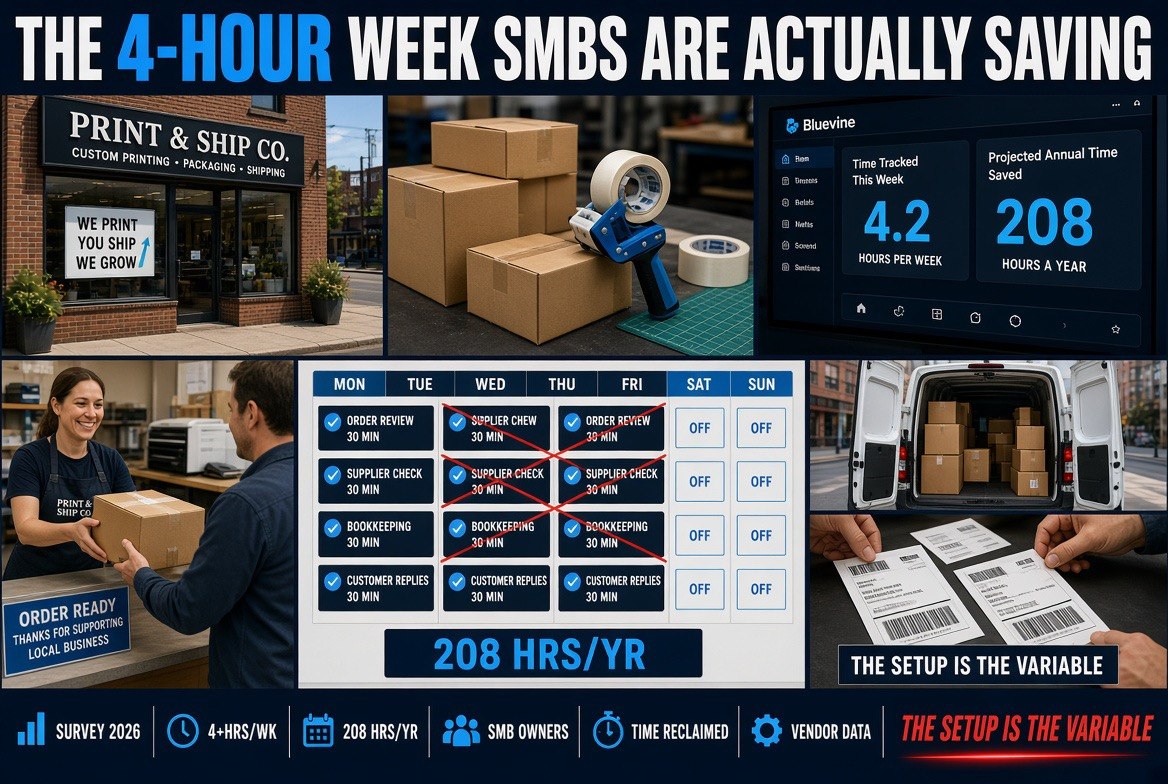
The print-and-ship shop floor where the reclaimed hours show up as tracked weekly time and a projected 208 hours a year.
What the Four Hours Are Actually Worth
\n\n
It is tempting to bank the four hours as productivity and move on. That is usually the wrong move. Saved time that gets refilled with email is not a gain. The owners who benefit most from the survey’s finding are the ones who decide in advance what the reclaimed hours are for.
\n\n
Three uses tend to pay off more than the alternatives. First, put the hours into revenue work — outbound, follow-ups on quotes that went quiet, or calling the customers you have been meaning to call. Second, put them into the constraint in your business, whether that is a bottleneck in fulfillment or a backlog in onboarding. Third, and most often skipped, use the time to work on the business rather than in it: pricing, positioning, a decision you have been avoiding for three months because there was never a free afternoon.
\n\n
Reinvested deliberately, four hours a week changes what a small business can attempt in a year. Left undirected, it disappears into the same noise that consumed it before.
\n\n
What to Do This Week
\n\n
If the survey describes your situation, the practical response takes about an hour and does not require buying anything new.
\n\n
Audit what you already pay for. Most owners are carrying two or three AI subscriptions they set up and abandoned. Pick the one closest to a task you genuinely hate and cancel the rest until the first one pays off.
\n\n
Time the task for one week. Track how long one recurring job actually takes — not your guess, your timer. Without the baseline number, you cannot tell whether anything improved.
\n\n
Build one workflow end to end. Input, output, and a definition of done. If it needs a human check at the end, build that in rather than hoping the model gets it right.
\n\n
Verify anything financial before it matters. If you are using AI on bookkeeping, reconcile on a real schedule. The failure mode is not an obvious error — it is a small miscategorization that quietly compounds for six months.
\n\n
Re-measure at thirty days. Compare against the timed baseline. If the saving is real, expand to a second task. If it is not, you have learned that in a month for the price of a subscription instead of a quarter of trying.
\n\n
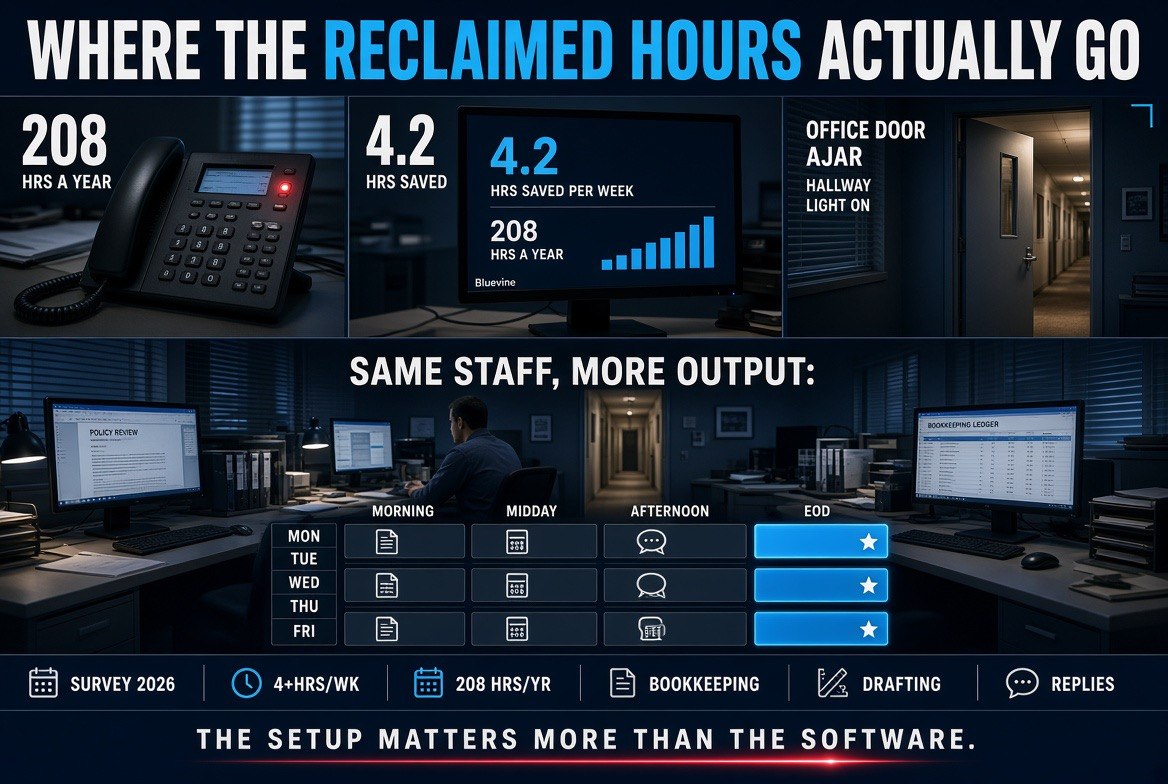
An after-hours bookkeeping office where the saved hours land: same staff, more output, and the setup doing the work.
The Bottom Line for Small Business Owners
\n\n
The Bluevine survey says roughly half of small business owners are reclaiming four or more hours a week through AI. That is a vendor-commissioned figure and the release is syndicated rather than hosted at a live primary link, so treat the precision with appropriate skepticism. The direction, though, matches what operators report everywhere else: the tools work when someone takes an hour to point them at a real job.
\n\n
The number to focus on is not the four hours. It is the gap between owners who are getting them and owners who are paying for the same tools and getting nothing. That gap is not a software feature. It is attention, spent once, deliberately.
\n\n\n\n
Frequently Asked Questions
\n\n
How much time does AI actually save small business owners?
\n
Bluevine’s survey found that nearly half report saving four or more hours per week. That is vendor-commissioned research and the release is syndicated rather than hosted at a live primary URL, so treat the exact figure as a vendor claim. Directionally it aligns with what operators report on bookkeeping, customer replies, and content drafting.
\n\n
Do small business owners see AI as a threat to jobs?
\n
The study found owners largely view AI as a tool rather than a threat. The competitive risk is not using AI badly — it is a competitor using it well while you stay on manual workflows.
\n\n
Why do some business owners get no time savings from AI?
\n
Usually because the tool was never wired into one specific recurring task. Owners who buy a subscription, try it briefly, and return to old habits save nothing. The gap is set-up, not capability. Pick one task, define what done looks like, and re-measure at thirty days.
\n\n
Which business tasks should owners automate with AI first?
\n
Start with high-volume, low-judgment work: transaction categorization, routine customer replies, first-draft marketing copy, and proposal templates. Keep pricing decisions, customer relationships, and legal commitments with a human, and always reconcile financial output on a real schedule.
\n\n
How should a business spend the hours AI gives back?
\n
Decide in advance, or the time refills with email. The best uses are revenue work such as following up on quiet quotes, fixing the current bottleneck in fulfillment or onboarding, and working on the business itself — pricing, positioning, and decisions that keep getting postponed.
\n\n
Is vendor-commissioned AI research reliable?
\n
Treat it as directional. Vendor surveys spot patterns across many respondents, but the exact percentages reflect a specific sample and a company with a commercial interest in the result. Compare against your own timed baseline before committing budget.
\n\n
 \n
\n
About Barak Schurr
\n
Barak Schurr built and sold a major ticketing platform, ran global nightlife operations at Eventbrite, and now spends his time figuring out which AI tools actually move the needle for independent business owners — and which ones are just noise. No hype. No fluff. Just what works.
Email: [email protected]
\n
\n
\n\n
More AI Resources for Your Business
\n
 \n
\n\n
 \n
\n\n
\n
\n\n\n\n