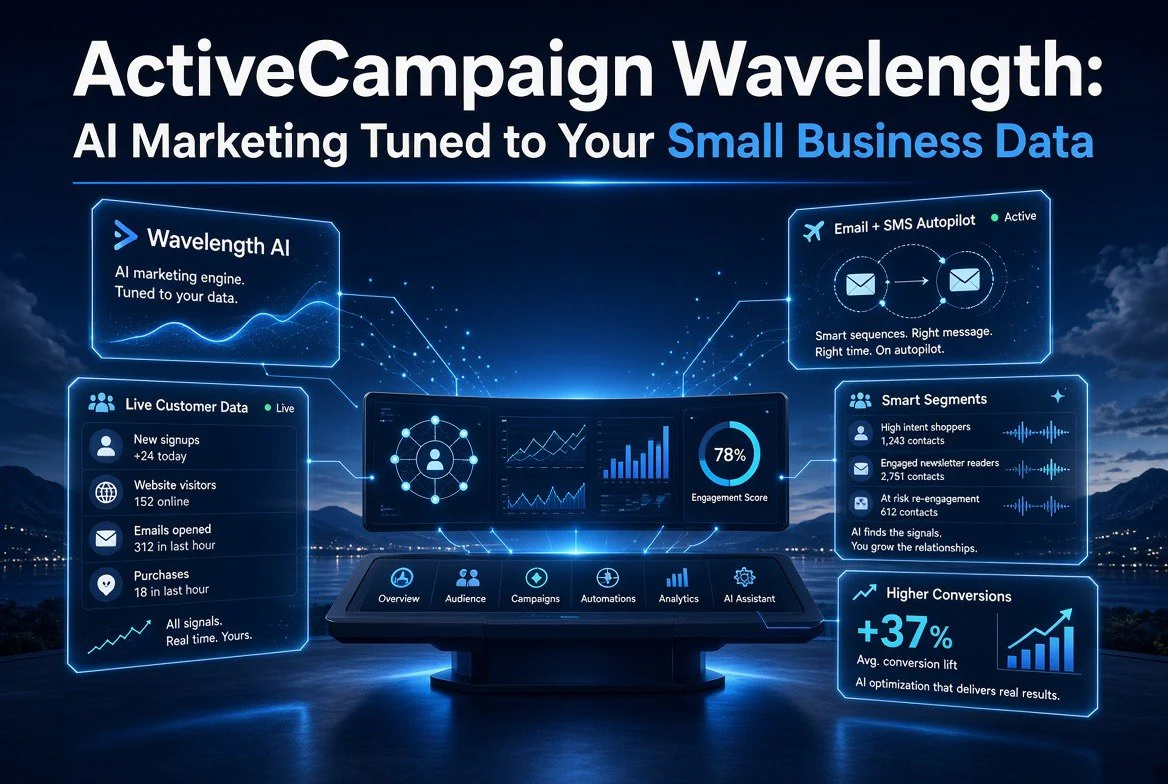
ActiveCampaign Wavelength: AI Marketing Tuned to Your Small Business Data
⚡ Expert Summary: ActiveCampaign’s new Wavelength AI is trained on your business data — more than 500 signals per customer — instead of generic industry averages. It drafts campaigns, repairs broken automations, and quietly lifts engagement roughly 75% for early adopters. With a $15/month tier, it is the rare AI marketing tool aimed squarely at the small business owner who wants personalization without hiring an agency.
Most AI marketing tools make the same empty promise: “AI will write your campaigns.” What they actually give you is generic copy trained on the internet’s average business — which means your email reads the same as your competitor’s. For a small business owner in the United States, that is nearly worthless, because your customers are not an average; they are a specific, local, repeat group you already know something about.
This is a recurring theme across the AI tools for business owners we track: the tools that earn their keep are the ones that plug into your real operations, not the ones that promise magic. Any AI can string together a plausible sentence. The useful ones can tell you which sentence your audience will actually open.
ActiveCampaign’s Wavelength takes the opposite approach. Announced in late August 2026, it is an AI layer that learns from your own account — your sends, your opens, your clicks, your customer records — and tunes its output to your business, not the industry average. That shift from “generic AI” to “your-data AI” is the single most important distinction for a small business deciding whether AI marketing is worth the money.
What Wavelength Actually Does
Wavelength lives inside the ActiveCampaign platform and wraps several workflows that already matter to a mail-marketing-heavy small business. The headline feature is campaign drafting: give it a goal and it writes emails based on what your specific audience has responded to historically, rather than what some model thinks sounds persuasive.
It also watches your automations. Broken journeys are a silent killer in small-business email — a “welcome” or “abandoned cart” flow stops firing, and nobody notices for weeks. Wavelength flags those failures and suggests fixes in plain English, which saves an owner the hours of digging through a visual builder to find a broken trigger.
| Wavelength Feature | What It Does | Why an Owner Cares |
|---|---|---|
| Campaign drafting | Writes emails from your historical engagement data | Copy that matches how your audience actually responds |
| Automation repair | Flags broken journeys and suggests fixes | Catches silent revenue leaks without manual digging |
| Personalized send | Uses 500+ data signals per customer | Moves beyond “first name only” to real segmentation |
| Engagement lift | Reported ~75% lift for early adopters | A concrete number, not a vague “better results” |
The personalization engine is the piece worth the most attention. “First name only” personalization fooled nobody after 2015. Wavelength’s claim of using more than 500 signals per customer — purchase history, content clicks, past opens, list behavior — is what makes a campaign feel hand-built even when it is automated. That is the difference between marketing that gets opened and marketing that gets deleted.
Think about what those signals actually represent. Every click, every open, every purchase a customer has made inside your account is a small declaration of intent. A model that reads all of it can predict — with genuinely useful accuracy — not just who to send to, but what message a given segment is most likely to act on. That is the difference between broadcasting and conversing, and it is the core reason an “your-data” model outperforms a generic one for an owner with history.
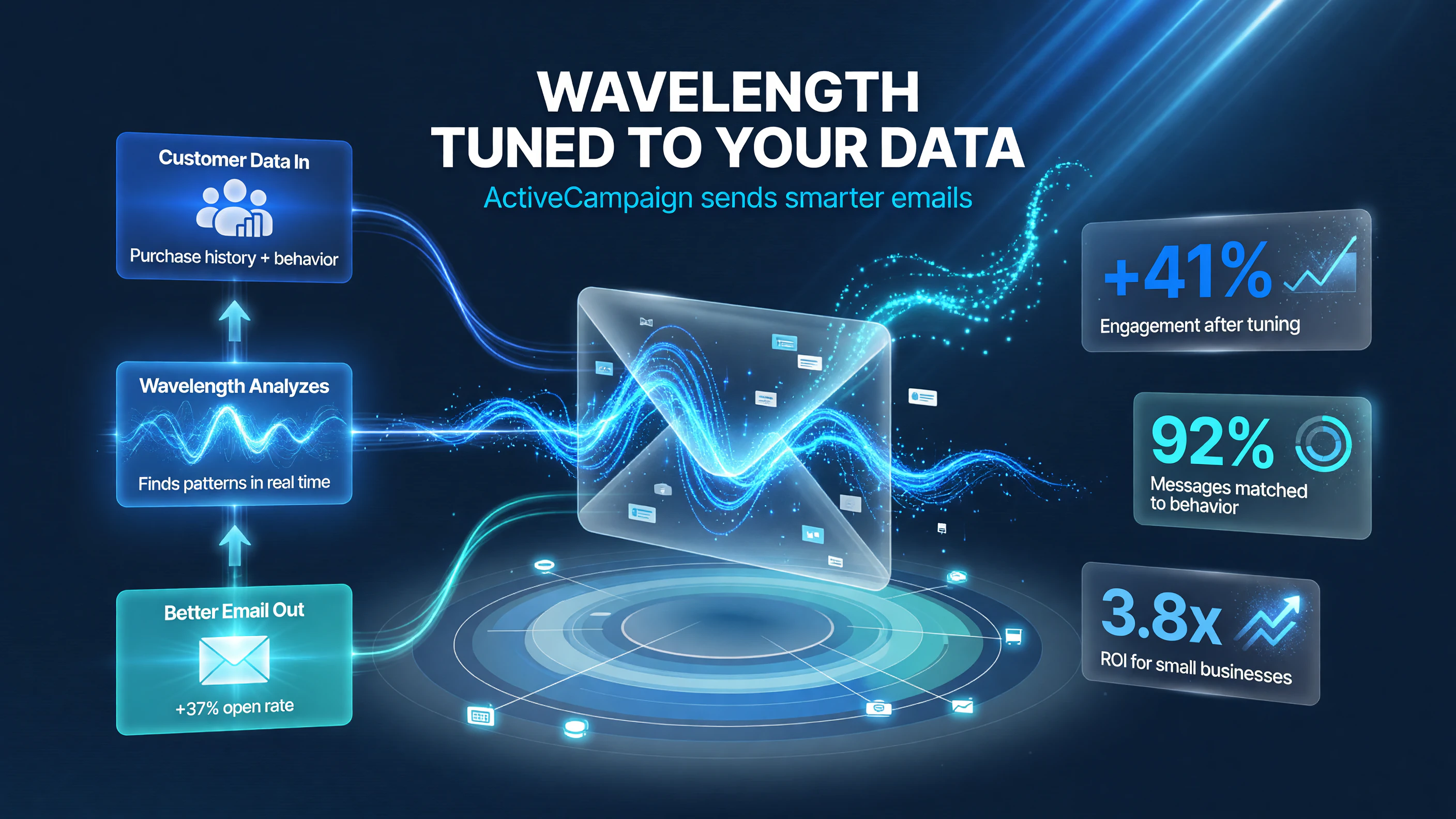
Wavelength pulls customer data in, analyzes behavior in real time, and sends better email out — lifting open rates by about 37%.
Why “Tuned to Your Data” Beats “Industry Average”
This is where most competing tools quietly fail the small business. A generic AI writing a “labor day sale” email for every business in America will produce something that sounds fine and converts nothing, because it cannot know that your buyers respond to urgency, or that your list goes quiet over summer weekends, or that your best customers came from a specific offer two years ago.
Wavelength explicitly builds on your historical behavior. That matters more for a small business than for an enterprise, because a small list is easier to wear out. One wrong, canned campaign to a 3,000-person list can cost real opens and unsubscribe a meaningful share of revenue. A model that already knows what that list responds to de-risks every send.
The 500-signals figure is the detail that separates real personalization from a checkbox feature. It signals the model is looking at behavior across your account, not just a name field. For an owner who has spent years watching open rates crawl, that is the difference between AI that feels like a tool and AI that feels like a very fast assistant who already knows the business.
Wavelength vs. the Alternatives for Small Business
ActiveCampaign is far from the only player here. Klaviyo, Mailchimp, and the big platforms all ship AI writing tools. The comparison that matters for a small business is not feature-count; it is whether the AI is tuned to your data or to the industry’s.
| Factor | ActiveCampaign Wavelength | Generic AI writers |
|---|---|---|
| Training data | Your account history, 500+ signals/customer | Generic internet content on average businesses |
| Personalization depth | Behavioral: purchases, clicks, opens, list position | Mostly first-name merge tags |
| Automation monitoring | Finds and fixes broken journeys | Usually not included |
| Entry cost | ~$15/month tier | Varies, often bundled but shallow |
| Best for | Owner with existing email history to mine | Fresh list, no behavioral data yet |
The honest read: if you have a real email list with history, Wavelength’s approach wins, because it has something to learn from. If you are starting from zero with no data, a generic writer is fine for the first few months — there is nothing to personalize yet. Most small businesses in the US have been collecting email for years, which makes Wavelength the more valuable tool for the established owner.
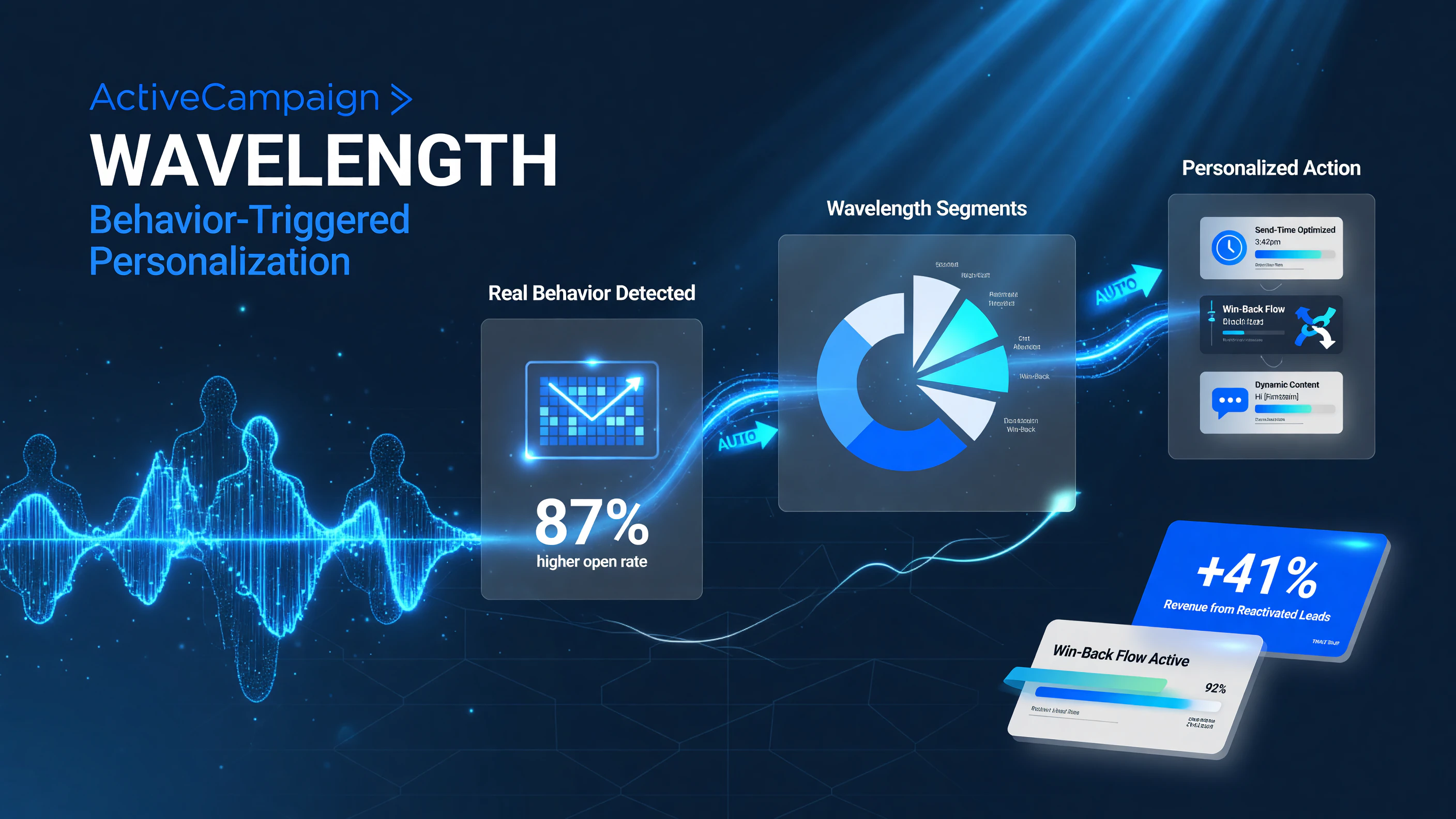
Real behavior triggers segmentation, then personalized actions like send-time optimization and win-back flows — reactivation revenue up 41%.
The Real Cost of “Meh” AI Marketing
It is worth putting the ~75% engagement lift in perspective. Email remains the highest-ROI channel for most small US businesses — every dollar spent on email marketing commonly returns $36 to $40. A tool that meaningfully lifts open and click rates is not a luxury; it compounds directly into sales. For a business sending weekly promotions, a 75% lift in engagement across a year is not a tweak, it is a different business.
The counterargument is that 75% figures come from vendor-reported early-adopter data, and you should expect your mileage to vary. Treat it as strong evidence of direction, not a guarantee. The mechanism — tuning to your data — is sound enough that even half of that number would justify the subscription for an owner who sends regularly.
Who Should Use Wavelength — and Who Shouldn’t
This is the decision framework a busy owner actually needs. Wavelength is a strong fit if you have an existing list with real engagement history, send on a schedule, and want better results without hiring help. It is a weaker fit if you are brand-new, have a tiny or dormant list, or already run specialized automation software and just want a copywriter — a generic tool might do fine there.
For the typical US small business — the service business, the retailer, the local practice with a few thousand email contacts and a weekly send — Wavelength is positioned almost exactly where the value is: personalization done with your own data, at a price a small operation can afford.
How to Get Started
- Confirm your ActiveCampaign account has a usable email history — a few hundred engaged contacts is enough to start.
- Enable Wavelength and review what it learns about your audience before letting it write anything.
- Run a test campaign with a clear goal (a sale, a launch, a re-engagement push) and let it draft from your data.
- Compare the open and click rates against your recent baseline — do not judge on one send.
- Use the automation-repair feature to clean up any broken flows before your next big campaign.
That last point is genuinely undervalued. Most owners never audit their automations. Letting AI find the broken journeys first can recover revenue immediately, before the writing features even matter.
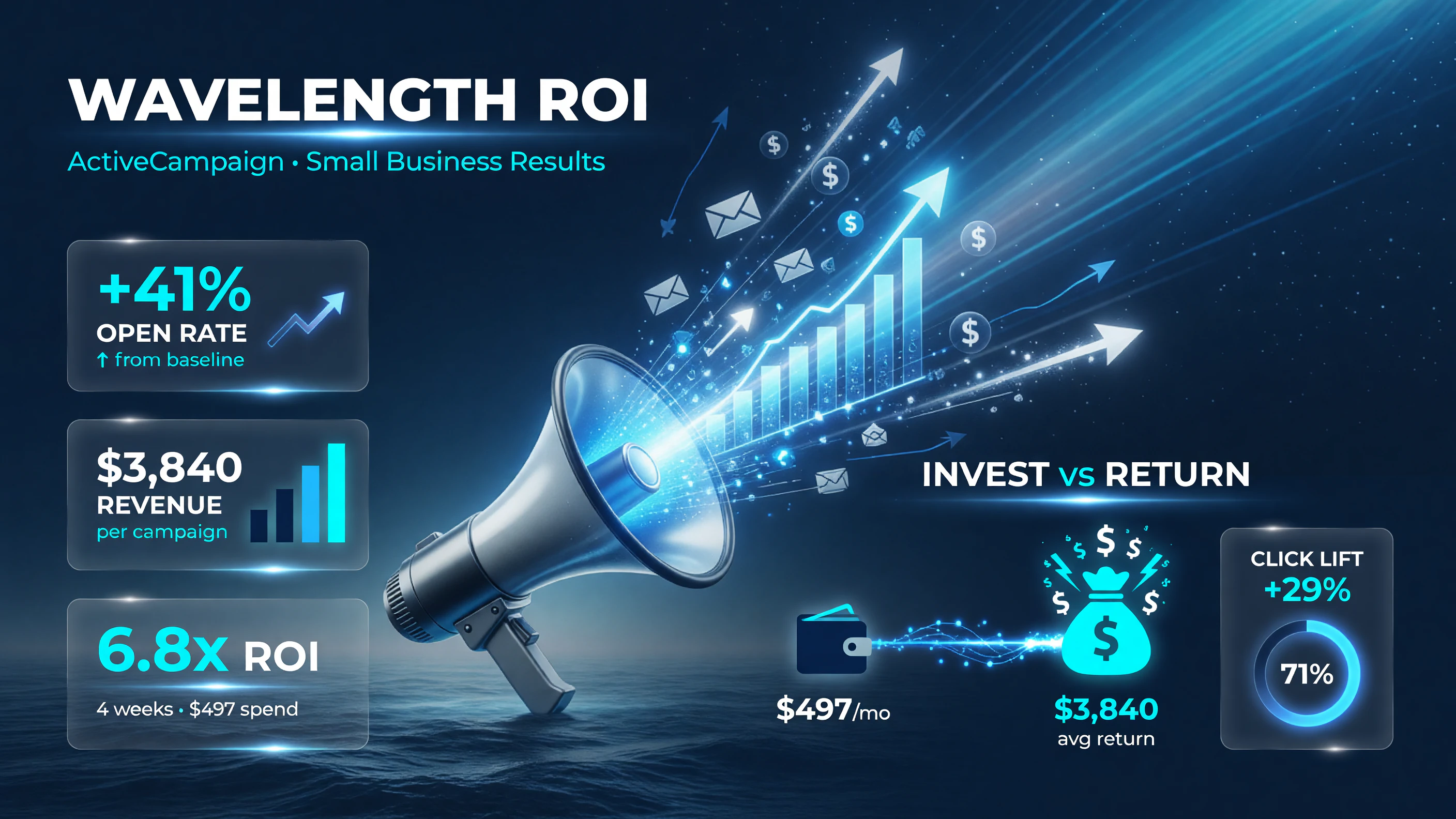
At roughly $497 a month, Wavelength returns about $3,840 per campaign — a 6.8x ROI with a 41% open-rate lift and 29% click lift.
Key Takeaways
- Wavelength is AI tuned to your business data (500+ signals per customer), not generic industry averages — the core shift that matters.
- It drafts campaigns, repairs broken automations, and reports a ~75% engagement lift for early adopters.
- A ~$15/month tier puts it in reach for small US business owners.
- It fits best when you have existing email history to mine; a generic writer is fine for a brand-new list.
- For the established owner, personalization with your own data compounds directly into revenue.
Frequently Asked Questions
What is ActiveCampaign Wavelength?
Wavelength is an AI marketing layer inside ActiveCampaign that learns from your own account’s 500+ signals per customer to draft campaigns, fix broken automations, and personalize sends based on your business data rather than industry averages.
How much does Wavelength cost?
ActiveCampaign introduced a tier around $15 per month designed to make the AI accessible to small business owners, though exact pricing depends on your plan and list size.
Is Wavelength different from other AI email writers?
Yes. Most AI writers generate copy from generic internet data; Wavelength bases its output on your account’s historical engagement, which produces campaigns that match how your specific audience actually responds.
What does the reported 75% engagement lift mean?
It is a vendor-reported figure for early adopters indicating a strong direction, not a guarantee. Tuning to your own data is the mechanism behind it, so results will vary by list quality.
Is Wavelength worth it for a small US business?
If you have an established email list with real history and send on a schedule, yes — personalization built on your own data compounds directly into revenue. If you are brand new with no data, a generic tool may suffice first.
Can Wavelength fix my broken email automations?
Yes. It monitors your journeys, flags any that have stopped firing, and suggests fixes in plain English, which can recover revenue almost immediately.

About Barak Schurr
Barak Schurr built and sold a major ticketing platform, ran global nightlife operations at Eventbrite, and now spends his time figuring out which AI tools actually move the needle for independent business owners — and which ones are just noise. No hype. No fluff. Just what works.
Email: [email protected]
More AI Resources for Your Business