Get The Solo Business OS — Free
The AI workflow that replaces a part-time employee for solo operators and small business owners.
Wisr AI Puts Agentic Security on the SMB Shortlist
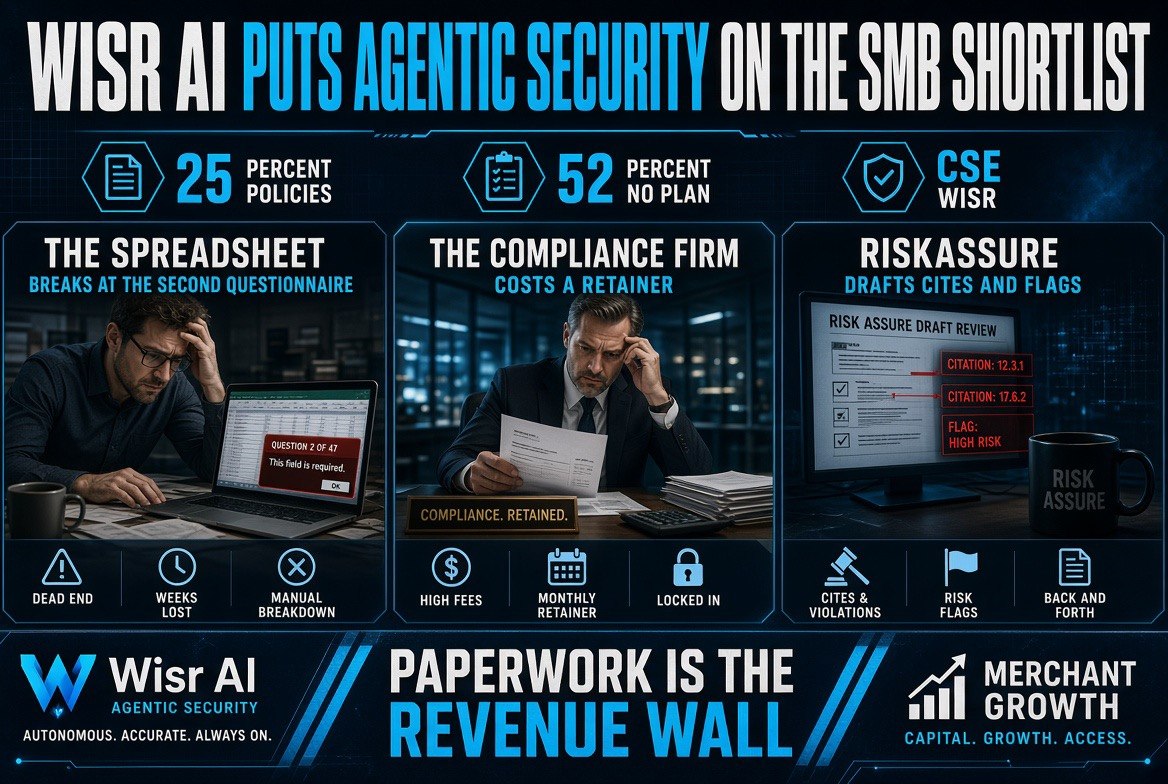
⚡ Expert Summary: Wisr AI Systems Inc. (CSE: WISR) has listed RiskAssure, its agentic AI security assurance platform, on Merchants’ Market, the partner marketplace run by Merchant Growth Ltd. The platform drafts security questionnaire responses with source citations and flags which ones need human review. Merchant Growth has funded 15,000+ small businesses and deployed $1.5B+ since 2009, and only 25% of small businesses have formal security policies while 52% have no incident response plan. Here is what the deal means for a US small business owner chasing enterprise contracts in 2026.
Every small business owner eventually hits the same wall: a bigger company wants to buy from you, and their procurement team sends over a security questionnaire. Forty pages. Multiple departments. A deadline. You have no security team, no compliance officer, and no idea what half the questions are asking. That wall is exactly where Wisr AI is placing its bet — and as of October 8, 2026, it has a new distribution channel aimed straight at small businesses.
What Wisr AI Just Announced
Wisr AI Systems Inc. (CSE: WISR), a Vancouver-based AI company, announced that RiskAssure — described in the release as its “agentic AI security assurance platform” — is now available through Merchants’ Market, the partner marketplace operated by Merchant Growth Ltd. The listing gives Merchant Growth’s clients access to RiskAssure through the customer portal they already use, rather than requiring them to find and onboard a new tool from scratch.
The distribution math is the interesting part. Merchant Growth has funded more than 15,000 Canadian small businesses and deployed over $1.5 billion in capital since it was founded in 2009. Merchants’ Market brings together more than 50 partners across business operations, payments, accounting and marketing. Wisr’s platform now sits inside that bundle.
“Our mission is to bring powerful cybersecurity tools to small and medium-sized businesses through our agentic AI platform,” said Rob Goehring, CEO of Wisr AI. “RiskAssure puts that mission into practice with a comprehensive suite of security assurance tools. Merchant Growth’s established small-business relationships make its marketplace a relevant channel for this offering.”
RiskAssure is also available directly at GetRiskAssure.com, so the marketplace listing is a distribution add rather than an exclusive — worth noting, because it tells you Wisr sees the lending channel as a customer-acquisition shortcut, not a walled garden.
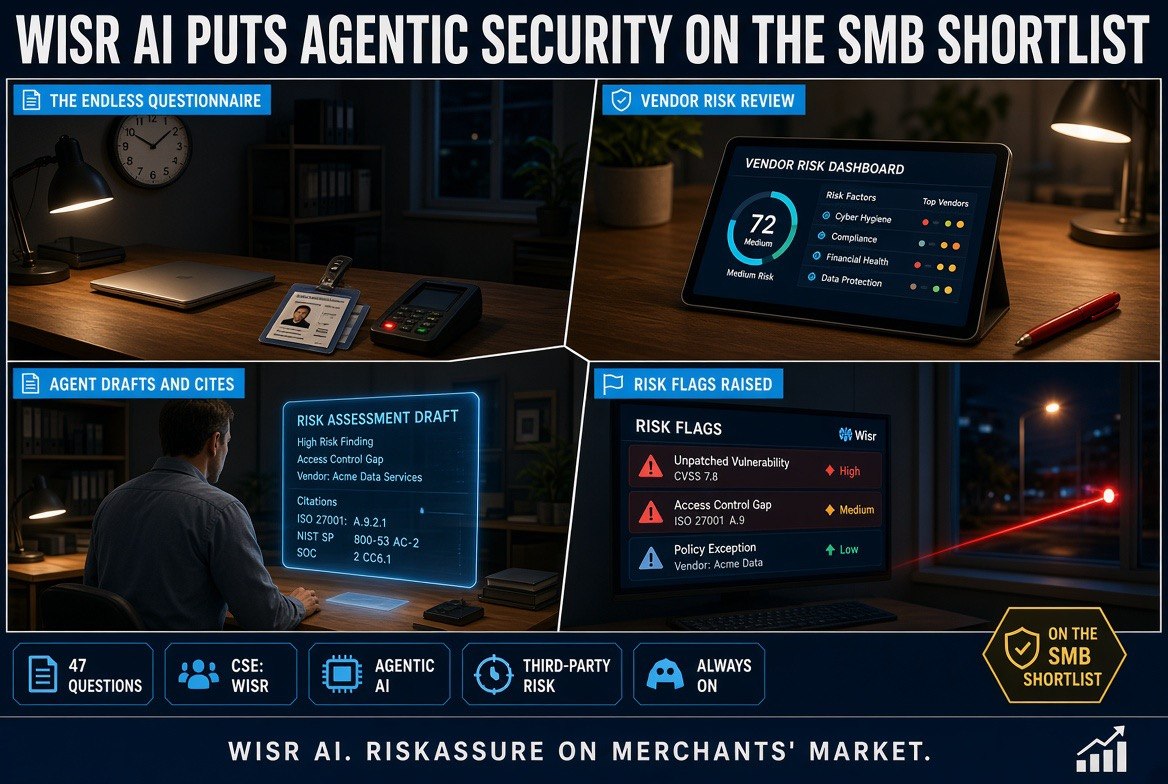
The endless questionnaire is the problem: an SMB owner at night working through a compliance form that never seems to finish.
Why Security Paperwork Is an AI Problem Now
The reason this matters more in 2026 than it did five years ago is that security questionnaires have become the de facto gate on enterprise revenue. A small business that cannot answer a vendor risk assessment does not get the contract — not because it is insecure, but because it cannot document that it is not insecure.
The preparedness gap is real and measurable. In a September 2024 survey published by the Business Development Bank of Canada (BDC), only 25% of small businesses polled had formal internal security policies, while 52% had no incident response plan at all. Half of the small business market is missing the single document an enterprise procurement team will ask for first.
Meanwhile adoption of digital tools has already gone mainstream. BDC’s June 2026 report, The Digital Transformation of SMEs in the Age of Artificial Intelligence, found that 96% of Canadian SMEs now use at least one digital technology, up from 91% in 2021, and that three in ten Canadian businesses already use generative AI. The tools are in the building; the paperwork is not.
That gap is what makes a questionnaire-automation product more than a novelty. The work is repetitive, rule-bound, and evidence-based — three properties that make it exactly the kind of task agentic AI is good at, and exactly the kind of task a two-person company has nobody to spare for.
What RiskAssure Actually Does
Strip away the category language and RiskAssure is a four-part toolkit aimed at the security-assurance workflow:
- A public-facing security scan — a starting read on your external security posture.
- The RiskAssure Index — risk posture visibility, so you can see where you stand rather than guess.
- Unlimited security questionnaire management — the core of the offer, and the part that maps directly to the enterprise-contract bottleneck.
- A hosted trust centre — a place to put the documentation answers that procurement teams keep requesting.
The agentic layer is where Wisr differentiates. Per the company, the platform uses its agentic AI technology to analyse approved security evidence, generate questionnaire responses with source citations, and identify which responses require human review. That last clause is the one to pay attention to. An AI that answers compliance questions and confidently invents an answer is a liability. An AI that drafts an answer, cites the evidence it drew from, and escalates the ones it is unsure about is a tool a small business owner can actually put in front of a client.
It is worth being precise about what is verified and what is not. Everything above comes from Wisr’s own announcement and product description. The claim that the platform cites its sources and flags review cases is vendor-reported. Wisr has not published independent accuracy benchmarks, and no third party has audited the questionnaire output. Treat the capability as credible and the performance as unproven until you test it on your own paperwork.
RiskAssure vs. the Alternatives: A Straight Comparison
If you are a small business owner facing a security questionnaire this quarter, you realistically have four options. Here is how they compare on the factors that actually decide the outcome.
| Factor | RiskAssure (Agentic AI) | DIY Spreadsheet | Managed Compliance Firm |
|---|---|---|---|
| Questionnaire turnaround | Drafted from approved evidence, review cases flagged | Days to weeks, entirely manual | Days, queued behind the firm’s other clients |
| Source citation on answers | Yes — vendor-reported, evidence-linked | Only if you maintain the evidence library yourself | Yes, as part of the engagement |
| Cost structure | Subscription, no agency retainer | Free in cash, expensive in your hours | Retainer plus project fees |
| Scales past first questionnaire | Unlimited questionnaire management | Breaks down at volume | Scales, but the meter keeps running |
| Human judgement in the loop | Built in — uncertain answers flagged for review | All of it, whether you have the expertise or not | All of it, from a specialist |
| Best fit | SMBs with steady enterprise or vendor requests | One-off questionnaire, strong in-house knowledge | Regulated industries needing attestation |
The honest read: RiskAssure competes with the spreadsheet, not the compliance firm. The spreadsheet is free and fails the moment you need to answer a second questionnaire while running the business. The compliance firm works but is priced for companies that already have the revenue the questionnaire is supposed to unlock. The middle ground — a subscription tool that drafts, cites and escalates — is where most small businesses actually live.
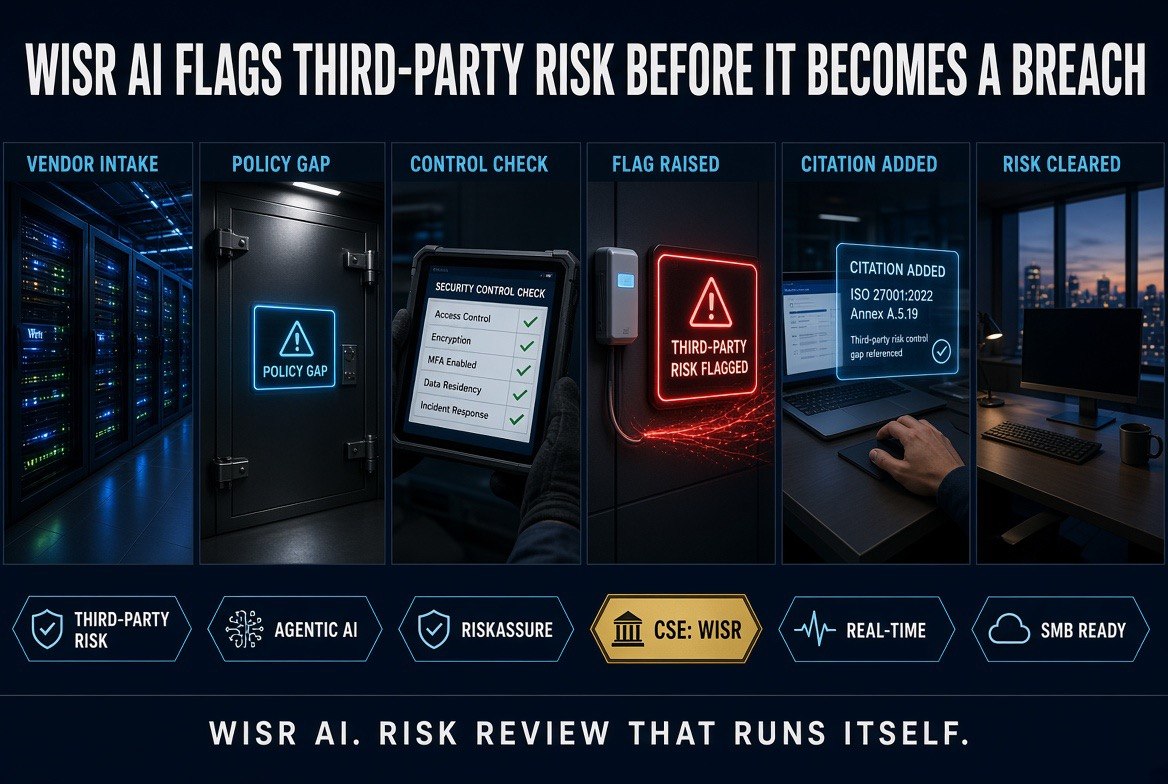
Third-party risk review, done by hand, stalls the same way: vendor intake, policy gaps, control checks and flags all waiting on a person.
The Distribution Angle: Why a Lending Marketplace
It would be easy to read this announcement as a press release about a partnership and move on. The more useful read is what the choice of channel says about how AI tools reach small businesses in 2026.
Small business owners do not browse for security assurance software. They do not wake up thinking about third-party risk. They encounter the problem at a specific moment — when a lender, a big customer, or an insurer asks for documentation — and they solve it with whatever is already in front of them. Merchant Growth’s clients already log into a portal to manage their financing. Putting RiskAssure there means the product shows up at the moment of need, in a place the owner already trusts, from a relationship they already have.
That is a different go-to-market than SaaS-at-large. And it is worth watching, because it is the pattern that has repeatedly worked for AI tools aimed at operators rather than technologists: ride an existing trusted relationship instead of buying attention.
What This Means If You Are a US Small Business
Two practical takeaways, neither of which requires you to buy anything.
First, the questionnaire is a revenue problem, not an IT problem. If your pipeline includes any enterprise, government, or large-vendor customer, you will be asked to document your security posture. The BDC numbers — 25% with formal policies, 52% with no incident response plan — suggest most of your competitors are not ready. That is an opening, not a threat.
Second, evaluate any AI compliance tool on its evidence trail, not its speed. The value of RiskAssure’s model is not that it answers fast. It is that it shows its work and escalates the uncertain cases. Any tool that generates compliance answers without citations and escalation should be treated as a drafting aid at best, and a professional-liability risk at worst.
The other thing to watch is pricing, which Wisr has not published in the announcement. Until it does, the comparison above is directional rather than dollar-for-dollar. If the subscription lands anywhere near what a one-off compliance engagement costs, the math for a small business with recurring questionnaires is straightforward.
The second table is the practical one: what the subscription buys you against what each alternative costs you in time, cash and risk. Compare the two on the dimension that matters most to a small business — the total burden of keeping the evidence current.
| Decision Factor | Subscription AI Tool | Manual Process |
|---|---|---|
| Upfront cost | Monthly subscription | No cash outlay |
| Owner hours per questionnaire | Review of flagged answers only | Days of drafting and chasing evidence |
| Evidence stays current | Managed in one place, reused per request | Rebuilt or hunted for every time |
| Risk of a wrong answer | Lower — citations plus human review gate | Higher — unaudited, easily overstated |
| Ceiling on volume | Unlimited questionnaires, bounded by review time | One or two before it disrupts the business |
Who Should Look at RiskAssure — and Who Should Not
Worth a look if: you are a services or software company with 10-200 employees, you regularly receive vendor risk assessments, you are losing time to questionnaire busywork, and you have at least some internal security documentation for the AI to draw on.
Skip it for now if: you are pre-revenue, you have never been asked to complete a security questionnaire, or you operate in a regulated vertical that requires formal attestation — SOC 2 reports, HIPAA documentation or similar. In those cases you need a compliance firm’s signature, not a drafting tool.
One more caution for US operators: the announcement is Canadian, the distribution partner is Canadian, and the cited preparedness data is Canadian. The structural problem it addresses is not. US procurement teams ask the same questions with the same seriousness, and the BDC numbers are directionally consistent with what US small businesses report. Read the data as a signal about the gap, not as a US statistic.
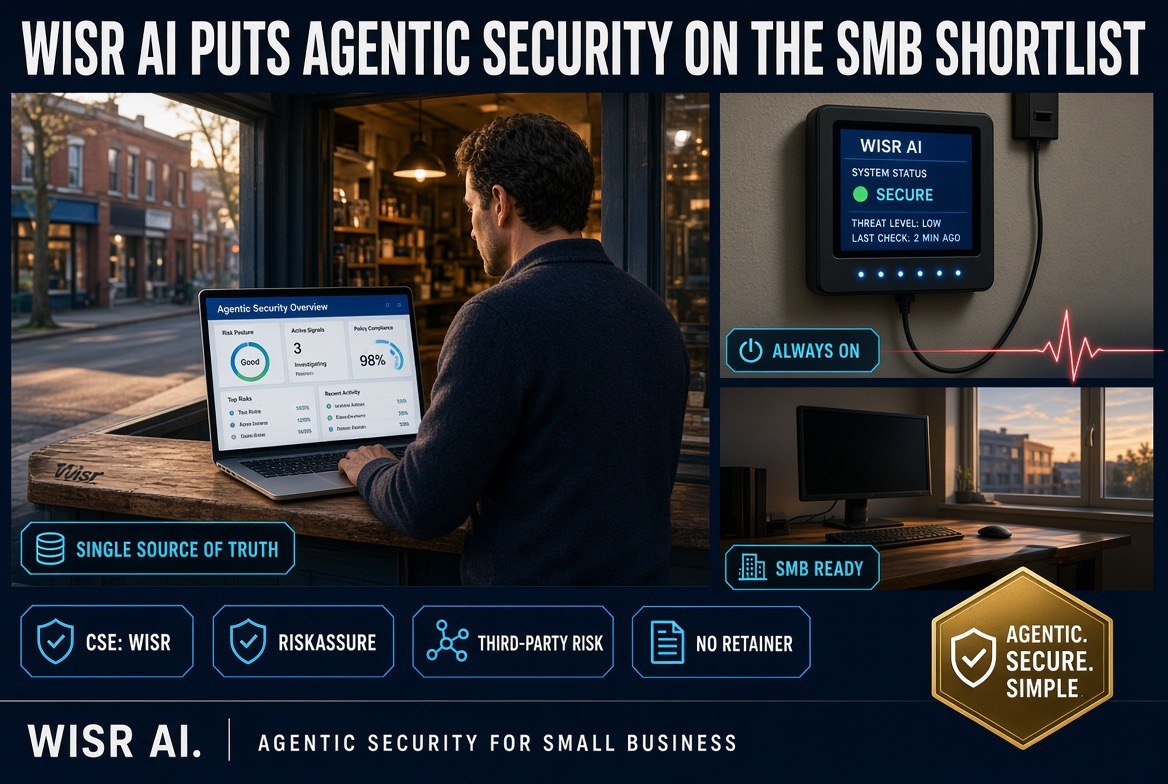
Wisr positions RiskAssure as always-on agentic security for small business, distributed through Merchants’ Market rather than sold as a consultancy retainer.
The Bottom Line
RiskAssure is not a security product. It is a paperwork product, and paperwork is what stands between a capable small business and a contract it has already earned. Wisr’s agentic layer is aimed at the right pain point — drafting responses from approved evidence, citing sources, and flagging the answers a human needs to check.
The claim that it does this well is unproven on the public record. But the market it is selling into is real, the gap is documented, and the distribution move through Merchant Growth puts the tool where the problem actually surfaces. For a small business owner who has ever stared down a 40-page security questionnaire at 11pm, that is a more useful announcement than most of what lands in the AI press.
Frequently Asked Questions
What is RiskAssure by Wisr AI?
RiskAssure is an agentic AI security assurance platform built by Wisr AI Systems Inc. (CSE: WISR). It combines a public security scan, the RiskAssure Index for risk posture visibility, unlimited security questionnaire management, and a hosted trust centre. Its AI drafts questionnaire responses from approved security evidence with source citations and flags the responses that need human review.
What does the Merchant Growth listing actually change?
It adds a distribution channel rather than new capability. Merchant Growth’s clients can now access RiskAssure through the customer portal they already use, instead of discovering and onboarding it separately. RiskAssure remains available directly at GetRiskAssure.com, so the listing is an additional route to customers, not an exclusive one.
How big is the small business security preparedness gap?
Large. A September 2024 BDC survey found only 25% of small businesses had formal internal security policies and 52% had no incident response plan. At the same time, BDC’s June 2026 report found 96% of Canadian SMEs use at least one digital technology and three in ten already use generative AI — the tooling has arrived ahead of the documentation.
Can AI safely answer security questionnaires?
Only with review built in. The defensible model is drafting answers from approved evidence, citing where each answer came from, and escalating uncertain responses to a human. Any tool that generates compliance answers without citations or a human-review path should be treated as a drafting aid, not an authority.
Is RiskAssure a replacement for a compliance firm?
No. For regulated industries or contracts requiring formal attestation such as SOC 2 or HIPAA documentation, you still need a qualified firm’s signature. RiskAssure addresses the recurring, evidence-based questionnaire workload that sits underneath that — the part most small businesses handle manually today.
Do US small businesses face the same problem?
Yes. The cited statistics are Canadian, but the underlying dynamic — enterprise procurement gating contracts behind vendor risk assessments — is standard practice in the US. The numbers signal the size of the gap; they are not a US-specific measurement.
For a practical look at which AI tools earn their keep in a small business stack, see our category guide on AI tools for business.

About Barak Schurr
Barak Schurr built and sold a major ticketing platform, ran global nightlife operations at Eventbrite, and now spends his time figuring out which AI tools actually move the needle for independent business owners — and which ones are just noise. No hype. No fluff. Just what works.
Email: [email protected]
More AI Resources for Your Business