Get The Solo Business OS — Free
The AI workflow that replaces a part-time employee for solo operators and small business owners.
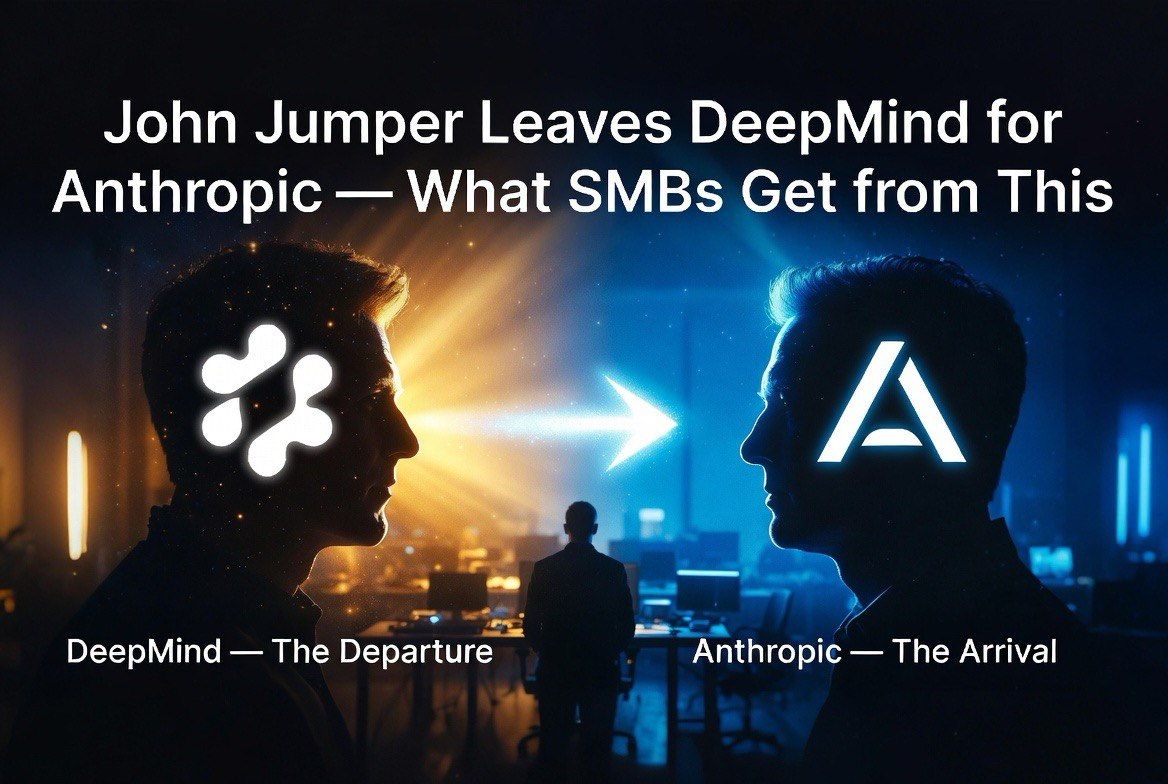
John Jumper Leaves DeepMind for Anthropic — What SMBs Get From This
⚡ Expert Summary: Nobel Prize-winning AlphaFold creator John Jumper announced he is leaving Google DeepMind after nearly nine years to join Anthropic. The move follows Character.AI co-founder Noam Shazeer leaving DeepMind for OpenAI the same week — signaling a high-stakes talent war between frontier AI labs. For small business owners, this matters because what drives competition between AI companies determines the tools you’ll use, the pricing you’ll pay, and the capabilities your business can access.
What Actually Happened
John Jumper, who shared the 2024 Nobel Prize in Chemistry with Demis Hassabis for creating AlphaFold, announced on June 19 that he is leaving Google DeepMind after “nearly 9 years” to join Anthropic. The announcement came via a post on X that was notably gracious — Jumper thanked Hassabis for “taking a real chance letting me lead the AlphaFold team just six months after finishing my PhD.”
According to Bloomberg, Jumper was a key member of Google’s internal team working on developer coding tools — an area where the company has struggled to sell to businesses despite its massive AI investments. This detail matters because it suggests Anthropic isn’t just hiring a biochemist. They’re hiring someone who was deep inside Google’s most ambitious coding AI projects, with firsthand knowledge of what works and what doesn’t in selling AI development tools to real businesses.
Jumper isn’t the only departure making headlines. The same week, Character.AI co-founder Noam Shazeer also left DeepMind — though he joined OpenAI, not Anthropic. Two Nobel-adjacent researchers leaving Google’s AI crown jewel in one week is not a coincidence. It’s a signal that the AI talent market has fundamentally shifted from employer-driven to researcher-driven. The labs that offer the most ambitious research environments — not the biggest paychecks or the most resources — are winning the talent war.
The context matters here. DeepMind’s original pitch was that it was the purest AI research lab on earth — no product pressure, no quarterly targets, just science. But Google’s 2024 restructuring that merged DeepMind with Google Brain began shifting that culture. Researchers who joined DeepMind to build scientific breakthroughs found themselves increasingly pulled into product engineering for Google’s search, ads, and cloud businesses. For someone like Jumper, who wants to build systems that change how industries work, Anthropic offers a culture where ambitious AI research still comes first.
Why This Talent War Actually Matters for Small Business Owners
It’s easy to watch this as industry gossip — top researchers switching between trillion-dollar companies, irrelevant to a 12-person retail business or a 40-person accounting firm. That reading is wrong.
Here is why a Nobel laureate choosing Anthropic over DeepMind affects your bottom line:
1. Better tools, faster. When the best researchers concentrate at one company, that company’s products improve faster. Anthropic already ships Claude for Small Business with prebuilt workflows in QuickBooks, PayPal, and HubSpot. John Jumper joining Anthropic means Claude’s underlying model gets better at reasoning, coding, and understanding business-specific data — and those improvements land directly in the tools you already pay for.
2. Pricing pressure. The talent war is driving costs up at frontier labs — but it also drives competition. Anthropic needs to justify its valuation (reportedly preparing a $65 billion IPO). OpenAI needs to justify its rumored $1 trillion IPO. Both are racing to sign up SMBs as customers. That means better pricing, more generous free tiers, and more SMB-specific features — exactly the dynamic small business owners should exploit by staying multi-model.
3. Google’s AI advantage is eroding. DeepMind was supposed to be Google’s secret weapon — the lab that produced AlphaFold, AlphaGo, and a decade of Nobel-caliber research. But 2026 has been brutal for DeepMind talent retention. Shazeer to OpenAI, Jumper to Anthropic, and reportedly more departures in the pipeline. For small businesses that rely on Google’s AI ecosystem — Gemini, Google Workspace AI features, Google Ads AI — this brain drain means Google’s tools may not improve as fast as Anthropic’s or OpenAI’s in the coming year.
4. The “pick a model” risk is real. Satya Nadella warned just last week that AI could “hollow out entire industries” if value concentrates in a few frontier models. Microsoft’s CEO introduced the concept of “token capital” — the AI capability a business builds and owns — vs. “human capital.” His key test: can you switch out a generalist model without losing the business-specific expertise you’ve built into your workflows? Jumper moving to Anthropic reinforces that point. The AI landscape is shifting. Betting everything on one provider is a liability, not a strategy. The companies that win in the AI era will be the ones that build portable workflows and stay model-agnostic — exactly because the model providers themselves are undergoing seismic talent shifts that will reshape their product roadmaps.
What This Means for Your Business Stack in Practice
Let me make this concrete. If you run a small business — say, a 15-person marketing agency — your current AI stack probably looks like this: ChatGPT for content generation, Claude for analysis and coding, Gemini for research from Google Workspace, Perplexity for competitive intelligence. That multi-model approach is exactly right — and the Jumper news confirms you should double down on it.
Here is why: if Anthropic pulls ahead of Google in model quality over the next 12 months — which becomes more likely with hires like Jumper — and you already have Claude integrated into your workflows, you benefit immediately. You don’t have to migrate. You don’t have to retrain your team. You are already there.
Conversely, if you went all-in on Google’s ecosystem — using only Gemini, Google Workspace AI, and Google Cloud for your business operations — you are now exposed to the risk that Google’s talent exodus slows its AI innovation pace. Your tools won’t get worse, but they may not get better as fast as your competitors’ tools. The gap between what Anthropic ships and what Google ships could widen over the next two product cycles.
The businesses that win in 2027 will be the ones that started diversifying their AI stack in 2026. Jumper’s move is a reminder that the window for building that stack is now — not when the talent war results are clear and Google’s response has already been determined.
What Is Anthropic Actually Getting From John Jumper?
This is where the story gets interesting for non-biotech businesses. Anthropic is not buying Jumper’s protein-folding expertise. They’re buying his systems-building mind.
Jumper led AlphaFold from a research project to a production system that predicts protein structures with accuracy that was previously unimaginable. That’s not a biochemist skill — it’s an engineering leadership skill at the highest level. He built a system that processes massive datasets, generates reliable predictions, and serves real users at scale. Those capabilities transfer directly to building large language models that serve business customers reliably.
Bloomberg’s reporting that Jumper was working on Google’s internal coding tools before leaving adds another layer. He wasn’t just the AlphaFold guy. He was positioned at the intersection of DeepMind’s frontier research and Google’s product engineering — exactly the kind of hybrid background Anthropic needs to bridge the gap between model capability and practical business tools.
Anthropic’s Claude for Small Business package, launched in May 2026, already integrates with QuickBooks, PayPal, HubSpot, Canva, and more than a dozen other SMB tools. If Jumper brings his systems-engineering rigor to how Claude processes business data — financial records, customer interactions, inventory logs — the improvements could be substantial.
The Broader Landscape: DeepMind’s Talent Exodus in 2026
To understand why Jumper leaving matters, look at the cumulative picture. DeepMind has lost multiple key figures in 2026:
- John Jumper — AlphaFold creator, Nobel laureate → Anthropic
- Noam Shazeer — Character.AI co-founder, Transformer architecture pioneer → OpenAI
- Dean Ball — Policy researcher, government AI advisor → OpenAI (reported)
- Multiple unnamed departures from the coding tools division, according to Bloomberg reports
Google has responded by pushing deeper into hardware — its TPU v7 chips and a reported $920 million per month GPU deal with SpaceX — but hardware alone doesn’t win the AI race. The best models are built by the best researchers. If the researchers are leaving, the models eventually follow.
For small business owners renting software from these companies, this is a leading indicator. The company that can attract, retain, and productize the best AI talent will produce the most useful tools in 12-24 months. Right now, Anthropic and OpenAI are winning that talent race, while Google is losing it.
Three Things Small Business Owners Should Do Right Now
1. Stay multi-model. The talent shifts confirm what the data already shows — no single provider will dominate all areas. ChatGPT is better at creative writing. Claude is better at business analysis and coding. Gemini is better at research synthesis and document processing. Run the same task on two models and compare before committing to one.
2. Watch Anthropic’s SMB features closely. With Jumper building toward product engineering, expect Anthropic to ship more small business-specific features in Q3-Q4 2026. The Claude for Small Business package already has 15+ prebuilt workflows integrated with QuickBooks, PayPal, HubSpot, and Canva. That number will grow as Anthropic scales toward its anticipated IPO. Check their new features monthly, not quarterly — and when something relevant to your industry ships, test it within the first week. Early adopters of new SMB features get asymmetric advantages before the feature becomes standard.
3. Build portable workflows. Nadella’s concept of “token capital” is not academic theory — it’s practical advice. If you build AI workflows that depend on one model’s API quirks, you’re locked in. Use open formats, document your prompts, and design systems where you can swap the underlying model without rewriting everything. This doesn’t mean building a complex multi-provider infrastructure — it means being intentional about not hardcoding provider-specific features into your critical business processes. A 2025 survey by the US Chamber of Commerce found that 82% of small businesses that invested in AI used multiple tools, and those with model-agnostic workflows reported 34% higher satisfaction with their AI ROI.
FAQ
Why did John Jumper leave DeepMind for Anthropic?
Jumper announced his departure on June 19, 2026, after nearly nine years at Google DeepMind. While he did not specify a reason beyond seeking a new challenge, Bloomberg reports he was a key member of Google’s coding tools team — an area where Google has struggled to sell to businesses. The move follows a pattern of top DeepMind researchers leaving for rival AI labs in 2026.
What does John Jumper’s move mean for Anthropic’s products?
Jumper’s expertise is in building production AI systems at scale — he led AlphaFold from research to a deployed platform. At Anthropic, his systems-engineering skills could accelerate Claude’s ability to process business data, generate accurate code, and integrate with small business tools like QuickBooks and HubSpot.
Should small businesses be worried about DeepMind losing talent?
Not worried — but aware. Google’s AI tools may not improve as fast as competitors’ in the near term. The best strategy is to use multiple AI providers and avoid deep lock-in to any single ecosystem. Competition between Anthropic, OpenAI, and Google is actually good for small businesses — it drives down prices and increases feature velocity.
Is John Jumper still working on protein folding at Anthropic?
It is unlikely. Anthropic’s core focus is building safe, capable large language models for business and consumer use. Jumper’s value to Anthropic is likely his systems-building expertise rather than domain-specific biology knowledge. He was reportedly working on coding tools at DeepMind before leaving.