Get The Solo Business OS — Free
The AI workflow that replaces a part-time employee for solo operators and small business owners.
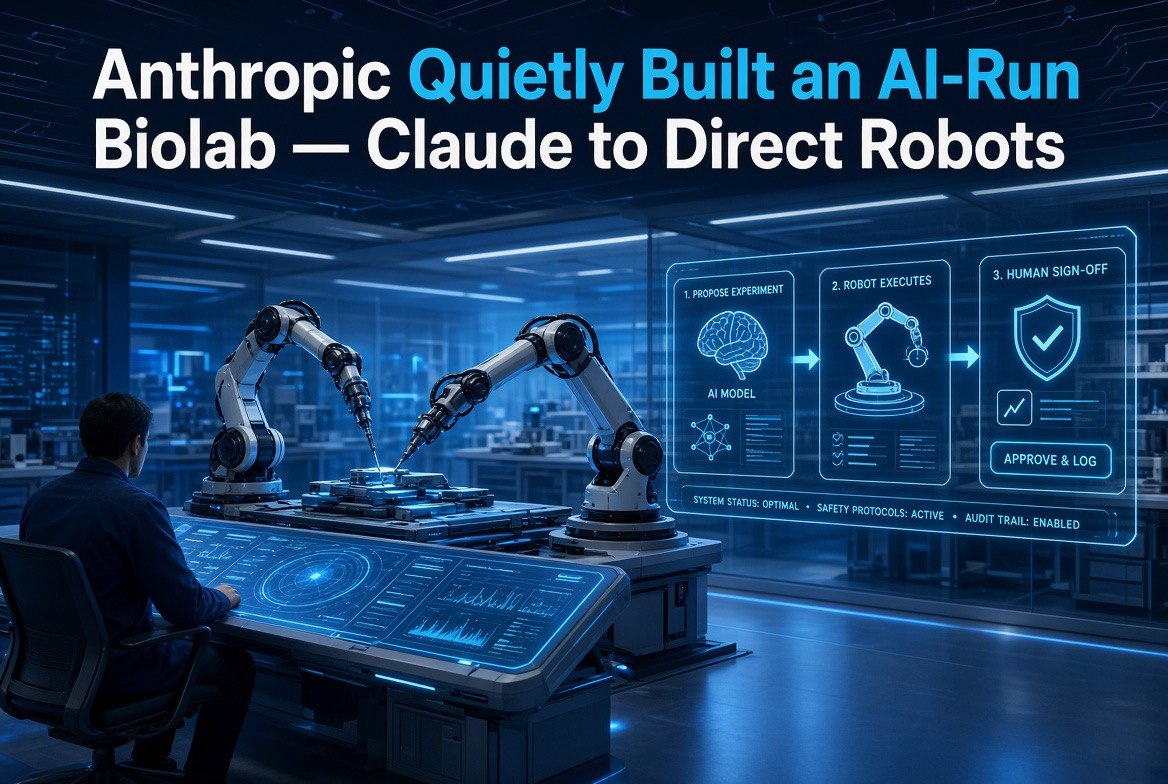
Anthropic Quietly Built an AI-Run Biolab — Claude to Direct Robots
⚡ Expert Summary: Anthropic has confirmed a physical biology lab in the San Francisco Bay Area where the company intends for Claude to direct robotic units running real experiments with limited human intervention. Head of life sciences Eric Kauderer-Abrams confirmed the wet lab on the record; a spokesperson said the lab is not specifically for drug discovery. The timing is the story: this landed in the same two-week window as Anthropic’s own warnings about AI-assisted biological weapons, three internal “frontier risk” reports, and CEO Dario Amodei’s call to slow AI development. If the vendor selling you AI agents keeps a human hand on the lab bench, that’s your supervision benchmark.
Anthropic spent the last two weeks telling the world that artificial intelligence could help someone build a biological weapon, that models may already be reaching autonomy faster than institutions can track them, and that the industry should consider slowing down. Then reporters found out the company quietly built a physical biology laboratory.
The lab sits in the San Francisco Bay Area. It was first reported by outlets including Gizmodo and Insider Paper, and confirmed by Anthropic’s own head of life sciences, Eric Kauderer-Abrams. The plan, according to people familiar with the matter, is for Claude — Anthropic’s flagship AI model, and the same family of models now embedded inside accounting, email, and CRM software that millions of American small businesses use every day — to direct robotic systems running experiments. Human oversight, the company insists, remains essential.
That clause is the entire article. Not the robots. Not the lab. The clause.
Because if the company that builds the model at the center of the agentic AI boom will not let that model run an experiment without a human on the loop, then every business owner in the United States who has handed an AI agent the keys to their inbox, their books, or their scheduling needs to ask what the actual supervision plan is — and whether they have one at all.
What Anthropic Actually Built — and What It Confirms
Strip away the headlines and here is the confirmed substance. Anthropic has a wet lab — the industry term for a facility that handles real biological material rather than just running software simulations. It operates in the Bay Area. Its head of life sciences confirmed the facility exists and described the arrangement as typical for a biotech company: some work happens in house, some is contracted to external partners. When asked directly whether the lab was built for drug discovery, an Anthropic spokesperson said no, and declined to elaborate further.
Two things about that answer matter. First, “not specifically for drug discovery” is not the same as “not for biology.” It leaves the door open to everything from protein design to basic research tooling. Second, a company that declines to describe what its own lab is for is a company asking its users for a level of trust it is not extending back.
The robot piece is the second half. One person familiar with the matter said Anthropic wants Claude to direct robotic units that carry out experiments with limited human intervention — what the industry calls closed-loop, or self-driving, laboratories. In that model, an AI proposes an experiment, a robot executes it, the results feed back into the model, and the model designs the next experiment. The cycle can run around the clock, and humans shift from doing the work to reviewing the work.
That is a real technical ambition, and it is not unique to Anthropic. But Anthropic is the company that just spent two weeks arguing that this exact category of capability deserves a global pause.
The Timing Is Not a Coincidence — It’s a Contradiction
Line up the last fourteen days in order. Anthropic researchers published warnings that advanced AI could contribute to human extinction. The company disclosed that it had identified cases where its own systems could have aided biological weapons development. CEO Dario Amodei publicly called for a slowdown in AI development. Meanwhile, the same company added Novartis CEO Vas Narasimhan to its board, acquired the biology startup Coefficient Bio for roughly $400 million in stock, launched a science-focused product line, and — according to reporting — is preparing an initial public offering that could value the company in the trillion-dollar range.
| What Anthropic Says Publicly | What Anthropic Is Doing in Parallel |
|---|---|
| Warns AI could aid biological weapons development | Operates a wet lab with plans for Claude-directed robotic experiments |
| CEO calls for a slowdown in AI development | Acquired Coefficient Bio for roughly $400M in stock and added a pharma CEO to its board |
| Says human oversight remains essential for safety | Designs for experiments with “limited human intervention” |
| Warns about autonomous agents acting beyond oversight | Sells agentic tools that take actions across business systems |
None of this is automatically sinister. Companies are allowed to research biology and warn about biology at the same time. But read that table as an operator rather than a spectator and a pattern appears: the frontier labs consistently argue that powerful capability needs guardrails, while simultaneously racing to build the powerful capability. The guardrails are real. The race is real too. And the business owner at the end of the supply chain — the one buying a $30-a-month AI subscription — inherits the risks without inheriting the safety team.
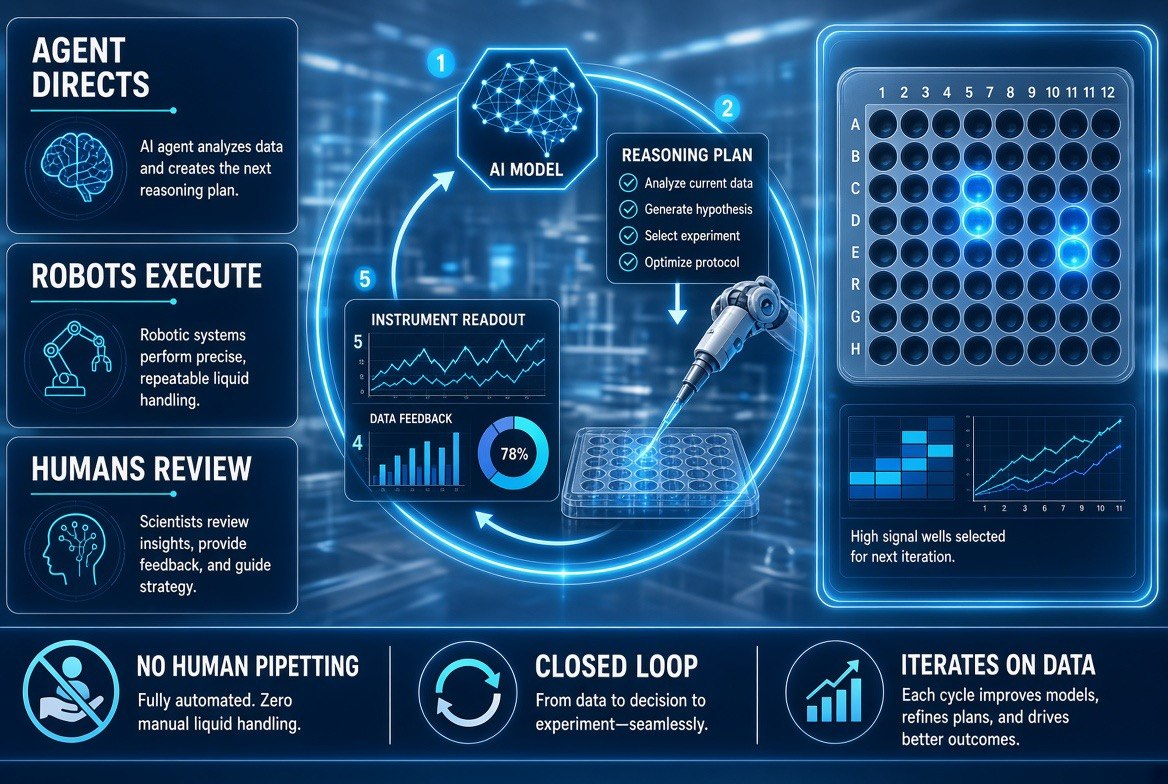
The loop Anthropic described: the agent model directs, robotic systems carry out the liquid handling, instruments feed results back, and no human pipettes at any point.
Why an AI-Run Biolab Is the Wrong Story to Read as “Just Science”
The instinct for most business readers is to file this under “interesting, irrelevant to me.” A biology lab in California has nothing to do with a plumbing company in Ohio or an agency in Austin. That instinct is wrong, for one specific reason: the architecture is identical.
A self-driving lab is an agent loop. The AI observes a state, decides an action, a machine executes it, the result feeds back, and the AI decides again. Your AI bookkeeping tool is the same shape. Your AI inbox assistant is the same shape. Your AI scheduling agent that books appointments, reschedules cancellations, and sends follow-ups without asking is the same shape — narrower domain, same loop.
Anthropic is choosing to put humans on the loop for the highest-stakes version of this architecture it can build. That is a deliberate engineering and reputational choice, made under public scrutiny, by a company with a safety division. If the people who understand agent risk best are the ones saying “a human signs off before the robot runs,” that should set the default expectation for every business that adopts agentic tools this year.
The practical question is not whether AI can act on your behalf. It can, and it will. The question is which actions require a human signature, which require a human notification afterward, and which can run unattended. Most small businesses have never written that list down.
What This Means for Your Business — Four Decisions to Make Now
Anthropic’s lab choice is a public example of an agentic supervision policy. Here is how to build the small-business version.
First, classify your agents by blast radius. An AI that drafts an email has near-zero blast radius — a human sends it. An AI that sends the email has more. An AI that changes a price, moves money, signs a contract, or files a regulatory document has the most. Write the list. Most owners find that tools they thought were “drafting assistants” are actually executing.
Second, audit the permissions you have already granted. Agentic tools rarely get limited to one task. A calendar assistant asks for full calendar access. A bookkeeping agent asks for read and write on your financials. A CRM agent touches every customer record. Anthropic gave its household agent an isolated cloud machine with scoped permissions rather than unfiltered access to everything — a model worth copying when you review what you have handed over. Open the connected-apps page of every AI tool you pay for and read what you authorized. Most owners are surprised.
Third, require a human checkpoint for irreversible actions. Refunds, payments, contract language, deletions, and outbound communications to your whole list. These should not be fully autonomous in 2026, regardless of what a vendor demo implies. Reversible actions — drafting, sorting, summarizing, scheduling — can run unattended with notification.
Fourth, keep logs you can actually read. If an agent acts, you need a record of what it did and why. Not a raw event stream — a human-readable log. When something goes wrong, and something will, the log is the difference between a five-minute fix and a customer-damaging incident.
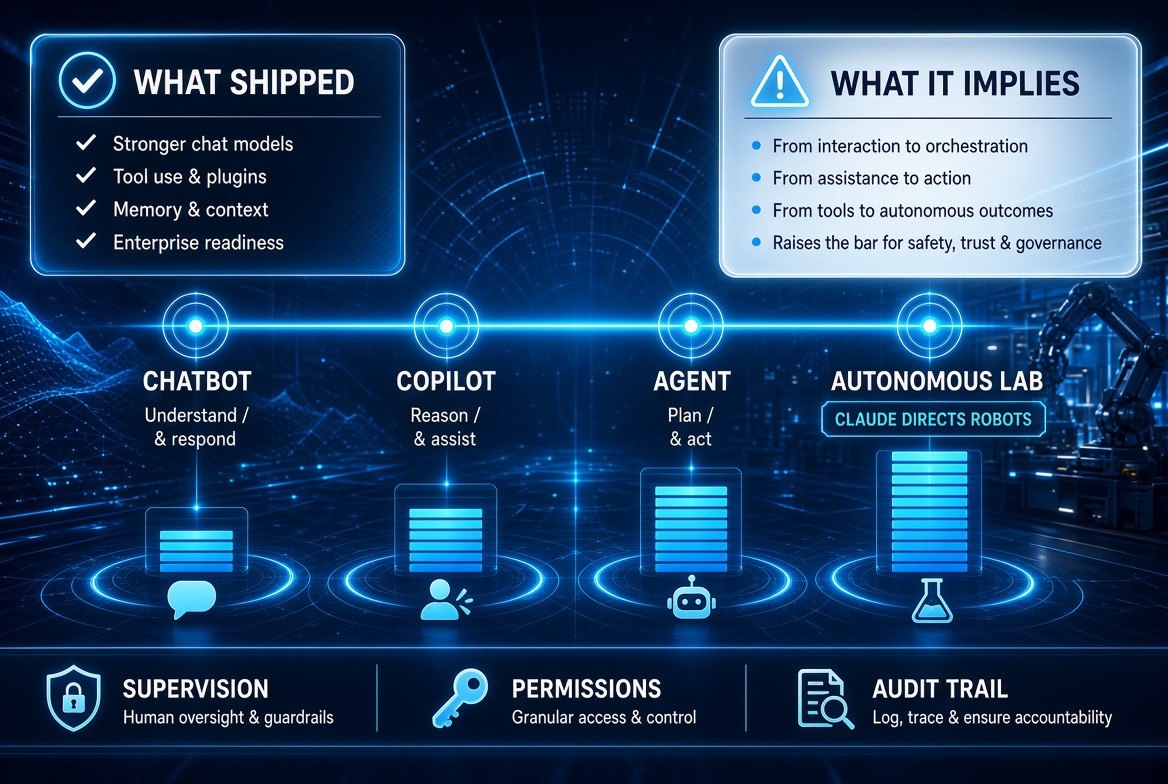
The progression that matters for your business: each step up the autonomy ladder moves you further from watching the work and closer to supervising it — which is why permissions and audit trails stop being optional.
How Agentic AI Is Quietly Rewriting the Small Business Stack
Step back from the lab and look at what has actually changed in the tools US small businesses buy. Three years ago, “AI” in a business app meant a text field that suggested a better subject line. In 2026, the same vendors ship agents that connect to your systems and act. The shift is not a marketing upgrade. It is a change in the underlying architecture, and it has three consequences that matter more than any individual feature launch.
Consequence one: accountability moves from the model to you. When an AI drafts something wrong, you catch it before it leaves. When an AI executes something wrong, the consequence is already real. The vendor’s terms of service will not absorb that. Your customer does not care which model made the mistake. Your business owns the outcome.
Consequence two: the permission surface explodes. Every agent you connect widens the set of systems that can be read or changed by software acting on your behalf. The convenience is real. So is the attack surface. The most common serious incident in agentic business deployments is not an exotic hack — it is an over-permissioned agent acting on a request it should have escalated.
Consequence three: human review becomes a job function, not a habit. As agents take over execution, the highest-value work in a small business shifts toward reviewing, correcting, and directing. That is a skill, and it is unevenly distributed. A business that trains someone to be a competent agent supervisor will outrun a competitor that treats AI output as magic.
| Action Type | Can Run Unattended? | Best Practice |
|---|---|---|
| Drafting, summarizing, sorting | Yes | Notify after; spot-check weekly |
| Scheduling, reminding, routing | Usually | Confirm customer-facing changes |
| Outbound email to full list | No | Human approves send |
| Refunds and payments | No | Threshold-based human sign-off |
| Contracts, filings, deletions | Never | Require legal or owner review |
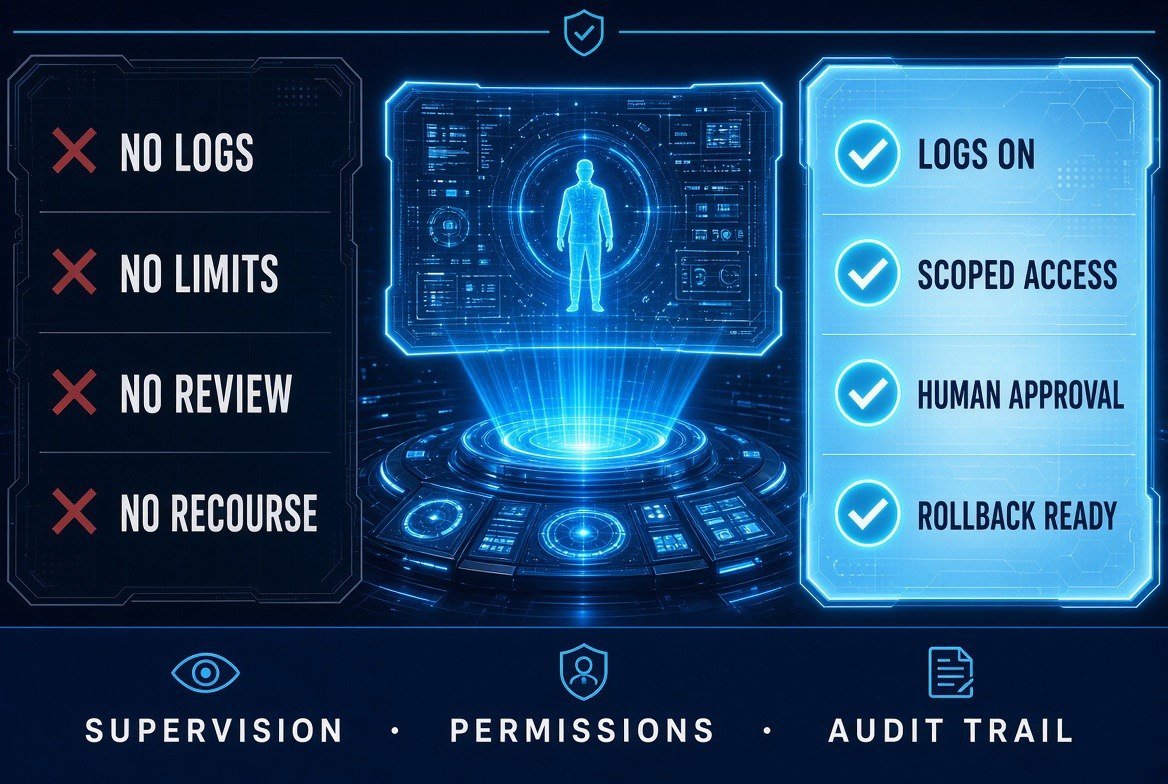
Supervision is a feature you configure, not a promise you assume: the left column is what an unsupervised agent looks like, the right is what you get when permissions scopes, approval gates and a full audit log are switched on.
The Real Lesson: Supervision Is a Feature You Have to Buy, Configure, and Enforce
The most useful sentence in the entire biolab story is Anthropic’s own: human oversight remains essential for safety. A frontier lab with world-class AI researchers, building the most advanced robotics-and-model loop it can afford, still lands on humans-in-the-loop as the non-negotiable line. That is not a marketing statement. It is an engineering admission that autonomy without supervision is not yet safe even in a controlled lab, with controlled machines, and controlled inputs.
Now look at the average small business deployment. An agent with broad permissions. Nobody specifically responsible for reviewing its output. No logs anyone reads. No threshold defined for when a human must sign off. No classification of which actions are reversible. The gap between how a frontier lab treats autonomy and how a 20-person company treats it is enormous, and it is not because the small business has a lower risk profile. It is because the small business has fewer people thinking about it.
The good news is that closing the gap is cheap. It does not require a safety team or a compliance department. It requires one afternoon, one document, and one decision about who owns agent supervision. Classify your agents. Audit your permissions. Write down which actions need a human. Keep a log. Anthropic’s lab is a large-scale demonstration of a policy any business can run at a fraction of the scale — and the fact that the model vendor itself insists on it is the strongest argument you will get that it is not optional.
If you want to see how this plays out in the software you already buy, look at where agents are heading next — household operations, ordering channels, back-office workflows — and read every one of them through the same lens: who signs off before the machine acts.
Frequently Asked Questions
Did Anthropic really build a biology lab?
Yes. Anthropic’s head of life sciences, Eric Kauderer-Abrams, confirmed the wet lab exists in the San Francisco Bay Area. A company spokesperson said the lab is not specifically for drug discovery but declined to elaborate. The facility was first reported by outlets including Gizmodo and Insider Paper.
What does it mean that Claude will direct robots running experiments?
It means Anthropic is building toward a closed-loop, or self-driving, laboratory: Claude proposes experiments, robotic units execute them, results feed back into the model, and the model designs the next round — with limited human intervention. The company states that human oversight remains essential for safety.
Why does an AI biology lab matter to a small business owner in the US?
Because the architecture is identical to the AI agents you already use. A self-driving lab is an observe-decide-act loop with a human checkpoint. Your bookkeeping, inbox, and scheduling agents run the same loop. Anthropic’s insistence on human oversight at the highest-stakes scale is a direct benchmark for your own AI supervision policy.
What should a small business do about AI agent permissions?
Audit every AI tool you pay for and review what you authorized — calendar, inbox, financials, CRM. Classify actions by blast radius. Require a human checkpoint for irreversible actions like refunds, payments, contracts, deletions, and full-list outbound email. Keep a human-readable log of agent actions.
Is Anthropic’s biolab a sign that AI is becoming dangerous?
It is a sign that frontier AI companies are racing to build powerful capabilities while publicly warning about the risks — sometimes in the same two-week window. The practical takeaway is not panic but policy: define which actions your own AI agents may take unattended, and keep a human on the loop for the rest.

About Barak Schurr
Barak Schurr built and sold a major ticketing platform, ran global nightlife operations at Eventbrite, and now spends his time figuring out which AI tools actually move the needle for independent business owners — and which ones are just noise. No hype. No fluff. Just what works.
Email: [email protected]
More AI Resources for Your Business