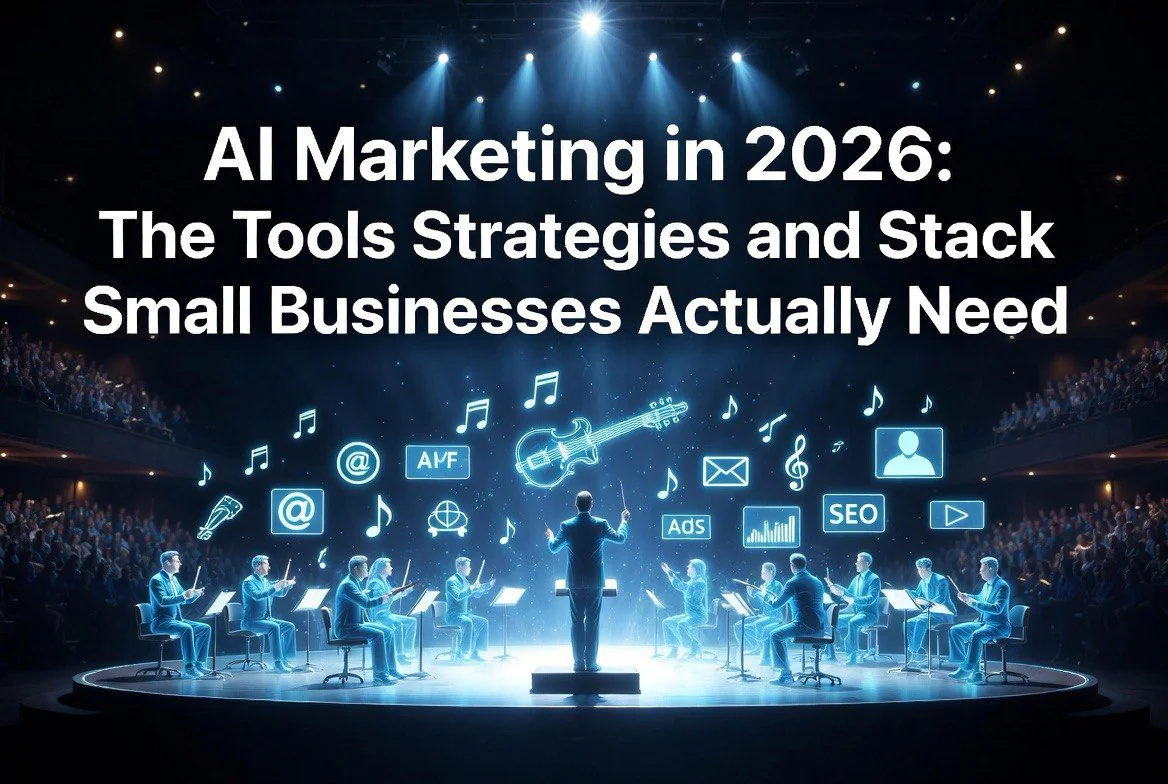
AI Marketing in 2026 — The Tools, Strategies, and Stack Small Businesses Actually Need
By 2026, 82% of small businesses have invested in AI tools — and marketing is the #1 use case according to SBE Council data. But most of them aren’t getting the ROI they expected. They’re using AI to generate random blog posts and social media updates without a strategy. The ones who are winning — the ones reporting 10-20+ hours saved per week and measurable revenue increases — are using a structured AI marketing stack tailored to their business size. This article breaks down exactly which tools to use at each stage, how much to spend, and where human judgment still matters.
What’s the Best AI Marketing Stack for a Solopreneur in 2026?
If you’re running a business by yourself or with one other person, your AI marketing stack needs to be cheap, dead simple, and cover four things: writing, visuals, scheduling, and research. Here’s exactly what I recommend:
Writing: ChatGPT Plus ($20/month). I’ve tested every writing tool on the market. Chatter, Jasper, Copy.ai, Writesonic, Rytr — they all claim to be “purpose-built for marketers.” Most of them are just wrappers around the same underlying models with a $30-50/month markup. ChatGPT Plus gives you access to the best models, a clean interface, and zero marketing fluff. Use it for blog posts, email sequences, landing page copy, and social media captions.
Visuals: Canva Pro ($13/month). Canva’s Magic Studio features — Magic Write, Magic Eraser, Magic Expand, background removal, and the AI image generator — cover 90% of what a solopreneur needs for marketing visuals. The templates are good enough that you don’t need a designer for social media graphics, blog featured images, or simple ad creatives.
Scheduling: Buffer free tier ($0/month) or Hootsuite free tier ($0/month). For a solo operator, scheduling posts to 3 platforms is free. Don’t pay for scheduling until you’re posting multiple times per day across 5+ platforms.
Research: Perplexity ($0 for free tier, $20/month for Pro with unlimited searches and file uploads). Before you write anything, research it in Perplexity. It surfaces current data, quotes from named sources, and competing content — all of which makes your AI-written content more authoritative.
Total cost: $33-53/month. Covers: writing, design, scheduling, research. Time saved: 10-15 hours/week.
How Much Does AI Marketing Cost Per Month?
Let me save you the math I’ve already done across dozens of businesses:
- Starter tier (1-2 people): $33-60/month. ChatGPT Plus or Claude Pro, Canva Pro, and one free scheduling tool and one free research tool. Handles everything except advanced video production and custom automation.
- Growth tier (3-10 people): $120-250/month. ChatGPT Team or Claude Team ($25-30/person), Canva Pro with brand kit, Perplexity Pro for research, and Make or Zapier for automation. This is where you add a CRM with AI features — HubSpot Starter with Breeze AI ($20/month) to handle lead scoring and email automation.
- Scale tier (10-50 people): $400-1,000/month. ChatGPT Enterprise or Claude Enterprise, a dedicated image generator (Midjourney), Perplexity Pro for the team, a proper automation platform (Make or n8n), plus Surfer SEO for AI search optimization and HubSpot Professional for full CRM automation with AI workflow builder.
The most common mistake I see? Businesses at the Starter tier buying tools for the Scale tier. You don’t need an all-in-one AI marketing platform when you’re producing 3 pieces of content per week. Start lean. Add as your output grows. Most businesses should be spending $50-100/month on AI marketing tools until they’re producing 10+ content pieces per week.
AI Content Creation: How It Works for a 2-Person Team
I work with a lot of 2-person teams — a founder and one employee, or two co-founders. Here’s how AI content creation actually works at that scale:
Research phase (30 minutes, done once per piece): One person researches the topic using Perplexity. They pull 3-5 sources, identify the unique angle, and note 2-3 data points that make the content credible. They paste this into a shared ChatGPT thread.
Drafting phase (15 minutes): The other person opens the ChatGPT thread, reviews the brief, and generates a first draft. They use a specific prompt: “Write a 1,500-word blog post on [topic] for [audience]. Use first person. Include the data from these sources. Structure it with clear headers. End with actionable takeaways.”
Editing phase (20 minutes): The person who did the research edits the draft. They add their own opinions, remove anything that sounds like generic AI output, inject specific examples from their own experience, and ensure the brand voice is consistent. This is where the human touch lives.
Publishing phase (10 minutes): They upload the post, add a featured image from Canva, schedule it, and move on.
Total time per piece: 75 minutes. Traditional time without AI: 4-6 hours. Savings: 75-80%.
The key insight: the AI does the heavy lifting of turning research into readable prose. The human does the part AI can’t — voice, opinion, specificity, and authenticity. Teams that skip the human edit get generic content that doesn’t rank or convert. Teams that lean on it produce 4-5x more content in the same time without sacrificing quality.
Why GEO Matters More Than SEO in 2026
GEO — Generative Engine Optimization — is the biggest shift in content marketing since Google’s PageRank algorithm. It’s not about ranking in Google search results anymore. It’s about ranking in AI-generated answers.
When someone asks Perplexity “what’s the best AI marketing tool for a small business?” or ChatGPT “how do I start using AI for marketing?” the AI reads your content and decides whether it’s authoritative enough to cite. If your content is optimized for GEO, you get cited. If it’s not, you don’t exist in the AI’s answers.
Here’s how GEO differs from traditional SEO, and why it matters for small businesses:
- Conversational queries: Traditional SEO targets keyword phrases. GEO targets natural questions people actually ask in conversation. “What’s the best…” “How do I…” “Why should…” — these are GEO queries.
- Direct answers: SEO rewards length and depth. GEO rewards clarity and directness. An AI needs to be able to pull a clean, authoritative answer from your content without ambiguity.
- Named sources: AI models rank content higher when it cites specific data from named sources. “Studies show” is meaningless to an AI. “The SBE Council’s 2026 survey of 3,200 small businesses found that 82%…” is gold.
- Structured information: AI systems love structured content — headers that read like answers, bullet lists for comparisons, FAQ sections with clear Q&A pairs. This maps to how AI models extract and present information.
- Zero fluff: AI-generated snippets are truncated at a specific context length. Every sentence needs to earn its place. If it’s not advancing the argument or providing data, cut it.
The small business advantage here is real. Large companies move slowly — their content is approved by legal, rewritten by committee, and published weeks late. You can pivot to GEO-optimized content today and start showing up in AI answers while your competitors are still debating whether to invest in it.
How AI Marketing Tools Are Changing Small Business ROI
I’ve been tracking the numbers across clients and public case studies. Here’s what the data shows for small businesses that adopt a structured AI marketing approach:
- Content output: 3-5x increase in publishing frequency. Same team, same budget, more content.
- Cost per piece: 70-80% reduction. A $200 blog post becomes a $40-50 blog post.
- Time to first draft: From 4-6 hours to 20-30 minutes. The editing phase is still human, but the blank page problem disappears.
- Revenue attribution: Businesses using AI for marketing report 25-40% of new leads coming from AI-generated or AI-assisted content (SBE Council, 2026).
- Competitive advantage: 68% of small businesses are still not using AI for marketing at all (Forbes, 2026). The 32% who are using it have a massive head start.
But here’s the catch: the ROI numbers are real only if you have a process. Buying ChatGPT and expecting magic is like buying a tractor and expecting a farm to appear. The tool is useless without the system around it.
The Specific Tools That Make Up a Real AI Marketing Stack
Not all AI marketing tools are created equal. Here are the ones I’ve actually used and can recommend, organized by function:
Content Generation
ChatGPT Plus or Pro ($20/month): The best all-around writing tool. Handles blog posts, emails, landing pages, social copy, and strategy brainstorming. The GPT-4 model in ChatGPT understands brand voice instructions better than any specialist tool I’ve tested.
Claude Pro ($20/month): Better for long-form content (3,000+ words), technical documentation, and content that requires careful structure. I use Claude when I’m writing a detailed guide or an ebook. I use ChatGPT for everything else.
Jasper ($49-69/month): Only worth it if you’re producing 20+ branded pieces per month and need brand voice training across multiple templates. For most small businesses, ChatGPT does everything Jasper does for less money.
Visual Content
Canva Magic Studio ($13/month): Best value for small businesses. The AI image generator, background removal, Magic Write, and Magic Expand features eliminate the need for a designer for most marketing visuals.
Midjourney ($10-30/month): Essential if you need high-quality, custom imagery for marketing campaigns. The learning curve is steeper than Canva (it runs on Discord), but the output quality is significantly better.
Automation and CRM
HubSpot Breeze AI ($20-50/month): HubSpot’s AI layer — Breeze — handles content generation, email personalization, lead scoring, and social media management within the CRM. For businesses already using HubSpot, this is a no-brainer addition.
Make ($9-29/month): Better than Zapier for most marketing automation workflows. More flexible, cheaper at scale, and the visual builder is intuitive enough for non-technical marketers to use.
Search and Research
Perplexity Pro ($20/month): The research tool I use before every piece of content I write. It pulls from current, cited sources with links — which means your AI-generated content can reference real data from named sources, making it GEO-friendly.
Surfer SEO ($69-179/month): Essential if content rankings matter to your business. Surfer analyzes what the top-ranking content looks like for any keyword and gives you a data-driven content brief. Combine this with GEO optimization for maximum reach.
Analytics
Cloudflare Web Analytics (free): Privacy-first, free, and gives you all the data you need — page views, unique visitors, top pages, referrers, and country breakdowns. No cookie banners needed.
Where Human Oversight Still Matters (and Always Will)
AI marketing tools are powerful, but they have specific, well-documented weaknesses that require human oversight. Here’s where I tell every client to keep a human in the loop:
Brand voice. AI can imitate your brand voice on a good day. It can’t invent it. Your brand voice is built from your values, your specific industry experience, your customers’ specific problems, and thousands of human decisions over years. AI can maintain that voice once you’ve established it. It can’t build it from scratch.
Strategy and messaging hierarchy. AI is great at execution — write this, design that, schedule the other thing. It’s terrible at strategic decisions. Which product should we feature this quarter? How should we position against a specific competitor? What’s the messaging hierarchy for a new market? These decisions require business context, market intuition, and judgment that AI doesn’t have.
Authenticity and trust. Readers can smell AI-generated content that wasn’t reviewed by a human. It reads generic. It hedges too much. It lacks the specific, sometimes controversial opinions that make content worth reading. The highest-performing content I’ve seen consistently has one thing in common: a strong, distinctive human perspective backed by AI execution.
Sensitivity and context. AI doesn’t understand cultural nuance, seasonal timing, or current events that might affect how your content is received. A marketing post that works in January might land wrong in June, when a crisis in your industry changes the context. Humans need to make the call on timing and framing.
The formula I’ve seen work consistently across small businesses: AI does the work, human makes the decisions. AI drafts, human edits. AI generates options, human chooses. AI executes, human approves. This hybrid approach delivers 3-5x the output without sacrificing the quality that makes your brand worth reading.
The Trap: Don’t Treat AI Marketing Tools as Magic Buttons
The fastest way to waste money on AI marketing tools is to treat them as magic buttons. You’ve seen the ads: “Generate a month of content in 10 minutes!” “Automate your entire marketing with one click!” “Let AI write your blog posts while you sleep!”
It’s not that simple. Here’s the reality check:
AI-generated content needs editing. The first draft from any AI tool is a solid starting point — not a publishable piece. Plan 30-40% of your content production time for editing. If you’re not editing, you’re publishing generic content that doesn’t rank and doesn’t convert.
AI needs context to be useful. The quality of AI output is directly proportional to the quality of your input. Spend time writing good prompts. Include your brand guidelines, customer profiles, and content examples. The businesses that get the most from AI marketing are the ones that invest in prompt engineering and content strategy up front.
AI doesn’t build relationships. Automated email sequences, social media posts, and follow-up messages — AI can generate all of these. But a prospect’s first meaningful interaction with your business shouldn’t be an AI-generated message. Use AI for the volume work. Do the relationship work yourself.
AI doesn’t replace market research. The most valuable marketing insights come from talking to customers, monitoring competitor moves, and understanding industry trends. AI can help you organize and act on those insights. It can’t discover them for you.
How to Start Using AI for Marketing Today (Including Prompts)
If you’re starting from zero, here’s your 3-day plan:
Day 1: Sign up for ChatGPT Plus and Perplexity (free tier). Spend 30 minutes researching 3 topics your customers ask about most. Pull real data and specific numbers. Save everything in a shared document.
Day 2: Write one blog post using this prompt:
“You are a marketing writer for [business type]. Write a 1,500-word blog post titled [topic]. Use first person. Include these specific data points: [paste research]. Structure with clear H2 headers. Write in a direct, opinionated style — no hedging, no passive voice. End with 3 actionable takeaways. The audience is [target audience]. The goal is [goal].”
Then spend 20 minutes editing. Add your own experiences. Remove anything that sounds generic. Tighten every paragraph.
Day 3: Create a basic Canva template for your blog featured image. Publish the post. Repurpose it into 3 social media posts (one quote, one stat, one key takeaway). Schedule them. Done.
That’s one piece of content, end-to-end, in 3 days with about 2 hours of total work. Do this weekly, and in 3 months you’ll have 12 pieces of GEO-optimized, human-reviewed content — which is more than most small businesses produce in a year without AI.
Frequently Asked Questions
What’s the best AI marketing stack for a solopreneur?
ChatGPT Plus ($20/month) for writing, Canva Pro ($13/month) for visuals, Perplexity (free) for research, and Buffer free tier for scheduling. Total: $33/month. This covers writing, design, research, and scheduling for a solo operator.
How much does AI marketing cost per month?
Starter tier: $33-60/month. Growth tier: $120-250/month. Scale tier: $400-1,000/month. Most small businesses should spend $50-100/month on AI marketing tools until they’re producing 10+ pieces of content per week.
What is GEO and why does it matter for marketing?
GEO (Generative Engine Optimization) is the practice of optimizing content so it gets cited by AI search engines like Perplexity, ChatGPT Search, Gemini, and Google AI Overviews. It matters because AI-generated answers are becoming the primary way people find information online. If your content isn’t GEO-optimized, you’re invisible in AI answers.
Will AI replace marketing jobs?
No. AI replaces marketing tasks, not marketing jobs. The businesses that succeed with AI are the ones where humans make the strategic decisions and AI executes the tactical work. The 80% of content creation that was previously busywork becomes automated. The 20% of strategy, voice, and relationship-building that drives results stays human.
How do I get started with AI marketing on a tight budget?
Start with three free tools: ChatGPT free tier for drafting, Canva free tier for basic visuals, and Perplexity free tier for research. Do this for a month. Track how much time you save. If it’s meaningful, upgrade to the paid tiers. The ROI of $33/month is obvious after two weeks.
Barak Schurr built and sold a major ticketing platform, ran global nightlife operations at Eventbrite, and now spends his time figuring out which AI tools actually move the needle for independent business owners — and which ones are just noise. No hype. No fluff. Just what works.
Contact him at [email protected]
More AI Resources for Your Business