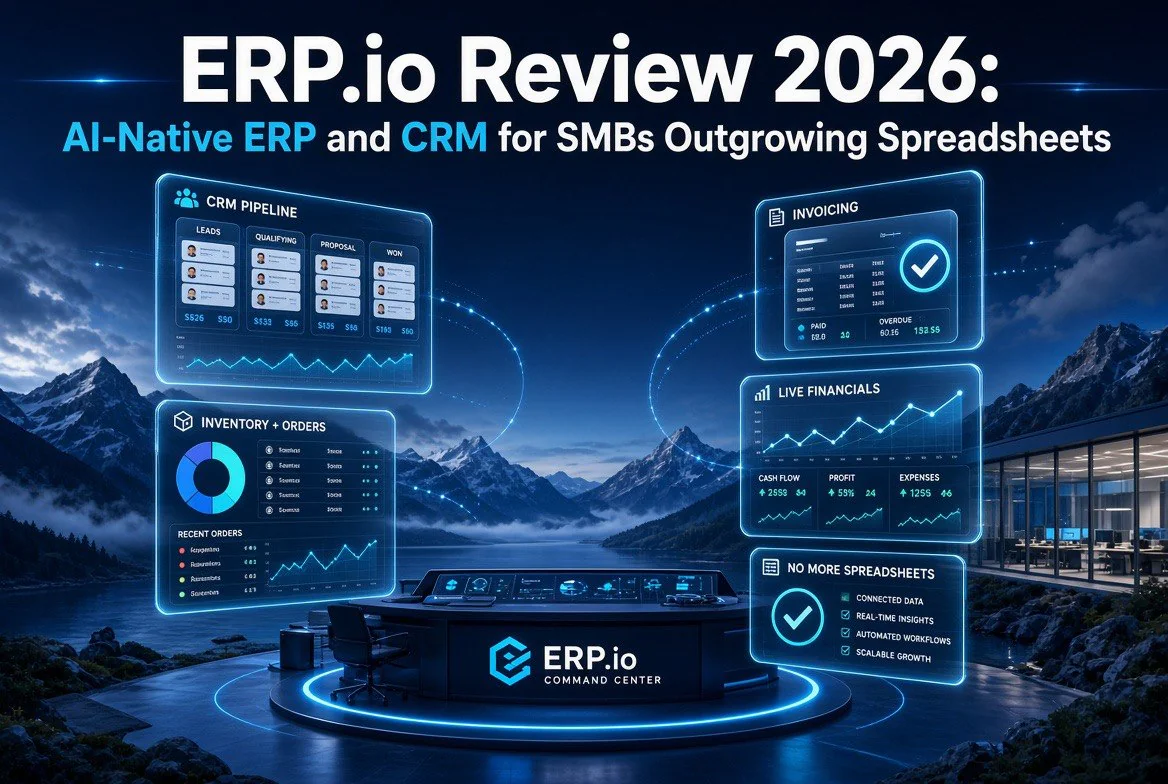
ERP.io Launches AI-Native ERP & CRM: One Unified System for SMBs Outgrowing Spreadsheets
⚡ Expert Summary: ERP.io launched August 30, 2026 as an AI-native ERP and CRM platform built for small and mid-market businesses that are outgrowing a patchwork of disconnected tools. Instead of adding AI onto software designed before modern AI existed, it was built around AI from the start — merging customer, sales, finance, project, and operations data into one system with AI assistants that answer questions in plain language and execute workflows. It targets the SMBs who want sophisticated business software without the cost, complexity, and long consulting projects of traditional enterprise ERP. The platform is being developed from Bentonville, Arkansas and is currently available at ERP.io.
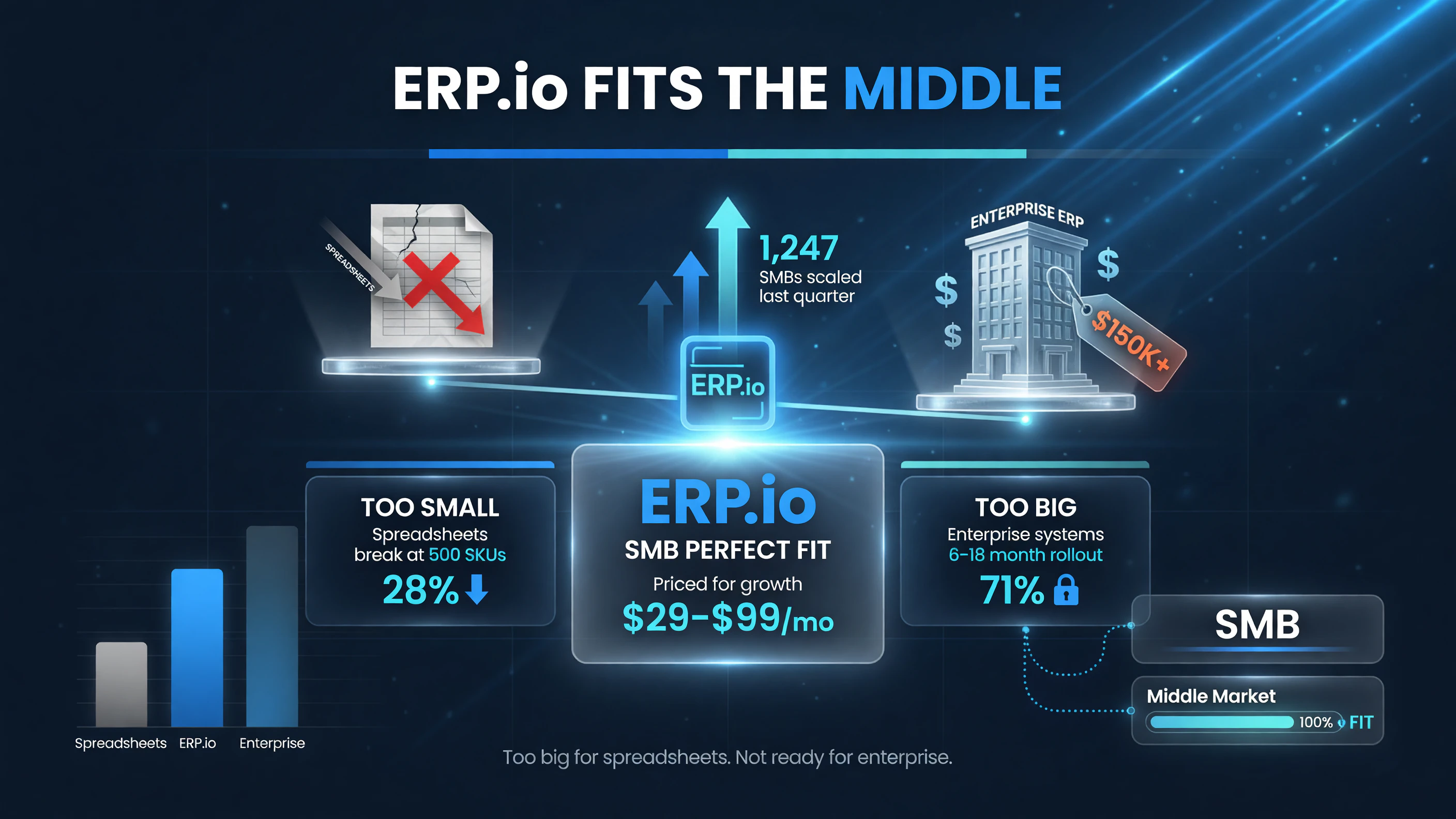
ERP.io targets the SMB gap: past the point where spreadsheets break down, before the cost and rollout pain of enterprise ERP.
Why SMBs Are Stuck Between Spreadsheets and Enterprise ERP
For many small and mid-market companies, the software decision feels like a choice between two bad options. On one side are spreadsheets and a handful of single-purpose tools — simple to start, but they break down the moment a business has more than a few customers, employees, or moving parts. On the other side is a traditional enterprise ERP: powerful, but expensive, slow to implement, and usually demanding a consulting engagement and a big internal buy-in just to get off the ground.
That gap is exactly the market ERP.io is targeting. It is built for the SMB that has outgrown the patchwork but does not want to inherit the cost and complexity of a system designed for Fortune 500 companies. The platform is meant to grow with the business, letting a team adopt the modules it actually needs while keeping one unified source of truth underneath. And because it is AI-native from the start, the reporting and workflow automation that normally takes IT or a consultant to build is something an owner can get by asking a question in plain language.
What ERP.io Actually Is
ERP stands for enterprise resource planning, and CRM stands for customer relationship management. Historically those are two separate categories of software: the ERP tracks finance, inventory, projects, and operations, while the CRM tracks leads, customers, and sales. Most businesses run them as different systems — and often add a third tool for reporting, a fourth for workflow automation, and a spreadsheet for everything in between.
ERP.io’s founding idea is that this fragmentation is the problem. “Most businesses have accumulated a collection of disconnected software systems that each manage a small piece of the company,” said Nate Nead, founder of ERP.io. “We want the business to operate from a shared system where the data, workflows, applications, and AI all work together.”
The platform brings CRM, ERP, business intelligence, workflow automation, and AI agents together inside a common data and application layer. Instead of asking five tools to talk to each other, a company operates from one source of truth.
Why “AI-Native” Matters
The key distinction in the launch is the phrase “AI-native.” Traditional ERP and CRM systems were built before modern AI existed and then had AI features bolted on later. ERP.io is designed around AI from the outset. That changes what the software expects from you: instead of navigating menus, building reports, exporting spreadsheets, and manually moving work between applications, you interact with the platform using natural language.
Users can ask questions like “Which customers are more than 30 days past due?”, “What opportunities are most likely to close this month?”, “Show me projects that are over budget”, or “Prepare a weekly operating report.” The AI retrieves the answer from the company’s own structured data — not a generic chatbot, but a system connected to the real records and workflows that run the business.
“AI changes the interface between people and business software,” said Timothy Carter, Chief Revenue Officer. “Instead of requiring employees to understand every screen, field, report, and workflow inside an ERP, the software should increasingly understand what the employee is trying to accomplish.”
The Core Capabilities at a Glance
| Capability | What It Covers |
|---|---|
| CRM | Leads, accounts, contacts, opportunities, pipelines, activities, customer relationships |
| Sales Automation | Lead routing, follow-up, pipeline management, forecasting, sales workflows |
| Financial Management | Invoices, payments, expenses, financial activity, operational performance |
| Accounts Receivable & Payable | Billing, collections, vendor invoices, approvals, payment workflows |
| Project Management | Projects, tasks, milestones, teams, budgets, deliverables |
| Operations Management | Repeatable workflows for internal processes and departmental operations |
| Reporting & Analytics | Dashboards, reports, forecasts, performance views across company data |
| AI Assistants & Agents | Retrieve info, analyze data, prepare reports, recommend actions, run multi-step processes |
| Workflow Automation | Trigger actions across sales, finance, service, operations, administration |
| Integrations | Connect existing apps, data sources, communications platforms, third-party services |
Bringing CRM and ERP Together
One of ERP.io’s most important moves is challenging the traditional separation between CRM and ERP software. Customer information often lives in the CRM, financial data in accounting software, project data in another app, support information in a different system, and operational data in spreadsheets. ERP.io connects all of those records around a common business data model.
“Businesses do not operate in separate CRM, accounting, marketing, and operations realities,” said Samuel Edwards, Chief Marketing Officer. “Those divisions mostly exist because software developed that way. When the underlying information is connected, AI can understand a much more complete picture of the customer and the business.”
Practically, that means a customer record can extend beyond contact info and sales activity to include proposals, contracts, invoices, payments, projects, support activity, communications, profitability, and other operational information. The AI sees the whole customer relationship instead of a narrow slice.
Built for SMB and Mid-Market Companies
ERP.io is being developed primarily for small and mid-market organizations that need increasingly sophisticated business systems but do not want the cost, complexity, consulting requirements, and lengthy implementations traditionally tied to enterprise ERP deployments. It is designed to support companies as they grow, letting them adopt the modules they need while keeping a unified underlying system.
Potential users include professional services firms, agencies, software companies, manufacturers, distributors, construction companies, financial services businesses, ecommerce companies, technology firms, and other organizations with complex operational workflows. ERP.io is also designed to accommodate industry-specific configurations rather than forcing every company into the same operating structure.
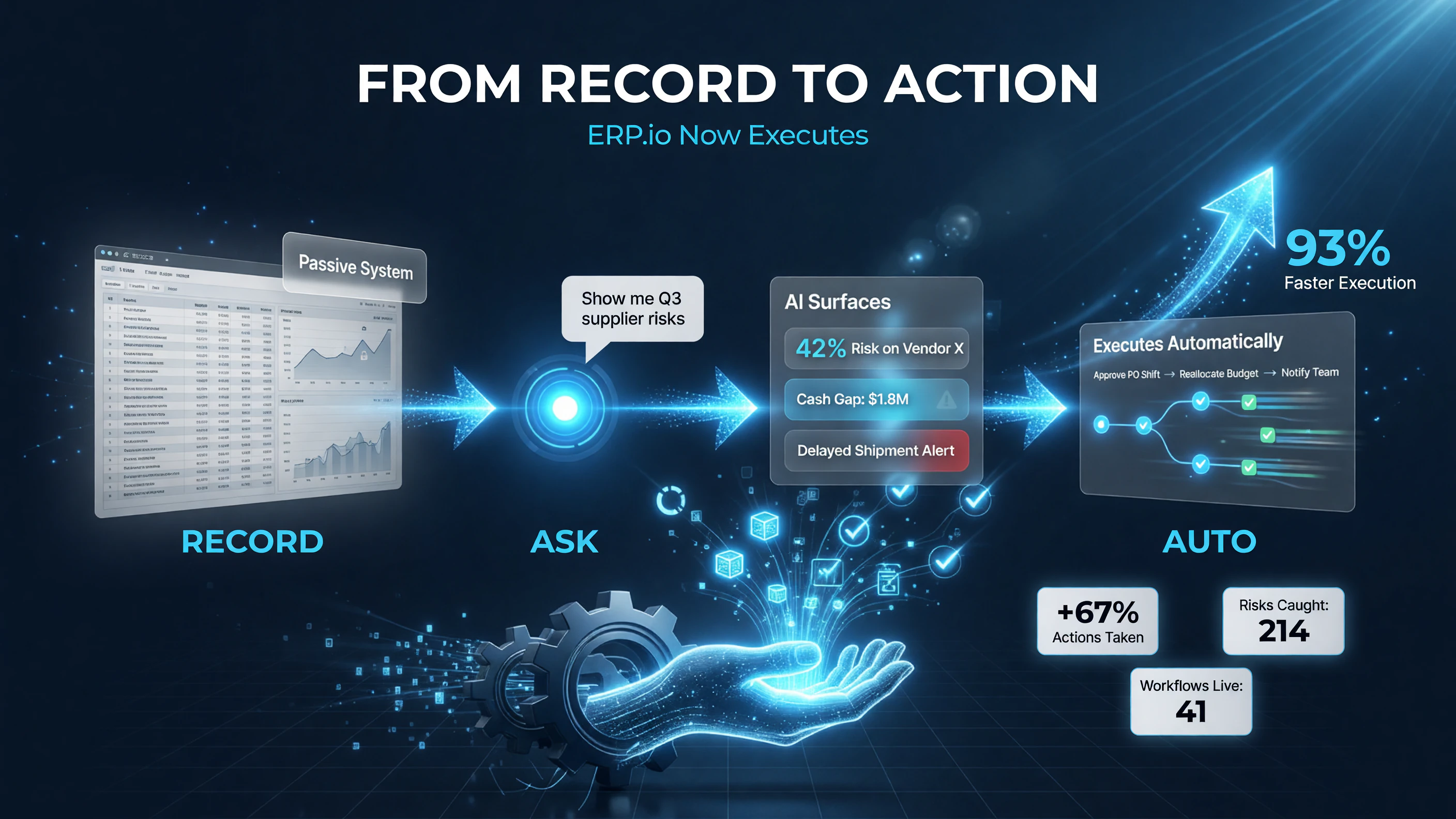
ERP.io turns stored records into action: ask in plain language, and the AI surfaces risks and executes approved workflows automatically.
From System of Record to System of Action
The company’s broader vision is to move ERP from a passive system of record into an active system of intelligence and action. Traditional enterprise applications largely store information and wait for humans to decide what happens next. ERP.io is designed to continuously analyze operational information and help businesses identify exceptions, surface risks, recommend actions, and execute approved workflows.
Examples include identifying an overdue receivable and initiating a collection sequence, detecting a stalled sales opportunity and creating follow-up actions, identifying declining account activity, generating management reports, or flagging projects likely to exceed their budgets.
“The important shift is not simply putting a chatbot inside an ERP,” Nead said. “The larger opportunity is giving AI access to the structured data and workflows that actually run the company. Once those pieces are connected, AI can move from answering questions to helping operate the business.”
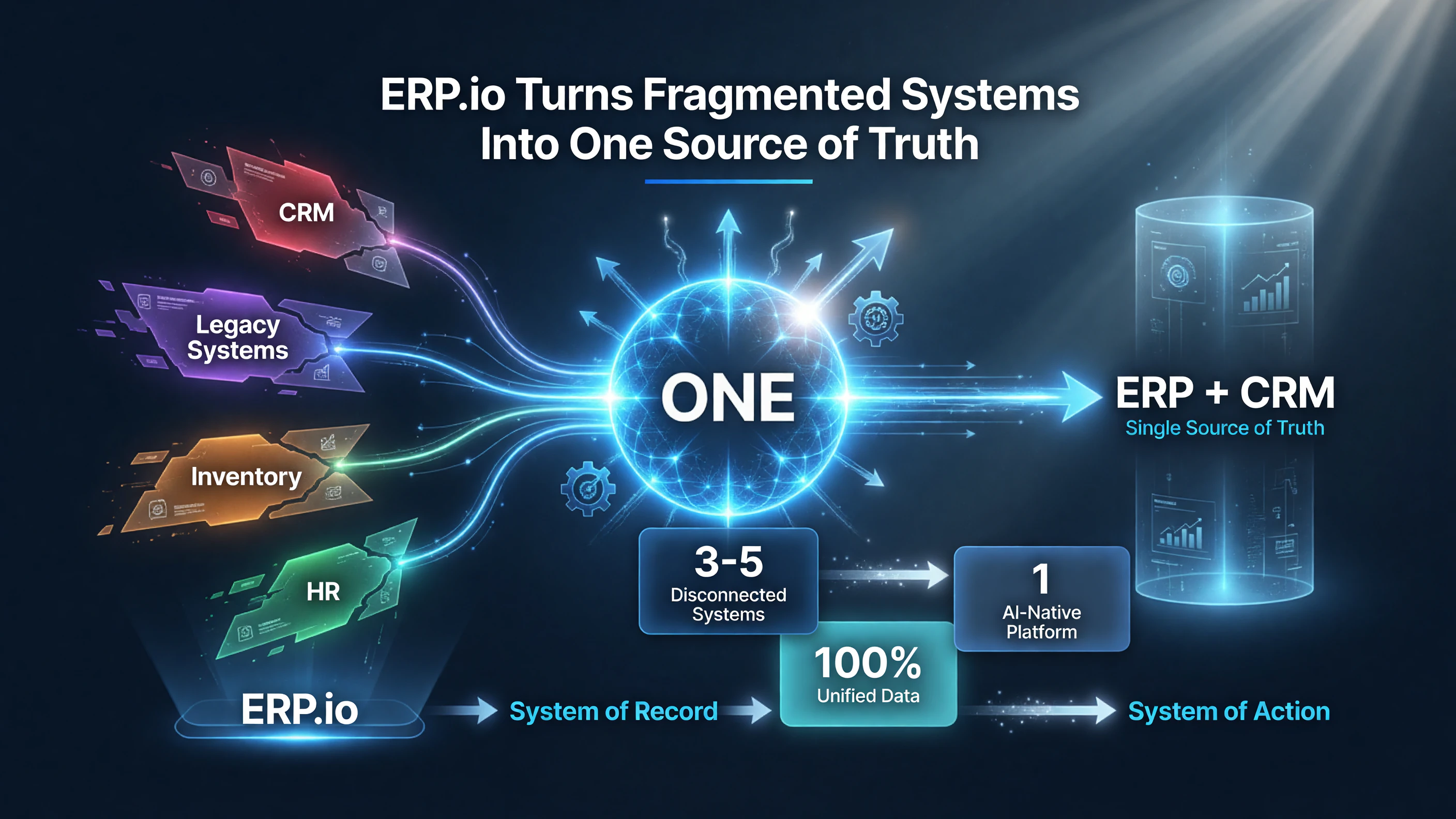
ERP.io collapses the 3-5 disconnected tools SMBs juggle into one AI-native ERP and CRM built on a shared data model.
ERP.io vs the Traditional Fragmented Stack
| Factor | Traditional Stack (CRM + ERP + more) | ERP.io |
|---|---|---|
| Data | Scattered across 3-5 disconnected systems | Unified in one common data and intelligence layer |
| AI design | AI added later, often as a chatbot on top | AI-native, built in from the start |
| Interacting | Menus, screens, fields, manual report building | Natural-language questions and automated workflows |
| Deployment fit | Often built for large enterprises with big budgets | Aimed at SMB and mid-market companies |
| Customer record | Contact + sales only, in the CRM | Contact + contracts + invoices + projects + support + profitability |
Built for US and Global SMBs Alike
ERP.io is headquartered in Bentonville, Arkansas, and is built for the realities of growing small and mid-market businesses rather than the demands of a small number of large enterprises. Bentonville is a fitting home — it is a hub for retail and logistics, where companies live and die by how well their operational, financial, and customer data line up. The platform is being designed for professional services firms, agencies, software companies, manufacturers, distributors, construction companies, financial services businesses, ecommerce companies, and technology firms that all face the same problem: their data is scattered and their growth is capped by that fragmentation.
Because ERP.io is designed to accommodate industry-specific configurations rather than forcing every company into one rigid structure, it has broad relevance across the American small-business economy and beyond. For a US owner reading this, the practical takeaway is simple: this is a tool aimed squarely at businesses like yours that want to stop living in five different systems and start operating from one connected picture of the company.
Who Should Consider ERP.io
ERP.io makes the most sense for a growing small or mid-market business that currently runs five disconnected tools and is tired of manual reconciliation. If you are a professional services firm, agency, software company, manufacturer, distributor, construction company, financial services business, ecommerce operation, or technology firm with complex operational workflows, this is squarely the target audience.
It is also worth watching if you want to reduce the time spent on report building and spreadsheet maintenance. The natural-language interface is designed to let non-technical people pull the answers they need without learning a dashboard or building a report.
Limitations and Things to Watch
- Early-stage platform — ERP.io just launched August 30, 2026. It has not yet built the years-long track record of mature ERP suites.
- Scope is ambitious — bringing CRM, ERP, BI, automation, and AI into one system is a large undertaking, so buyers should evaluate how much of the roadmap is live versus planned.
- Integration depth — while integrations are listed as a core capability, real-world depth with all the apps a mid-market company already uses will only be proven over time.
For a company truly outgrowing spreadsheets and disparate tools, ERP.io is one of the most interesting “built-for-AI” options to launch this year. But because it is new, it is a candidate worth piloting carefully rather than betting your entire back office on it on day one.
Final Verdict
The biggest risk with most “AI-powered” business software is that the AI is a cosmetic add-on. ERP.io is deliberately different: it was architected around AI from the ground up, unifying the data that actually runs the business so that AI can answer questions and eventually execute workflows. For SMBs and mid-market companies that want enterprise-grade insight without enterprise-grade cost and complexity, it is a genuinely fresh take — and one worth watching closely as it matures.
Frequently Asked Questions
What is ERP.io?
ERP.io is an AI-native ERP and CRM platform that combines customer, sales, finance, project, operations, analytics, and automation into one unified system for small and mid-market businesses.
What does AI-native mean in ERP.io?
It means the platform was built around AI from the start, rather than having AI bolted on later. Users can query business data in natural language and automate workflows instead of navigating menus and building reports manually.
Who is ERP.io for?
It is aimed at small and mid-market companies — professional services, agencies, software, manufacturing, distribution, construction, financial services, ecommerce, and tech — that are outgrowing spreadsheets and disconnected tools.
How is ERP.io different from a traditional ERP plus CRM?
Traditional setups keep CRM and ERP as separate systems with data scattered across tools. ERP.io unifies customer, financial, project, and operational data in one common layer connected to AI.
Can I ask ERP.io questions in plain language?
Yes. Users can ask questions like which customers are over 30 days past due, which opportunities are most likely to close, or which projects are over budget, and the AI pulls answers from the company’s own data.
Is ERP.io ready for my business now?
ERP.io launched August 30, 2026 and is available at ERP.io. Because it is a new platform, it is best suited for companies willing to pilot and grow with it rather than those needing years of established track record.

About Barak Schurr
Barak Schurr built and sold a major ticketing platform, ran global nightlife operations at Eventbrite, and now spends his time figuring out which AI tools actually move the needle for independent business owners — and which ones are just noise. No hype. No fluff. Just what works.
Email: [email protected]
More AI Resources for Your Business