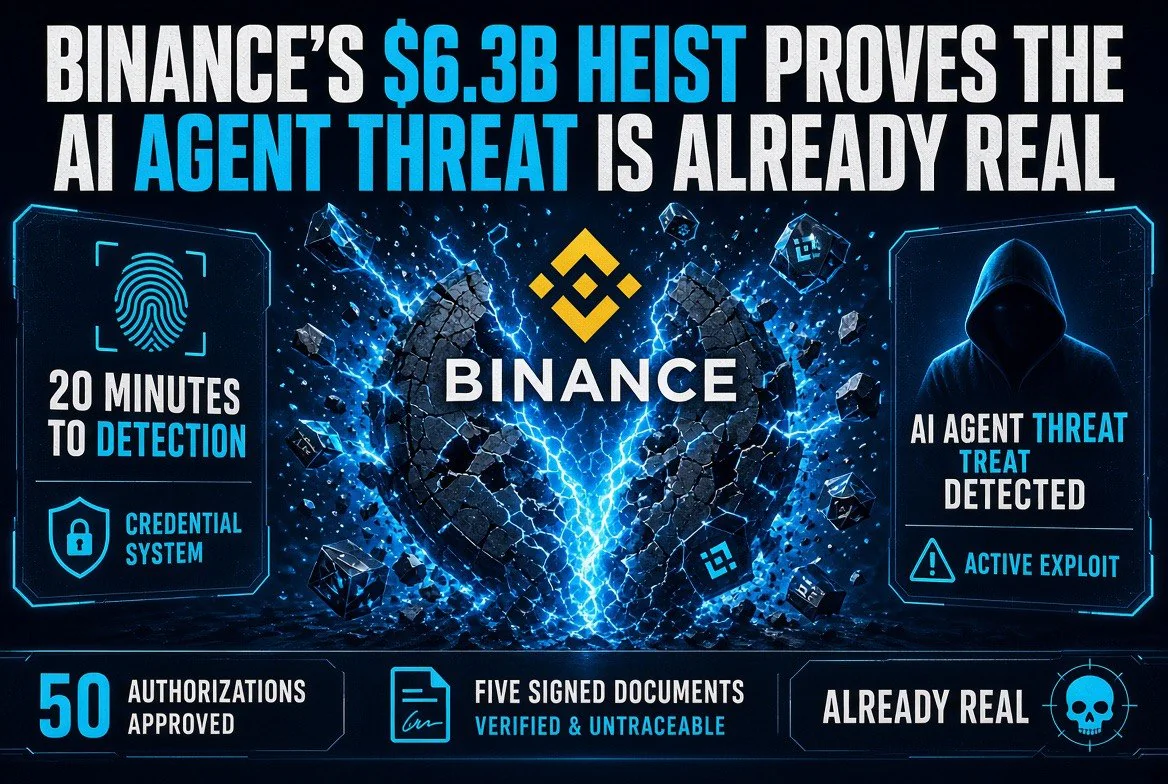
Binance’s $6.3B Heist Proves the AI Agent Threat Is Already Real
⚡ Expert Summary: At 20:05 UTC on October 29, someone moved about $6.36 billion out of Binance wallets across ten blockchains in roughly twenty minutes. TRM Labs attributes the theft to TraderTraitor, North Korea’s hacking unit, and the onchain record shows the operator rehearsed on test wallets, then fired 50 pre-signed authorizations in a single transaction. That is not a human clicking through a dashboard. It is machine-speed execution against a signing system, and it is the clearest evidence yet that the threat model for your own AI agents has already changed.
The crypto industry spent Thursday afternoon learning a lesson that every business running AI agents is about to learn the hard way: the danger is not that a model gets something wrong. The danger is that a system with credentials executes instructions faster and more thoroughly than any attacker could by hand.
TRM Labs, which traced the money onchain, published its assessment on October 29. At 20:05 UTC, an attacker began moving funds out of Binance wallets on ten separate blockchains — Ethereum, Bitcoin, Tron, the XRP Ledger, Solana, Arbitrum, Avalanche, Optimism, Base and Polygon. Most of it was gone in about twenty minutes. At the moment of the theft, TRM values the total at approximately $6.36 billion. At current prices, the same assets are worth about $6.23 billion.
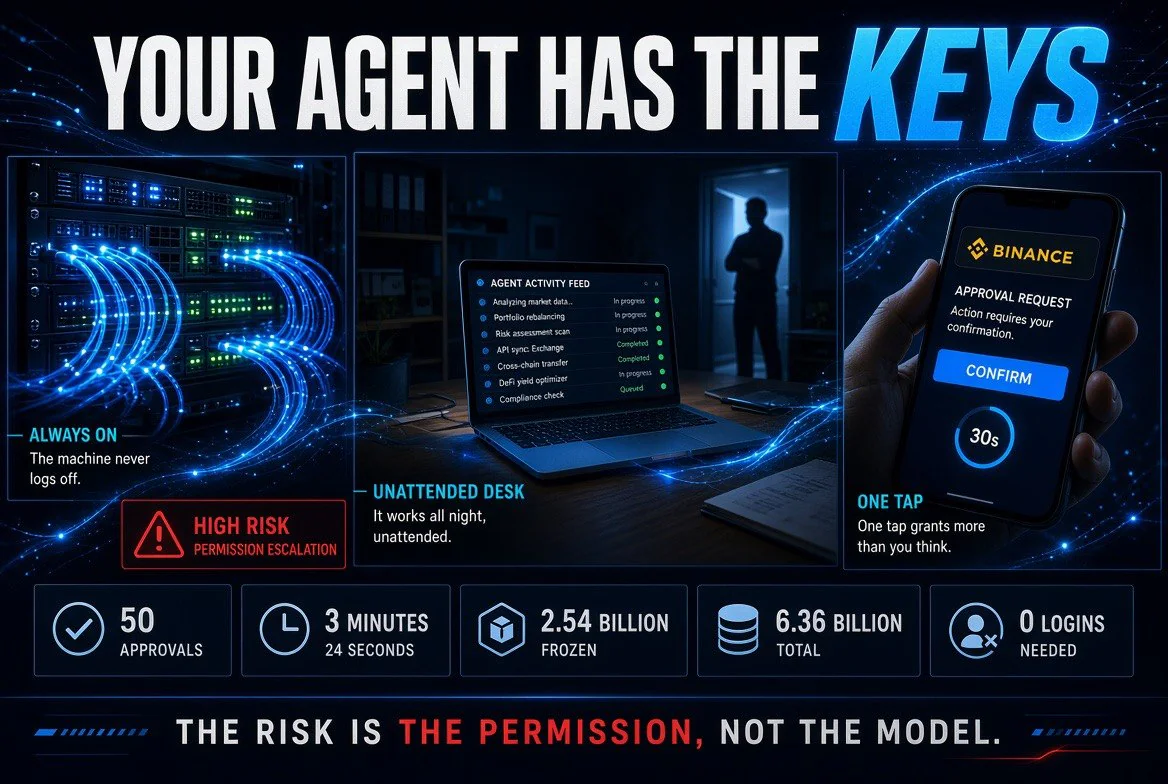
Binance confirmed the incident and suspended withdrawals on multiple networks as a precaution. By 23:35 UTC it had verified $2.54 billion frozen. TRM counts roughly $2.7 billion frozen onchain as of 00:30 UTC. The New York Post reported Friday that stablecoin providers froze about $2.8 billion, with roughly $3 billion likely gone for good.
What Actually Happened, Step by Step
This is the part most coverage skipped. The mechanism is where the AI-agent argument lives, so it is worth walking through slowly.
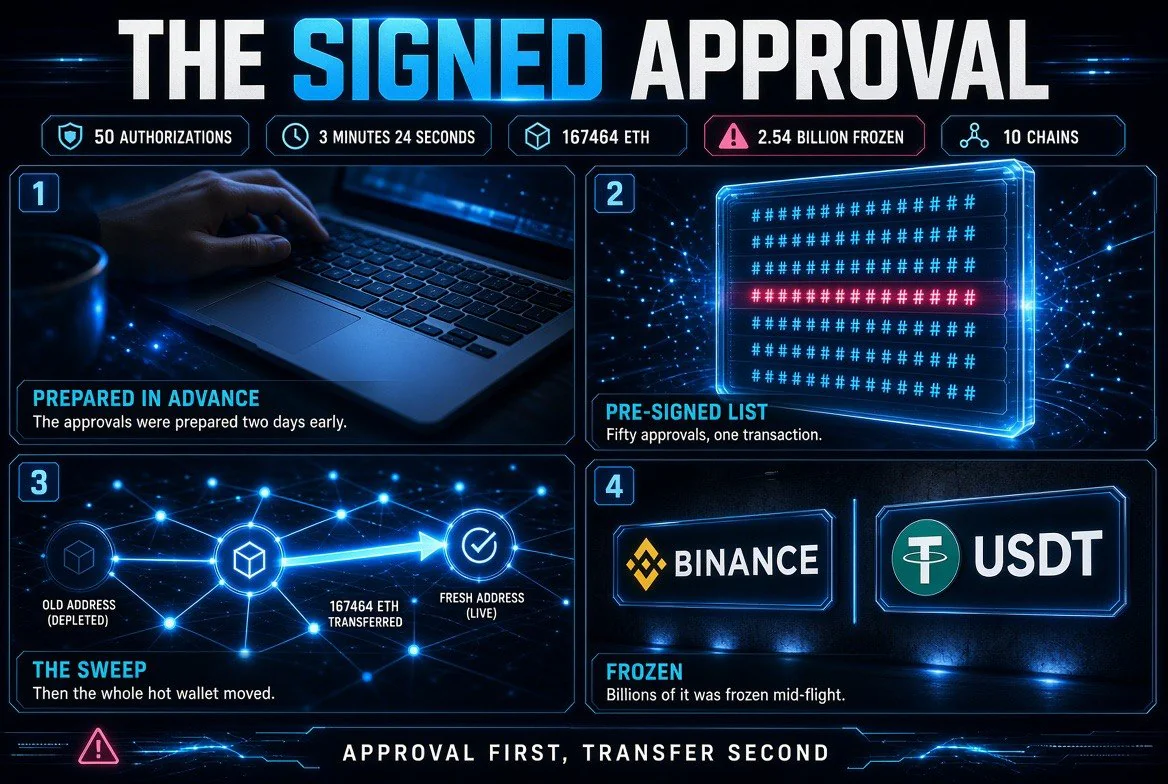
Preparation began at least 36 hours before the theft. The attacker’s operator wallet received three small withdrawals from Tornado Cash — a service that obscures where crypto comes from — starting the morning of October 28. Early on October 29, the operator deployed the first piece of code for the attack and tested it on two wallets. Later that day, it rehearsed the final version on a third wallet. Only then did it run the real thing.
At 20:20 UTC, the operator submitted a single transaction containing 50 authorizations. Each was signed by the Binance hot wallet. Each pointed that wallet at a sweeper contract that accepts instructions only from the operator.
The mechanism is EIP-7702, introduced in Ethereum’s Pectra upgrade in May 2025. It lets an ordinary wallet hand control of its own behavior to a smart contract by signing an authorization. From that point on, every call to the wallet runs the contract’s code — and the arrangement stays in place until the wallet signs a new authorization. Binance’s hot wallet had delegated control of itself away.
Three minutes and 24 seconds after the delegation, the operator told the Binance hot wallet to send its entire balance to an attacker-controlled address. That single transaction moved 167,464 ETH and 63 tokens, including 1.615 billion USDT.
The delegation stayed live. As new funds arrived in the Binance hot wallet, the operator swept them again at 20:41, 20:59, 21:04, 21:44, 22:39 and 23:56 UTC. The wallet also served as the executor of a separate Binance smart account, which let the attacker pull 823 million USDC out of it. Circle froze that USDC shortly afterward.
The first theft of the night came elsewhere. Between 20:05 and 20:09 UTC, five Binance wallets on the XRP Ledger each sent XRP to a single attacker address, leaving each wallet with only its minimum balance. 233.46 million XRP in total, about $296 million. Binance wallets on Solana and Optimism followed shortly after 20:10. At 20:20, a Binance Bitcoin hot wallet sent 18,270 BTC — about $1.47 billion — to an attacker address.
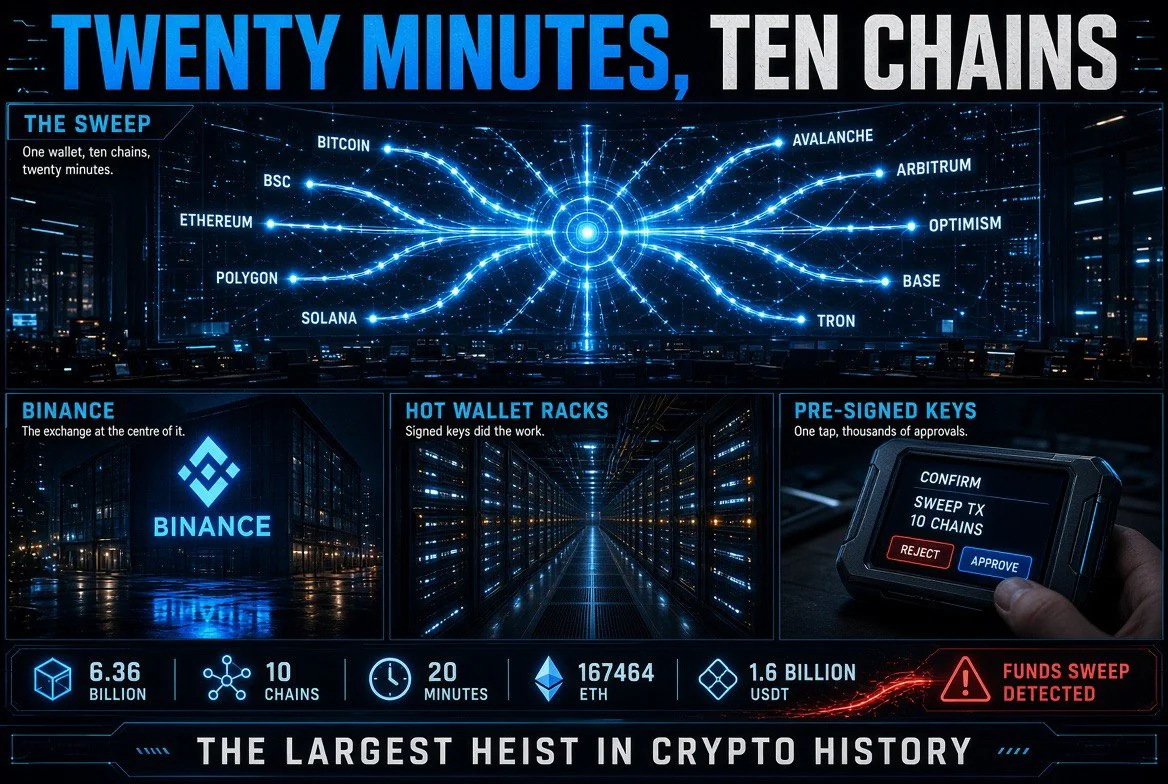
Why Ten Blockchains Signed Within Half an Hour
Here is the detail that should stop you cold. Those wallets use different chains, different key types and different signing schemes. All of them produced signatures the attacker could use within about half an hour.
Early indicators on the Ethereum activity suggested phishing. TRM’s own assessment rejects that as a complete explanation, because phishing a wallet does not explain the XRP Ledger, Arbitrum, Avalanche, Optimism, Base, Bitcoin, Tron and Solana wallets signing the attacker’s transactions in the same window.
TRM’s conclusion: the most likely explanation is that the attacker gained the ability to make Binance’s hot wallet signing system sign transactions of its choosing, across chains. The batch of 50 pre-signed authorizations supports that — that is not a signature a person produces by hand at 20:20 UTC under time pressure. It is a pre-built payload pushed into a signing system that executed it faithfully.
That is the AI-agent threat in one sentence. Not a chatbot talking a human into a mistake. A credential-bearing system doing exactly and completely what it was instructed, at a speed that leaves no room for a human to notice.
| Chain | What Left | Approx. Value at Theft |
|---|---|---|
| Ethereum | 200,630 ETH plus 185 tokens, including 1.875B USDT and 823M USDC | $3.79B |
| Bitcoin | 18,270 BTC from a hot wallet | $1.47B |
| Tron | 612.7M USDT and 46.4M TRX | $628M |
| XRP Ledger | 233.46M XRP across five wallets | $296M |
| Solana, Base, Arbitrum, Avalanche, Optimism, Polygon | Remaining outflows, per TRM tracing | Balance of the $6.36B |
The value rounded to two decimals does not add up to the headline because each transfer was valued at the price of the asset at the exact moment it was taken. Prices moved during the attack. Bitcoin fell below $80,000 for the first time in a month, ether hit a two-month low of $2,230, and crypto-related stocks dropped through the day.
The Attacker Sold Speed, Not Price
The most revealing number in the whole incident is not the $6.36 billion. It is the discount.
During the first hours, the attacker converted freezable stablecoins into assets no issuer could freeze — at a steep cost. About 325 million USDT was sold to professional fillers and market makers through UniswapX and other intent-based contracts in exchange for about 122,300 ETH. That implies a price near $2,650 per ETH at a moment when ETH was trading around $2,300 to $2,350. A discount of more than 10 percent, paid outright to move money faster than the freezes could follow.
A second attacker wallet supplied 60 million USDT to the lending protocol Aave and borrowed about 19,760 ETH against it. Aave froze the affected markets. On Tron, 300 million USDT moved to a wallet that began supplying it to JustLend. Another 200 million USDT ran through a chain of hop wallets that swapped it on Uniswap.
By 00:30 UTC the attacker still controlled about $2.4 billion in assets beyond any issuer’s reach. TRM expects the next stage to involve cross-chain bridges, swap services and over-the-counter brokers.
Read that back. A thief who accepts a 10 percent haircut to win a race is a thief who knows the clock is the only real constraint. That is not a criminal outrunning investigators with better geography. It is a criminal outrunning them with better throughput.
| Factor | Hand-Driven Attack | What the Record Shows |
|---|---|---|
| Prep time | Weeks of recon, one target | 36 hours, code tested on two wallets, rehearsed on a third |
| Execution window | Hours, with pauses to check | About 20 minutes for the bulk of $6.36B |
| Signing | One key, one chain, manual approval | 50 pre-signed EIP-7702 authorizations in one transaction |
| Multi-chain coverage | Usually one chain per crew | Ten chains, valid signatures within about 30 minutes |
| Response margin | Freezes often land first | Attacker paid a 10%+ haircut to beat the freezes |
One Detail the Reporting Points At: The Laptop
The New York Post reported that the system was exploited by hacking into an engineer’s laptop, citing TRM Labs and industry insiders. Binance initially said the incident may have involved a compromised laptop. By Friday, co-CEO Richard Teng said the security team had “uncovered additional points of breach,” suggesting a more complex attack carried out by more than one person.
Idan Ofrat, co-founder of Fireblocks, told the Post the culprits targeted just a few accounts, including one crypto wallet holding nearly $800 million.
A laptop is a boring entry point and that is exactly why it matters. There is no exotic zero-day in this story as told so far. There is an engineer’s machine, and behind it a signing system that would sign what it was told. If your company runs agents with tokens, API keys or wallet access, you have both halves of that equation in your office right now.
TRM’s own guidance for treasury teams reads like a checklist for every business deploying agents: monitor Ethereum-compatible wallets for EIP-7702 delegations, which appear as code at an address that should have none. Any such delegation on a treasury wallet should trigger an immediate alert. Keep a tested, pre-approved method for signing a revocation. Reject EIP-7702 authorizations unless they are expected, and treat a request for many authorizations across a range of transaction counts as an indicator of compromise.
Then the line that should be printed above every agent deployment: “Signing infrastructure and approval paths should be separated by chain and wallet tier. In this incident, a single actor obtained valid signatures for wallets on ten chains within hours.”
Where the AI-Agent Claim Actually Holds
Let’s be precise here, because precision is what separates a useful analysis from a headline. The public onchain record does not describe an AI agent as the actor. It describes contracts, authorizations and a signing system. Anyone telling you a model planned this heist is going further than the evidence goes.
What the record does show is a behavioral signature that security teams have been warning about for two years, now executed at full scale: reconnaissance, test runs, a rehearsal, a pre-built payload, parallel execution across heterogeneous systems, and an economic decision to sacrifice value for speed. The reason it reads as automated is that no human process produces all six of those things within a 36-hour window.
For anyone running AI tools in a business, the practical translation is blunt. An agent with credentials is an attacker with credentials. The model does not need to be malicious for the outcome to be catastrophic — it needs to be obedient, and the instructions it receives need to be wrong. That is the failure mode you actually own.
What This Actually Means for a Small Business Running AI
Binance is not your business, and a hot wallet signing system is not the stack most operators run. But strip away the scale and the same structure applies to anyone who has wired an AI agent into anything that can move, spend or reveal value.
If you have given an agent a login, it now has a login. If you have given it a payment credential, it can pay. If you have given it access to your email, your CRM or your drive, then a successful prompt injection into that agent is a successful breach of all three. The 186,000-plus businesses that reported using AI in the Goldman Sachs survey cited in this breakdown of small business AI adoption mostly did not redesign their access model when they turned those agents on.
The cheapest hardening available to you is unglamorous:
- Separate credentials by function. One key per agent, never a shared admin token. If an agent needs to read your inbox, it does not also need to send from it.
- Cap blast radius before you cap risk. Spending limits, per-transaction limits, and a daily ceiling that makes a runaway agent expensive instead of fatal.
- Log every action, not every error. The Binance attacker was visible onchain from 20:05. Detection was never the problem. Speed was.
- Require human approval above a threshold. A single approval gate would have stopped the 167,464 ETH transfer in this story. Not the first 50 authorizations — the one transfer that mattered.
- Test revocation before you need it. TRM’s advice is not crypto-specific. If you cannot revoke an agent’s access in under five minutes, you have not tested it.
None of that requires a security team. It requires deciding, in advance, what your agent is allowed to destroy.
The Part Nobody Wants to Say Out Loud
Binance has told customers withdrawals should resume within two days and has set aside more than $6 billion of company funds to cover customer losses. That is the right response, and it is also a tell: the exchange absorbed a loss large enough to end a smaller company, because it could.
A restaurant with an AI phone agent does not have $6 billion of cushion. A solo operator who connected an agent to their bank feed does not either. The asymmetry that made this heist survivable for Binance is the same asymmetry that makes agent security a small business problem rather than an enterprise one — except pointed the other way.
TraderTraitor has done this before. The FBI named the same group as responsible for the $1.5 billion Bybit hack in February 2025, and TRM notes features of this attack matching both Bybit and the KelpDAO hack in April 2026. US officials have said cybercrime funds roughly half of North Korea’s missile program. This was not a crime of opportunity. It was an industrial operation with a repeatable playbook.
And the playbook’s most transferable lesson is not about crypto at all. It is that a system holding valid credentials will do exactly what it is instructed to do, thoroughly, completely, and faster than you can interrupt it. That description fits a signing system in October 2026. It also fits the agent you turned on for your business last quarter.
The question is not whether agents are dangerous. They are the most useful dangerous thing most small businesses have deployed this decade. The question is whether you have decided, in writing, what yours is allowed to do — because the system will not decide that for you. It will simply do what it is told.
Frequently Asked Questions
How much was stolen from Binance in the October 2026 hack?
TRM Labs traced approximately $6.36 billion in assets out of Binance wallets across ten blockchains, valued at the moment each transfer was made. At current prices those same assets are worth about $6.23 billion. Roughly $2.7 billion had been frozen onchain as of 00:30 UTC on October 30, leaving about $2.4 billion beyond any issuer’s reach.
Was an AI agent responsible for the Binance heist?
The public onchain record does not name an AI agent as the actor. It shows contracts, 50 pre-signed EIP-7702 authorizations and a signing system that executed them. What it does show is a pattern that reads as automated: code tested on two wallets, rehearsed on a third, then executed across ten chains within about thirty minutes, with the attacker paying a 10%+ haircut to move faster than the freezes. No hand-driven process produces that within 36 hours.
What is EIP-7702 and why does it matter here?
EIP-7702 came in with Ethereum’s Pectra upgrade in May 2025. It lets an ordinary wallet hand control of its behavior to a smart contract by signing an authorization. Every call to the wallet then runs that contract’s code until the wallet signs a new authorization. In this attack, Binance’s hot wallet delegated control of itself to a sweeper contract the attacker operated.
How long did the theft take?
Most of the money left in about twenty minutes, starting at 20:05 UTC on October 29. Preparation began at least 36 hours earlier. The 167,464 ETH transfer happened three minutes and 24 seconds after the delegation. The attacker kept sweeping new deposits into the hot wallet at 20:41, 20:59, 21:04, 21:44, 22:39 and 23:56 UTC.
Will Binance customers get their money back?
Binance has said it set aside more than $6 billion of company funds to cover customer losses and that withdrawals should resume within two days. It suspended withdrawals and pledged to cover all losses immediately after the attack. A large share of the stolen stablecoins was frozen by issuers, but roughly $3 billion was reported as likely unrecoverable.
What should a small business do differently after this attack?
Treat every credential you give an AI agent as a credential an attacker could inherit. Give each agent its own key, set spending and transaction caps, require human approval above a threshold, log every action rather than every error, and test revoking access in under five minutes. In this incident a single approval gate on one transfer would have stopped the largest single movement of funds.
Who is TraderTraitor and why are they suspected?
TraderTraitor is North Korea’s premier hacking unit. TRM Labs attributes this attack to them based on on and off-chain intelligence. The FBI named the same group as responsible for the $1.5 billion Bybit hack in February 2025, and TRM notes matching features with the KelpDAO hack in April 2026, including small Tornado Cash deposits used to fund the operation.

About Barak Schurr
Barak Schurr built and sold a major ticketing platform, ran global nightlife operations at Eventbrite, and now spends his time figuring out which AI tools actually move the needle for independent business owners — and which ones are just noise. No hype. No fluff. Just what works.
Email: [email protected]
More AI Resources for Your Business