Get The Solo Business OS — Free
The AI workflow that replaces a part-time employee for solo operators and small business owners.
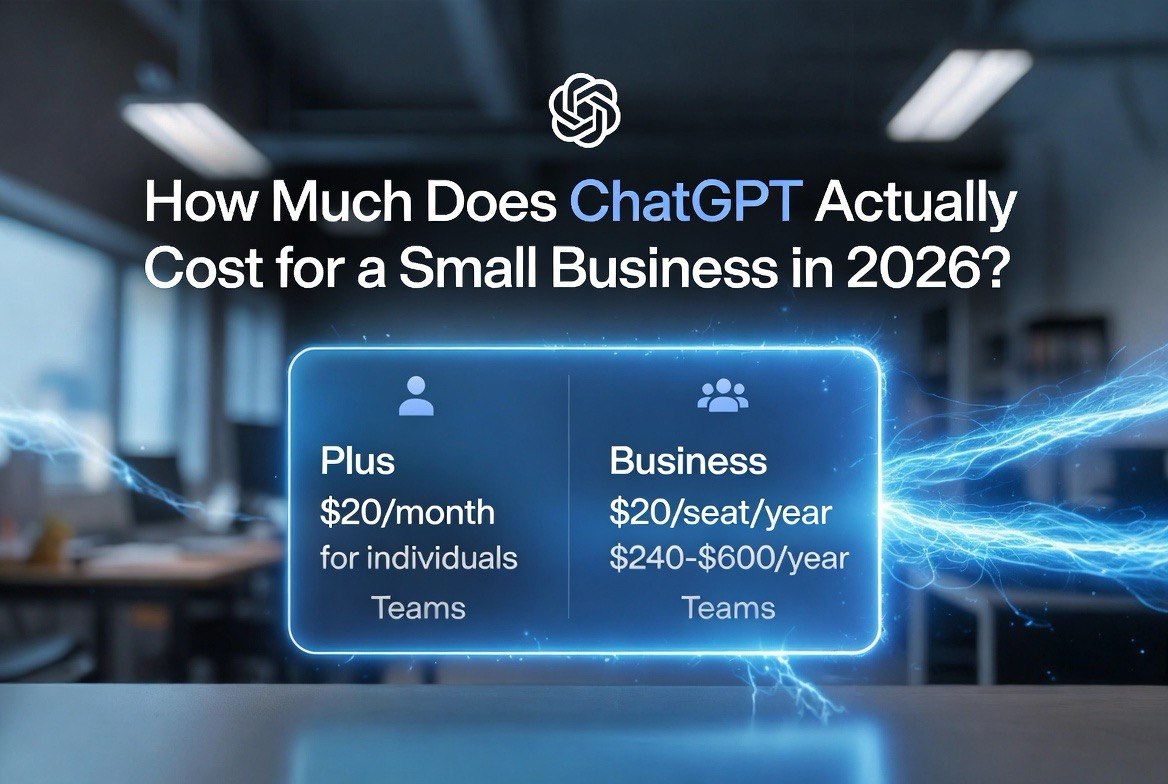
How Much Does ChatGPT Actually Cost for a Small Business in 2026?
⚡ Expert Summary: For a US small business, ChatGPT’s real cost is $20 per user per month on Plus, or $25/user/month on Business (billed monthly, $20 annual) with a 2-seat minimum. Most solo operators get 80% of the value from a single Plus seat; teams of 2+ save with annual Business billing. Skip Enterprise (custom pricing) unless you’re regulated or need 500+ seats. The trap isn’t the base fee — it’s paying for seats nobody uses and letting multiple AI subscriptions stack. Map seats to roles, bill annually, and you’re looking at $240–$600/year for a functional AI assistant that replaces manual admin work.
Every small business owner I talk to asks the same question in slightly different ways: “What does ChatGPT actually cost me?” The confusion is real. OpenAI renamed plans, split Pro into a $100 and $200 tier, and re-branded the old Team plan into “Business.” Add in the API pricing story that’s constantly in the news, and it’s no wonder owners either overpay for seats they don’t use or skip the tool entirely because they think it’s expensive.
Here’s the straight answer for US small businesses in 2026, broken down by what you’re actually buying, what each plan costs, and — most importantly — what a sensible setup looks like so you don’t waste a cent.
ChatGPT Plan Pricing at a Glance (2026)
Let me put the plans side by side so you can see the spread before I dig into each one. These are OpenAI’s published US prices as of August 2026.
| Plan | Price (US) | Best For | Key Limits |
|---|---|---|---|
| Free | $0 | Testing the waters, light use | Limited access to advanced models, usage caps |
| Plus | $20/user/month | Solo operators, everyday work | No shared workspace for teams |
| Pro | $100 or $200/user/month | Heavy power users, higher limits | Overkill for almost all SMBs |
| Business | $25/user/month (monthly) or $20 (annual) | Teams of 2+ with shared workspace | 2-seat minimum |
| Enterprise | Custom (quote) | Regulated or large orgs | Requires sales contact |
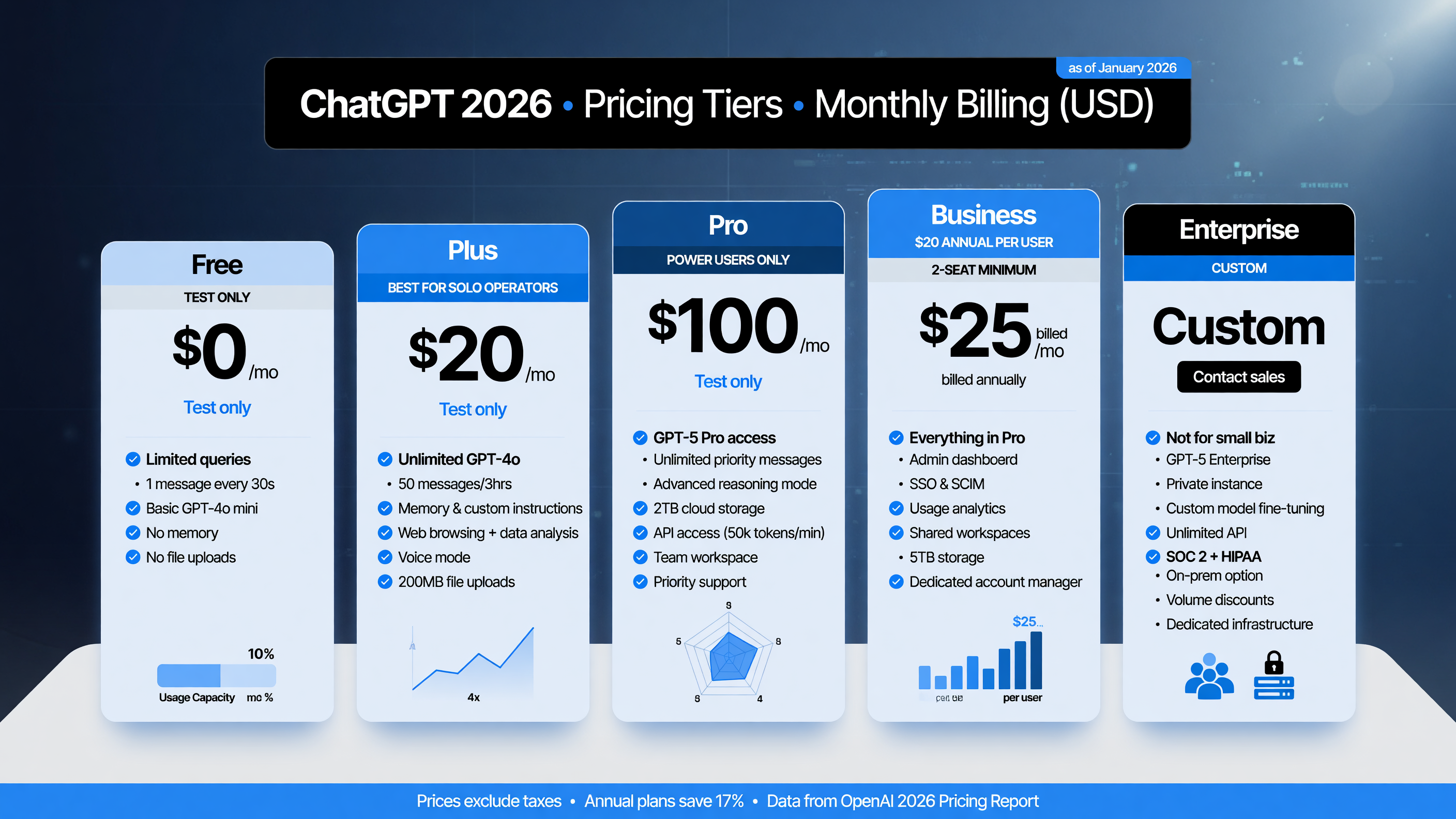
The full 2026 pricing spread: Free, Plus at $20, Pro at $100/$200, Business at $25 (or $20 annual), and Enterprise at custom pricing. The two plans most small businesses should care about are Plus and Business.
The takeaway: the plans you actually care about are Plus at $20 and Business at $25/$20 per user. Everything above that is for teams or enterprises that won’t bat an eye at the price. Let’s go through each one so you know exactly what you’re getting.
The Free Plan: Fine to Test, Not to Run On
ChatGPT’s free tier is a legitimate way to find out whether AI fits your workflow — but it’s genuinely not a plan a growing business should rely on. You get access to a capable model, but with usage caps that hit exactly when you’re in the middle of something important, and limited access to the newest reasoning models. For a business owner, “I got cut off mid-proposal” is a productivity killer.
The real cost of “free” is time. If you’re using it 5–10 times a week for quick questions, free is fine. The moment it becomes part of your daily operations — drafting emails, analyzing spreadsheets, drafting marketing copy — those caps become a bottleneck. That’s the moment to move to Plus.
Plus at $20: The Sweet Spot for Solo Operators
For a solo business owner or a micro-team where people work independently, Plus at $20/month is the plan that makes sense. It removes the usage anxiety, gives you access to the latest and most capable models, and — for the vast majority of one-person and two-person operations — that single seat does everything you need.
Think about what $20 buys you in practical terms: a research assistant, a copywriter, a spreadsheet analyst, an email drafter, and a sounding board — all on call whenever you need them. If you were hiring even a part-time VA for a few hours a week, you’d spend 10–20 times that. The value per dollar on a single Plus seat is genuinely hard to argue with.
One caveat for solo founders: if you’re an unusually heavy power user — generating large volumes of long-form content, doing a lot of deep analysis, or hitting rate limits on Plus — the $100 Pro tier exists. But in my experience across US small businesses, that’s the exception, not the rule. Most owners who think they “need” Pro are bumping into Plus’s cap on heavy usage days, not their actual daily need.
Business at $25/user: When You Add a Second Seat
The minute you have two or more people sharing one login (which you shouldn’t, by the way — shared accounts are a security and accountability problem), you should move to the Business plan. It’s priced at $25 per user per month billed monthly, or $20 per user per month billed annually, with a 2-seat minimum.
What Business adds over a pile of individual Plus accounts is real: a shared workspace, admin controls, SAML SSO, and — critically for many owners — a data policy where OpenAI does not train on your business data by default. That data-protection piece matters more than most owners realize, especially if ChatGPT is handling customer names, financials, or proprietary processes.
Here’s the math that matters. For a 3-person team:
| Setup | Monthly Cost | Annual Cost |
|---|---|---|
| 3 × Plus seats | $60 | $720 |
| 3 × Business, monthly billing | $75 | $900 |
| 3 × Business, annual billing | $60 | $720 |
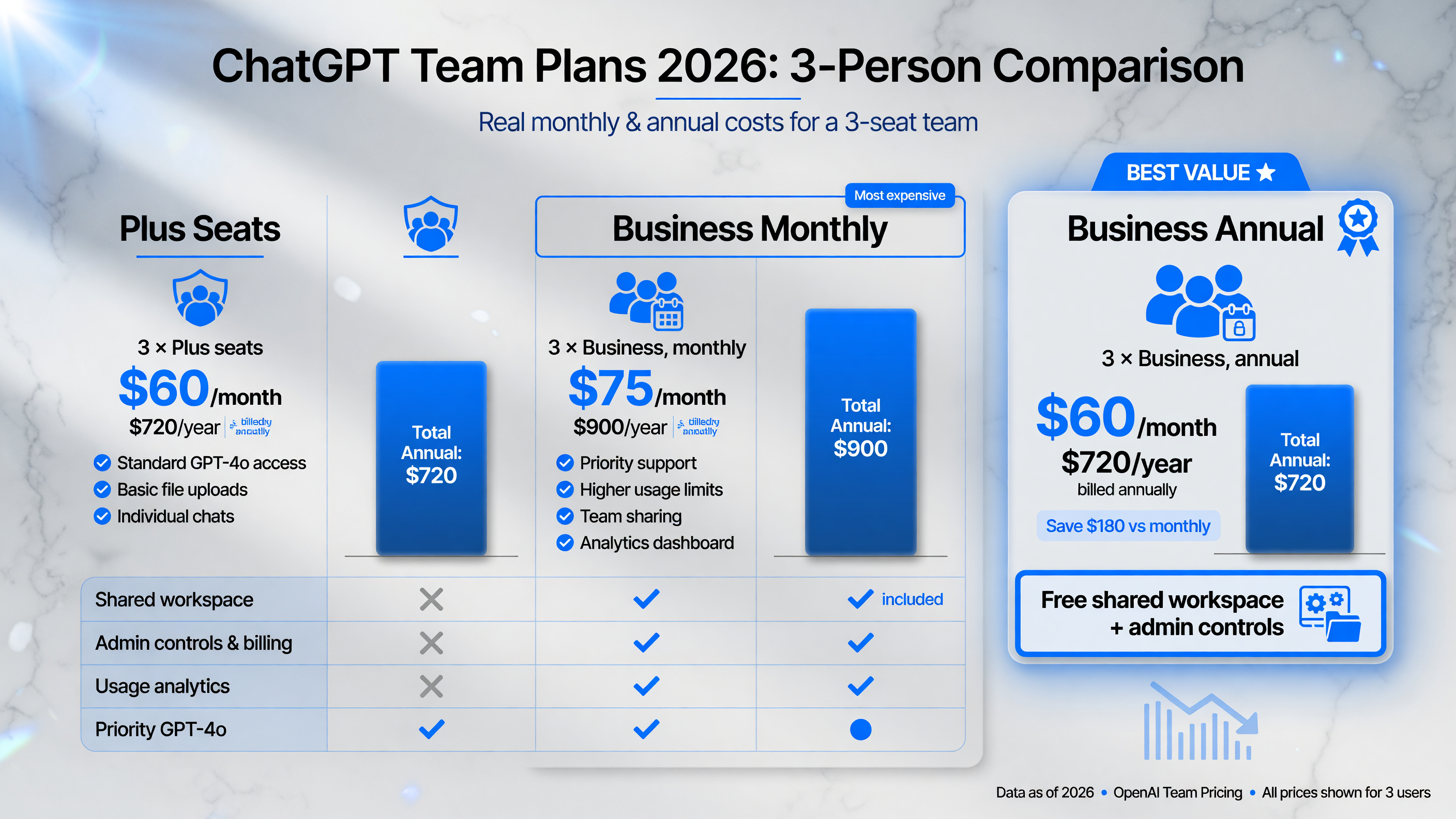
Annual Business billing matches Plus per-user cost ($720/year for three) while adding a shared workspace and admin controls — effectively free value for any team of 2+.
Notice something useful: Business billed annually ($20/user) equals the same cost as Plus per user — $720/year for three people either way — but you get the shared workspace, admin controls, and data protections on top. For a team, annual Business billing is effectively free value once you’re at 2+ seats. That’s the move.
Skip Pro and Enterprise Unless You Really Need Them
I want to be direct about this: for almost every small business, Pro and Enterprise are not worth it. Pro’s $100 or $200/month tier is built for power users running 5x–20x more usage on advanced models — people generating massive content pipelines or doing research-heavy work all day. If you’re a normal owner, this is money you’d be throwing away.
Enterprise is a different beast entirely — custom pricing negotiated with OpenAI sales. It adds advanced compliance, security, and support for larger or highly regulated organizations. If you’re a healthcare practice handling PHI at scale or a financial firm under strict compliance rules, you might need it. If you’re a 3-person shop, you almost certainly don’t, and you’ll get 95% of the benefit from Business for a fraction of the cost.
The Hidden Cost: Seat Bloat and Subscription Stacking
Here’s where most small businesses actually lose money with AI, and it has nothing to do with ChatGPT’s price tag. Two failure modes show up over and over:
1. Paying for seats nobody uses. You buy Business or Enterprise for 10 seats because “the team might need it.” Five people use it twice a month. That’s $100–$250/month (or more) in dead weight. Before you add seats, run a simple audit: who actually opened ChatGPT in the last 30 days, and did it meaningfully change their output? If not, don’t buy the seat.
2. Subscribing to five different AI tools. It’s shockingly easy to end up paying for ChatGPT, Claude, Gemini, plus a couple of specialized tools — $60–$150/month in overlapping subscriptions where one model could handle most of the work. I’ve written about AI business tools at length, and the pattern is always the same: pick one general assistant for the bulk of your work, then add specialized tools only where the general model genuinely can’t do the job.
The fix is discipline, not more software. Map your seats to roles, bill annually where it saves you money, and consolidate subscriptions ruthlessly.
Real-World Cost Scenarios for US Small Businesses
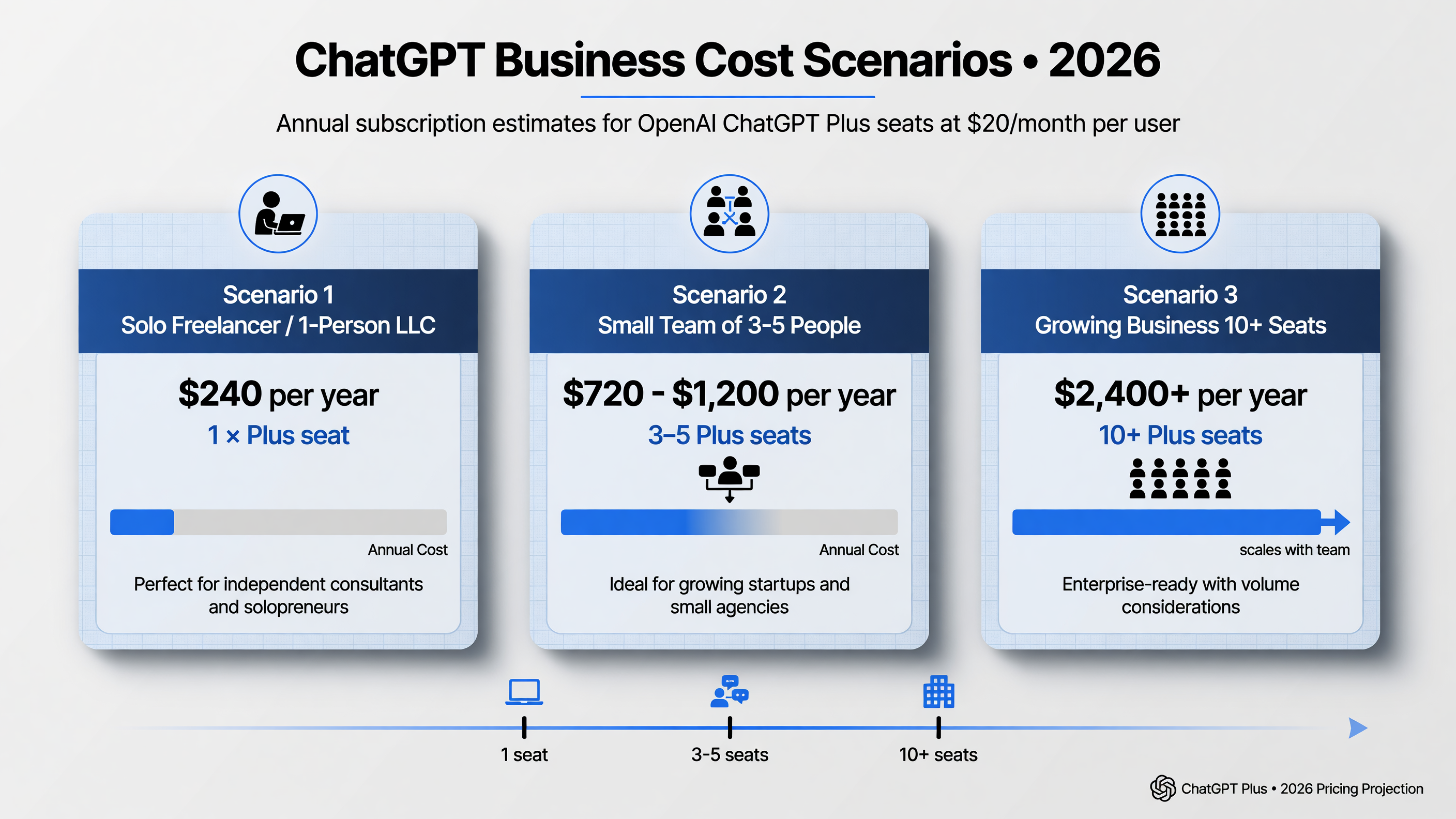
Real 2026 cost scenarios: a solo operator stays lean at $240/year, a team of 3–5 runs $720–$1,200/year, and a 10-seat business starts at $2,400/year — where seat discipline matters most.
Let me make this concrete with three typical setups so you can find the one that matches your situation.
Scenario 1: Solo freelancer or one-person LLC
Setup: 1 × Plus seat. Cost: $240/year. This is the easiest call in this entire guide. One Plus account gives a solo operator a full assistant stack — drafting, research, analysis, emails — for less than $20/month in real terms. There’s no reason to look at anything else until you hire.
Scenario 2: Small team of 3–5
Setup: Business plan, 3–5 seats, annual billing. Cost: $720–$1,200/year. The shared workspace and admin controls become valuable here, and annual billing keeps you at $20/user — the same as Plus. This is the plan most US small businesses with employees should be on.
Scenario 3: Growing business with 10+ seats
Setup: Business plan (or Enterprise if regulated), annual billing. Cost: $2,400+/year at 10 seats. At this scale, seat discipline matters most. Audit usage quarterly, remove inactive seats, and only upgrade to Enterprise if compliance demands it. A 15-seat Business account you only actively use 8 of is $1,400/year of waste.
What About the API? (Don’t Confuse It With the App)
There’s a recurring point of confusion here. The API — where developers pay per token of usage — is a different thing from the ChatGPT app plans. You don’t need to understand token pricing to use ChatGPT as a business tool, and you should not sign up for the API “to get better ChatGPT.” The app plans above are what a small business actually buys.
The only time the API enters the picture is if you’re building a custom product — automating workflows with a tool like Unibase or hooking AI into your own software. In that case you’d be looking at per-token rates and a different cost model entirely. For day-to-day operations, stick with the flat monthly plans.
How to Decide: A Simple Framework
If you’re still unsure which plan fits, run through this:
- Do you work alone? Get Plus at $20/month. Done.
- Do you have 2+ people who need it? Get Business, bill annually, at $20/user/month.
- Are you at 10+ seats or in a regulated industry? Consider Enterprise pricing for compliance — but only if you actually need the compliance features.
- Are you a heavy all-day power user? Consider Pro — but only after you’ve outgrown Plus’s limits on normal days.
That’s really the whole framework. Most owners overcomplicate this because the pricing page looks dense. It isn’t. One seat, Plus. A team, annual Business. Anything beyond that, you’ll know if you need it.
Frequently Asked Questions
Is ChatGPT free for small businesses?
There’s a free tier you can test with, but it has usage caps and limited access to advanced models. For daily business use, Plus at $20/month removes those limits and is the practical starting point for most US small businesses.
How much is ChatGPT Plus per month?
ChatGPT Plus is $20 per user per month, billed monthly. It’s the entry paid plan and the right fit for a solo operator who uses ChatGPT regularly.
How much is ChatGPT Business per month?
Business is $25 per user per month billed monthly, or $20 per user per month billed annually, with a 2-seat minimum. It adds a shared workspace, admin controls, SAML SSO, and data-protection defaults.
Is ChatGPT Business worth it for a small business?
Once you have 2+ users, yes — especially on annual billing, which brings Business to the same $20/user as Plus while adding shared workspace and admin controls.
How much is ChatGPT Pro per month?
Pro is $100 or $200 per month depending on the tier. It’s designed for heavy power users with high usage on advanced models, not typical small business owners.
What’s the difference between ChatGPT Business and Enterprise?
Business is self-serve per-user pricing for teams of 2+. Enterprise has custom pricing, advanced compliance, security, and support, and is for larger or regulated organizations. Most small businesses need Business, not Enterprise.

About Barak Schurr
Barak Schurr is the founder and former president of the nightlife ticketing platform Wantickets and former Global Director of Dance and Nightlife at Eventbrite. He currently focuses on AI research and writes about practical AI for independent business owners that actually moves the needle — no hype, no corporate fluff. More at topnotchaitools.com.
Contact: [email protected]
More AI Resources for Your Business