Get The Solo Business OS — Free
The AI workflow that replaces a part-time employee for solo operators and small business owners.
Cerebras CEO: Your Next AI Assistant Buys for You
⚡ Expert Summary: At TechCrunch Disrupt 2026 on October 13, Cerebras CEO Andrew Feldman said a world where every home has a personal AI appliance is “not very far away” — and that the assistant will run partly on your own device, will be surrounded by a security perimeter, and will “have access to credit cards and be able to buy things for you.” Read that last part twice. The CEO of a company that sells the chips behind AI inference just described an assistant that knows your calendar, your contacts, and your spending authority. For a US small business owner, this is not a consumer gadget story. It is the next interface your customers, your suppliers, and your own staff will use to get things done — and the security and spending decisions you make now will decide whether that is an asset or a liability.
Your customers do not walk into your store the way they did five years ago. Some of them never walk in at all. They tell an assistant what they need, and the assistant handles it. That is already true for search, for scheduling, and for support tickets. Feldman’s claim is that it is about to become true for the physical shopping trip as well.
The reason this matters to a business with nine employees and a payroll run on Friday is simple: when the assistant becomes the interface, the assistant becomes the gatekeeper. It decides what it sees, what it recommends, and what it buys. If you run a small operation, you want to be on the right side of that decision loop, and you want it to be your assistant doing the buying for your business — not somebody else’s.
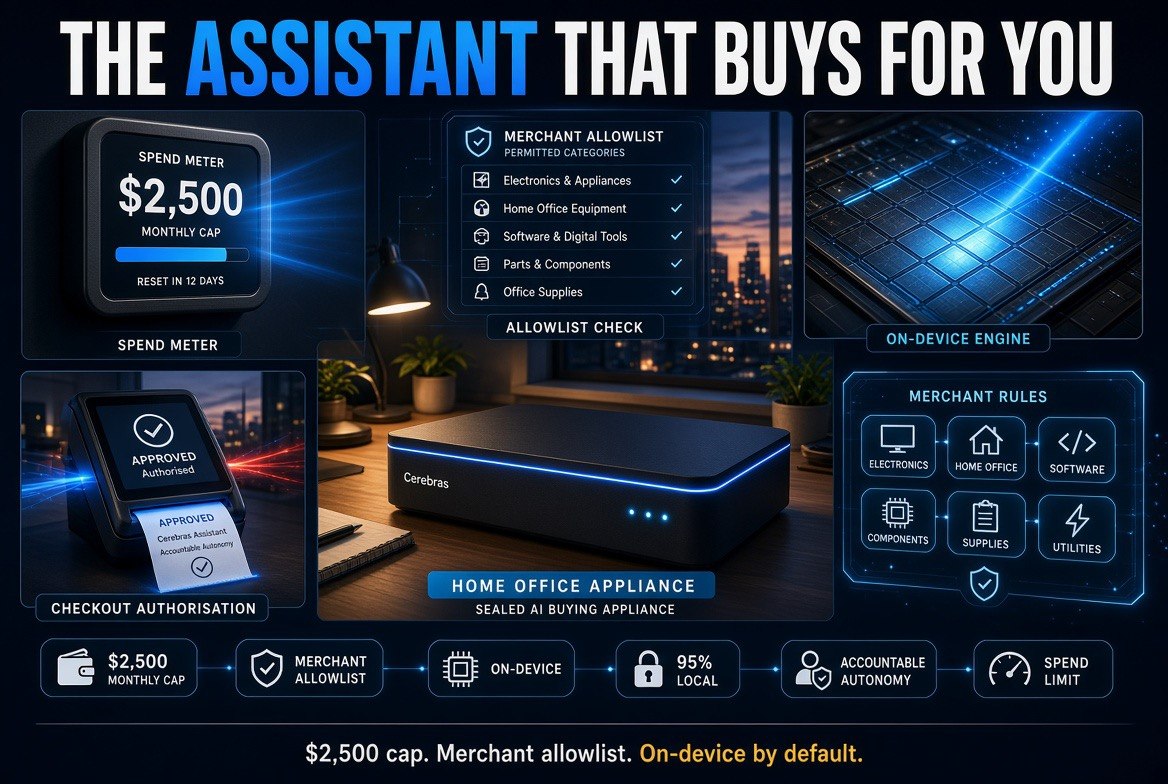
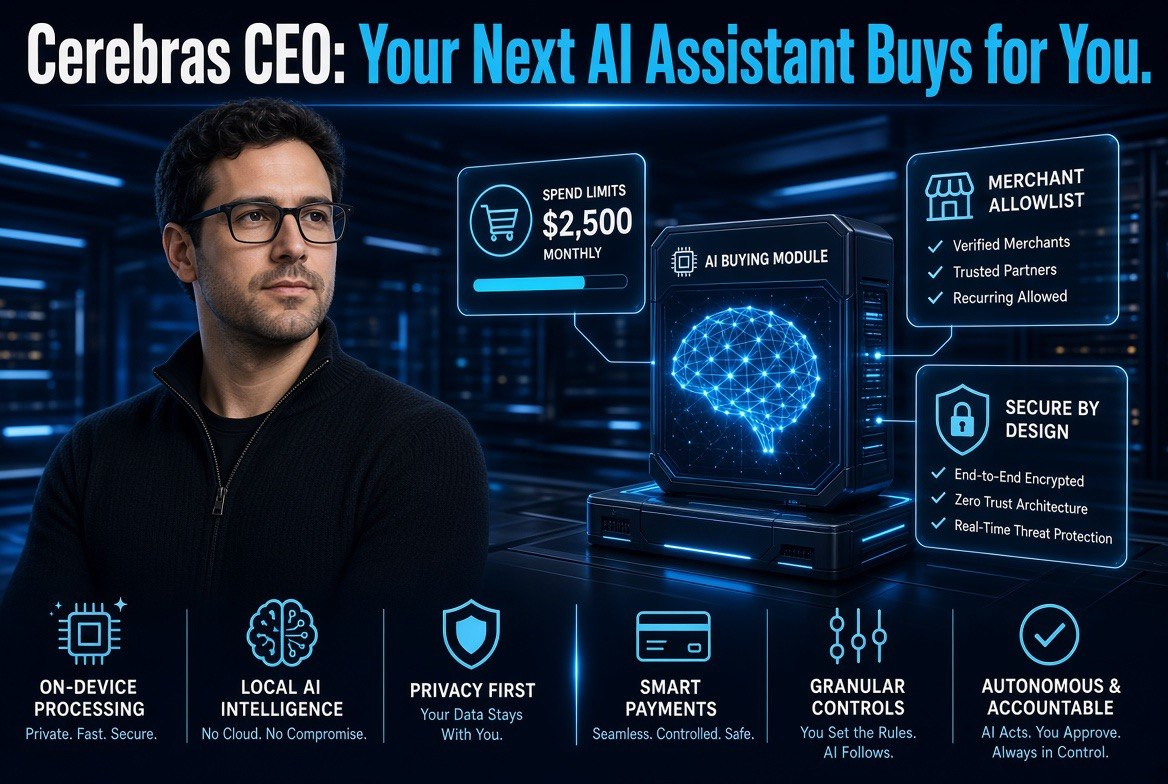
The appliance makes the purchase, the $2,500 meter caps it, and the merchant allowlist decides which categories are even reachable. Everything runs on-device.
What Feldman Actually Said — And What He Deliberately Did Not Say
Feldman was on stage at Disrupt 2026 answering a straightforward question: what would need to happen for AI to become a home appliance? His answer was not a roadmap. It was, “Actually, I don’t think that’s very far away.”
He then gave the shape of the thing in three sentences that are worth reading slowly:
“Just like your cell phone, they’ll do some work on device and some work going back to the cloud. But I think they will get to know you very well, and you will have a security perimeter around them. And they will certainly have access to credit cards and be able to buy things for you.”
Strip the optimism out and you have an architectural description of a buying agent. Local processing for the private stuff. Cloud processing for the heavy stuff. A defined security boundary. And payment authority. That is not a chatbot. That is a procurement function with a personality.
What he did not say is more instructive. He did not name a device. He did not name a launch window. He did not say Cerebras would build it. In fact, he explicitly ruled his own company out of the consumer layer: “One of the reasons I love being in infrastructure is because I don’t need the consumer-facing idea … I like building the platforms that other people’s ideas take flight on.”
That is a chipmaker telling you the demand is coming and he intends to sell picks and shovels. When an infrastructure CEO makes a consumer prediction, treat it as a capacity forecast, not a product announcement. He is describing what his customers are building toward.
The Three Claims, Translated for an Operator
Feldman’s vision statement contains three separate claims. Each one lands differently on a small business, so it is worth pulling them apart rather than swallowing the whole quote as one thing.
| Feldman’s Claim | What It Means Technically | What It Means for Your Business |
|---|---|---|
| Assistants run “some work on device and some work going back to the cloud” | A hybrid architecture — a small model executes locally on private data, a larger model handles reasoning in the cloud | Your sensitive business data does not have to leave the building to be useful. Ask any vendor which parts run locally before you sign. |
| “You will have a security perimeter around them” | Scoped permissions, identity verification, and an audit trail for what the agent accessed | This is the exact control that is missing from most agent tools you can buy today. A perimeter you cannot inspect is marketing, not security. |
| “They will certainly have access to credit cards and be able to buy things for you” | Tokenized payment credentials with spending limits and merchant-category restrictions | You need a dedicated card with a hard limit and a category allowlist before any agent touches your money. Never hand over your primary operating card. |
The first claim is the one with immediate practical value. A hybrid assistant that keeps your pricing data, your supplier terms, and your customer list on a local device is a fundamentally different risk profile from one that ships everything to a server farm. If you are evaluating assistant tools in 2026, “where does this run” belongs on your checklist next to “what does this cost.”

One wafer instead of a rack of chips, 44GB of memory sitting on it, and a 20x inference advantage that exists because of the architecture, not the software.
The Evidence He Pointed To — And Why It Is the Interesting Part
Feldman did not rest his prediction on a demo. He pointed at consumer AI agents that are already finding traction with ordinary users, naming Meta’s Muse and Instinct as examples.
That reference is worth following, because TNAIT has already covered where Instinct is going. Instinct is the agent that started showing up in group chats in early October — the one that does not wait for you to open an app and type a prompt. It sits where the conversation already is. Meta’s Muse line is the frontier-model push in the same direction.
The pattern across both is the same, and it is the actual signal underneath Feldman’s quote. The assistant is leaving the chat box. It is moving into the calendar, the group thread, the inbox, and eventually the checkout. Once an assistant lives where you already work, asking it to buy something is a two-word follow-up, not a whole new workflow.
That transition has a measurable effect on attribution. When a purchase originates inside an assistant, there is no browser session, no search query, and no UTM parameter. If your analytics platform depends on cookies and referrers to tell you where customers come from, an assistant-mediated sale looks like a direct visit — or it does not appear at all.
The Spend Control Problem Nobody Is Advertising
Here is the part of Feldman’s quote that deserves the most attention from anyone who signs the company card: “access to credit cards and be able to buy things for you.”
Granting that authority is not a small step. It is the moment an AI system stops being a research tool and becomes a spending counterparty, and it fires off every control question a small business owner should already know how to ask.
| Control Question | Weak Answer (Walk Away) | Strong Answer (Worth Testing) |
|---|---|---|
| What is the spending ceiling? | “The agent respects your budget.” | A hard numeric cap per transaction and per day, enforced at the card level, not in the prompt. |
| Which merchants can it pay? | “Anywhere that accepts cards.” | A merchant-category allowlist you control, with unknown merchants held for human approval. |
| What is the audit trail? | “You’ll see it on your statement.” | A per-agent log of every authorization request, including what the agent claims it was buying and why. |
| How do you kill it? | “Just revoke the login.” | Instant token revocation that takes effect on the next transaction, plus a documented dispute path for agent errors. |
Note the shape of the strong answers. Every one of them lives outside the AI. The cap is on the card. The allowlist is in the merchant-category setting. The kill switch is a token revocation. That is not an accident — it is the difference between trusting a model’s judgment and constraining its authority. Only one of those survives a bad day.
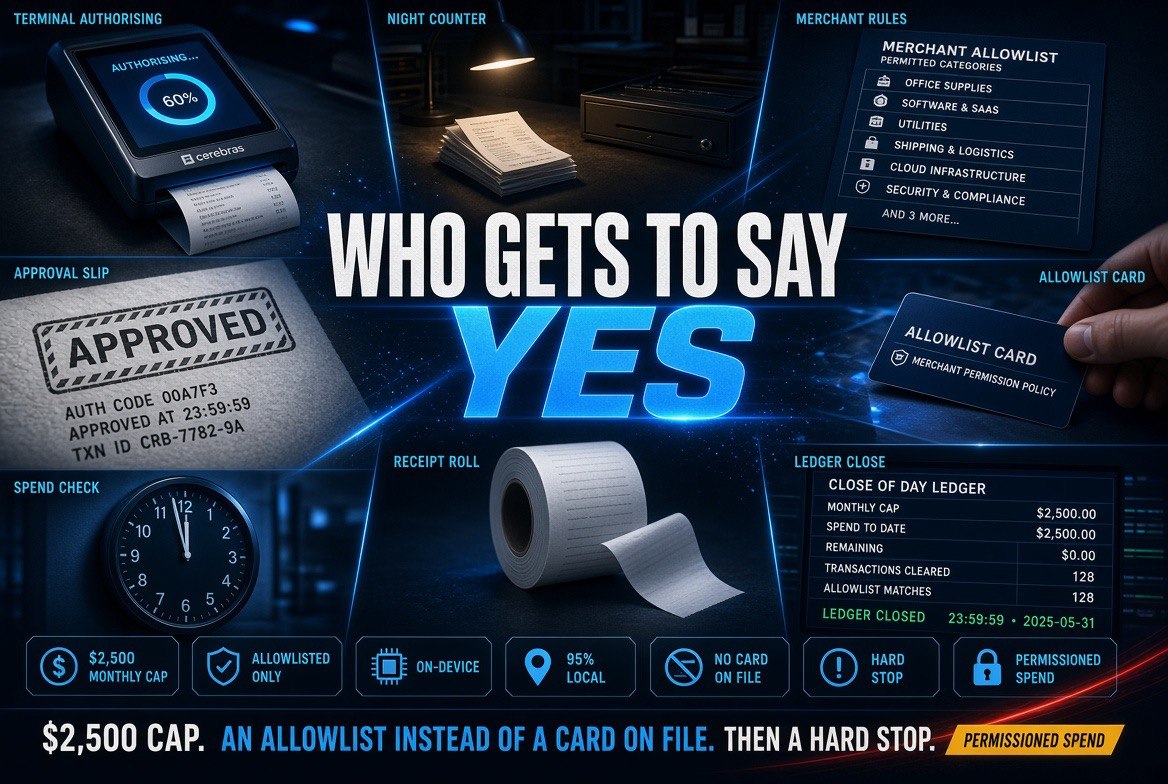
No card on file. An allowlisted set of merchants, a $2,500 monthly ceiling, on-device processing and a hard stop when the meter runs out.
What to Do Before the Assistant Arrives
The temptation with a story like this is to file it under “someday” and go back to the invoices. That would be a mistake, because the groundwork is cheap and it compounds — and most of it is useful even if the home AI appliance takes another three years.
1. Issue a dedicated agent card with a hard cap. Do not use your operating account. Open a separate virtual card, set a low per-transaction ceiling, restrict it to the merchant categories you actually need, and treat it as disposable. If a vendor claiming to be an AI assistant asks for your primary card details in 2026, that is a red flag, not a feature.
2. Write down what an agent is never allowed to decide. Payroll, tax filings, contract signatures, hiring, and pricing changes belong on that list. The more specific your never-list, the easier it is to configure any tool you evaluate against it.
3. Clean your structured data now. Agents select on machine-readable attributes — accurate product titles, clear variants, real availability, correct prices, honest lead times. Incomplete data means the agent cannot confidently choose you, no matter how good your actual product is. This work pays off in search today and in agent commerce tomorrow.
4. Ask every vendor where their model runs. “On device, in the cloud, or both” is a legitimate procurement question now. A hybrid answer means your sensitive data has a chance of staying in the building. A cloud-only answer is not automatically wrong, but it changes your risk calculation and should change your willingness to feed it sensitive material.
5. Put “who can spend” in writing before you put it in software. The single most common failure mode with buying agents will not be a rogue model. It will be an employee quietly delegating purchasing authority to a tool nobody approved. A one-paragraph internal policy — who may authorize an agent to spend, and what limits apply — closes that gap for the price of an email.
None of that requires buying anything. It requires deciding, in advance, what you are willing to hand over — which is the only part of this transition you actually control.
Frequently Asked Questions
Did Cerebras announce a home AI device?
No. CEO Andrew Feldman made a prediction on stage at TechCrunch Disrupt 2026 that personal AI assistants running partly on local hardware are close, but Cerebras builds AI inference infrastructure, not consumer devices. Feldman explicitly said he prefers building the platforms other companies’ ideas run on, so treat this as a demand signal from a chipmaker rather than a product announcement.
What does “runs locally” actually mean for a small business?
It means part of the assistant’s work happens on hardware you control instead of on a remote server. In practice that is usually a smaller model handling private data — your documents, your calendar, your pricing — while a larger cloud model handles heavier reasoning. The benefit is that sensitive business information does not have to leave your premises to be useful.
Should I let an AI agent have access to my business credit card?
Not your primary card. If you test an agent with spending authority, use a separate virtual card with a hard per-transaction limit, a merchant-category allowlist, and instant revocation. That way a mistake costs you the cap you set, not your operating account — and you keep a clean audit trail of what the agent authorized.
How close is this to affecting my business today?
Closer than the device timeline suggests. The assistant as an interface is already here — consumers research, schedule, and buy through AI systems right now. The home appliance is the delivery mechanism, not the capability. The practical preparation is data hygiene, spend controls, and a written policy on what an agent may decide, all of which are useful immediately.
What is the biggest risk small business owners should watch for?
Not a rogue AI. The bigger risk is unmanaged delegation — an employee handing purchasing or customer-data access to an unapproved tool because it saved time, with no documentation and no spending limit. A short internal policy naming who can authorize agent spending and under what caps prevents most of the damage that actually occurs.

About Barak Schurr
Barak Schurr built and sold a major ticketing platform, ran global nightlife operations at Eventbrite, and now spends his time figuring out which AI tools actually move the needle for independent business owners — and which ones are just noise. No hype. No fluff. Just what works.
Email: [email protected]
More AI Resources for Your Business