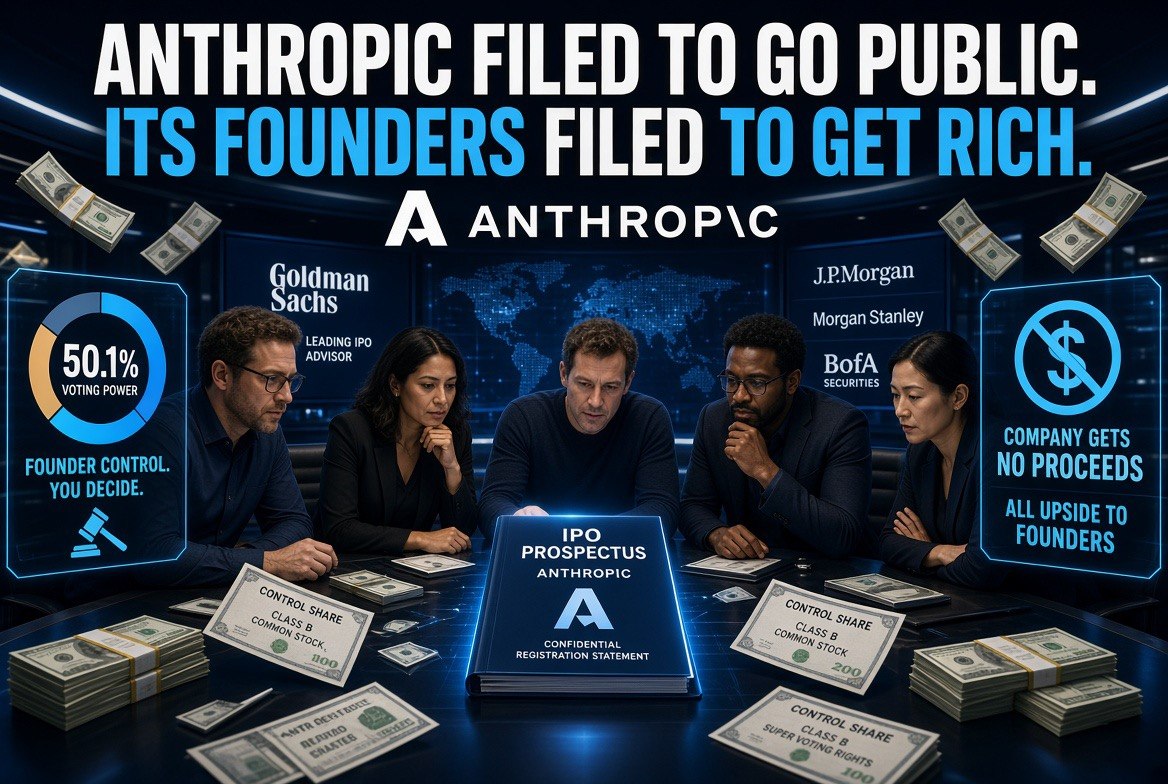
Anthropic Filed to Go Public. Its Founders Filed to Get Rich.
⚡ Expert Summary: Anthropic’s S-1 shows a company with roughly 900% net revenue retention and $6.6 million in trailing revenue per employee — and a single share of Class F stock handed to a founder-controlled LLC that carries 50.1% of all voting power. Seven co-founders are about to become billionaires off a business that genuinely works. The paperwork makes sure nobody outside those seven ever gets a say in it.
On October 26, 2026, Anthropic, PBC filed its Form S-1 with the U.S. Securities and Exchange Commission. The filing was accepted at 9:00:11 a.m. Eastern. It runs 87 documents. It lists Goldman Sachs, Morgan Stanley, J.P. Morgan, Citigroup, Barclays, Wells Fargo, Bank of America, Deutsche Bank, UBS, BNP Paribas and fourteen other banks as underwriters — a lineup you assemble when you expect to raise money at a scale that changes the league tables.
It also leaves the two most important numbers blank. The number of shares for sale and the price range are empty in the preliminary prospectus, with the standard caveat that the information is not complete and may change.
Here is what is not blank. Immediately before the offering closes, Anthropic will issue a single share of Class F common stock to a Founder LLC. The sole initial members of that LLC are the seven co-founders: Dario Amodei, Daniela Amodei, Tom Brown, Jack Clark, Jared Kaplan, Sam McCandlish, and Christopher Olah. That one share carries votes equal to 50.1% of total voting power on matters submitted to stockholders.
One share. Majority control. And it is not a share you or I can buy.
What the S-1 Actually Says About Control
Strip out the growth numbers for a moment and read the governance section, because that is where the story is. Anthropic’s filing describes a structure with four classes of stock doing very different jobs:
| Share Class | Who Holds It | Voting Rights | Economic Rights |
|---|---|---|---|
| Class A | Public buyers, selling stockholders | One vote per share | Full |
| Class F | Founder LLC — the seven co-founders | 50.1% of total voting power | None |
| Class N | Strategic partners, public benefit fund | None until transferred to an unaffiliated third party, then converts to Class A | Full |
| Class E | Employees | Limited | Full |
| Net result | Seven people | Permanent majority | Their economic stake sits elsewhere |
The Class F share carries no economic rights. It is pure authority. The founders’ money lives in regular shares, the kind that trade, the kind that get valued, the kind that convert into the $13 billion per person figures that Bloomberg and Fortune have reported — figures I cannot independently verify from this filing, so treat them as reported estimates rather than statements of fact.
There is a second layer on top. Anthropic’s Long-Term Benefit Trust, set up in 2023 as five financially disinterested trustees, holds Class T stock with the power to elect and remove the Class T directors — who together constitute a majority of the authorized board. Because that trust can elect a board majority, Anthropic qualifies as a controlled company under Nasdaq governance rules. The company says it expects to rely only on the exemption covering its nominating and corporate governance committee, and that its board currently has a majority of independent directors with fully independent audit and compensation committees.
Read that carefully. The exemption they are taking is narrow. That is better than most controlled companies do. It is also still a controlled company, and the phrase does not usually appear in press releases.
The Business Is Real, Which Is the Uncomfortable Part
None of this would matter if the underlying machine were broken. It is not broken. The S-1 numbers explain why the banks lined up and why nobody in the room had leverage to argue about voting rights.
Anthropic launched Claude commercially in the first quarter of 2023. The prospectus describes the resulting uptake as “the fastest enterprise adoption of any technology in history,” and then backs it with customer counts that survived the filing’s own lawyers:
| Metric (as of Sept 30, 2026 unless noted) | Figure |
|---|---|
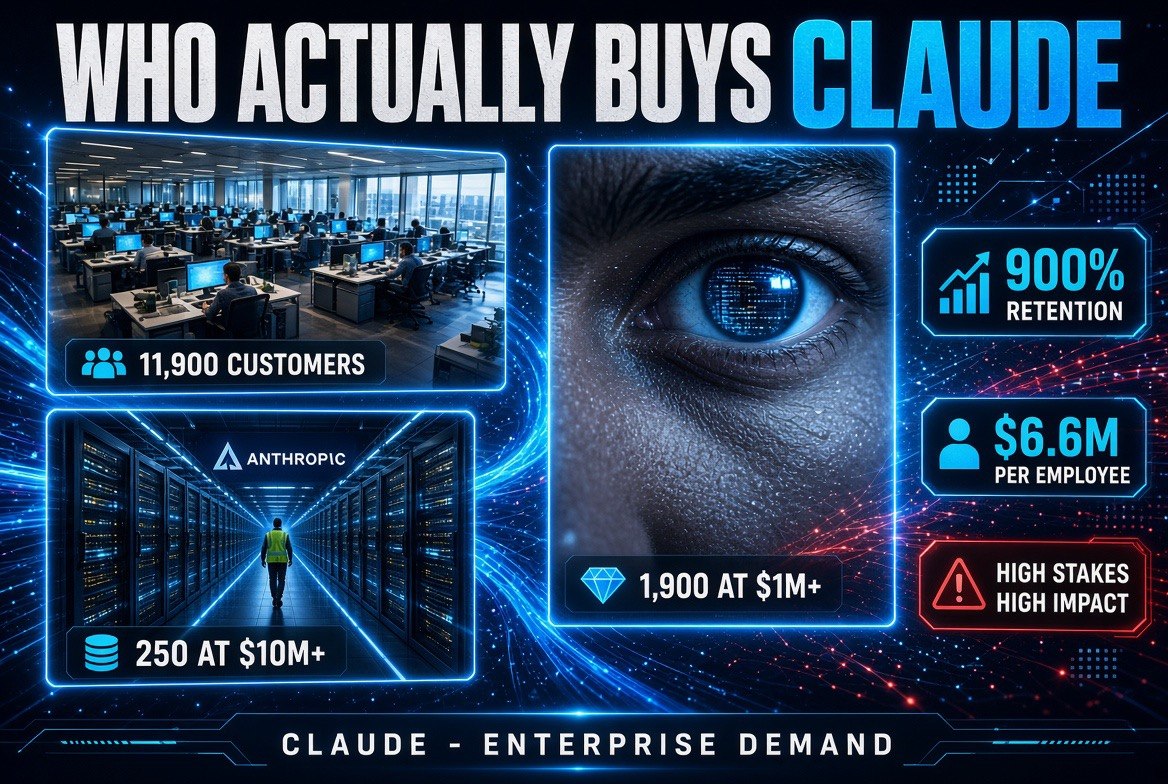
| Customers spending $100,000+ per year | More than 11,900 |
| Customers spending $1 million+ per year | More than 1,900 |
| Customers spending $10 million+ per year | About 250 |
| Net revenue retention | About 900% |
| Revenue growth, three months ended June 30, 2026 | Up 1,368% year over year |
| Compute and infrastructure expense growth, same period | Up 300% |
| Trailing-twelve-month revenue per employee | $6.6 million (vs. $1.4 million a year earlier) |
| Capital raised through June 30, 2026 | $141.1 billion |
| Cash plus short-term investments | $131.7 billion ($112.4B cash + $19.3B STI) |
A 900% net revenue retention figure deserves a sentence of its own. That number means the cohort of customers you already had is spending nine times what it spent a year earlier. In normal enterprise software, 120% is world-class and 130% gets you invited to conferences to explain yourself. Anthropic is reporting something closer to a category that did not previously exist.
The mechanism is not mysterious. TechCrunch’s read of the filing is that Anthropic is not selling a static product against a single use case — it sells the model, the developer platform, and the end-user applications, and an advance in any one layer compounds across all three. A company starts with the API. Then it deploys Claude Code to its engineers. Then it rolls Claude Cowork out to everyone else. Each additional layer takes a customer who was spending a normal amount and turns them into a customer spending an abnormal amount. The top 5% of enterprise Claude Code users reportedly spend about 20 times as much per month as the average enterprise user.
That is a good business. It is also, for anyone who runs a business, a warning worth studying. The vendor relationship you are entering is designed to move from one department to all of them, and the price rises with each door it opens.
The Public Benefit Fund, and What 80% Actually Commits To
This is where the philanthropy story needs to be read slowly, because two very different things got bundled together in the coverage.
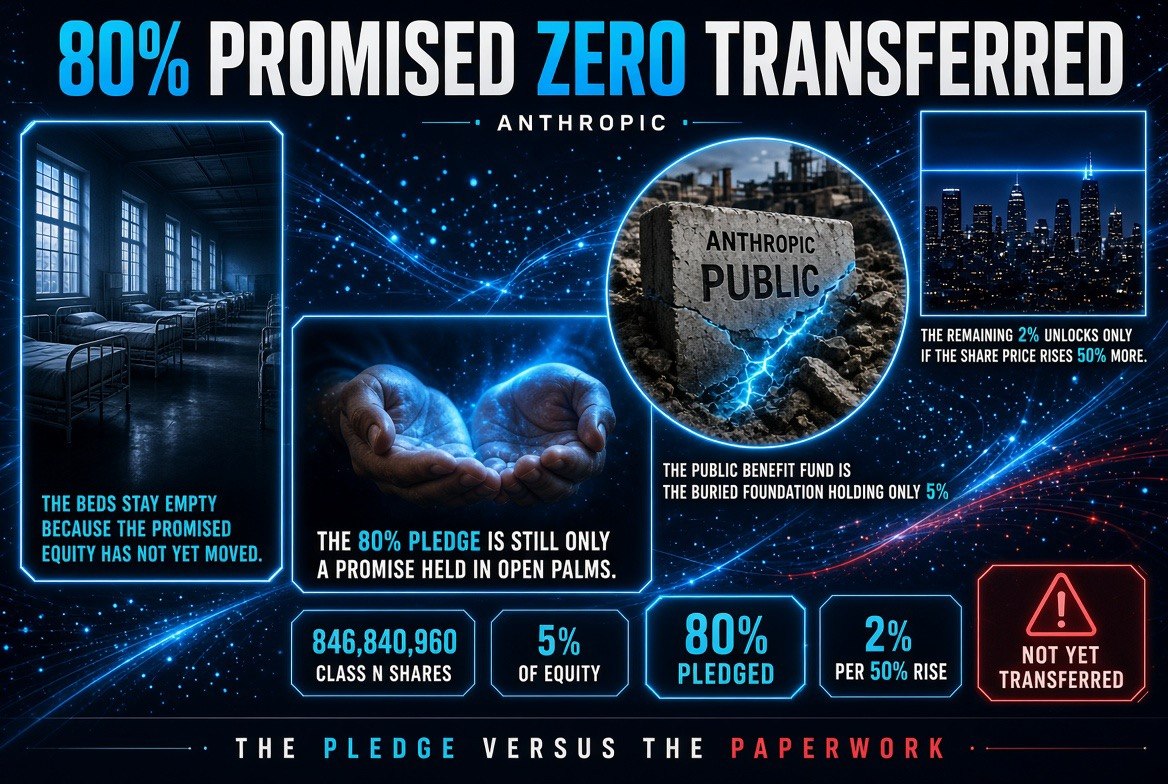
Item one: Anthropic contributed 846,840,960 Class N shares to the Anthropic Public Benefit Fund, a wholly owned subsidiary. That represents 5% of fully diluted shares as of June 30, 2026, assuming full conversion of the Amazon notes. The board has also approved discretionary issuances of up to an additional 2% of outstanding shares each time the share price appreciates 50% above the prior milestone, starting from the IPO price.
Item two: each co-founder has separately pledged to dedicate 80% of their personal Anthropic equity to philanthropic causes, and there is a matching program that pairs employee equity pledges to charity with Class N shares.
Those are two different commitments from two different parties with two different enforcement mechanisms. The company’s 5% goes to a fund it wholly owns — a fund it controls. The founders’ 80% is a pledge, made verbally in public and now repeated in a prospectus, but the filing does not convert it into a binding transfer of shares to an independent body. A pledge is a promise. A transfer is a transaction. Investors reading page by page will notice which one appears in the capitalization table.
That gap is not unique to Anthropic. It is the standard playbook for founders who have publicly committed to giving wealth away while retaining control of the vehicle that holds it. But a 5% company contribution plus a personal 80% pledge, arriving in the same filing that hands 50.1% of voting power to a founder LLC, is a lot of generosity to take on faith.
Why This Matters More for Small Business Than for Wall Street
Wall Street will argue about the multiple. The people who should be paying attention are the ones with a Claude invoice.
Anthropic reports that Claude is distributed through joint go-to-market arrangements with Amazon Web Services, Google Cloud Platform, and Microsoft Azure, plus systems integrators including Accenture, Deloitte, KPMG, and PwC, data platforms Salesforce and Snowflake, and a services venture called Ode with Anthropic built with private equity partners. Read the list again and notice what it means: the companies that will sell Claude to you are also the companies that host it, the companies that audit your books, and the companies that consult on your operations.
The filing names that concentration as a risk. Under “risks,” it cites dependence on developing advanced models and securing adequate compute, competition, potential misuse of its models or failure of safeguards, misaligned or autonomous model behavior, customer and distribution-channel concentration, limited operating history, reliance on cloud providers that are also investors and customers, and the concentration of voting power in the Long-Term Benefit Trust and the Founder LLC.
That last item is Anthropic admitting, in its own filing, that the control structure is a risk to shareholders. Fair enough. Shareholders in a public company get the vote they buy. An independent business owner who depends on Claude for quoting, scheduling, or customer support gets something else entirely: a supplier whose strategy will now be set by quarterly expectations and a founder majority that answers to nobody at the annual meeting.
Here is the practical version of that. A public Anthropic has to grow revenue every quarter. Growth comes from moving customers up the tier ladder — more seats, more layers, more usage. The 20x spend gap between heavy Claude Code users and average enterprise users is not a side effect of the business model. It is the business model. Budget accordingly, and make sure whatever you build on Claude has an exit door that is not welded shut.
The Valuation Question Nobody in the Filing Answers
The headcount and pricing lines are empty. The valuation chatter in the press has ranged into territory that would make this the largest listing in history, and the reported per-founder fortunes in the $13 billion to $14 billion range depend entirely on a number that Anthropic has not yet stated.
What is stated is that Anthropic will receive no proceeds from shares sold by selling stockholders. That line tells you something specific: part of this offering is existing holders converting paper into cash. The company raises money, and separately, insiders raise money. Both happen in the same transaction, and only one of them shows up in the company’s bank account.
That is normal for a company at this stage. It is also exactly the moment when the phrase “their founders filed to get rich” stops being a joke and becomes a description of the document. Seven people built something genuinely extraordinary. The filing lets them sell part of it while keeping permanent control of what remains. Both things are true, and the second one is the reason the first one is worth so much.
What to Watch Before the Listing
Three specific things, all checkable, none of them vibes:
First, the price range when it appears. The blank lines in the preliminary prospectus will be filled in an amendment. Whatever range appears fixes the milestone from which the Public Benefit Fund gets its additional 2% issuances each time the stock rises 50%. The higher the range, the fewer milestones the fund is likely to clear in any near-term window.
Second, the selling stockholder table. When the amendment names the selling stockholders and their share counts, compare that against the 80% pledge. If founders are selling into the offering while the pledge remains a pledge, the question of where that money goes becomes the most important line in the document.
Third, whether the founder LLC ever unwinds. Class F converts to nothing and carries no economics; it exists to hold votes. Any amendment to that arrangement — or any transfer of that single share — would be the single most significant governance event in the company’s public life, and it would be remarkably easy to miss in a proxy filing.
Anthropic is a public benefit corporation. Its certificate of incorporation identifies its purpose as “the responsible development and maintenance of advanced AI for the long-term benefit of humanity.” That is a real legal structure with real obligations, and it deserves credit for existing at all. But a public benefit corporation with a 50.1% founder vote, a five-trustee body electing a board majority, and Nasdaq controlled company status is a very specific instrument. It benefits the public in the way its founders define the public benefit, for as long as its founders hold that share.
The business is real. The growth is real. The safeguards against misuse are real enough that the filing lists their failure as a risk. What is not settled, and what no filing can settle, is whether a company this well built can be handed to the public without the public getting anything except a price.
Frequently Asked Questions
Did Anthropic actually file for an IPO?
Yes. Anthropic, PBC publicly filed a Form S-1 registration statement with the SEC on October 26, 2026, for an initial public offering of Class A common stock, and applied to list on the Nasdaq Global Select Market. The filing is the first step; the registration must become effective before any shares can be sold.
What is the Class F share and why does one share control 50.1% of the vote?
Immediately before the offering closes, Anthropic issues a single share of Class F stock to a Founder LLC whose only members are the seven co-founders. That share carries votes equal to 50.1% of total voting power on matters submitted to stockholders, and carries no economic rights. It is a control instrument, not an ownership stake.
How much is each Anthropic co-founder worth?
Press reports citing the filing have put the figures in the range of $13 billion to $14 billion per co-founder at a valuation near $965 billion. Those figures are estimates that depend on a share price the filing does not yet state, and they should be treated as reported projections rather than confirmed values.
What does the 80% pledge from Anthropic’s founders actually commit them to?
Each co-founder has pledged to dedicate 80% of their personal Anthropic equity to philanthropic causes. The filing records the pledge and a matching program for employee pledges. It does not convert the pledge into an irrevocable transfer of shares to an independent body, which is why the distinction between a company contribution to its own fund and a personal charitable commitment matters.
Why is Anthropic considered a controlled company on Nasdaq?
Because its Long-Term Benefit Trust can elect a majority of the board and the Founder LLC holds majority voting power. Nasdaq governance rules allow companies controlled in that way to rely on limited exemptions. Anthropic states it expects to rely only on the exemption for its nominating and corporate governance committee, while keeping independent audit and compensation committees.
Should small businesses worry about Anthropic going public?
Not about the listing itself, but about what public ownership rewards: quarterly growth from existing accounts. Anthropic’s own disclosure shows revenue concentrated in customers who keep buying more layers of the platform. Budget for rising usage, negotiate terms that survive a pricing change, and keep a migration path that does not depend on one vendor.

About Barak Schurr
Barak Schurr built and sold a major ticketing platform, ran global nightlife operations at Eventbrite, and now spends his time figuring out which AI tools actually move the needle for independent business owners — and which ones are just noise. No hype. No fluff. Just what works.
Email: [email protected]
More AI Resources for Your Business