Get The Solo Business OS — Free
The AI workflow that replaces a part-time employee for solo operators and small business owners.
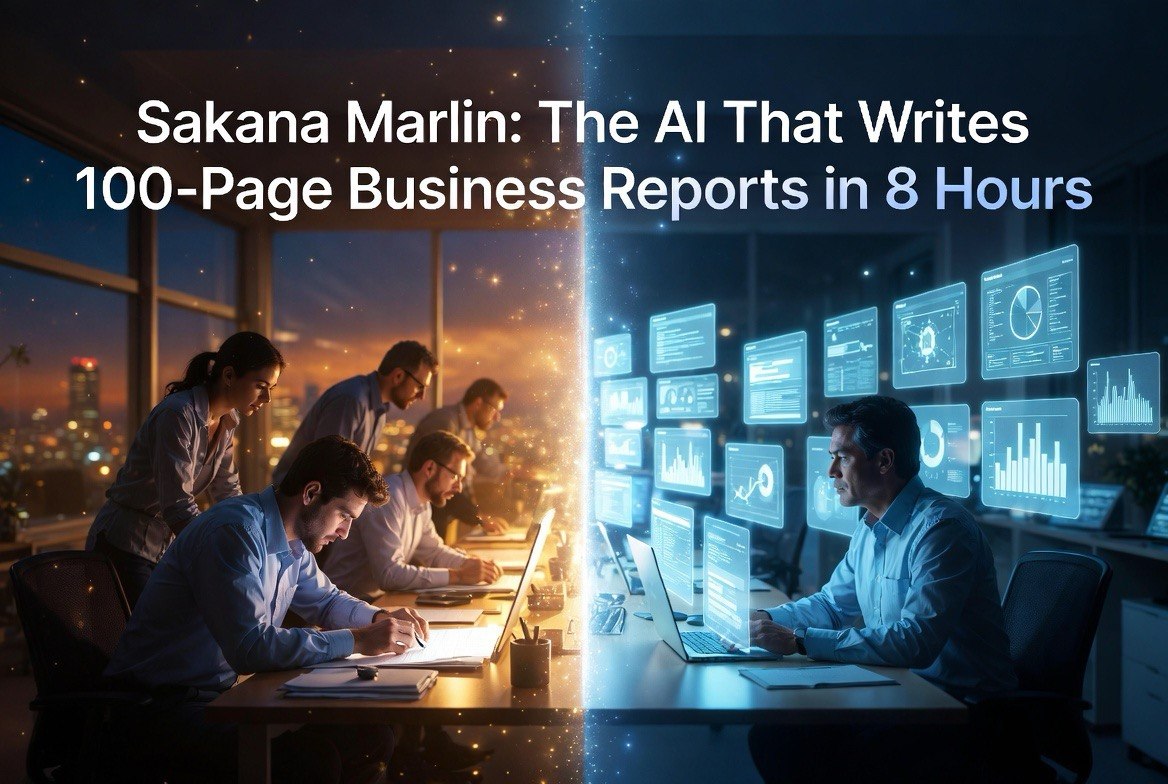
Sakana Marlin: The AI That Writes 100-Page Business Reports in 8 Hours
u26a1 Expert Summary: Sakana AI launched Marlin, an autonomous B2B research agent branded as a “Virtual CSO” that produces 100-page strategy reports with executive summaries in up to eight hours. Unlike OpenAI, Google, and Perplexity deep research tools that return answers in minutes, Marlin runs continuous reasoning loops for hours and targets corporations, financial institutions, and think tanks that need deeply researched strategic analysis without hiring a Chief Strategy Officer.
Here is a number that should stop any business owner: eight hours for a 100-page strategy report with cited sources, executive slides, and competitive analysis. That is what Sakana AI’s Marlin delivers u2014 not as a prototype, not as a beta, but as a commercial product available today.
Sakana AI, the Tokyo-based startup that has been making noise with biologically inspired AI architectures, launched Marlin on June 15, 2026. They call it a “Virtual CSO” u2014 Chief Strategy Officer u2014 and the branding is not marketing fluff. It reflects a real gap in how businesses approach research and strategic planning.
The Core Problem Marlin Solves
Every small to mid-size business owner faces the same strategic research problem. You need to understand a market, analyze a competitor, evaluate a new technology, or assess regulatory risk. But hiring a Chief Strategy Officer costs $200,000 to $400,000 per year in the United States. Contracting a consulting firm for a single strategic analysis runs $20,000 to $100,000. Either option takes weeks.
Current AI research tools u2014 ChatGPT Deep Research, Google Gemini Deep Research, Perplexity Deep Research u2014 handle the quick-briefing use case well. They produce 5- to 10-page summaries in 3 to 30 minutes. But none of them produce the depth required for a strategic investment decision, a competitive market analysis, or a technology evaluation that needs to hold up to board-level scrutiny.
Marlin fills that gap. Instead of returning an answer in seconds, it runs continuous, self-governing reasoning loops for up to eight hours, iterating through sources, cross-referencing data points, identifying contradictions, and building a coherent analytical narrative. The output is a 100-page report with cited sources and executive-ready presentation slides.
How Marlin Works
Marlin is not a chatbot. You do not open a chat window and type questions. The workflow starts with a brief dialogue where Marlin sharpens the scope of the investigation u2014 clarifying objectives, identifying key research questions, and defining deliverables. Once the scope is set, Marlin executes autonomously for hours.
During that execution window, Marlin runs multiple parallel research threads. It searches for academic papers, industry reports, regulatory filings, news coverage, and company disclosures. It cross-references claims across sources and flags inconsistencies. It builds arguments and tests them against contradictory evidence. It generates citations from verifiable sources rather than AI hallucinated references u2014 a problem that continues to plague faster research tools.
At the end of the run, Marlin delivers a report structured around the strategic questions defined at the start. The reports include executive summaries, detailed analysis sections, competitive landscape mapping, and appendixes with full source citations. Sakana AI posted sample reports on their product website showing the depth and structure.
Pricing and Accessibility
Marlin is available immediately via Sakana AI’s website with pay-as-you-go pricing starting at an enterprise tier. The company is targeting corporations, financial institutions, and think tanks u2014 organizations that currently spend tens of thousands of dollars on strategic research engagements. Sakana has not released a small business tier, but the pay-as-you-go model means a solo operator or small team can use it for a single strategic analysis without committing to an annual contract.
The pricing sits between the consumer deep research tools ($20 to $200 per month) and a full consulting engagement ($20,000 to $100,000). The exact cost per report depends on the depth and duration of the research run, but the value proposition is clear: the equivalent of a six-figure annual hire available on demand.
How Marlin Compares to ChatGPT Deep Research, Gemini, and Perplexity
The difference between Marlin and existing deep research tools comes down to time horizon, output scale, and target audience.
OpenAI’s ChatGPT Deep Research completes multi-step research in 3 to 30 minutes and produces 5- to 10-page summaries. Google’s Gemini Deep Research offers collaborative planning features u2014 you can edit a bulleted outline before execution u2014 but produces outputs at a similar depth and speed. Perplexity’s Deep Research uses parallelized search-as-code and targets the same quick-briefing use case.
Marlin operates on a fundamentally different timescale: up to eight hours of continuous reasoning. It is not designed for quick answers. It is designed for the kind of analysis that currently requires a human analyst spending three to five days reading, synthesizing, and writing. For a business owner evaluating whether to enter a new market or invest in a significant technology shift, the difference between a 10-minute summary and an 8-hour report is the difference between a directional signal and an investment-grade analysis.
Practical Use Cases for American Small Businesses
Marlin’s enterprise positioning does not exclude smaller operators. Any business that makes strategic decisions based on market research can benefit from autonomous deep research. Here are concrete use cases:
Competitive analysis. A business evaluating a new competitor entering their space can commission Marlin to compile everything publicly available about the competitor u2014 funding history, product roadmap signals, hiring patterns, customer reviews, partnership announcements u2014 and deliver a consolidated strategic assessment.
Market entry evaluation. A business considering expansion into a new region or vertical can use Marlin to analyze market size, regulatory environment, competitive density, customer demographics, and entry barriers u2014 without hiring a consulting firm.
Technology assessment. A business evaluating whether to adopt a new AI tool, platform, or infrastructure investment can get a comprehensive analysis of the technology landscape, vendor comparison, integration requirements, and ROI projections.
Regulatory impact analysis. With AI regulation evolving rapidly across the United States and internationally, Marlin can analyze how proposed regulations in specific states or sectors affect a business’s operations and compliance obligations.
Accuracy and Reliability
Sakana AI designed Marlin specifically to address the hallucination problem that plagues faster AI research tools. The continuous reasoning loop architecture allows Marlin to verify its own claims by cross-referencing multiple sources before including them in the final report. If a claim appears in one source but is contradicted by another, Marlin flags the discrepancy rather than picking the more convenient answer.
This verification approach is critical for strategic analysis. A 10-minute deep research tool that hallucinates a citation is an inconvenience. An 8-hour report with a hallucinated data point that drives a business decision is a liability. Marlin’s slower, more deliberate architecture is a feature, not a bug u2014 designed for accuracy over speed.
The Technology Behind Marlin: Biologically Inspired Architecture
Sakana AI is not a conventional AI company. The name Sakana means fish in Japanese, and the company builds AI systems inspired by biological principles u2014 specifically the collective intelligence found in schools of fish and swarms of insects. Instead of one massive model trying to solve every problem, Sakana AI builds systems where multiple specialized models collaborate.
Marlin applies this philosophy to research. Instead of a single AI model attempting to produce a comprehensive report in one pass, Marlin runs multiple specialized agents that each focus on different aspects of the research question. One agent searches for academic sources. Another analyzes industry reports. A third cross-references claims for consistency. A fourth builds the narrative structure. A fifth handles citations and source verification. These agents work in parallel, share findings with each other, and converge on a coherent final output over the full eight-hour research window.
This multi-agent architecture is fundamentally different from the monolithic approach used by ChatGPT Deep Research and Gemini Deep Research. Both of those tools use a single model that iterates through research steps sequentially. Marlin spreads the work across specialized agents that can operate simultaneously. The result is deeper research in a shorter wall-clock time relative to the breadth of analysis u2014 even though the total runtime is longer.
Real-World Results from Early Users
Sakana AI published sample reports on the Marlin product website that demonstrate the depth of analysis available. The reports include detailed competitive landscape mapping with market share estimates, regulatory analysis with specific statute references, technology evaluation with integration requirements, and financial modeling with assumptions clearly documented.
Early users reported that Marlin identified market trends and competitive threats that their internal teams had missed during months of manual research. One early adopter in the financial services sector noted that Marlin uncovered a regulatory risk in an overseas market that their compliance team had not flagged u2014 a finding that saved the company significant exposure.
These results highlight the advantage of autonomous research that can process thousands of sources without fatigue. A human analyst reading for eight hours can cover perhaps 100 to 200 sources, depending on complexity. Marlin processes thousands, cross-references every claim against every other claim, and surfaces connections that no single human analyst would catch.
Limitations and What Marlin Cannot Do
Marlin is powerful, but it has clear limitations that business owners need to understand before depending on it for strategic decisions.
First, Marlin can only analyze publicly available information. It cannot access internal company data, proprietary databases, or information behind paywalls unless specifically granted access. If your strategic question depends on non-public data, Marlin cannot help u2014 at least not yet.
Second, Marlin delivers analysis, not judgment. The report will present evidence, identify patterns, and flag contradictions, but the final strategic decision requires human judgment. A 100-page report can inform a decision. It cannot make the decision for you.
Third, Marlin targets enterprise use cases and its pricing reflects that. While the pay-as-you-go model makes it accessible for occasional use, regular strategic analysis at Marlin-level depth will require a budget that most small businesses have not allocated for AI tools.
Despite these limitations, Marlin represents a genuine leap forward in what autonomous AI can deliver for strategic business analysis. For any business owner who has ever wished they could get board-level research without the board-level price tag, Marlin is worth understanding today u2014 because the competitive gap it creates will only widen as the technology improves.
According to a report by Forrester Research, autonomous B2B research agents like Marlin could reduce strategic planning costs by up to 70 percent for enterprises that currently rely on human consultants for competitive intelligence work. TechCrunch noted the launch as one of the most significant AI agent developments of early 2026 for the business research sector.
Frequently Asked Questions
What is Sakana Marlin?
Sakana Marlin is an autonomous B2B research agent that produces 100-page strategy reports with cited sources and executive slides. It runs continuous reasoning loops for up to eight hours, producing deeper analysis than consumer deep research tools.
How is Marlin different from ChatGPT Deep Research?
ChatGPT Deep Research completes research in 3 to 30 minutes and produces 5- to 10-page summaries. Marlin runs for up to eight hours and produces 100-page reports. They serve different use cases u2014 quick briefings versus investment-grade strategic analysis.
How much does Sakana Marlin cost?
Marlin uses pay-as-you-go pricing at an enterprise tier. The exact cost per report depends on research depth and duration, but it sits between consumer AI subscriptions ($20 to $200 per month) and full consulting engagements ($20,000+).
Can small businesses use Sakana Marlin?
Yes. While Marlin is positioned as an enterprise product, its pay-as-you-go model means small teams can use it for individual strategic analyses without annual commitments.
Is Marlin more accurate than other AI research tools?
Marlin uses continuous reasoning loops that cross-reference sources and flag discrepancies before including claims in the final report. This verification architecture is designed to reduce hallucinations compared to faster research tools.