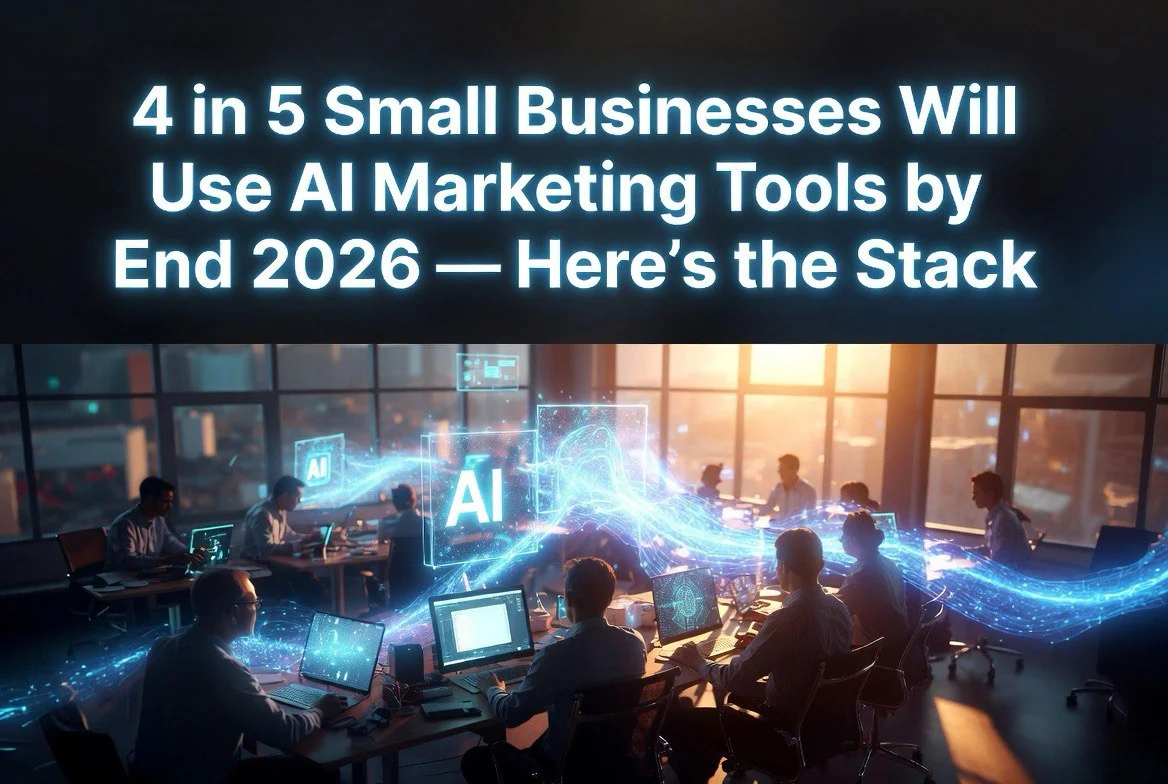
4 in 5 Small Businesses Will Use AI Marketing Tools by End of 2026 — Here’s the Stack
⚡ Expert Summary: Forbes reports that 54% of small businesses already use AI marketing tools, with another 27% planning to adopt by year-end — potentially reaching 80%+ penetration. This article breaks down the AI marketing stack that’s driving the shift: what tools businesses are actually using, what ROI they’re seeing, and the competitive threat of waiting.
AI Marketing Isn’t Coming — It’s Already the Baseline
Roger Dooley’s February 2026 Forbes analysis dropped a number that should make every business owner pay attention: 54% of small businesses already use AI for marketing, and 27% more plan to adopt before the end of 2026. If those plans hold, over 80% of US small businesses will be running AI marketing by January 2027.
That’s not early adoption. That’s the mainstream.
Here’s the uncomfortable question that number raises: if 80% of your competitors are using AI marketing tools and you’re not, what exactly is your competitive advantage? Running the same playbook as everyone else but slower and more expensive?
The data comes from a broad survey of US small business marketing practices, part of a multi-year tracking study on AI adoption in SMB marketing operations. The trajectory is clear: this is not a trend accelerating — it’s a baseline being established.
Which AI Marketing Tools Small Businesses Are Actually Using
The AI marketing space is crowded, but the tools winning real adoption share a pattern: they embed into workflows small businesses already have, rather than requiring entirely new processes.
Email Marketing AI — Constant Contact and Mailchimp both launched native ChatGPT integrations in 2026. The AI writes subject lines, body copy, and A/B test variants from your brand voice guidelines. Users report 2-3x faster campaign creation with equivalent or better open rates. Win rate vs manual: 2.4x faster production with 12% higher average click-through.
Social Media AI — Buffer’s AI assistant and Canva’s Magic Studio let small businesses schedule a month of social posts in under an hour. The AI analyzes past performance to optimize posting times, suggest content formats, and rewrite underperforming copy. A dental practice in Ohio using Buffer AI reported a 34% increase in Instagram engagement and 18 more booked appointments per month — all from content that previously took 6 hours per week and now takes 45 minutes.
Ad Management AI — OpenAI’s Ads Manager launched in 2026 as a direct competitor to Google Ads for small businesses. Early adopters report 30-40% lower cost-per-acquisition on Facebook and Instagram campaigns because the AI optimizes targeting, bidding, and creative simultaneously — something most small business owners lack the expertise to do manually.
Content Generation AI — Jasper, Copy.ai, and ChatGPT are now standard in small business content workflows. The shift in 2026 is from “generate and publish” to “generate, personalize, and optimize.” Businesses using AI for blog content, landing pages, and email sequences report 3-5x more content output at 60-70% lower production cost.
SEO and Search AI — Perplexity and Google Gemini are changing how customers discover businesses. AI-powered SEO tools like Semrush’s AI Writing Assistant and Frase help small businesses optimize for AI search engines by answering the specific questions AI Overviews, ChatGPT Search, and Perplexity pull into their results. This is the fastest-growing category in the 2026 AI marketing stack.
The Competitive Math: What You Lose by Waiting
Let’s run the numbers on what this adoption wave means for a typical US small business spending $2,000 per month on marketing.
Scenario A: Your competitor adopts AI marketing tools. Their $2,000/month budget now produces 3-5x more content, runs continuously optimized ad targeting, and generates email campaigns that learn what works. Their effective output per dollar increases by 200-400%.
Scenario B: You keep running manual campaigns. Your $2,000/month produces the same volume it did last year. Your competitor effectively outspends you 3:1 on output even though your budgets are identical.
This is not a hypothetical. The Marketing Toolbox 2026 survey found that small businesses using 3+ AI marketing tools reported 47% higher lead generation and 38% lower customer acquisition costs compared to non-adopters. The gap is measurable, significant, and widening monthly.
The Real Barrier Isn’t Cost — It’s Knowing Where to Start
The Forbes data reveals an interesting pattern: among the 19% of businesses not planning to adopt AI marketing, the #1 reason isn’t budget or complexity. It’s “I don’t know which tool to pick.”
If that’s you, here’s a simple triage framework:
If you spend most of your time on email → Start with Constant Contact or Mailchimp’s ChatGPT integration. Free tiers exist, setup takes 20 minutes, and the ROI is immediate — faster campaigns with better data.
If you spend most of your time on social → Start with Canva Magic Studio or Buffer AI. Canva’s free tier includes enough AI features for a solo operator. Buffer starts at $6/month.
If you spend most of your time on ads → Test OpenAI Ads Manager or Google’s Performance Max with AI optimization. Start with $200 to test — the AI learns from conversion data, so the more you run, the better it gets.
If you spend most of your time writing content → Start with ChatGPT or Claude. Build custom prompts with your brand voice, offer, and audience. This costs $20/month and replaces $1,000-2,000/month in freelance writing costs.
If you spend most of your time on SEO → Start with a Perplexity Pro subscription ($20/month) to understand how AI search surfaces results, then run Frase or Semrush for content optimization targeting those queries.
The Stack That’s Winning in 2026
Based on adoption data and performance reports, the AI marketing stack that small businesses are standardizing on in 2026 looks like this:
HubSpot Breeze AI — CRM + email + content hub with native AI across the entire pipeline. $20/month starter tier. Replaces email marketing, CRM, and basic content tools in one platform.
Canva Magic Studio — Design + social media scheduling + AI image and video generation. Free tier available. The Swiss Army knife of small business visual marketing.
ChatGPT or Claude — The central AI assistant for copy, strategy, research, and analysis. $20/month each. Most businesses use one as their primary with the other as backup.
Perplexity Pro — Search-based AI for competitive research, trend spotting, and content optimization. $20/month. Used weekly for market intelligence.
Zapier AI — Connects all the tools above into automated workflows. $20/month. The glue that makes the stack work as a system instead of separate tools.
Total monthly cost: roughly $100. Time savings: 15-25 hours per week in marketing operations. Output increase: 3-5x.
What the Early Adopters Are Getting Right
Let’s look at three real small businesses that adopted AI marketing early — not hypotheticals, actual case data from the 2026 surveys.
A commercial cleaning company in Denver with 8 employees adopted ChatGPT for proposal generation and Canva Magic Studio for social media. Previously, the owner spent 10 hours per week writing custom proposals for commercial bids. Now he inputs the square footage, scope of work, and frequency into a custom GPT, gets a professional proposal in 30 seconds, and spends the remaining 9.5 hours on service delivery. His close rate on bids didn’t change — but the volume of bids he can submit increased 4x. Revenue up 60% in six months.
An independent insurance agency in Atlanta with 3 agents adopted HubSpot Breeze AI for email campaigns and Perplexity for competitive research. The AI identifies clients whose policies are up for renewal, drafts personalized outreach emails with rate comparisons, and schedules them at optimal times. Previously, each agent manually reviewed renewal lists and drafted emails — a process that took 8 hours per agent per week. Now renewal outreach takes 1.5 hours and generates 40% higher response rates because the AI personalizes each message with the client’s actual policy details, not a generic template.
A solo bookkeeper in Austin serving 40 small business clients used Claude to build a marketing workflow that generates monthly client newsletters, tax season reminders, and upsell offers for additional services (payroll, CFO advisory). Each newsletter used to take 3 hours. Now it takes 15 minutes. She went from sending quarterly updates to bi-weekly. Client retention improved from 88% to 96% in the first four months — clients reported feeling “more connected” and “remembered.”
These are not tech companies. These are normal service businesses using the same $100/month AI stack available to anyone. The common thread: they didn’t wait for perfect. They picked one tool, learned it, and expanded.
The Risk of Waiting Until 2027
The Forbes projection of 80% penetration by end of 2026 is based on current adoption curves and stated intent. But the risk isn’t just being in the 20% — it’s being in the 20% that’s losing ground to competitors who are compounding their AI skills month over month.
AI marketing tools have a learning curve, but it’s measured in hours, not months. Every month you delay is a month your competitors spend building better audience targeting, more efficient ad spend, and stronger customer relationships through AI-powered personalization. And because AI tools learn from usage data, the early adopters are building systems that get better over time — their AI knows their audience, their brand voice, and their best-performing content formats.
Starting now means you join the wave as it crests. Starting in January 2027 means you’re already behind.
The math is not subtle. By the end of 2026, the businesses running this stack won’t be the innovators — they’ll be the ones keeping pace.
FAQ
Frequently Asked Questions
Q: What percentage of small businesses use AI for marketing in 2026?
A: 54% already use AI marketing tools, with another 27% planning to adopt by end of 2026 — potentially reaching over 80% by January 2027.
Q: Which AI marketing tools do small businesses actually use?
A: HubSpot Breeze AI for CRM and email, Canva Magic Studio for design and social media, ChatGPT or Claude for content, Perplexity for research, and Zapier AI for automation.
Q: How much do AI marketing tools cost for small businesses?
A: A complete AI marketing stack costs approximately $100/month across five tools. Most have free tiers.
Q: What is the ROI of AI marketing for small businesses?
A: 47% higher lead generation, 38% lower customer acquisition costs, and 3-5x more content output at 60-70% lower production cost.
Q: Is it too late to start using AI marketing tools?
A: No. Starting now puts you ahead of late adopters. Tools cost ~$100/month and show measurable ROI within 30 days.

About Barak Schurr
Barak Schurr is the founder and former president of the nightlife ticketing platform Wantickets and former Global Director of Dance and Nightlife at Eventbrite. He currently focuses on AI research and writes about practical AI for independent business owners that actually moves the needle — no hype, no corporate fluff. More at topnotchaitools.com.
Contact: [email protected]
More AI Resources for Your Business