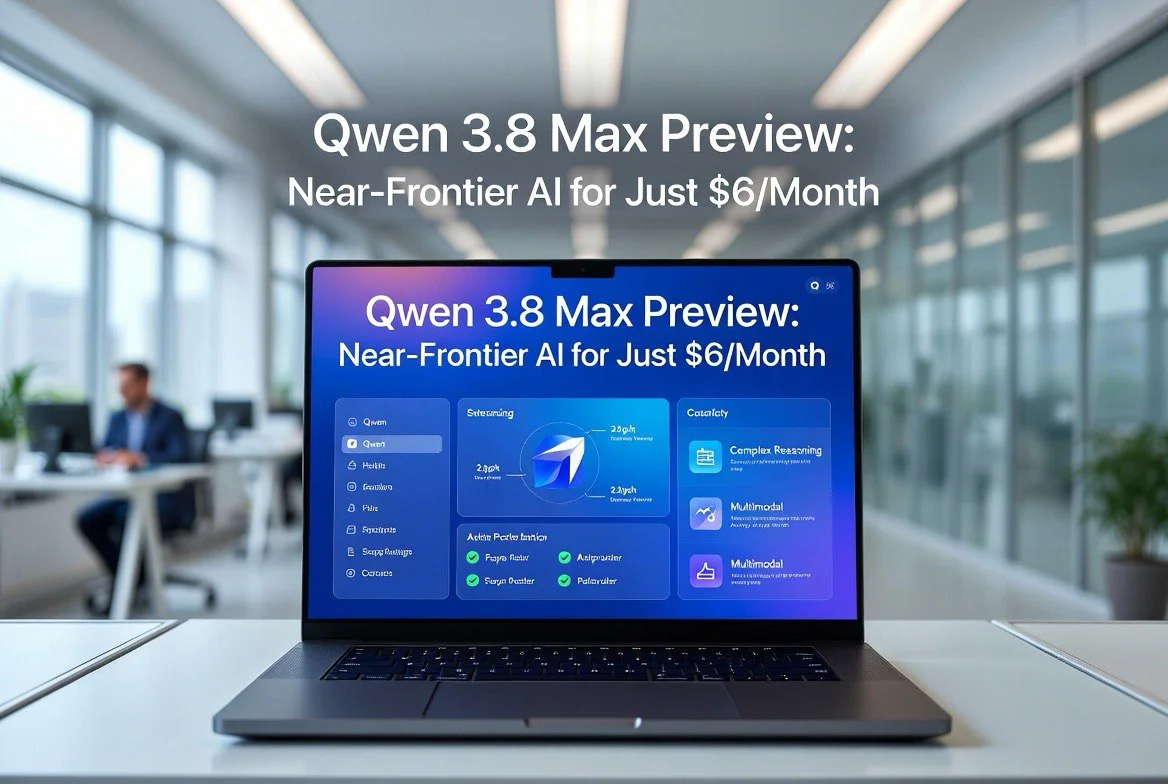
Qwen 3.8 Max Preview: Near-Frontier AI for Just $6/Month
⚡ Expert Summary: Alibaba previewed Qwen 3.8 on July 19, 2026 — a 2.4-trillion-parameter multimodal AI model the company claims is “second only to Claude Fable 5.” The kicker: you can access it through personal subscription plans starting at just $6/month during the preview period. Open weights are promised “soon,” which would make it the largest open-weight model ever released. For U.S. small business owners running on lean budgets, this is frontier-class AI at hobbyist prices — and it changes the math on who gets access to world-class AI.
What Is Qwen 3.8 Max Preview?
Alibaba’s Qwen team dropped a bombshell on July 19, 2026, when they announced Qwen 3.8 — a 2.4-trillion-parameter multimodal AI model. Built on a sparse Mixture-of-Experts (MoE) architecture, it processes text, images, video, and documents simultaneously — making it one of the most versatile models ever released for public preview.
The model’s preview version — Qwen3.8-Max-Preview — went live immediately through Alibaba Cloud’s Token Plan subscription system, Qoder coding platform, and QoderWork productivity suite. The team stated it ranks “second only to Fable 5” (Anthropic’s top-tier Claude model), though independent benchmark verification is still pending (Yottalabs, July 2026).
For context, Qwen 3.8 succeeds Qwen 3.7-Max, which scored 92.4% on GPQA Diamond and 80.4% on SWE-bench Verified (MLQ.ai, July 2026). The successor is expected to outperform it significantly across coding, reasoning, full-stack development, data analysis, and office workflows. This isn’t an incremental update — it’s a generational leap from the previous flagship.
Qwen 3.8 vs. the Competition
The parameter race among Chinese AI labs is heating up fast. Moonshot AI released Kimi K3 at 2.8 trillion parameters earlier in 2026 — briefly holding the largest open-source model title. Qwen 3.8 sits at 2.4 trillion, making it the second-largest publicly disclosed model. To put that in perspective, GPT-4 is estimated at roughly 1.7 trillion parameters. A model at 2.4 trillion represents a dramatic increase in raw capacity.
Here’s how the landscape stacks up:
| Model | Parameters | Access Price | Open Weights |
|---|---|---|---|
| Claude Fable 5 (Anthropic) | Not disclosed | $20/month+ | No |
| Kimi K3 (Moonshot) | 2.8T | API pricing | Yes |
| GPT-5.6 Sol (OpenAI) | Not disclosed | $20+/month | No |
| Qwen 3.8 Max Preview (Alibaba) | 2.4T | $6/month (preview) | Coming “soon” |
Early independent tests are promising. One 8-task benchmark suite covering 3D rendering, SVG generation, mathematics, and UI design scored Qwen3.8-Max-Preview at 65 out of 80 (81.25%). Community evaluations on YouTube describe it as “insane” for coding, front-end development, and multimodal reasoning (BenchLM, July 2026). In a matched repository-exploration comparison, it scored 80/100 against Kimi K3’s 83/100 — competitive enough that the gap could be closed with prompt engineering or fine-tuning.
Coursiv.io’s detailed analysis (updated July 20, 2026) confirms the model supports a 983,616-token context window and 131,072-token maximum output — among the largest in the industry. For comparison, GPT-4o sits at 128K context and Claude 3.5 Sonnet at 200K. A nearly 1-million-token context window means you can feed entire codebases, legal documents, or customer histories into a single prompt. Reasoning is always enabled, and the endpoint supports OpenAI and Anthropic API protocol compatibility, meaning you can plug it into existing workflows without restructuring your stack.
The Killer Feature: $6/Month Frontier Access
This is where Qwen 3.8 becomes a small business story — and it might be the most important detail in the entire announcement. The preview is available through Alibaba’s credit-based Token Plan:
- Lite: $6/month — 2,500 credits, suitable for light testing and 1–2 concurrent agents
- Standard: $18/month — 10,000 credits, 3–4 concurrent agents
- Pro: $68/month — 40,000 credits, 6–8 concurrent agents (MLQ.ai, July 2026)
During the preview, Alibaba is offering a limited-time 10% of standard pricing — effectively a 10x value boost. Nighttime discounts (80% off credits from 22:00–08:00 in some regions) apply in certain markets. A U.S. small business owner running a marketing agency, a freelance developer, or a solopreneur building internal tools can test near-frontier AI capabilities for less than the cost of a streaming subscription.
Compare that to Claude Fable 5 at $20/month with no open-weight option, or GPT-5.6 Sol at similar pricing. The value gap for experimentation-heavy workflows is enormous. If you’re a U.S.-based entrepreneur building an AI-first product, the math changes completely when your test-and-learn costs drop by 70% or more.
What the 983K Context Window Means for Your Business
The context window on Qwen 3.8 deserves its own section because it unlocks workflows that smaller models simply cannot handle. With 983,616 tokens of context, you can:
Analyze your entire customer database in one pass. Upload years of support tickets, chat logs, and review data — then ask Qwen 3.8 to identify patterns, segment customers, and recommend responses. No chunking, no splitting, no loss of continuity.
Process lengthy legal or financial documents. A typical franchise agreement runs 50–100 pages. Qwen 3.8 can ingest the entire document, your notes, and a competitor’s contract — then produce a comparison in a single query.
Build complex AI agents. The 131K output limit means the model can generate full reports, codebases, or multi-page strategy documents in one shot. For U.S. small businesses building automated customer service, content generation, or lead qualification agents, this reduces development time significantly.
The practical implication: tasks that previously required custom engineering — document chunking, retrieval-augmented generation pipelines, multi-step reasoning chains — can now be done with simpler prompts and less infrastructure. That translates directly to lower costs and faster deployment for operators with lean tech stacks.
What Small Business Owners Should Know
Coding and automation. The model excels at full-stack development and agent/tool workflows. A restaurant owner could use it to build a custom reservation widget by describing the requirements in natural language. A real estate agent could automate lead response workflows that qualify prospects and schedule showings. An e-commerce operator could generate product descriptions at scale, complete with SEO metadata and category assignments.
Multimodal analysis. Because it processes text, images, and documents together, you can drop in a competitor’s menu PDF, a financial spreadsheet, and a product photo — then ask complex cross-referencing questions like “Which menu items have the highest profit margin, and how do our competitors price similar items in the same ZIP code?” For U.S. small businesses drowning in disconnected data, this is a practical time-saver that doesn’t require a data science team to implement.
Affordable experimentation. At $6/month during preview, the barrier to testing is essentially zero. You can evaluate whether Qwen 3.8 outperforms your current AI stack before committing. For seasonal businesses or project-based operators, the Lite plan covers intermittent usage without the overhead of a full API integration.
How to Access Qwen 3.8 Max Preview
Getting started is straightforward. Visit Alibaba Cloud’s Model Studio or the Qwen Chat interface. Sign up for a Token Plan subscription — the Lite tier at $6 is the fastest on-ramp. The endpoint supports OpenAI and Anthropic API protocols, so if you’re already using tools like Cursor, Claude Code, or custom agent frameworks, you can point them at Qwen 3.8’s endpoint with minimal configuration changes.
Alibaba has also published integration guides for Codex, Qwen Code, OpenCode, and other developer tools. The built-in tooling includes web search, scraping, and code execution capabilities — meaning the model can browse the web, fetch data, and run code as part of its reasoning loop. For U.S. developers evaluating the model, this agent-ready architecture means less custom infrastructure to build.
The Open-Weight Question
Alibaba has promised an open-weight release of Qwen 3.8 “soon” — which would make it the largest open-weight model ever released. This would be a departure from Alibaba’s historical practice of keeping Max-tier models closed-source. If delivered, it would allow U.S. businesses to self-host, fine-tune, and customize the model without ongoing API costs — a significant advantage for industries with data privacy requirements, such as healthcare, legal, and finance.
However, no date, license, model card, or Hugging Face checkpoint has been published (Coursiv.io, July 2026). The preview endpoint itself may change behavior without notice. Treat it as an exploration tool for now, not a production migration target. The open-weight promise is real in intent but unconfirmed in timeline — a distinction that matters for operational planning.
FAQ
When was Qwen 3.8 released?
How much does Qwen 3.8 Max cost for small businesses?
Is Qwen 3.8 open source?
How does Qwen 3.8 compare to Claude Fable 5 or GPT-5.6 Sol?
Can I use Qwen 3.8 with my existing tools and workflows?
What hardware do I need to run Qwen 3.8 locally?

About Barak Schurr
Barak Schurr is the founder and former president of the nightlife ticketing platform Wantickets and former Global Director of Dance and Nightlife at Eventbrite. He currently focuses on AI research and writes about practical AI for independent business owners that actually moves the needle — no hype, no corporate fluff. More at topnotchaitools.com.
Contact: [email protected]
More AI Resources for Your Business