OpenAI Presence: Enterprise AI Agent Platform With Built-In Guardrails and Human Escalation
⚡ Expert Summary: OpenAI launched Presence on July 22, 2026 — a managed enterprise platform for deploying trusted AI agents in customer support, sales, IT, and HR workflows. Unlike self-serve tools like ChatGPT Work, Presence includes OpenAI engineers who handle deployment, define policies, implement guardrails, set up escalation rules, and monitor performance. OpenAI’s own phone support already resolves ~75% of issues using the same platform. Limited general availability is live now for enterprise customers.
What Is OpenAI Presence?
OpenAI Presence is a managed enterprise platform for building, deploying, and operating AI agents that represent a company consistently across every customer-facing and internal channel. It was announced on July 22, 2026, and is currently in limited general availability for qualifying enterprise customers.
The core distinction between Presence and other OpenAI products is simple: Presence is a deployed product, not a builder product. OpenAI’s Forward Deployed Engineers or select global systems integrators handle the setup, governance configuration, monitoring, and continuous improvement cycle. The enterprise defines the outcomes and policies; OpenAI makes the agents run reliably at scale.
What Presence Agents Can Do
Presence agents handle conversational workflows across voice, chat, and email. They can answer questions, resolve issues, connect to company systems through scoped APIs and tool integrations, retrieve and update information, execute approved actions, and escalate to humans when policy boundaries, risk thresholds, or complexity require it. Each agent operates within a defined scope — it does not attempt to be a general-purpose assistant. The scope is encoded as enforceable policies during the deployment phase.
Agents use configurable OpenAI models per workflow. For real-time voice interactions, the system uses a low-latency model optimized for conversation. For deeper reasoning like policy analysis or multi-step problem solving, it can call a more capable model. The enterprise does not need to manage model selection — the platform handles it based on the interaction context.
OpenAI has identified six primary use cases based on its design partner deployments:
Customer Support
The flagship use case. OpenAI has been dogfooding Presence in its own phone support at 1-888-GPT-0090. The system resolves approximately 75% of inbound issues without any human handoff while meeting or exceeding human quality benchmarks. That is not a lab demo — it is live, handling real customer problems daily, across tier 1 and tier 2 support scenarios.
Demand Generation and Lead Qualification
Presence agents can handle inbound sales conversations, qualify leads against defined criteria, schedule meetings, and route high-intent prospects to sales teams — all without a human needing to take the first call.
Claims Processing
Design partner IAG deployed Presence for insurance claims processing during high-demand weather events. The agents handle initial claim intake, document collection, and policy verification before routing complex claims to human adjusters.
HR Benefits and Onboarding
Employees can interact with a Presence agent for benefits enrollment questions, policy lookups, and onboarding task completion. The agent pulls from HR systems, confirms eligibility, and handles routine inquiries without HR staff intervention.
IT Help Desk
Password resets, access requests, software provisioning, and common troubleshooting issues flow through a Presence agent that connects to the company’s identity and IT service management tools.
Procurement
Vendor onboarding, purchase order status checks, and catalog queries can be handled by a Presence agent that connects to procurement systems and ERP platforms. This is one of the newer use cases, with fewer design partner deployments than customer support, but early results show strong fit for structured, process-driven workflows.
Across all six use cases, the common thread is repeatability. Presence works best for workflows where the enterprise can document the rules, define the exceptions, and measure the outcomes. It struggles with unstructured processes where every interaction is fundamentally different — and OpenAI is transparent about that limitation.
Core Capabilities That Make Presence Different
Policies, Guardrails, and Pre-Launch Testing
Every Presence deployment starts with a structured definition phase. The enterprise and OpenAI engineers define what the agent can do, what it cannot do, permissions boundaries, escalation rules, and standard operating procedures. These are not abstract guidelines — they are encoded as enforceable policies in the agent runtime.
Before going live, the team runs simulations covering common cases, edge cases, and high-risk scenarios. Automated graders score the agent’s responses against expected outcomes. If the agent fails edge cases — trying to process a transaction outside its authorization scope, for example — the policies get refined before any real customer interaction occurs.
Real-Time Monitoring and Guardrails
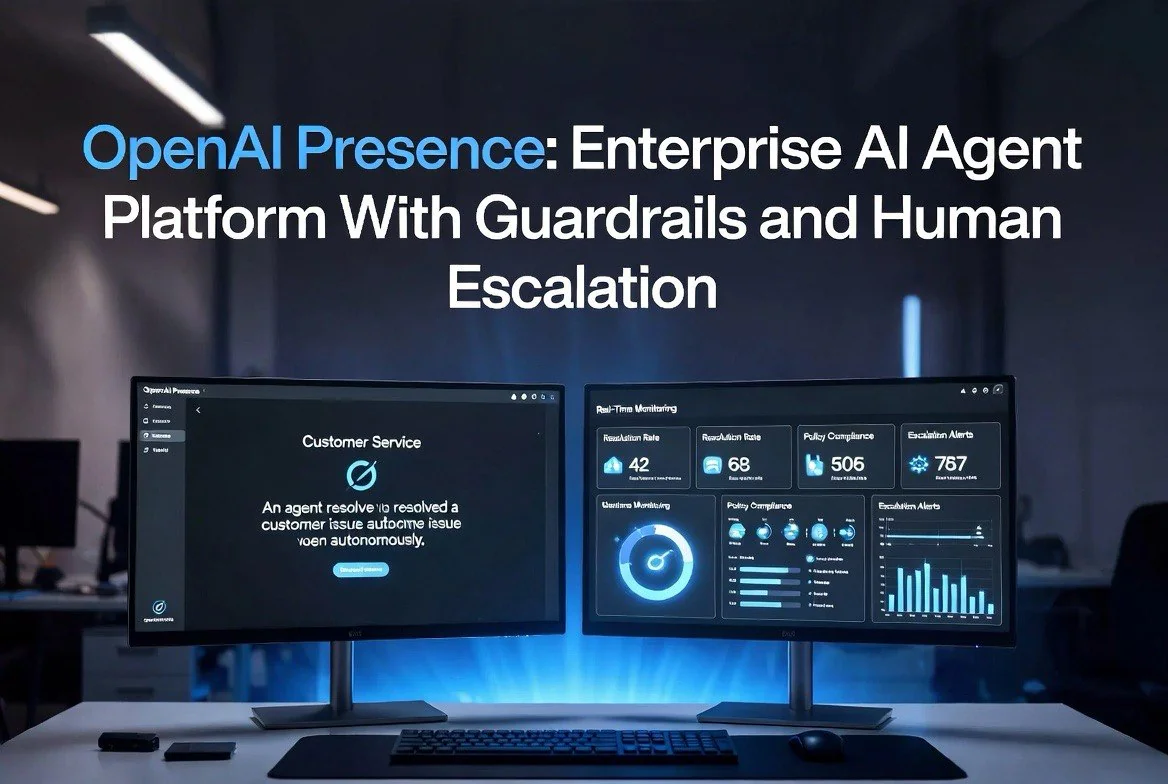
Post-launch, guardrails monitor every interaction for policy drift. The system detects when an agent starts behaving outside its defined boundaries — answering questions it should not, taking actions it should escalate — and flags those interactions for immediate review. A real-time dashboard surfaces live metrics: resolution rate, escalation rate, average handle time, customer satisfaction scores, and incident alerts.
The monitoring system tracks both quantitative metrics and qualitative signals. If a customer uses escalated language or repeats themselves, the system flags potential frustration even if the agent technically resolved the issue. This prevents the classic customer support trap where quantitative metrics look fine but qualitative satisfaction is declining.
Continuous Improvement Loop
Production conversations, escalations, and quality signals feed into a Codex-powered improvement cycle. The system analyzes patterns: where do agents struggle most? What questions consistently trigger escalations? Where are customers expressing frustration despite the agent resolving the issue?
Based on this analysis, the system suggests policy updates or response refinements. Teams can test proposed changes in an isolated evaluation environment — measuring before-and-after performance on the same simulation suite — before rolling changes to production. This is controlled deployment, not guesswork.
Multi-Channel Consistency With Channel Adaptation
Agents maintain one “presence” across voice, chat, and email while adapting tone and behavior per channel. A customer who starts a support ticket via chat can continue by phone without repeating themselves. The agent knows the conversation history regardless of channel. Policies and escalation rules apply uniformly regardless of entry point, but the agent can adjust its communication style — more conversational on phone, more structured in email — within the same policy framework.
Design Partners and Real-World Deployments
Presence was shaped through partnerships with several large enterprises across different industries and regulatory environments:
BBVA deployed Presence for voice banking support in Mexico, handling Spanish-language customer inquiries about accounts, transactions, and banking products. The deployment required compliance with Mexican banking regulations and data sovereignty requirements.
SoftBank integrated Presence for Japanese customer conversations across mobile and internet services. The agent handles Japanese-language interactions with the cultural and linguistic nuance that Japanese consumers expect from service providers.
IAG (Insurance Australia Group) deployed Presence for insurance claims processing during high-demand weather events. When storms or floods trigger a surge in claims, the agent handles initial intake and triage, routing only the most complex cases to human adjusters who are already stretched thin.
These deployments show the platform works across industries, languages, and regulatory environments — not just in English-language tech support.
Security and Data Handling
Presence deployments include per-deployment data architecture decisions: data retention policies, masking rules for sensitive information, storage location requirements, and access controls. Each deployment undergoes security, privacy, and legal reviews before going live. OpenAI publishes transparency reports for its agent systems, including Presence, detailing performance metrics, incident logs, and safety evaluations.
For enterprises in regulated industries — banking, healthcare, insurance — Presence offers configurable data sovereignty. The platform supports deployment architectures that keep data within specific geographic boundaries, which was a requirement for the BBVA Mexico deployment and would apply to any US financial services deployment under state and federal regulations.
How Presence Fits Into the OpenAI Product Family
OpenAI now offers three tiers of AI agent products, each serving a different market segment:
ChatGPT Work is a self-serve workspace agent for small and medium businesses. Any business can set up an agent within ChatGPT for workflow automation, research, and task completion. No deployment engineers needed, but also no dedicated governance framework or guaranteed uptime SLAs.
OpenAI Frontier (launched February 2026) is a platform for developers to build custom agent architectures. It provides the building blocks — model access, tool integration APIs, evaluation frameworks — but the developer handles deployment, monitoring, and governance.
OpenAI Presence is the managed enterprise tier. You define the policies and outcomes; OpenAI handles the deployment, monitoring, improvement cycle, and SLAs. It is the most expensive option but also the only one with guaranteed reliability and dedicated engineering support.
For small businesses, Presence is overkill and likely out of budget. But the technology it validates — governed agents that handle real customer interactions at scale with measurable quality — will trickle down to accessible tools within 12-18 months.
What Presence Means for US Business Owners
Three implications worth understanding even if you are not in the market for a six-figure enterprise agent deployment:
Customer expectations are about to shift. When large enterprises deploy AI agents that resolve 75% of issues instantly and consistently, customers will expect similar responsiveness from every business they interact with. The gap between enterprise-grade AI support and small business support will widen — until accessible tools close it. Businesses that start experimenting with AI customer support now, even with simpler tools, will have a head start when customers start expecting it everywhere.
The guardrail-first approach is the right bet. Presence shows that governance and safety baked into the platform — not bolted on after a problem — is the only viable path for production AI agents. Any tool claiming to offer business agents without policy enforcement, escalation rules, and real-time monitoring is not ready for real customers. When evaluating AI agent tools for your business, ask specifically: what guardrails exist? How does escalation work? Can I test behavior before going live?
The critical skill is shifting from building to governing. The hard part of enterprise AI is no longer model access or prompt engineering — it is defining policies, evaluating outcomes, and knowing when to escalate. Businesses that invest in AI governance skills now — understanding how to define agent boundaries, measure quality, and manage exceptions — will have a 2-3 year head start on competitors who are still trying to find the perfect prompt.
FAQ
What is OpenAI Presence?
OpenAI Presence is a managed enterprise platform for deploying trusted AI agents across voice, chat, and email channels. It includes built-in guardrails, policy enforcement, human escalation, and continuous improvement. It launched July 22, 2026, in limited general availability.
How is OpenAI Presence different from ChatGPT Work?
ChatGPT Work is a self-serve AI agent for small business workflows. Presence is a managed enterprise product deployed by OpenAI engineers or systems integrators. Presence includes dedicated governance, pre-launch testing, and ongoing monitoring that ChatGPT Work does not.
What use cases does OpenAI Presence handle?
Presence is designed for customer support, demand generation and lead qualification, insurance claims processing, HR benefits and onboarding, IT help desk, and procurement. It operates across voice, chat, and email with consistent policies and escalation rules.
How much does OpenAI Presence cost?
OpenAI has not published standard pricing for Presence. Each deployment is custom-priced based on scope, scale, integrations, and support requirements. It is available through limited general availability for enterprise customers with revenue and compute thresholds.
Can small businesses use OpenAI Presence?
Presence is designed for enterprise customers with dedicated deployment engineers. Small businesses should look at ChatGPT Work for AI agent capabilities today, with the expectation that governed agent platforms will become more accessible over the next 12-18 months.
What design partners helped build Presence?
BBVA (voice banking in Mexico), SoftBank (Japanese customer conversations), and IAG (insurance claims during weather events) were design partners. OpenAI also dogfoods Presence in its own phone support at 1-888-GPT-0090, resolving ~75% of issues without human handoff.

About Barak Schurr
Barak Schurr is the founder and former president of the nightlife ticketing platform Wantickets and former Global Director of Dance and Nightlife at Eventbrite. He currently focuses on AI research and writes about practical AI for independent business owners that actually moves the needle — no hype, no corporate fluff. More at topnotchaitools.com.
Contact: [email protected]
More AI Resources for Your Business