AMD Invests $5 Billion in Anthropic in Major AI Chip Deal
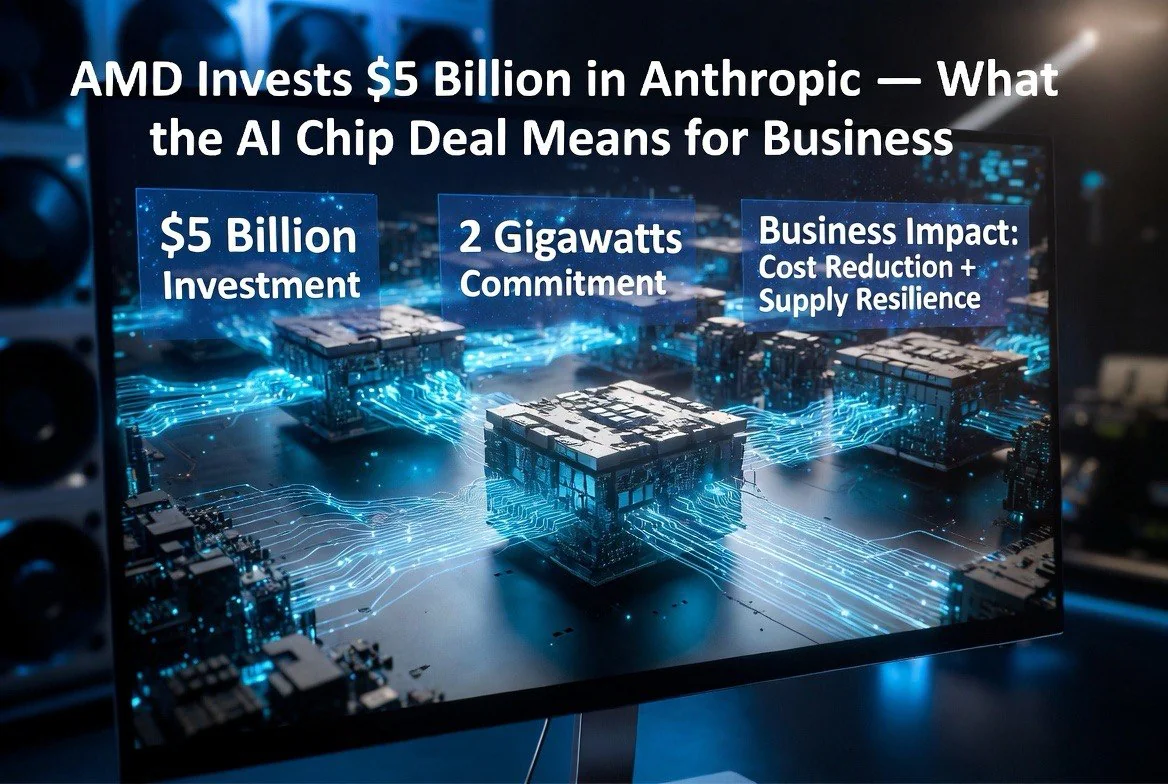
⚡ Expert Summary: On July 22, 2026, AMD announced a landmark deal with Anthropic: up to $5 billion in AMD investment — its first equity stake in an AI company — paired with Anthropic’s commitment to purchase up to 2 gigawatts of AMD’s next-generation Instinct MI450 AI accelerators in a deal valued in the tens of billions. The partnership signals a major shift in the AI chip landscape as AMD muscles into Nvidia-dominated territory, and it has direct implications for American businesses relying on AI infrastructure.
The Deal: What AMD and Anthropic Actually Agreed To
This is not a standard vendor-customer relationship. It’s a strategic alliance with two interconnected parts:
AMD invests up to $5 billion in Anthropic. This is AMD’s first-ever equity investment in an AI company. The investment is tied to specific computing power deployment milestones — meaning AMD’s commitment scales with Anthropic’s infrastructure growth. It’s a bet that Anthropic will be one of the dominant AI model providers in the coming years, and AMD wants to be the chip company powering that growth.
Anthropic commits to buying up to 2 gigawatts of AMD’s next-gen Instinct MI450 accelerators. For context, 2 gigawatts of AI compute is enough to power something approaching a small data center campus. The chip supply portion of the deal alone is valued in the tens of billions of dollars, with deliveries expected to begin in the first half of 2027.
Why This Deal Matters for AI Infrastructure
The AI chip market has been defined by one dominant player: Nvidia. The company’s H100, B200, and subsequent data center GPUs have become the default compute platform for training and running large AI models. Nvidia’s market share in AI accelerators is estimated at over 80%, giving it enormous pricing power and supply control.
AMD has been trying to break that grip for two years. The Instinct MI300X and MI350 series made progress in raw compute specs, but adoption lagged because AI labs had optimized their software stacks around Nvidia’s CUDA platform. AMD’s ROCm software ecosystem has been playing catch-up.
The Anthropic deal changes the dynamic. Here is why:
1. It gives AMD its first marquee AI lab customer at scale. Anthropic is one of the three most important AI model developers in the world, alongside OpenAI and Google DeepMind. Having Anthropic commit to 2 gigawatts of AMD hardware signals to the broader market that AMD’s AI accelerators are production-ready. Other enterprises evaluating AI hardware now have a reference customer they can point to.
2. It accelerates AMD’s software optimization. When Anthropic runs its models on AMD silicon at massive scale, it will push AMD’s ROCm software to improve faster than it would through general development. Every optimization Anthropic demands benefits every other AMD-powered AI deployment down the line.
3. It gives model buyers a credible alternative. One of the biggest concerns for American businesses building AI infrastructure has been Nvidia dependency. Supply constraints, pricing pressure, and single-vendor risk have been pain points. The AMD-Anthropic deal creates a genuine second path for enterprise AI compute.
4. It pressures pricing across the board. When AMD gains meaningful market share, Nvidia’s pricing power weakens. For US businesses buying AI compute — whether through cloud providers or on-premises hardware — competition between AMD and Nvidia should lead to better pricing and more options over the next 18-24 months.
What This Means for Anthropic
For Anthropic, the deal solves a strategic problem: compute access. The AI model arms race is as much about hardware availability as model architecture. OpenAI has deep ties with Microsoft’s Azure infrastructure. Google builds its own TPUs. Anthropic has been relying on a mix of cloud providers and Nvidia hardware, which creates both cost pressure and strategic vulnerability.
Securing 2 gigawatts of AMD’s next-generation accelerators gives Anthropic predictable compute capacity for years. The $5 billion investment also provides significant financial runway. The company has been competing aggressively with OpenAI on model quality, and access to dedicated compute at scale is a critical advantage in that race.
Anthropic CEO Dario Amodei has been clear about the company’s strategy: build the safest and most capable AI models, and build the infrastructure to deploy them at scale. This deal delivers on the infrastructure side in a way that no previous partnership did.
What This Means for American Businesses
For US business owners who use AI tools or are building AI into their operations, this deal matters more than the headline numbers suggest:
AI tool costs could come down. When Nvidia faces real competition, the cost of AI compute drops. Lower compute costs mean lower prices from AI vendors — or better capabilities at the same price. The businesses that benefit most are the ones that are heavy users of AI APIs for tasks like content generation, data analysis, and customer interaction.
More AI capacity means faster innovation. Anthropic with dedicated 2-gigawatt compute capacity can train larger models, run more experiments, and deploy updates faster. That translates to better Claude models reaching the market sooner. For businesses building on top of Anthropic’s API, that’s a direct competitive advantage.
Supply chain diversification matters. The single most important lesson from the past three years of AI development is that hardware supply chains are fragile. Nvidia lead times, export controls on advanced chips, and data center power constraints have all created bottlenecks. The AMD-Anthropic deal is a step toward a more resilient AI infrastructure ecosystem.
Watch for more deals like this. AMD’s investment in Anthropic is likely the first of several similar arrangements. Other AI labs will need to secure compute capacity. Other chip companies will want anchor customers. American businesses should expect more vertical integration between AI model developers and hardware providers in the coming year.
The Numbers Behind the Deal
| Metric | Detail |
|---|---|
| AMD investment in Anthropic | Up to $5 billion (tied to deployment milestones) |
| Chip purchase commitment | Up to 2 gigawatts of Instinct MI450 accelerators |
| Chip deal value | Tens of billions of dollars |
| Hardware delivery | First half of 2027 |
| AMD’s market share in AI accelerators | Estimated 10-15% (vs Nvidia’s 80%+) |
The Competitive Landscape
This deal doesn’t just affect AMD, Anthropic, and Nvidia. The entire AI chip and cloud computing landscape shifts:
Microsoft and OpenAI. Microsoft has invested over $13 billion in OpenAI and provides its Azure cloud infrastructure. The AMD-Anthropic deal creates a direct competitive axis: Microsoft-OpenAI on one side, AMD-Anthropic on the other. Both pairs now have deep financial ties and dedicated compute infrastructure.
Google and its TPUs. Google has been investing in its own Tensor Processing Units for years and runs DeepMind and its Gemini models on them. The AMD-Anthropic deal doesn’t directly threaten Google’s position, but it confirms that the AI chip market is becoming a multi-player game.
Amazon and AWS. Amazon has its own AI chips (Trainium and Inferentia) and has invested in Anthropic as well. The AMD-Anthropic deal complements Amazon’s chip strategy rather than competing with it — Anthropic will likely run workloads across both AMD and AWS hardware.
What Business Leaders Are Saying
Industry analysts have broadly characterized the AMD-Anthropic deal as a pivotal moment for AI infrastructure. Dan Ives of Wedbush Securities called it “the most significant AI hardware partnership of 2026,” noting that it validates AMD’s strategy of targeting enterprise AI workloads rather than competing directly with Nvidia’s gaming and consumer GPU dominance.
For American business leaders evaluating AI strategy, the consensus message is clear: the AI chip market is no longer a single-vendor game. Companies that have been waiting for alternatives to Nvidia before committing to large-scale AI deployments now have a credible second option to evaluate.
That doesn’t mean Nvidia is in trouble — the company’s software ecosystem, developer tools, and enterprise relationships remain formidable. But it does mean that the AI infrastructure cost curve is likely to bend more favorably over the next two years as AMD scales production and competing chip architectures mature.
For small and mid-size businesses, the near-term impact is indirect but real. When the cost of training and running AI models decreases, every AI-powered tool becomes more accessible. API prices drop. Free tiers get more generous. The gap between what enterprise AI and small business AI can do narrows.
The AMD-Anthropic deal is a bet that AI compute demand will continue to grow exponentially. If that bet pays off, the winners include every business that uses AI — because more compute options mean lower costs and faster innovation across the entire ecosystem.
FAQ
Is this AMD’s first investment in an AI company?
How does this affect Nvidia’s position?
When will Anthropic actually use AMD chips?
Will this deal make Anthropic’s Claude models cheaper?
Does this mean AMD is competing with Nvidia on AI software too?
How does this affect businesses using AI APIs?

About Barak Schurr
Barak Schurr is the founder and former president of the nightlife ticketing platform Wantickets and former Global Director of Dance and Nightlife at Eventbrite. He currently focuses on AI research and writes about practical AI for independent business owners that actually moves the needle — no hype, no corporate fluff. More at topnotchaitools.com.
Contact: [email protected]
More AI Resources for Your Business