Get The Solo Business OS — Free
The AI workflow that replaces a part-time employee for solo operators and small business owners.
Gemini 3.7 Flash for Small Business: Pricing and Value
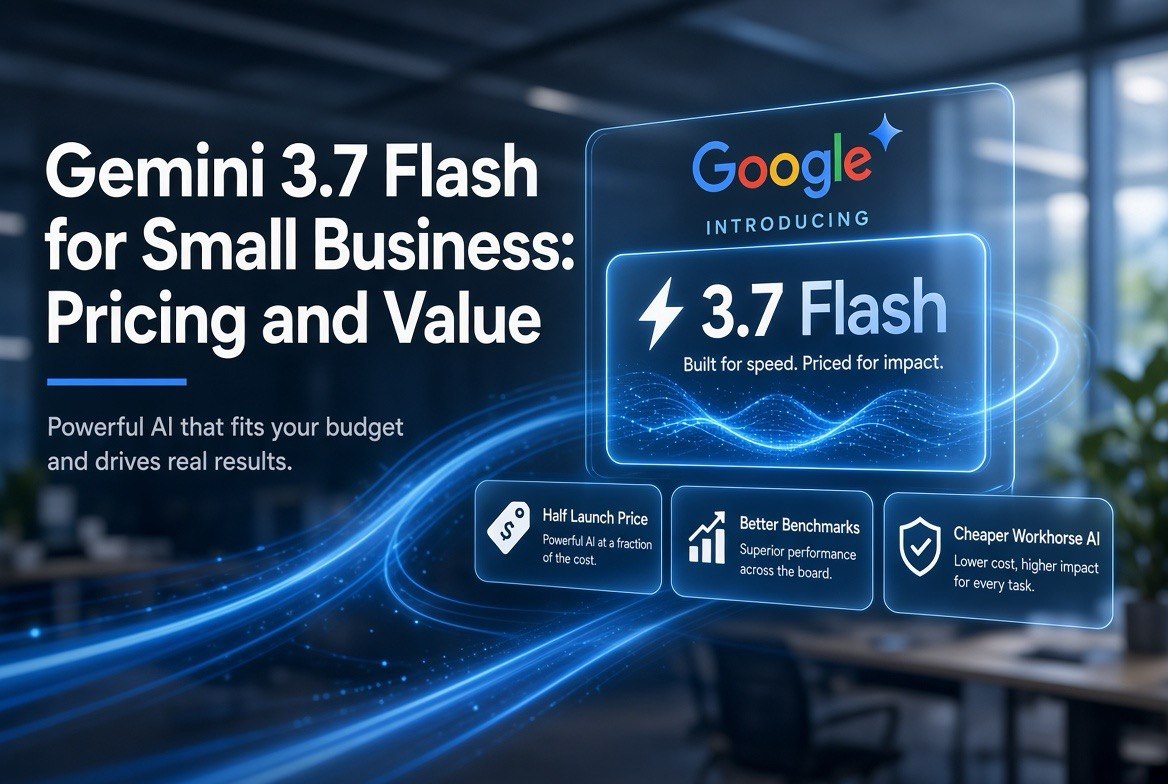
⚡ Expert Summary: Google just released Gemini 3.7 Flash at half the launch price of its predecessor — $0.75 per million input tokens and $3.75 per million output. The model posts big benchmark gains (DeepSWE v1.1 jumping 49.0% to 65.3%, AutomationBench 30.4% vs 17.0%) and arrives just three weeks after Gemini 3.6 Flash. For a US small business owner, this matters because the AI tools you already pay for run on models like this — and a cheaper, more reliable workhorse usually means your subscription either gets better results or gets cheaper. If you build even small automations, this is the moment to check which model your tools are actually calling.
What Is Gemini 3.7 Flash and Why Does It Matter for Your Business?
On August 13, 2026, Google announced Gemini 3.7 Flash, its newest small-but-fast model that continues the company’s accelerated release cadence. It lands just three weeks after Gemini 3.6 Flash and is a “direct result of developer feedback and algorithmic innovations” the company plans to carry into future models. If that sounds like a lot of version numbers, here is the part that actually matters for your business: this is the class of model that quietly runs inside the AI tools you use every day — assistants, email drafters, customer-support bots, and no-code automation platforms. If you are just getting started building an AI toolkit for your business, our AI tools for small business hub collects the practical guides that map directly onto what a model upgrade like this can actually change for you.
For US small business owners, the practical takeaway is simple. When a model like Gemini 3.7 Flash gets noticeably better and cheaper, the tools built on top of it improve too. You do not need to understand transformer architecture to benefit. You need to know what changed, what it costs, and where to look to make sure your stack is taking advantage of it.
Google itself frames 3.7 Flash around three pillars: software engineering, web development, and knowledge work. All three have direct business applications — building or fixing workflows, maintaining a website, and processing dense documents like contracts, financial reports, and legal agreements.
The Numbers Behind the New Model
Google published specific benchmark results that show why 3.7 Flash is more than a version bump. These are the same kinds of metrics that determine how well a model handles real business workloads, from debugging code to completing multi-step administrative tasks.
| Benchmark | Gemini 3.6 Flash | Gemini 3.7 Flash | What It Tests |
|---|---|---|---|
| DeepSWE v1.1 | 49.0% | 65.3% | Software-engineering issue resolution |
| FrontierCode 1.1 Main | 34.4% | 43.6% | Competitive coding and debugging |
| WebDev Arena Elo | 1538 | 1588 | Functional web layouts and app building |
| GDP.pdf | 22.0% | 34.0% | Complex document processing |
| AutomationBench | 17.0% | 30.4% | Real-world business workflows |
Two of these jump out for a business owner. AutomationBench tests how well a model completes real-world business workflows — and it nearly doubled from 17.0% to 30.4%. That is the category that maps directly onto “AI does the boring admin so you do not have to.” Likewise, the GDP.pdf leap (22.0% to 34.0%) signals far better handling of complex documents, which is exactly what contract review and financial-report work require.
Google also says 3.7 Flash “thinks more diligently,” puts more effort into multi-step planning and tool calls, adapts to roadblocks, and follows instructions with greater fidelity. In plain terms: fewer retries, less manual oversight, and more reliable output. For a small team with no dedicated IT staff, that reliability is worth more than any single benchmark number.
Pricing: Half the Launch Price of the Previous Model
Here is the headline for cost-conscious operators. Until the end of 2026, Gemini 3.7 Flash is available at an introductory price of $0.75 per million input tokens and $3.75 per million output tokens. Google states that is half the price of the previous model at launch. In an era where AI usage-based pricing has been climbing, a meaningful price cut on a faster, more capable workhorse is the exception worth paying attention to.
Why does pricing matter to a small business that does not buy API access directly? Because most AI SaaS tools pass their model costs through to you. When the underlying model gets cheaper, the tool vendor either improves margins, lowers prices, or both. And when a model gets both cheaper and better, the competitive pressure forces other model providers to respond — which tends to benefit every small business using any AI tool.
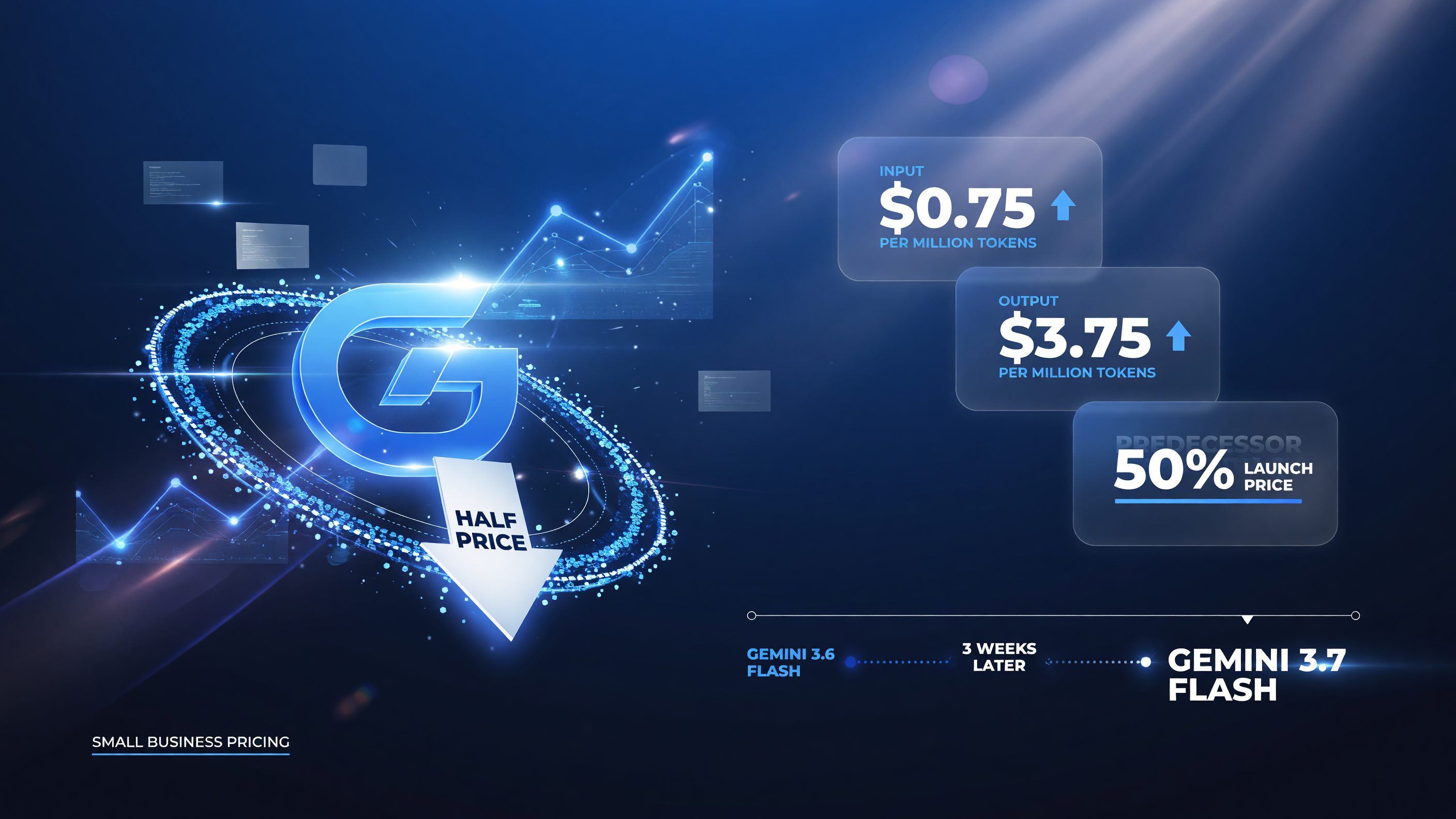
Gemini 3.7 Flash is offered at $0.75 per million input tokens and $3.75 per million output — half the launch price of its predecessor, just three weeks after 3.6 Flash. Cheaper workhorse models mean your existing automations either get better results or get cheaper.
Where You Can Actually Get Gemini 3.7 Flash Today
You do not need an API key to start using it. Google is rolling out 3.7 Flash across its consumer and developer surfaces immediately:
- Gemini app (Spark): Rolling out to AI Pro and AI Ultra subscribers. Google says the improvements make the personal agent “more efficient for knowledge work with improved tool use for Google Workspace apps” — so better handling of your email, docs, and calendar.
- Google Antigravity: A coding and agent workspace for building automations.
- AI Studio: Free-tier web playground to test prompts and workflows without writing code.
- Android Studio: For developers building Android apps and automations.
- Gemini Enterprise Agent Platform + Gemini Enterprise app: For larger operations running agents at scale.
If you are a small business owner, your fastest win is opening Gemini in the Spark tier and asking it to summarize a dense document or draft a process. If you build automations with tools like Zapier or Make, check their model settings to see whether Gemini 3.7 Flash is available as a cheaper action step.
What the Cheaper Workhorse Means for Your AI Tool Stack
The bigger story for US small businesses is what a model like this does to your overall stack. For the past year, the recurring advice has been to build a lean, cost-effective set of AI tools rather than stacking a dozen subscriptions. A cheaper, more capable workhorse model changes that math in your favor.
Consider the three most common business uses:
- Customer support: Support bots and phone-answering services run on these models. Better AutomationBench scores mean fewer failed escalations and less human handoff.
- Document work: Contract review, invoice extraction, and report summarization all benefit from the GDP.pdf jump. That is where the model’s improved document reasoning shows up in your daily work.
- Website and workflow building: The WebDev Arena Elo gain (1538 to 1588) plus better instruction-following means no-code tools can generate more functional pages and automations with fewer iterations.
If you are not sure which models your current tools use, it is worth a quick look. Many tools now surface the model in their settings or billing pages. When a faster, cheaper model is available on the same plan, switching can cut your per-task costs without changing anything about how you work. Even a modest cost reduction matters when you run agents or automations at volume, because those per-run fees compound fast — a customer-support agent handling a few thousand queries a month can burn through meaningful spend if the underlying model is inefficient.
There is also a time-saving angle that rarely gets credited. Google explicitly says Gemini 3.7 Flash “better adapts to roadblocks, clarifies intent when needed, and follows instructions with greater fidelity.” In practice, that means fewer rounds of “no, that is not what I meant” when you ask a tool to draft, revise, or build something. For a small business owner who is not a prompt engineer, the model simply getting it more right the first time is worth more than a marginal price cut. The benchmark improvements in AutomationBench and GDP.pdf are exactly the workload categories where that reliability shows up in hours saved, not just cents saved.
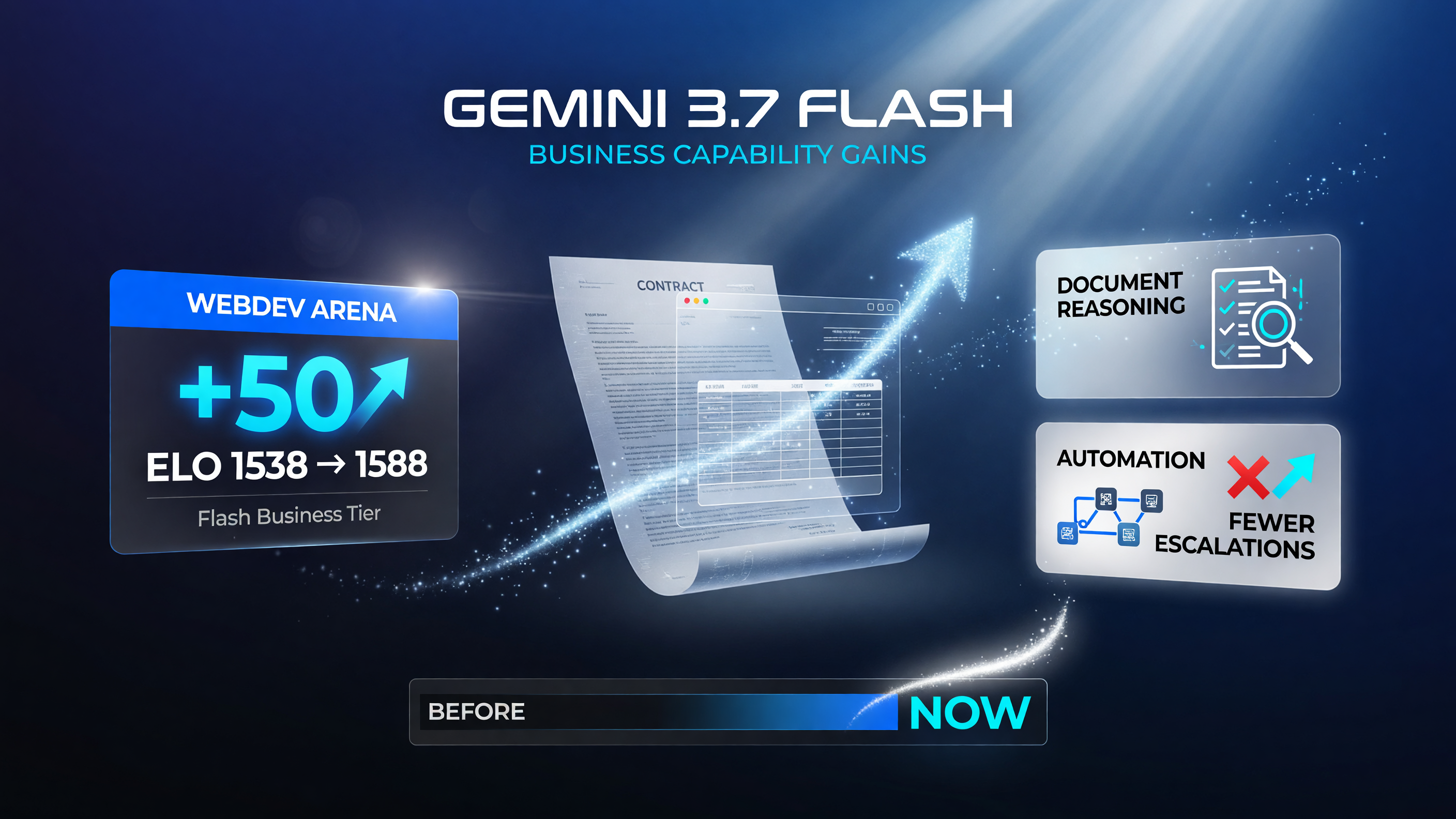
Gemini 3.7 Flash delivers measurable capability gains for small business: WebDev Arena Elo climbs from 1538 to 1588, document reasoning improves for contract review and invoicing, and support automations see fewer failed escalations.
Should You Switch Anything Right Now?
For most small business owners, the answer is “not yet, but keep an eye on it.” Here is a practical framework for deciding whether to act:
- If you buy AI tools as subscriptions: Do nothing today. Vendors will roll out 3.7 Flash upgrades on their own schedule, and you benefit automatically.
- If you use AI Studio or the Spark tier directly: Start testing 3.7 Flash now, especially for document-heavy or multi-step tasks. The workflow benchmark gains are most visible there.
- If you build automations with model selection: Check whether 3.7 Flash is available as a cheaper option. At half the launch price, it may cut your per-run automation costs noticeably.
- If you rely on a custom chatbot or agent: Ask your developer or platform to check model availability. A cheaper, better workhorse usually means a better assistant at a similar or lower cost.
One clear warning, though: do not churn your whole stack every time a new model drops. The value of a stable stack is that your workflows are tested. Let vendors bring Gemini 3.7 Flash to you where it fits, and only switch manual model selection when the savings are material.
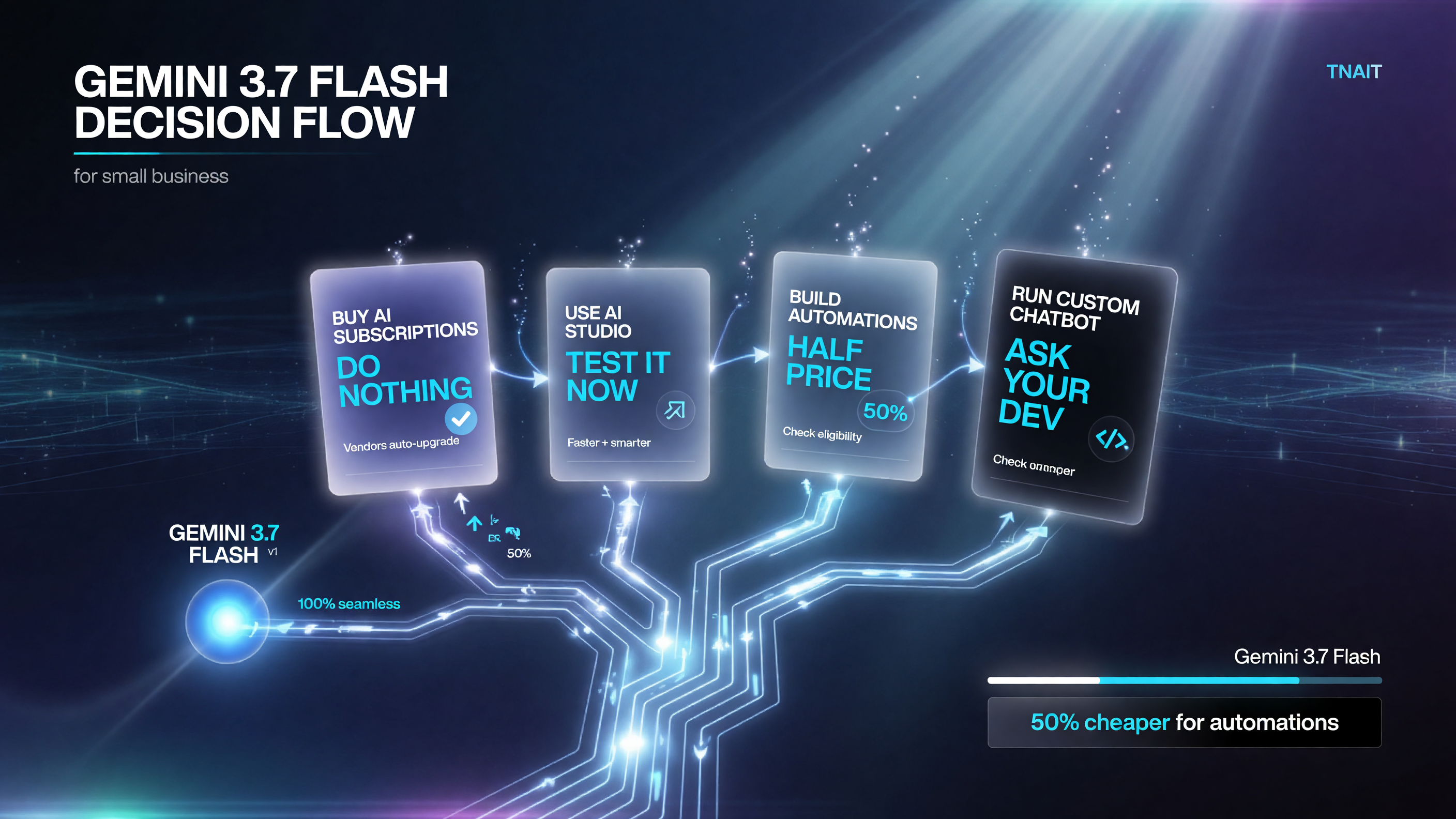
Deciding whether to act on Gemini 3.7 Flash: subscription users can do nothing and let vendors auto-upgrade; AI Studio users should test now; automation builders should check the half-price option; custom chatbot owners should ask their developer.
What Small Business Owners Should Watch Next
Google’s accelerated cadence — a new Flash model every three to four weeks — is itself the signal. The company is shipping improvements faster than many businesses can track. Three things to watch:
- Vendor adoption: Which no-code, CRM, and support tools list Gemini 3.7 Flash in their model options. Fast adoption means faster benefit for you.
- Pricing pressure on competitors: A half-price workhorse from Google tends to push Anthropic, OpenAI, and xAI to respond, which benefits every small business using AI.
- Gemini 3.7 Pro (anticipated): If the Flash tier improved this much, the larger model — if and when it ships — should push agentic and document work further. That is the one worth planning around for heavier workloads.
The through-line for a US small business owner is simple: model wars are your friend. Every time a major provider ships a cheaper, more reliable workhorse, your AI tools get a little better and a little cheaper. Gemini 3.7 Flash is the clearest recent example, and it costs you nothing to benefit from it.
FAQ
What is Gemini 3.7 Flash?
Gemini 3.7 Flash is Google’s newest fast, efficient AI model, released August 13, 2026 — just three weeks after Gemini 3.6 Flash. It focuses on improved software engineering, web development, and knowledge work, and it is available at half the launch price of its predecessor.
How much does Gemini 3.7 Flash cost?
Until the end of 2026, it is priced at $0.75 per million input tokens and $3.75 per million output tokens, which Google says is half the price of the previous model at launch.
Is Gemini 3.7 Flash better than Gemini 3.6 Flash?
Yes, on measured benchmarks. DeepSWE v1.1 went from 49.0% to 65.3%, AutomationBench from 17.0% to 30.4%, and WebDev Arena Elo from 1538 to 1588. Google also says it follows instructions with greater fidelity and needs fewer retries.
Where can small business owners use Gemini 3.7 Flash?
It is rolling out in the Gemini app (Spark AI Pro/Ultra), Google Antigravity, AI Studio, Android Studio, and the Gemini Enterprise Agent Platform. AI Studio is the free way to test it.
Should I switch my AI tools to Gemini 3.7 Flash?
Mostly no. If you buy subscriptions, vendors will roll it out automatically. If you manually select models in automations or AI Studio, it may be worth switching for document-heavy or multi-step tasks where the benchmark gains are largest.

About Barak Schurr
Barak Schurr is the founder and former president of the nightlife ticketing platform Wantickets and former Global Director of Dance and Nightlife at Eventbrite. He currently focuses on AI research and writes about practical AI for independent business owners that actually moves the needle — no hype, no corporate fluff. More at topnotchaitools.com.
Contact: [email protected]
More AI Resources for Your Business