Get The Solo Business OS — Free
The AI workflow that replaces a part-time employee for solo operators and small business owners.
DeepSeek-V4-Pro-0813: Open-Source Model for Small Business
⚡ Expert Summary: DeepSeek released V4-Pro-0813 on August 13, 2026 as the open-source general-availability build of its flagship model — MIT-licensed, weights free on Hugging Face. It packs 1.6 trillion total parameters (49 billion active per token), a 1-million-token context window, and was trained on more than 32 trillion tokens. For a US small business owner, the practical story is simple: a top-tier model you can run or route to for free removes the biggest cost barrier in your AI stack. If you self-host or use a provider, this is a genuine lever to cut per-task AI spend without giving up quality.
What Is DeepSeek-V4-Pro-0813?
On August 13, 2026, DeepSeek rolled out DeepSeek-V4-Pro-0813 as the official general-availability (GA) build of its flagship model. The “0813” in the name marks the release date. It supersedes the earlier preview version and brings what the company describes as significantly enhanced agentic capabilities and production performance gains. If you follow the AI space at all, you already know the pattern: DeepSeek keeps shipping open-weights models that rival paid, closed rivals — and this release continues that run. For more practical guides on building an AI toolkit for your business, visit our AI tools for small business hub.
For a small business owner, the most important word in that paragraph is open-source. The model is released under the MIT license with weights publicly available on Hugging Face (deepseek-ai/DeepSeek-V4-Pro-0813). That means you are not locked into DeepSeek’s API. You can run it yourself, route to it through a provider like OpenRouter or Fireworks, or use any tool that plugs into open models.
The catch is context: this is a big, heavy model. It is not the kind of thing you run on a laptop. But the key point stands — the cost of entry for a top-tier reasoning model just dropped to effectively zero for the software itself.
The Specs That Matter for Business Use
Here is what is under the hood, stripped of jargon so you know what it can actually do for you:
| Specification | DeepSeek-V4-Pro-0813 | Why It Matters for You |
|---|---|---|
| Total parameters | 1.6 trillion (1.6T) | Large, capable model — the reason it rivals paid flagships |
| Active parameters per token | ~49 billion (49B) | Cost-efficient to run despite its size |
| Context window | 1 million tokens | Can process entire books, long contracts, whole codebases |
| Max output length | Up to 384K tokens | Generates very long documents and full work products |
| Training data | 32+ trillion tokens | Broad general knowledge and reasoning |
| License | MIT (open source) | Free to use, run, and modify — no lock-in |
| Architecture | Mixture-of-Experts (MoE) | Efficient for long-context and agent workflows |
Two numbers deserve your attention. The 1-million-token context window means the model can hold an enormous amount of your business material at once — your entire price list, your product catalog, a long operating manual — and reason across all of it in a single pass. The 49B active parameters mean that despite the 1.6T total size, it is comparatively economical to run, which is why providers can host it at reasonable rates.
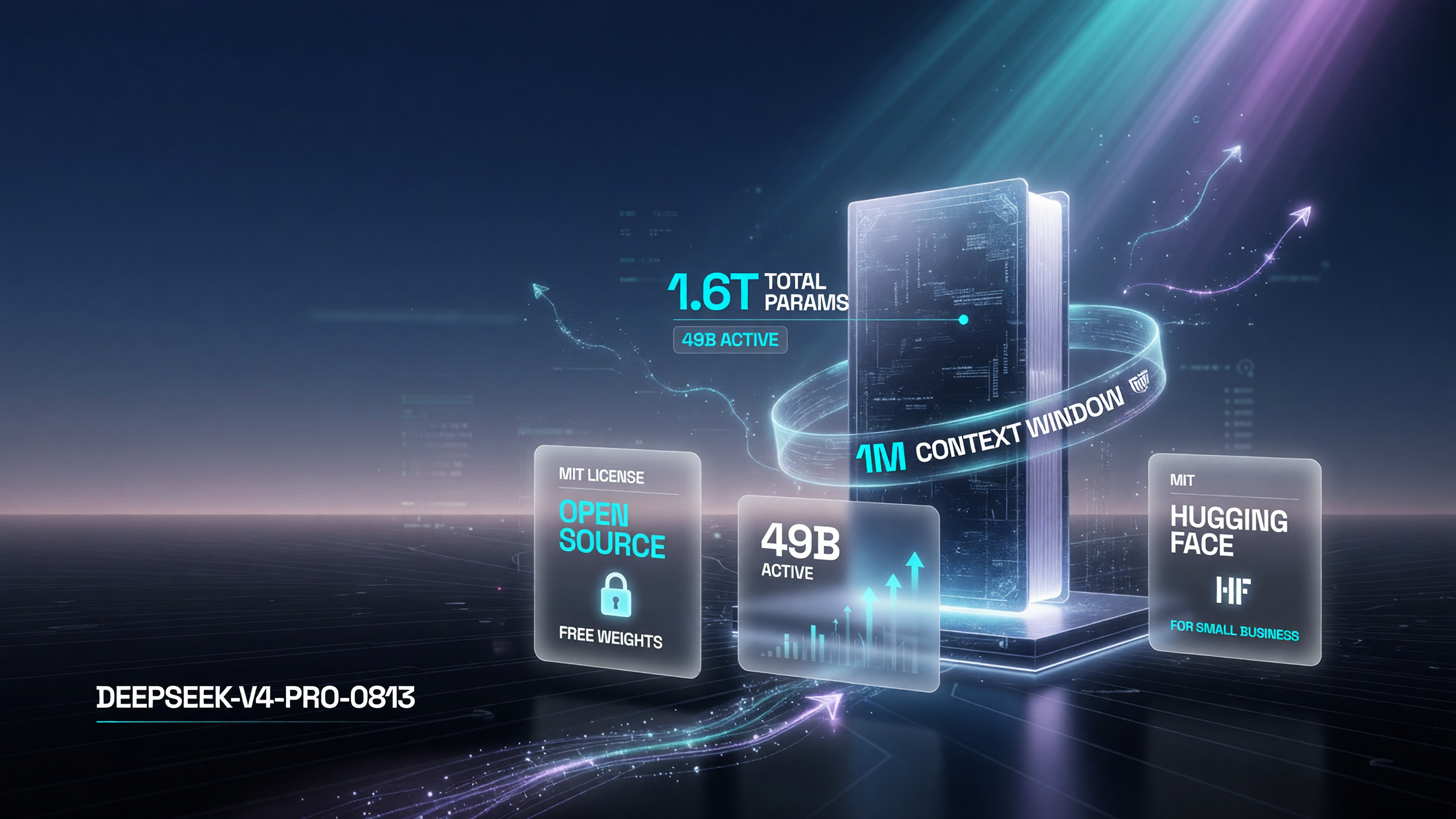
DeepSeek-V4-Pro-0813 packs 1.6 trillion total parameters with 49 billion active per token and a 1-million-token context window. Its lighter sibling V4-Flash (284B total, 13B active) targets faster, lower-cost workloads.
Why “Open Source” Is a Real Business Advantage
Here is the part most SMBs miss. When a model is open-source and MIT-licensed, it changes your negotiating position with every AI vendor you use. You are no longer forced to accept whatever a single provider charges. If your tool vendor’s pricing rises, or their model quality lapses, you have a credible free alternative — and vendors know it.
Three concrete ways an MIT-licensed flagship helps a small business:
- No per-seat or per-token lock-in: The software cost is zero. You only pay for compute, and multiple providers compete to host it, which keeps prices low.
- Data control: Running an open model on your own infrastructure means your sensitive business data never leaves your environment. That matters for contracts, customer lists, and financials.
- Longevity: An open-weights model does not disappear when a company changes strategy. You can keep using this exact version indefinitely.
The trade-off is real: self-hosting a 1.6T-parameter model requires serious hardware or a capable cloud setup, so most small businesses will route to a hosted provider rather than run it locally. Either way, you benefit from the competitive pressure it creates.
How Does It Perform? The Benchmarks
DeepSeek reports strong GA improvements over the preview, especially in agentic and coding work. These are the same categories that map onto automating real business tasks.
| Benchmark | DeepSeek-V4-Pro-0813 Score | What It Measures |
|---|---|---|
| Terminal Bench 2.1 | 87.9 | Real-world computer and workflow tasks |
| DeepSWE | 62.7 | Software-engineering issue resolution |
| Cybergym | 83.3 | Cybersecurity and defensive tasks |
It’s worth being honest here. Some community discussion on Reddit has questioned whether real-world performance fully matches the reported numbers, noting possible deployment and configuration issues in the initial rollout. That is normal for any major model launch, and it does not change the underlying value: a free, open, top-tier model with these capabilities. If you are going to test it, give it a fair shot in your actual workload rather than trusting a single number.
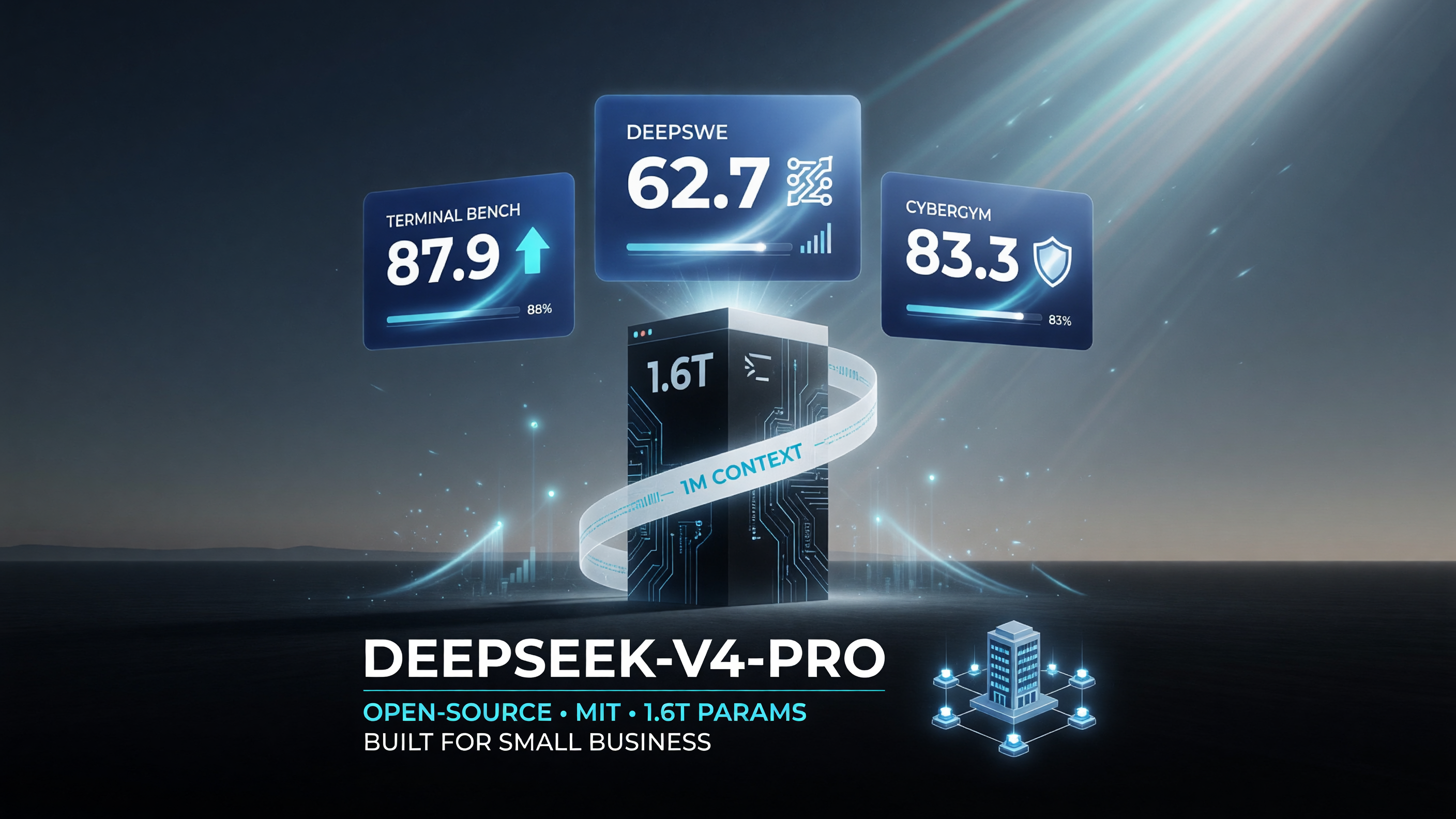
DeepSeek-V4-Pro-0813 benchmark scores: Terminal Bench 87.9, DeepSWE 62.7, Cybergym 83.3. These results map directly to real business automation and workflow tasks.
How to Actually Use It as a Small Business
You do not need a data-science team to benefit from DeepSeek-V4-Pro-0813. Here is the practical path for a US small business owner:
- Easiest: pick a provider. The model is available on DeepSeek’s own platform (model name
deepseek-v4-pro) and hosted by providers like Fireworks and OpenRouter. You buy API access by token, exactly like any other model. New DeepSeek API pricing took effect around August 16, 2026, so check current rates before committing. - Middle: plug it into tools you already use. Many no-code and automation platforms let you select a model. If a tool supports open models, you can often switch to V4-Pro as a cheaper or equal-quality option.
- Advanced: self-host. If you have the infrastructure, you can run it with frameworks like vLLM or SGLang. This is the route that gives you full data control, but it is only realistic for businesses with an IT capability.
One feature worth knowing: the model supports three reasoning levels via a reasoning_effort parameter — low (fast, standard), high, and max (deepest deliberation). You can pay for deep thinking only when you need it, and keep routine tasks fast and cheap. That is a genuinely useful dial for controlling cost on a small budget.
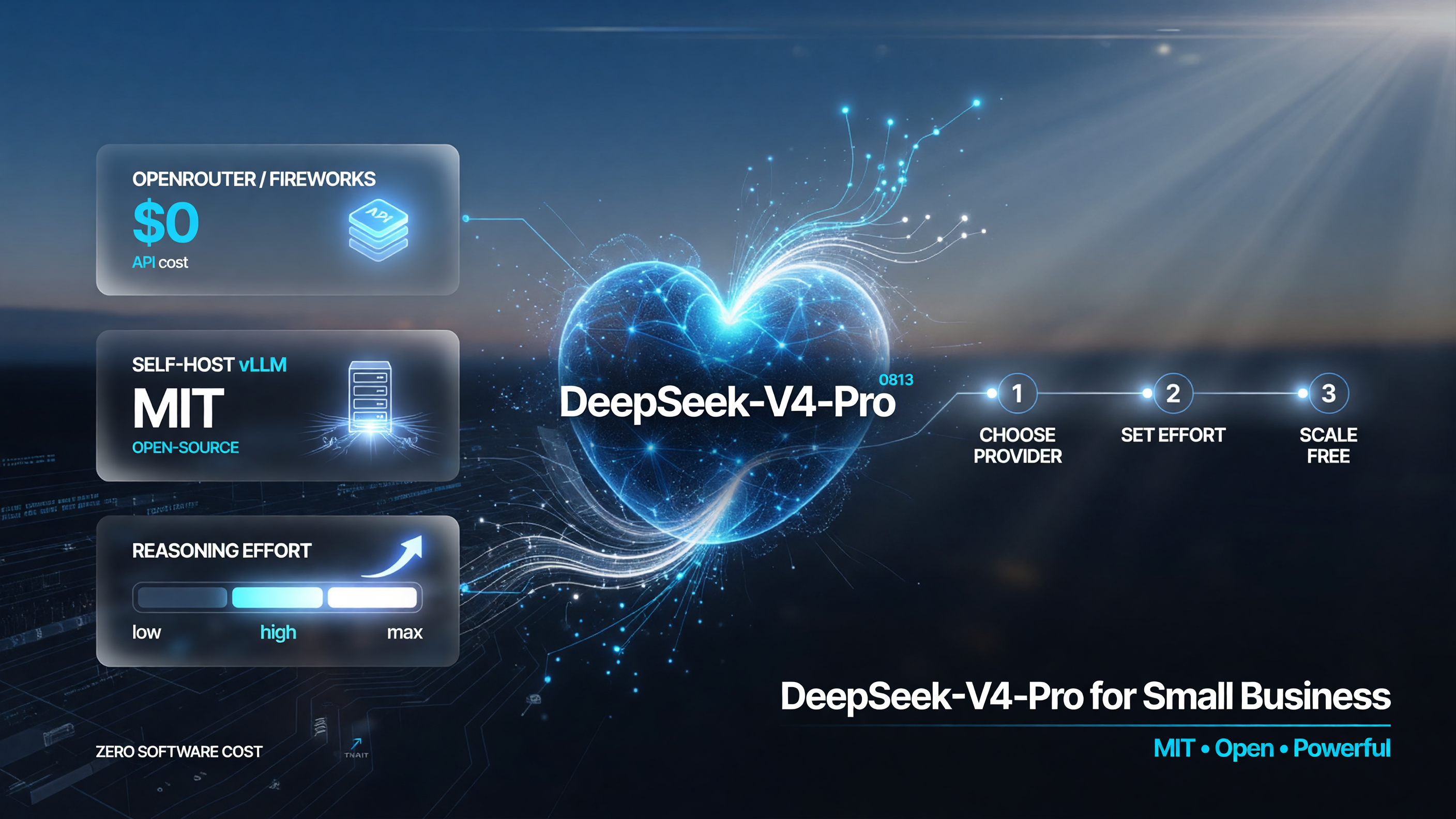
DeepSeek-V4-Pro-0813 usage paths for small business: API providers (OpenRouter, Fireworks), self-host with vLLM, and the reasoning_effort parameter (low/high/max) for cost control.
DSpark: Why This Model Runs Fast
Fast inference matters for business use because slower models burn time and, on metered plans, cost money. DeepSeek pairs V4-Pro-0813 with its DSpark speculative-decoding technique, which accelerates inference. If you have dealt with a slow AI assistant, you know how quickly a tool that “thinks” for thirty seconds stalls your workflow. DSpark is one reason this model can stay responsive even at flagship scale.
There is also a smaller sibling worth knowing about. DeepSeek-V4-Flash (284B total, 13B active parameters) is designed for lighter, faster use cases. For a small business that mostly wants quick answers and drafts, Flash may be the better daily driver — while V4-Pro-0813 handles the heavy reasoning, long-context, and agentic work.
Which Use Case Fits Which Model?
DeepSeek now ships two tiers that pair well together, and the right choice depends entirely on the job. The heavy V4-Pro-0813 is built for deep reasoning, long-context work, and agentic tasks; the lighter V4-Flash is built for speed and everyday volume. Mapping your actual workloads to the right tier is the simplest way to control cost without sacrificing quality.
| Use Case | Best Fit | Why |
|---|---|---|
| Long contracts, manuals, full codebases | V4-Pro-0813 | 1M-token context handles entire documents in one pass |
| Multi-step workflow automation | V4-Pro-0813 | Strong agentic and high/max reasoning modes |
| Quick drafts, summaries, customer replies | V4-Flash | Lighter and faster, 13B active parameters |
If you only remember one thing from this guide, make it this: open-source models are not a downgrade you tolerate to save money. A model like V4-Pro-0813 is genuinely competitive with paid flagships on agentic and reasoning work, and it gives you control over cost, data, and vendor lock-in that closed models cannot. The question is not whether your business can afford to use it — it is whether your tools make it easy enough to justify the switch.
Should Your Business Adopt DeepSeek-V4-Pro-0813?
Here is a clear framework for deciding:
- If you route models through an API or provider: Test it. The open-weights availability and competitive pricing make it a low-risk experiment that could cut your per-task AI costs.
- If you value data control: Strong candidate, because self-hosting keeps your data in-house. But weigh the infrastructure cost honestly.
- If you just use off-the-shelf AI tools: Do nothing immediate. Watch whether your vendors add it as a model option, then benefit automatically from the pricing pressure it creates.
- If you need guaranteed enterprise support: An open model plus a third-party host may not give you the same SLA as a managed vendor. For mission-critical daily AI, keep your primary vendor and test open models in parallel.
The honest recommendation: treat DeepSeek-V4-Pro-0813 as a serious option, not a mandate. The real, durable advantage it gives a small business is choice — the freedom to route around any single provider’s pricing or policy. That is a lever worth having, whether or not you switch today.
What to Watch Next
Three things signal where this is heading for small businesses:
- Provider adoption: The faster OpenRouter, Fireworks, and others add V4-Pro-0813, the easier it becomes to use through tools you already run.
- Pricing pressure: When a free open flagship matches closed rivals, it tends to push everyone’s prices down — which benefits every business using AI.
- Reasoning-cost controls: The
reasoning_effortdial is the model’s quiet cost feature. Tools that surface it let you spend only when precision matters.
The through-line for a US small business owner is straightforward: open-source flagships like DeepSeek-V4-Pro-0813 turn AI from a vendor-priced commodity into a competitive market. That is good for your budget, good for your data control, and — once vendors integrate it — good for the quality you get for the money.
FAQ
What is DeepSeek-V4-Pro-0813?
It is the official general-availability release of DeepSeek’s flagship model, rolled out on August 13, 2026. It is open source under the MIT license with weights available on Hugging Face, and it improves on the earlier preview with stronger agentic capabilities and production performance.
Is DeepSeek-V4-Pro-0813 free?
The model itself is free and open source (MIT license). Using it through an API or hosted provider costs money for compute, but the software cost is zero and multiple providers compete to host it.
What hardware do I need to run DeepSeek-V4-Pro-0813?
It is a large 1.6T-parameter model (49B active per token). Self-hosting requires serious hardware or cloud infrastructure. Most small businesses are better off using a hosted provider like DeepSeek, OpenRouter, or Fireworks rather than running it locally.
How big is the context window?
It supports a 1-million-token context window, with maximum recommended output length up to 384K tokens. That lets it process long contracts, entire manuals, or full codebases in a single pass.
Is DeepSeek-V4-Pro-0813 good for business automation?
It scores well on agentic benchmarks like Terminal Bench 2.1 (87.9) and supports three reasoning levels (low, high, max), making it a strong fit for workflow automation where you can dial reasoning depth to control cost.

About Barak Schurr
Barak Schurr is the founder and former president of the nightlife ticketing platform Wantickets and former Global Director of Dance and Nightlife at Eventbrite. He currently focuses on AI research and writes about practical AI for independent business owners that actually moves the needle — no hype, no corporate fluff. More at topnotchaitools.com.
Contact: [email protected]
More AI Resources for Your Business