Get The Solo Business OS — Free
The AI workflow that replaces a part-time employee for solo operators and small business owners.
Runable’s $21M Series A: AI Agents That Grow Businesses
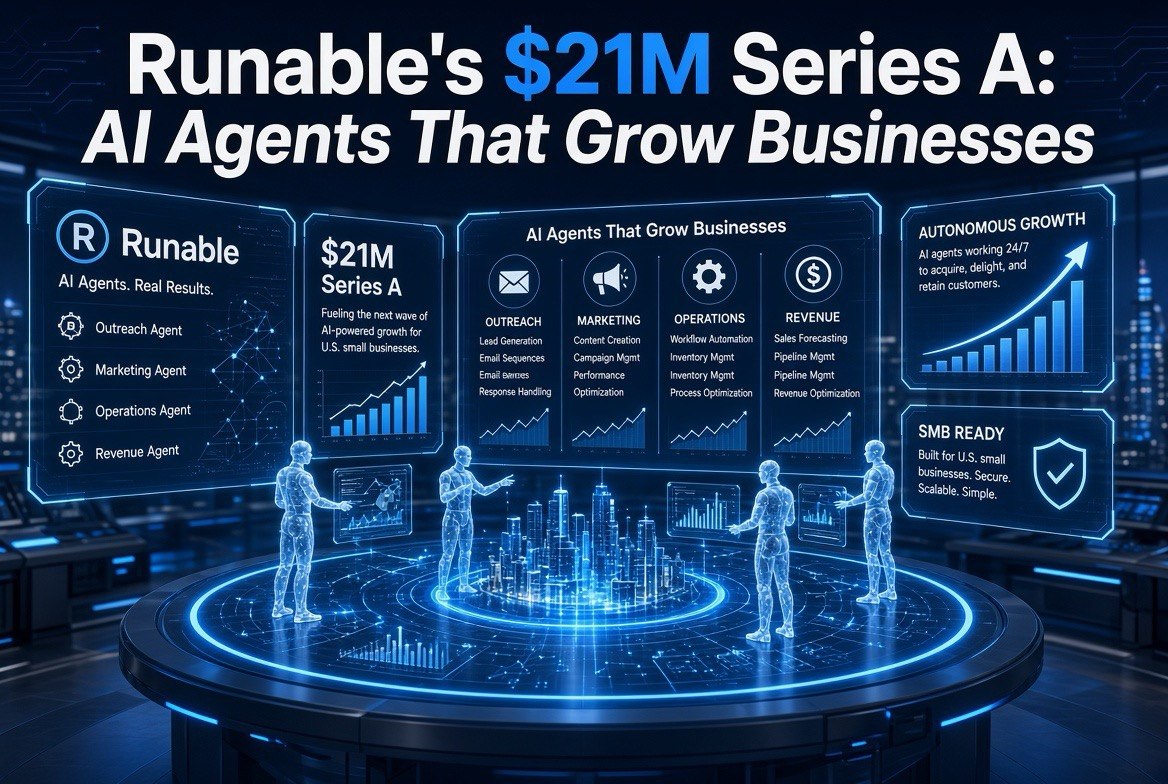
⚡ Expert Summary: Runable, an AI-agent platform led by former Bolt CEO Maju Kuruvilla, raised a $21M Series A to push AI agents from merely building businesses to actively growing them. Backed by Nexus Venture Partners, the round (announced August 26, 2026, first reported by TechCrunch and Business Wire) signals a clear shift for US small business owners: the next wave of AI isn’t about writing copy or making images — it’s about agents that automate the work of finding customers, converting them, and keeping them. For a US SMB, that means the growth tasks that used to require a marketing hire or an agency retainer can now be run on software that works around the clock.
For the past two years, the AI story for small business has been stuck on the same few verbs: write, generate, summarize, edit. Those tools are useful, but they touch the edges of a business. They don’t bring in revenue. They don’t find the next customer. They don’t tell you which channel is actually paying off. Runable’s pitch is that the next generation of AI agents is finally aimed at the part of the business that matters most — growth.
The company, founded by former Bolt CEO Maju Kuruvilla, announced a $21M Series A on August 26, 2026, with Nexus Venture Partners leading the round. The headline is simple and worth reading twice: AI agents can now go from building businesses to growing them. That single phrase — and the money behind it — is a direct signal to every US small business owner still treating AI as a content-generation toy.
What “Building to Growing” Actually Means
Most AI stacks today are build tools. They help you create a website, draft a pitch, write a blog post, generate a logo. That’s real value, but it’s front-end. Runable is betting that the bigger prize is in the growth loop — the continuous cycle of finding prospects, reaching them, qualifying them, closing them, and keeping them. That’s where a small business either compounds or stalls.
An agent that sits inside that loop is doing different work than an agent that writes an article. It’s making decisions against live data, updating sequences based on what’s working, and handling the repetitive follow-up that most owners simply don’t have time for. The company frames this as agents that don’t just help you run the business, but agents that run the growth function — leaving the owner to make the high-judgment calls.
- Pipeline motion — agents that keep outreach moving so no lead goes cold.
- Conversion automation — follow-up sequences that adapt based on reply behavior, not static scripts.
- Retention and expansion — the quieter, higher-margin half of growth that most SMBs neglect.
- Decision support — surfacing which channels and messages earn, so spend follows proof, not vibes.
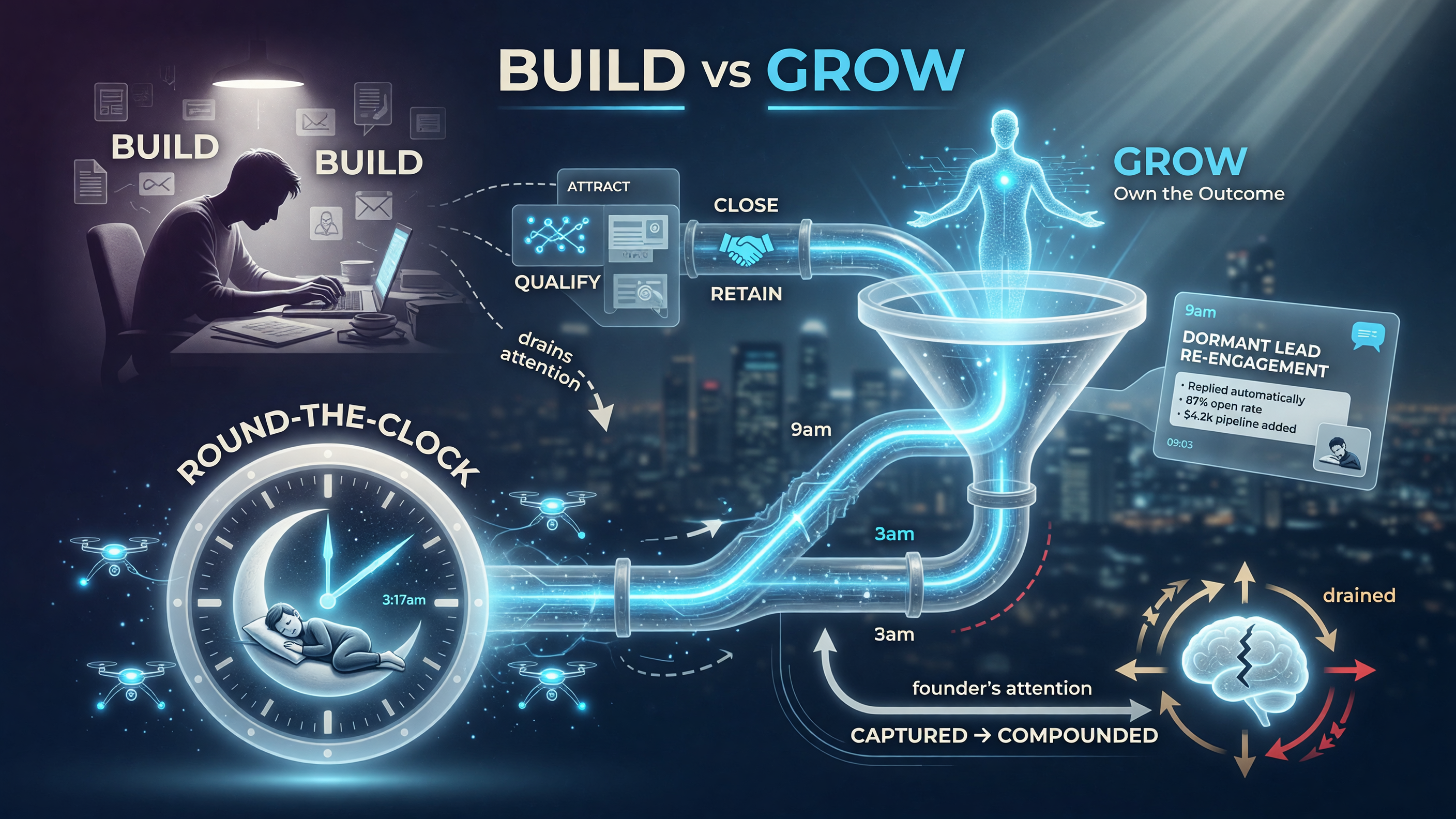
The build-vs-grow difference: an agent that owns the outcome around the clock, not a task-performer that demands more of the founder’s attention.
Why This Matters More Than Another “AI Assistant”
Here’s the uncomfortable truth for US operators: the tools that “help” you are a commodity now. Every vendor sells an assistant that drafts, summarizes, or prettifies. The advantage shifts when software can own an outcome, not just perform a task. A growth agent that maintains your pipeline overnight, re-engages a dormant lead at 9am, and reports what worked is owning an outcome a human would otherwise own — and owning it around the clock, including the hours when a founder is asleep, serving a customer, or doing the operational work that comes before any revenue lands.
That round-the-clock ownership is exactly why investors are writing larger checks in this category. A founder’s attention is the scarcest asset in a small business, and the tools that capture and compound that attention — rather than demanding more of it — are the ones with real staying power. Runable’s bet, and the reason established investors like Nexus wrote a $21M check, is that this category is about to separate from the assistant pack. The distinction matters to a small business because it changes what you’re buying. You’re not buying a faster way to do the work; you’re buying a way to not do the work at all and still get the result. That is the difference between a productivity upgrade and a genuine capability your business simply did not have before.
AI Growth Platform vs. Traditional Growth Stack: What Changes for an SMB
| Growth Work | Traditional Stack (Human-Led) | AI Growth Agent (Runable Model) |
|---|---|---|
| Outreach to prospects | Manual emails, CRM reminders, hours of follow-up | Automated, sequenced, always-chasing warm leads |
| Following up with leads | Depends on owner remembering, often drops off | Persistent, adaptive follow-up that re-engages dormancy |
| Deciding which channel works | Gut feel, end-of-quarter review, spreadsheets | Live attribution, spend shifts toward proven channels |
| Retaining + expanding customers | Reactive; only when renewal is at risk | Ongoing re-engagement and upsell triggers |
| Reporting on growth | Monthly, retrospective, someone compiles it | Continuous, actionable, owned by the agent |
The right column isn’t a faster version of the left — it’s a different operating model. The owner stops being the bottleneck on growth and starts being the decision-maker on direction. For a US small business where the founder is usually the best salesperson AND the only one following up, that change is the difference between flat revenue and compounding revenue.
The Competitive Picture
Runable isn’t alone in chasing this, and that’s a good sign. The money flowing into AI agents that own outcomes — rather than AI that just generates content — tells you where the market thinks the value is heading. A platform like Runable sits near the intersection of three crowded fields: marketing automation, CRM intelligence, and AI agents. The differentiation is the “agent owns the growth outcome” framing, which is more ambitious than a workflow tool and more useful than a chatbot.
For a small business evaluating options, the practical question isn’t which vendor has the best demo. It’s whether the tool owns an outcome you currently pay a human or an agency to own. If the answer is yes, the ROI conversation is simple: it either replaces or compounds a real recurring cost. If the answer is “it helps me do the task faster,” that’s genuinely useful but it’s a different — and smaller — purchase.
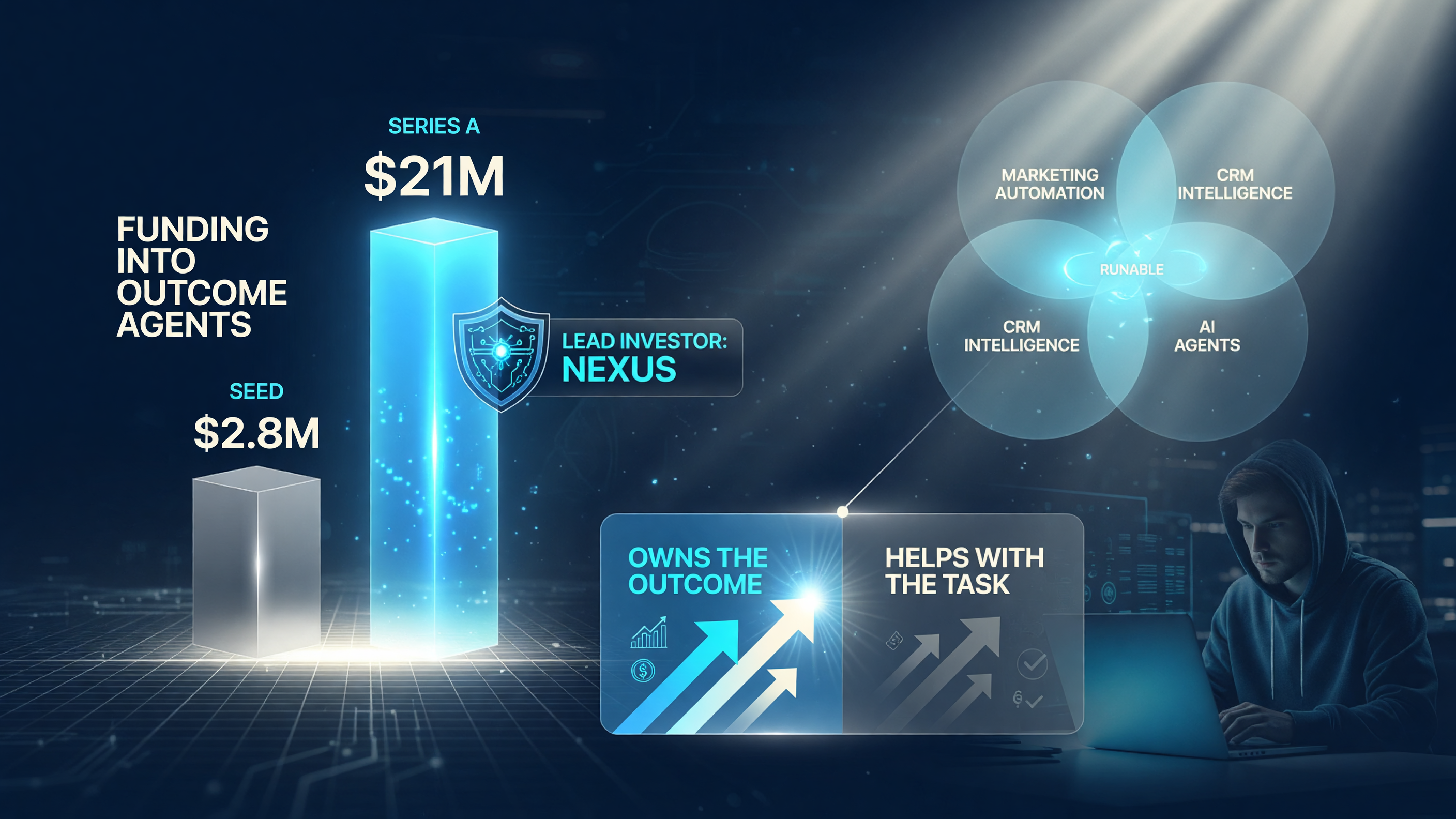
Funding into outcome-owning agents is accelerating — a $21M Series A led by Nexus signals where the market thinks the value is heading.
How to Evaluate a Growth Agent Before You Commit
Not every “AI growth” product delivers what the press release promises. Before you hand a US small business’s revenue engine to an agent, run a simple screen. The checklist below is what I’d push any operator through before plugging a growth agent into their stack.
- Name the exact outcome it owns. If you can’t say in one sentence what recurring cost or outcome this replaces, you don’t understand it well enough to buy.
- Check it works on live data, not a demo. Ask for a test run against your actual pipeline or audience — not a scripted walkthrough.
- Confirm the follow-up logic is adaptive. A static sequence isn’t an agent. It should change behavior based on how contacts respond.
- Verify attribution is real. If it can show which channel earned a customer and shift spend accordingly, that’s substance. If it just reports clicks, that’s decoration.
- Decide your guardrails. Decide now what it may and may not send, so you stay on brand and on side of your customers’ trust.
That screen separates an agent that grows a business from software that just talks about growth. Runable’s Series A is a bet that the former is now buildable and sellable — and that’s exactly the category a US operator should be watching.
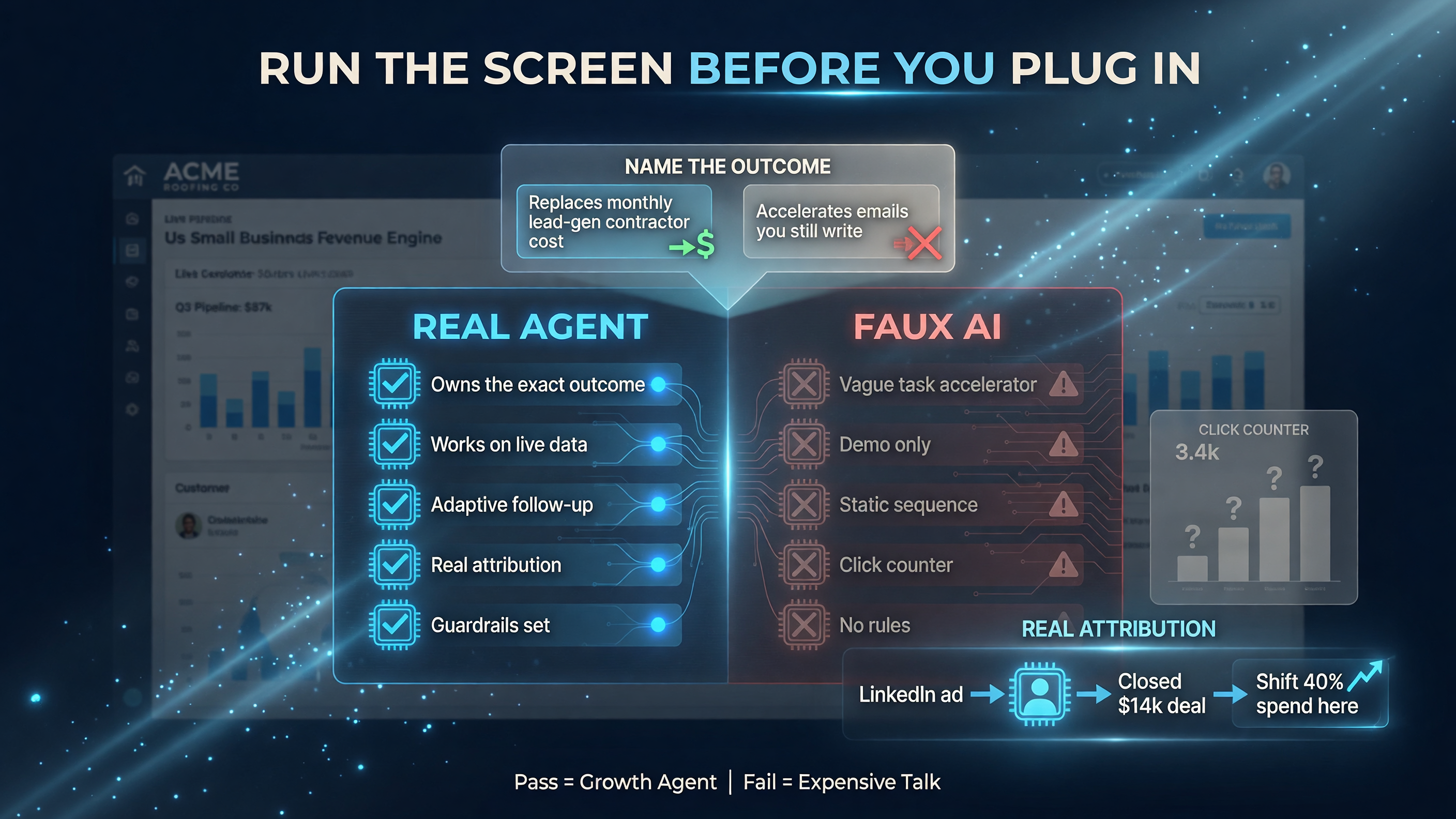
Run the screen before you plug in: the five checks that separate an agent that grows a business from software that just talks about growth.
| Evaluation Criterion | Pass (Real Agent) | Fail (Faux AI) |
|---|---|---|
| Owns a specific outcome | Replaces a recurring cost or task end-to-end | Just accelerates a task you still do |
| Adaptive behavior | Changes course from real responses | Runs a fixed, static sequence |
| Real attribution | Shows channel-to-revenue, shifts spend | Reports clicks and views only |
| Works on your live data | Proof on your actual pipeline | Only a polished demo |
For US small businesses, the opportunity is real because the constraint is real. Most owners have the ambition to grow but not the hours — or the budget for a full growth team. An agent that owns the outcome closes that gap. The $21M vote behind Runable says this category is ready for prime time. The smart operator’s move is to start evaluating it now, not after the copycat wave arrives.
Frequently Asked Questions
What is Runable? Runable is an AI-agent platform, led by former Bolt CEO Maju Kuruvilla, that helps small businesses move from building their operations to actively growing them — using agents that automate and own growth outcomes like outreach, follow-up, and retention.
What does “AI agents go from building to growing” mean? Build tools help you create things (websites, copy, images). Growth agents own the ongoing loop of finding, converting, and keeping customers. Runable’s thesis is that the bigger business value sits in the growth loop, not the content creation front-end.
Who led Runable’s Series A? Nexus Venture Partners led the $21M Series A, announced August 26, 2026, and first reported by TechCrunch and Business Wire.
Is Runable relevant to a US small business? Yes. The pitch speaks directly to US SMB founders who carry both the sales and follow-up load — the people with the ambition to grow but no hours or budget for a dedicated growth team.
How is Runable different from marketing automation? Marketing automation runs scheduled workflows you set up. Runable’s model pushes agents to own the growth outcome — adapting sequences, shifting spend to proven channels, and re-engaging dormant leads without a human orchestrating every step.

About Barak Schurr
Barak Schurr is the founder and former president of the nightlife ticketing platform Wantickets and former Global Director of Dance and Nightlife at Eventbrite. He currently focuses on AI research and writes about practical AI for independent business owners that actually moves the needle — no hype, no corporate fluff. More at topnotchaitools.com.
Contact him at [email protected]
More AI Resources for Your Business