
Perplexity AI Agents for Small Business: QuickBooks and Mailchimp Tasks Now Run Themselves
⚡ Expert Summary: Perplexity just made its agent mode useful for real US small business work. Instead of answering questions, its Computer agents can now connect to your QuickBooks and Mailchimp accounts and actually handle cash flow follow-ups, invoice tracking, payroll lookups, and marketing campaign analysis. The catch is you need the $200/month Max plan for meaningful agent usage — so the real question for a small business owner is whether that cost beats the hours and late-payment pain it removes. Here is how it works, what it costs, and how it lines up against Claude for Small Business.
If you run a US small business, you have probably used an AI chatbot to ask a question — “what should I charge for this project?” or “draft a follow-up email.” Perplexity’s new move is different. Rather than answering and stopping, its agents are built to take the next step inside the tools you already pay for: QuickBooks for your money and Mailchimp for your marketing.
Announced in late August and rolling out through early September 2026, the integrations let you hand real, multi-step back-office jobs to an AI agent and let it work on them with your approval. For an audience that is drowning in invoicing, chasing late payments, and trying to read campaign numbers without a marketing degree, this matters more than another chatbot with a shinier interface. This post breaks down exactly what Perplexity’s small business agents do, the pricing reality, and whether it beats the alternatives already on the market for US owners.
What Perplexity Actually Launched for Small Business
Perplexity’s agent product is called Perplexity Computer. It originally launched in February 2026 as a multi-model reasoning platform that breaks a goal into subtasks and routes each one to the best model for the job — drawing on a library of specialized AI models rather than leaning on a single engine. What changed in September is that it now connects to Intuit QuickBooks and Mailchimp with authenticated, action-taking connectors.
That distinction matters. A chatbot gives you advice and stops. An agent connects to your account, checks the state of your invoices or campaigns, and either does the task or prepares it for one-tap approval. Perplexity frames this as moving beyond “personalized recommendations to real business action” — and for a solo operator or small team with no dedicated bookkeeper or marketing manager, that is the difference between software you talk to and software that does work.
What the QuickBooks Agent Can Take Off Your Plate
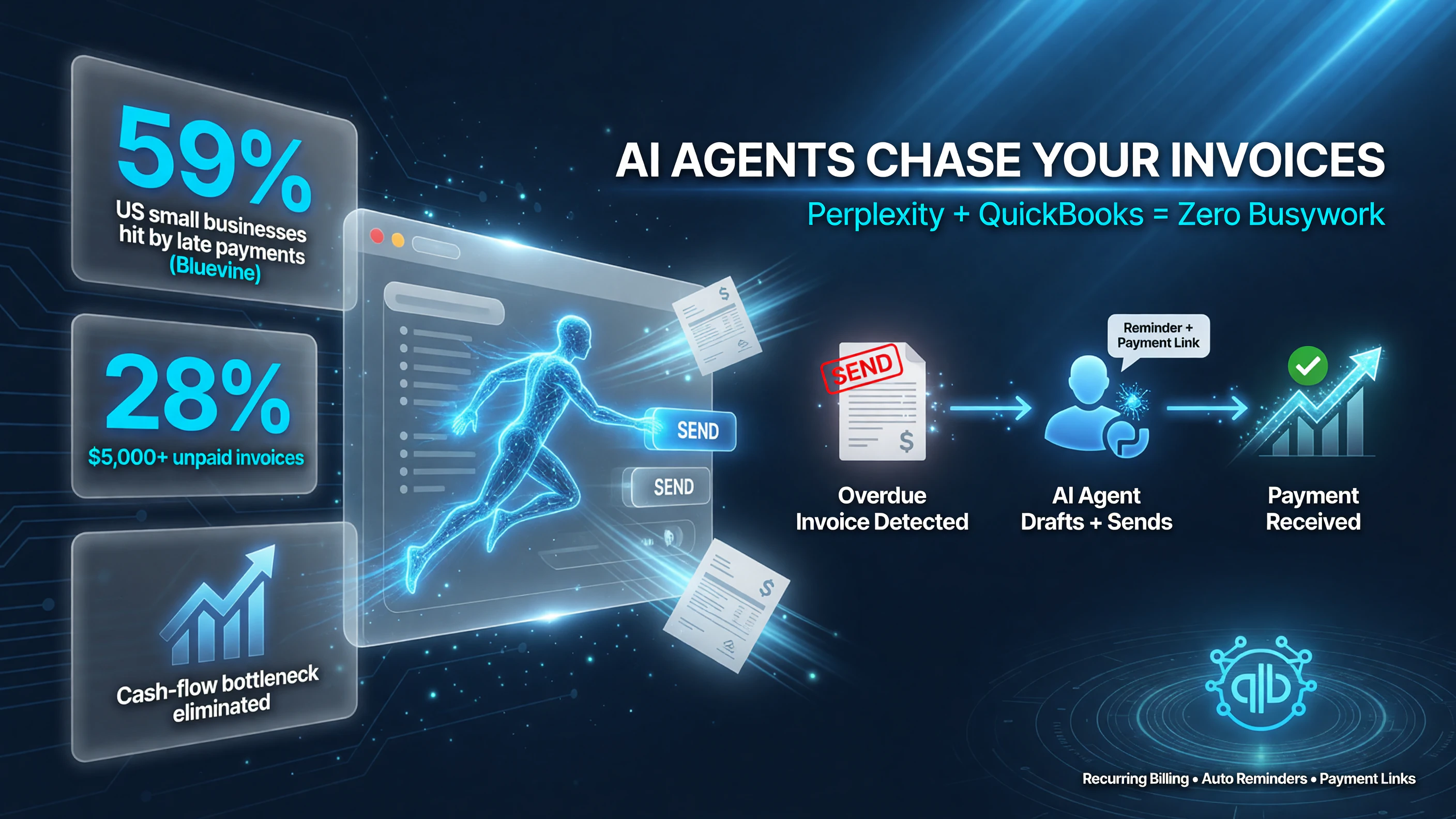
A Perplexity Computer agent spots the overdue invoice, drafts the reminder with a payment link, and sends it for you – attacking the 59% of small businesses hit by late payments (Bluevine).
The QuickBooks connector is aimed at the financial busywork that quietly eats an owner’s week. Based on the launch materials and the type of tasks Perplexity and Intuit highlight, the agent can handle cash flow management, chase overdue invoices, set up recurring billing, and distribute payment links — the actions a business owner usually has to stop doing revenue work to complete manually.
This lands on a real, measurable pain point. A separate Bluevine survey of small businesses found that 59% of SMBs experience late payments at least occasionally, 28% are carrying $5,000 or more in unpaid invoices at any given time, and 18% say their single biggest problem with past-due payments is how long it takes to collect them. If an agent can draft the reminder, pick the right tone, and send it through your connected account at the right moment, it attacks the exact bottleneck owners name most often.
What the Mailchimp Agent Handles
The Mailchimp connector points the agent at your marketing, not just your money. It can pull campaign performance, surface what is working and what is not, and act on the insights — identifying campaigns worth scaling or segments worth re-engaging. For a business owner running their own email list, the value is skipping the export-spreadsheet-stare cycle and getting a plain-language read on where to spend effort next.
Both connectors build on Perplexity’s wider connector library, which the company puts at more than 400 integrations covering tools like Shopify, Stripe, Slack, and Gmail. That breadth matters because the whole point of an agent platform is that it lives where your business already operates, not in a separate silo.
What Each Connector Can Do: A Quick Reference
The two new connectors differ in the kind of work they automate, and that split is worth seeing side by side so you know which one solves the problem you actually have. The table below lays out the tasks each agent handles.
| Area | What the Agent Handles |
|---|---|
| Cash flow | Follow up on overdue invoices and surface who owes what. |
| Billing | Set up recurring billing and distribute payment links. |
| Payroll info | Retrieve payroll and employee details on demand. |
| Marketing analytics | Pull Mailchimp campaign performance and flag what works. |
Notice the pattern: every task in that table is administrative busywork that pulls you away from selling, serving, or building. That is precisely why agentic tools are resonating with owners who have no support staff to delegate these jobs to.
Perplexity Pricing: Where the Small Business Math Gets Real
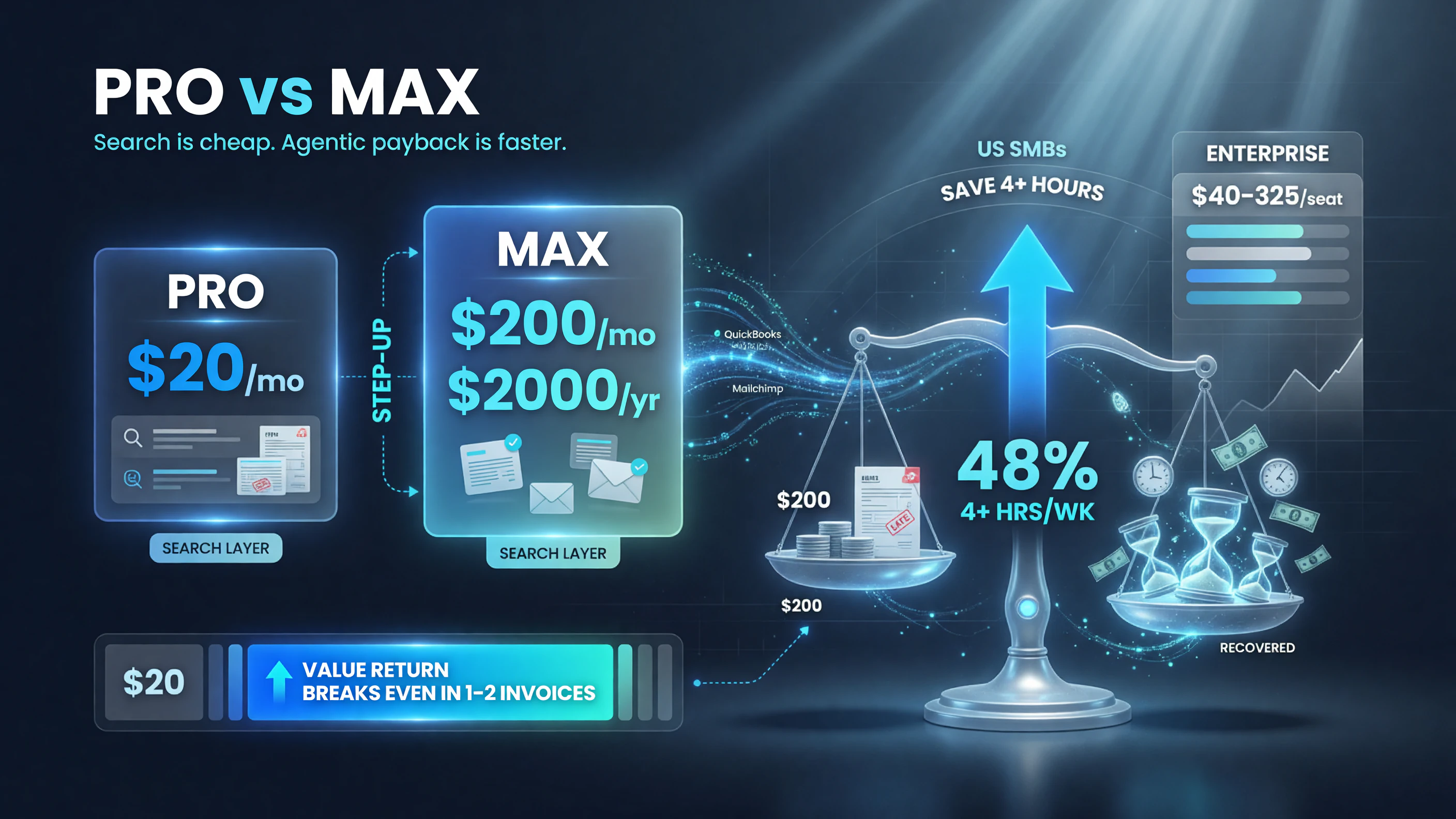
The search layer is cheap at $20/month, but the agentic QuickBooks and Mailchimp tools sit behind Max at $200/month – a real decision until you weigh the 48% of SMBs already saving 4+ hours a week with AI.
Here is the honest part most coverage skips. The search layer of Perplexity is cheap — Pro runs $20/month. But the agentic Computer features that actually connect to QuickBooks and Mailchimp are gated behind the heavier usage tiers, chiefly Max at $200/month (or $2,000/year), which includes the biggest monthly credit pool for agent tasks. Enterprise plans start around $40 to $325 per seat depending on tier.
For an independent owner, that $200/month is a real decision, not pocket change. The counter-argument is the Bluevine stat that 48% of SMBs already report saving at least four hours a week with AI tools. If a reliable back-office agent genuinely recovers several of those hours on a weekly basis — or stops even one or two late invoices a month from slipping — the payback math can justify itself quickly. The pragmatic reading: this is not a $20 impulse tool for most owners; it is a deliberate investment, and you should trial it against your actual invoice volume before committing.
Perplexity Computer vs Claude for Small Business: Side by Side
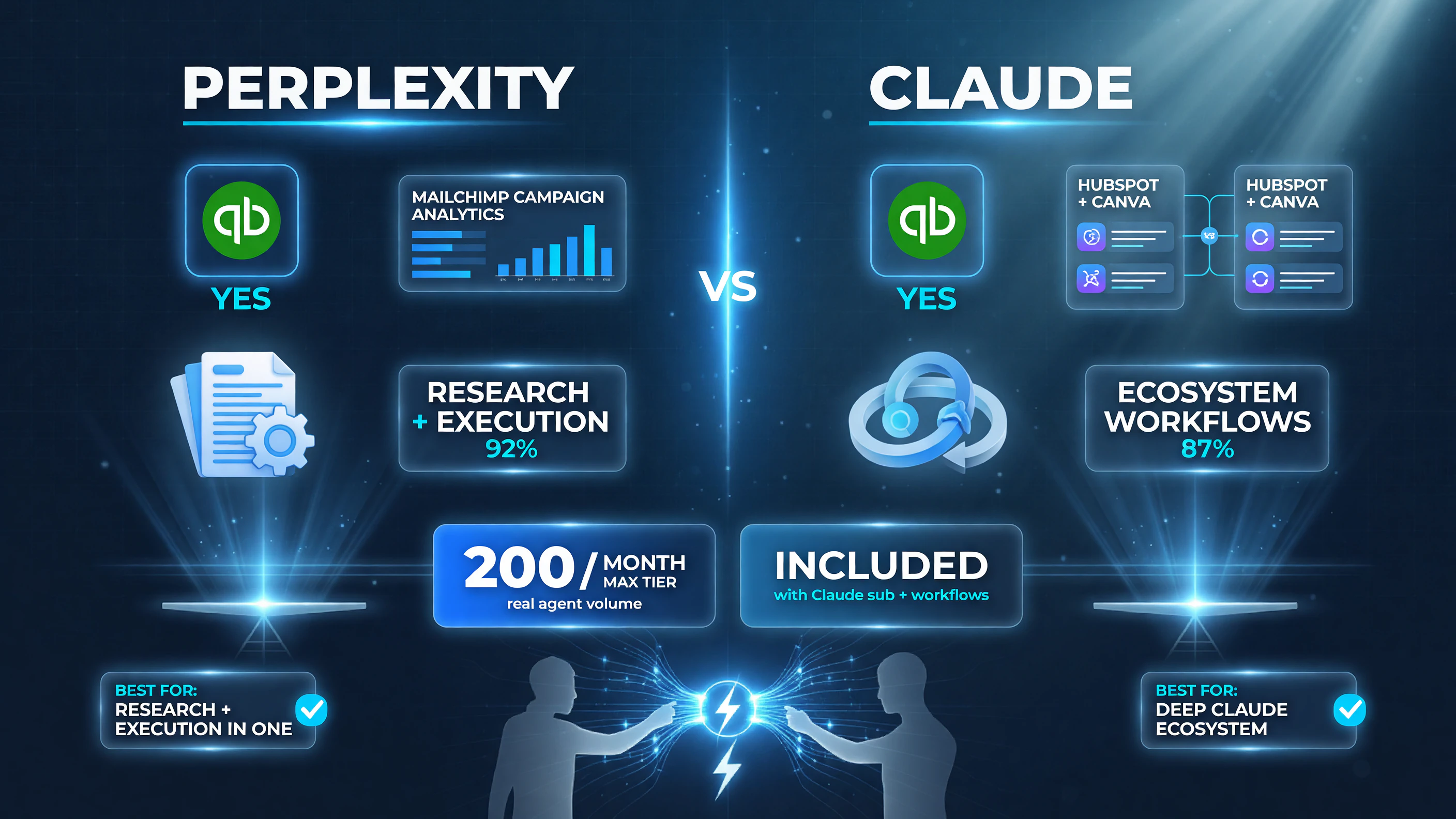
Both platforms connect to QuickBooks, but the split is real: Perplexity routes research plus execution at $200/month Max, while Claude bundles its small-business workflows into a subscription you may already pay for.
Perplexity is not the only player pointing agents at small business back-office work. Anthropic’s Claude for Small Business launched earlier in 2026 with pre-built agentic workflows and connectors for QuickBooks, PayPal, HubSpot, and Canva, among others — and it sits inside the subscription many owners and freelancers already pay for. The comparison below is the practical way to decide which one fits a US SMB.
| Factor | Perplexity Computer | Claude for Small Business |
|---|---|---|
| Core focus | Search + multi-model agent routing | Pre-built workflows inside tools you use |
| QuickBooks connector | Yes — invoice chase, billing, cash flow | Yes — month-end, reconciliation workflows |
| Marketing connector | Mailchimp campaign analytics + actions | HubSpot, Canva tools |
| Entry price for agent use | $200/month (Max) for real agent volume | Included tier of Claude subscription + workflows |
| Best for | Owners who want research + execution in one place | Owners already deep in Claude’s ecosystem |
Neither tool should be trusted to take money-moving actions without oversight. The vendors themselves are leaning into safeguards — requiring approval through push notifications and letting you set price limits and opt-in controls before an agent acts independently. For a small business, that guardrail is not a nice-to-have; it is the difference between a helpful assistant and a liability. Always keep a human approval step on anything that touches payment or sends to customers.
Which Small Businesses Should Actually Adopt This
Not every US small business is a fit, and pretending otherwise does nobody a favor. The businesses that get the most from Perplexity’s agents share a few traits: they invoice clients or sell services, they run their own email or marketing in Mailchimp, and they have enough recurring back-office volume that a $200/month agent pays for itself in recovered hours. Freelancers, consultants, agencies, and productized service companies are the clearest audience.
If you are a very small operation whose invoicing fits on one screen a week, or you barely touch marketing automation, then the Max price tag is likely overkill right now. A cheaper path is to use the free search layer plus a lighter tool, then step up to agentic plans only when the volume genuinely hurts. Buy the agent when it removes a bottleneck you can name — not because an AI platform released a new feature.
How to Get Started With Perplexity Agents for Your Business
If you decide the fit is real, the setup is straightforward and worth doing in order. Start by connecting the accounts you actually use, grant only the permissions each task needs, then run one low-risk task end to end before trusting it with anything that touches money.
- Pick your tier. Confirm you have a paid plan with agent credits — realistically Max for meaningful volume — before expecting the connectors to be useful.
- Connect QuickBooks and Mailchimp. Authenticate through OAuth and grant scoped access so the agent can see invoices or campaigns without blanket control.
- Run a single test task. Ask it to summarize outstanding invoices or read last month’s campaign performance. Verify the output before you enable actions.
- Turn on approval controls. Require your sign-off on anything that sends payment links, chases a client, or broadcasts to your list.
- Scale to recurring workflows. Once a task runs clean, let it repeat on a schedule and audit the results weekly.
FAQ: Perplexity AI Agents for Small Business
How much does Perplexity cost for small business agent use?
Search starts at $20/month on the Pro plan, but the agentic Computer features that connect to QuickBooks and Mailchimp realistically need the Max plan at $200/month to get meaningful monthly credits. Enterprise tiers run from roughly $40 to $325 per seat.
Can Perplexity agents actually take actions in QuickBooks?
Yes. With the authenticated QuickBooks connector, agents can handle cash flow management, follow up on overdue invoices, set up recurring billing, and distribute payment links — subject to your approval controls.
Is Perplexity Computer better than Claude for Small Business?
It depends on your stack. Perplexity pairs research with execution and adds a Mailchimp connector, while Claude for Small Business offers pre-built workflows inside QuickBooks, PayPal, and HubSpot for owners already in its ecosystem. Compare connectors against the tools you actually use before you choose.
Are Perplexity’s small business agents safe to let act on their own?
Perplexity and its connector partners build in safeguards such as approval via push notifications, price limits, and opt-in controls. You should keep a human approval step on anything that moves money or contacts customers.
Which US small businesses get the most value from these agents?
Service businesses that invoice clients, run their own Mailchimp marketing, and carry enough recurring back-office volume that the $200/month entry price pays for itself in recovered hours are the clearest fits.

About Barak Schurr
Barak Schurr built and sold a major ticketing platform, ran global nightlife operations at Eventbrite, and now spends his time figuring out which AI tools actually move the needle for independent business owners — and which ones are just noise. No hype. No fluff. Just what works.
Email: [email protected]
More AI Resources for Your Business