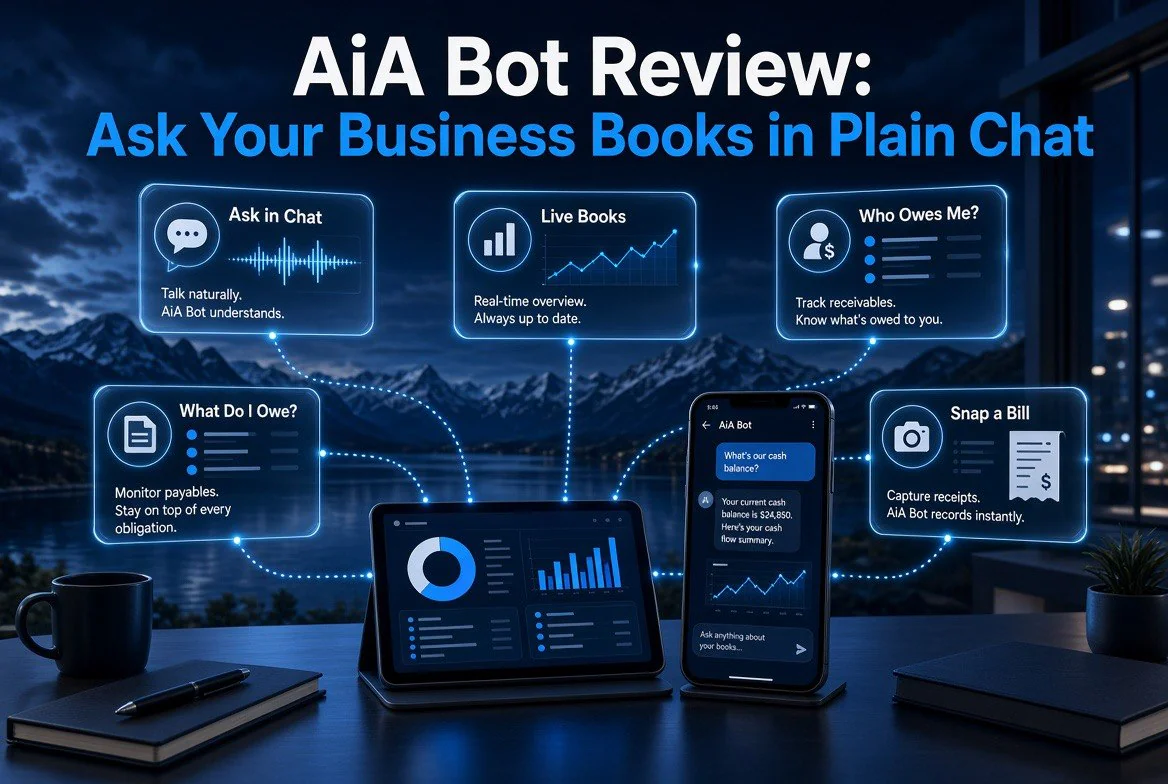
AiA Bot Review: Ask Your Business Books in Plain Chat
⚡ Expert Summary: AiA Bot (AI Accountant) is a WhatsApp-based AI bookkeeping assistant that answers questions about your money in plain language — no dashboard, no login, no accountant on call. Its early pilot across 122 businesses fielded more than 1,600 messages and ~700 financial queries in about six weeks, a real-world proof that the “just ask your books in chat” model works. For US small business owners, the tool itself is built around Tally (an Indian accounting system), so the durable lesson is the concept: conversational bookkeeping is here, and American owners should see what it looks like in tools built for them.
Here is a question every small business owner has wrestled with at the worst possible moment: how much money do I actually have right now? Not what the bank statement said last week. Not what your accountant will tell you after close. Right now, from the messy, day-to-day reality of invoices sent, bills owed, and money coming in.
For most owners, that answer lives behind a login, a spreadsheet, or a phone call to someone who is busy. That friction is exactly what AiA Bot is trying to kill. It is an AI accountant you reach the way you already reach customers and vendors every day — through a chat window — and it answers questions about your books in plain language, in roughly ten seconds, from the live data in your accounting software.
This review digs into what AiA Bot actually did in its launch pilot, why the “ask your books in chat” model matters for small business owners, and — most usefully for an American audience — how to get the same outcome with tools built for the US market today.
What AiA Bot Actually Is
AiA Bot, built by the fintech startup AI Accountant, is a WhatsApp-based AI assistant for business bookkeeping. It connects to your books and lets you ask natural-language questions about your finances — cash position, receivables, sales, payables, ledger balances — and get answers in seconds without opening a dashboard or logging into anything.
The flagship setup works with Tally, the accounting software used by millions of small and medium businesses and startups in India. Once your Tally books are synced, you simply message questions to AiA Bot. It reads the live data and replies conversationally in English (or Hindi). If you snap a photo of a bill or invoice, its OCR reads it and files it into your books.
The most important detail for a US reader is what the pilot proved about behavior. From July 24 to September 2 of this year, across 122 real businesses, AiA Bot handled more than 1,600 messages and roughly 700 genuine financial questions — including about 1,000 bills uploaded through the chat. That is not a demo. That is real owners asking real questions about real money, through a channel they already use every day.
Why “Ask Your Books in Chat” Is a Big Deal
Strip away the specific tool and the Indian market, and you will find a genuinely important idea for small business owners everywhere: your financial data should answer questions the way your best employee would — instantly, in plain English, no training required.
Think about how owners actually get a financial answer today. Option one is logging into accounting software and hunting through reports — doable, but only if you know the software well enough to trust what you find. Option two is asking your bookkeeper or accountant, which works but costs money and takes time, and they are not always available at 8 p.m. when a decision is urgent. Both options put a barrier between a simple question and a simple answer.
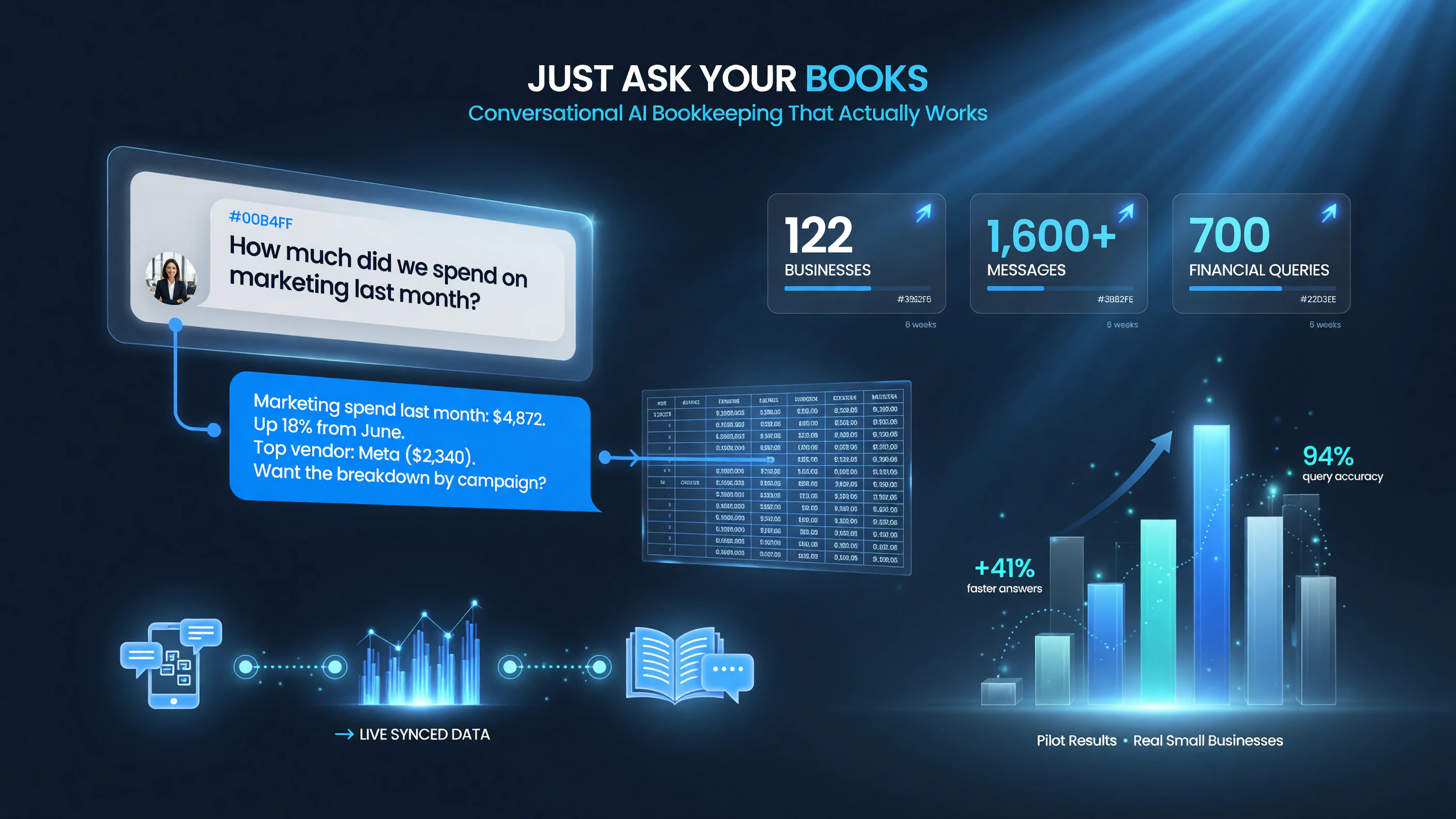
The proof the model works: AiA Bot’s pilot across 122 businesses fielded 1,600+ messages and ~700 financial queries in about six weeks.
Conversational bookkeeping removes that barrier entirely. Instead of learning report navigation or waiting on a professional, you ask the question the way you would ask a person, and the AI pulls the answer from live, synced data. The data is not a stale export — it is current, because the tool reads from the books directly. For owners who never feel fully in control of their numbers because the numbers live behind a wall of software, this is a genuine shift in how accessible financial truth becomes.
What Real Owners Actually Asked
The pilot data is valuable because it tells you what owners genuinely want to know when the friction disappears. This is not a vendor marketing claim — it is the actual distribution of ~700 real queries across 122 businesses.
| What Owners Asked About | Share of ~700 Queries | Why It Matters to You |
|---|---|---|
| Ledger and party balances | 33% | “Who owes me, and what do I owe?” is the question owners ask most |
| Custom financial analysis | 20% | Owners wanted specific breakdowns, not just standard reports |
| Receivables | 18% | Chasing what customers owe is a constant, real pain |
| Revenue and sales | 14% | Owners watch top line closely and want it in real time |
| Payables | 13% | Knowing what you owe — and when — protects cash flow |
The pattern is unmistakable. Owners are not asking for theoretical strategy. They are asking operational, cash-in-cash-out questions — who owes me, what do I owe, what did I sell, what is coming in. Those are the questions that keep owners up at night, and they are exactly the ones a chat-based assistant can answer instantly from live books. The QR capability added a second real workflow: owners snapped photos of roughly 1,000 bills and invoices and had them filed, which removes the dreaded pile of un-recorded paper.
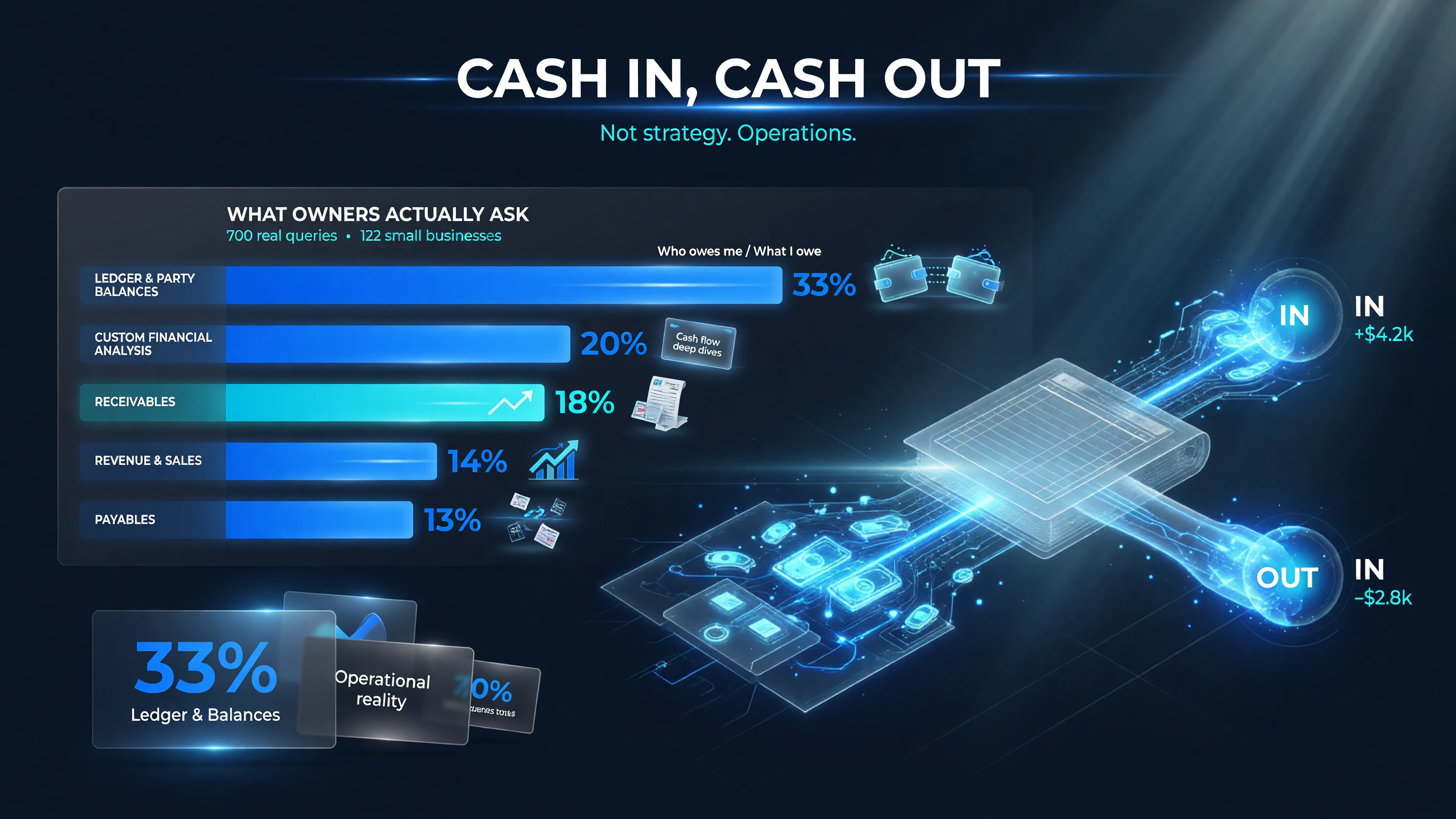
Cash in, cash out — owners ask operational questions. Top real query categories from the ~700-question pilot across 122 businesses.
How Conversational Bookkeeping Compares to What US Owners Use Now
Here is where an American owner should pay close attention. The AiA Bot pilot is strong evidence that chat-based access to your books is valuable. But AiA Bot itself is built around Tally and the Indian MSME market. For a US business, the practical move is to apply the same philosophy with bookkeeping tools built for the US — and to know how they actually deliver.
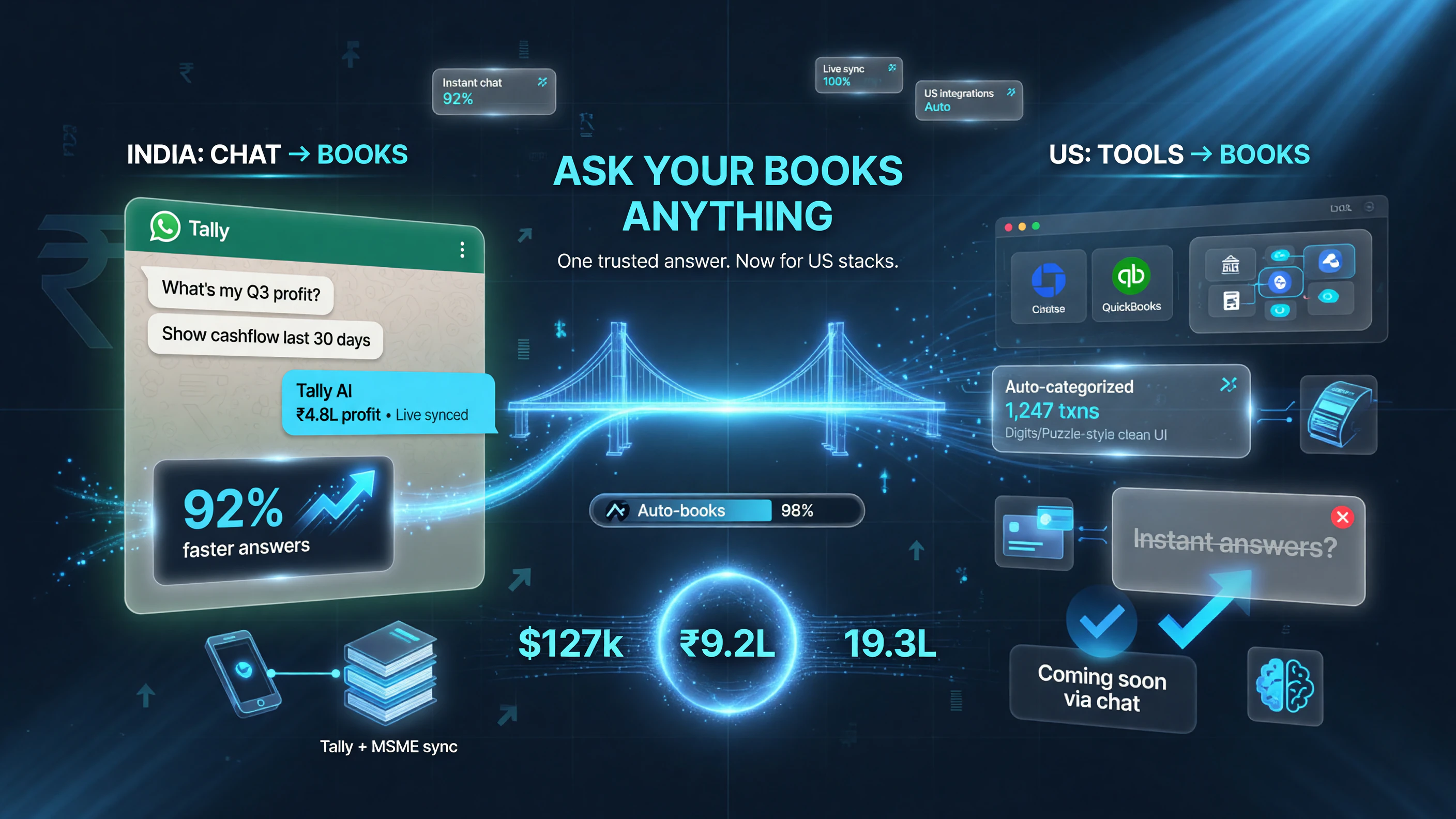
Two routes to instant answers from your books: the chat-first pilot model versus modern US bookkeeping tools built for the US banking and tax stack.
| Factor | AiA Bot (WhatsApp AI bookkeeping) | US Modern Bookkeeping Tools (e.g. Puzzle, Digits) |
|---|---|---|
| Where you ask | Inside WhatsApp, no dashboard | App or chat-style interface, no manual bookkeeping |
| Accounting integration | Tally (flagship) | US bank/business integrations, auto-categorization |
| Answer style | Plain-language chat replies in ~10 seconds | Ask questions / get answers without navigating reports |
| Best for | Tally-based SMBs wanting conversational access | US owners wanting automatic, reliable books with AI speed |
| The takeaway | Proves owners will ask their books questions in chat | Delivers that same instant-answer value in the US stack |
How to Get the Chat-Powered Books Experience in the US
Before getting to the practical setup, one honest caveat is worth stating plainly: conversational bookkeeping is only as trustworthy as the books it reads from. An AI assistant answering in plain language does not make bad data good — it makes current data instantly accessible and stale data confidently wrong. That is why the order matters. Automate accuracy first, then layer on the convenience of asking questions in chat. Owners who skip the first step often end up with a very fast assistant quoting very unreliable numbers, which is worse than no assistant at all because it creates false confidence. The pilot data shows owners used the tool heavily precisely because their synced Tally books were current. Recreate that condition and the same behavior follows.
The useful way to read the AiA Bot pilot is as proof of demand, not as a prescription to adopt a Tally-native tool. If the idea of asking your books a question and getting an instant, trustworthy answer appeals to you, the goal is to recreate that experience with books you actually keep and software that fits the US banking and tax environment.
Start With Books That Close Themselves
Conversational bookkeeping only works if the underlying books are accurate and current. An AI assistant answering from messy, half-finished books just gives you confident answers about unreliable numbers. So step one is automation that keeps the ledger clean: bank feeds, auto-categorization, and tools that close your monthly books without a manual reconciliation slog. The fewer manual entries, the more you can trust a chat answer pulled from live data. Modern US tools like Puzzle and Digits are built exactly around this principle — automatic books with AI speed.
Ask the Same Questions AiA Bot Owners Asked
Once your books are clean, start asking the questions the pilot showed real owners ask most — the ones that keep you up at night. What is my true cash position right now? Who still owes me and how much total? What do I owe suppliers this month? How much did I actually sell last week? The point of automated bookkeeping is not to enjoy pretty dashboards; it is to be able to answer those operational questions in seconds, with confidence, whenever a decision or a vendor or a supplier demands it.
Keep the Receipts Flowing With Minimal Effort
The roughly 1,000 bills uploaded through AiA Bot’s chat point to a second habit worth copying. Instead of a shoebox or a folder of unrecorded receipts, get every expense into the books the moment it happens. Whether that is snapping a photo and having it logged by AI, or swiping the right card so transactions flow in automatically, the goal is zero backlog. A backlog of unrecorded expenses is invisible cash-flow risk — money you have spent but have not counted.
Three Questions to Ask Your Books This Week
To translate conversation into action, start with the questions every owner should be able to answer from current books — the ones the pilot showed owners ask most. First, what is my true cash position right now, net of what I owe this month? Second, who still owes me, how old is that money, and which balances need chasing today? Third, what did I sell this week and how does that compare to my payables coming due? None of these require a fancy report if your books are current and you can simply ask. The calm that comes from knowing the answer to each of these in under a minute, at any moment, is the real product. That is the outcome AiA Bot’s pilot proved owners want, and it is the outcome worth building toward no matter which tool you use.
The Bottom Line for US Small Business Owners
AiA Bot is a meaningful signal even though its flagship works on Tally in India. It proves, with real pilot data — 1,600+ messages, ~700 genuine financial questions, ~1,000 bills — that when you remove the barrier between a business owner and their numbers, owners will actually engage with their books. They ask about cash, receivables, payables, and sales. They file their receipts. They stop treating their finances as a quarterly mystery.
Your move is not to adopt a tool built around an accounting standard you do not use. It is to take the same principle and apply it where it fits your business: automate your books so they are always current, then get into the habit of asking your numbers questions and acting on the answers. When your money answers back in seconds instead of hiding behind a login, you are no longer flying blind — and that is a competitive edge every owner can use.
Frequently Asked Questions
What is AiA Bot?
AiA Bot is a WhatsApp-based AI bookkeeping assistant built by the fintech startup AI Accountant. It connects to your accounting books and answers natural-language questions about your finances — cash, receivables, sales, payables — in plain English or Hindi in about ten seconds, without needing a dashboard or login.
Is AiA Bot available for US small businesses?
AiA Bot’s flagship integration is built around Tally, an accounting system used widely in India, and it targets Indian MSMEs and startups. US owners are better served by bookkeeping tools built for the US banking and tax environment that deliver the same conversational, automated access to current books.
What does AiA Bot do?
It lets business owners message questions about their money through WhatsApp and get instant answers from live, synced books. It also reads bills and invoices from photos and files them into the books using OCR. In its pilot across 122 businesses it handled over 1,600 messages and roughly 700 financial questions.
What did real business owners ask AiA Bot?
About 33% of ~700 pilot queries were about ledger and party balances, 20% custom financial analysis, 18% receivables, 14% revenue and sales, and 13% payables. Owners mostly wanted operational cash-in-cash-out answers: who owes me, what do I owe, what did I sell.
Can AI really replace a bookkeeper?
AI that keeps books current and answers questions on demand can remove the manual, time-consuming core of bookkeeping — categorization, reconciliation, and reporting. Many US owners still use a professional for tax season and judgment calls, but AI tools handle the ongoing operational books automatically. See this guide to AI bookkeeping tools for a deeper comparison.
What is conversational bookkeeping?
It is the practice of getting financial answers by asking questions in plain language through a chat interface, rather than navigating dashboards or waiting on an accountant. The assistant reads from current, synced books and responds in seconds, making financial truth accessible to owners who do not live inside accounting software.

About Barak Schurr
Barak Schurr built and sold a major ticketing platform, ran global nightlife operations at Eventbrite, and now spends his time figuring out which AI tools actually move the needle for independent business owners — and which ones are just noise. No hype. No fluff. Just what works.
Email: [email protected]
More AI Resources for Your Business