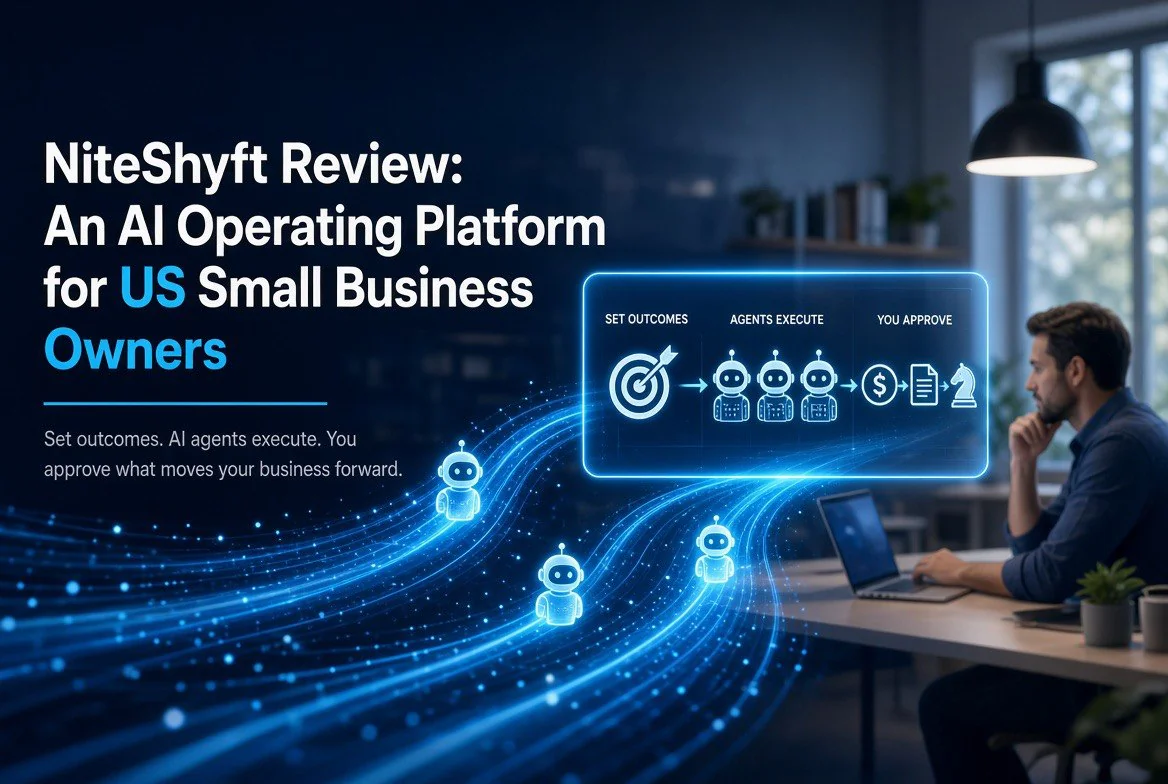
NiteShyft Review: An AI Operating Platform for US Small Business Owners
⚡ Expert Summary: NiteShyft is a new AI “business operating platform” that deploys hundreds of autonomous AI agents to run day-to-day tasks across research, marketing, content, sales, finance, and operations while the owner stays in control of the big calls. Announced September 9, 2026, it is set for public launch in October 2026. The company reports 123+ specialized capabilities and waitlist interest from more than 2,800 businesses in 45+ countries. For US small business owners, the pitch is blunt: hand the repetitive workload to an always-on AI workforce, but keep the final say over spending, publishing, and strategy.
Every small business owner in the US knows the same trap. You did not start your company to spend your evenings writing product descriptions, chasing invoices, scheduling social posts, and answering the same three questions from customers over and over. But that is exactly where most founders end up — because hiring a full team to handle the busywork is not an option when payroll is the thing keeping you up at night.
NiteShyft is built for that specific problem. Rather than being another chatbot or a smarter task manager, it frames itself as an operating platform — a workforce of autonomous AI agents that can take a task and actually finish it, across the functions a small business actually runs. The caveat, and the part owners should care about most, is how it handles control: the agents do the work, but the owner approves the money moves, the published content, and the strategic changes.
This review breaks down what NiteShyft actually is, how its agent workforce operates, what the early numbers claim, and — most importantly for an American owner deciding whether to pay attention — how to think about it alongside the AI tools you may already be using.
What Is NiteShyft?
NiteShyft is an AI business operating platform announced on September 9, 2026, with a public launch planned for October 2026. It is the creation of founder Meraj Syed, a self-described operator who built and ran businesses before turning to AI — a background the company leans on heavily to argue these agents are built around real day-to-day business work, not demo-friendly tasks.
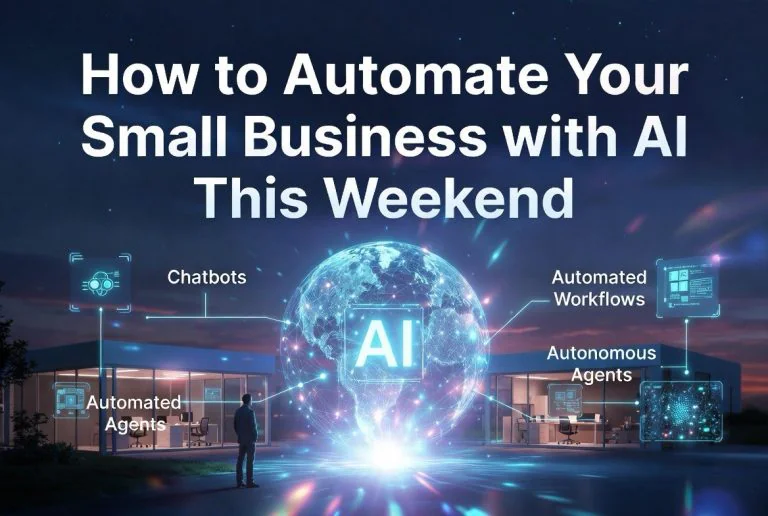
The core idea is a shift in how small businesses use AI. Most tools today are assistants: you ask, they answer, you do the work. NiteShyft’s model is delegation: hundreds of autonomous agents work in parallel across the functions of a small company — researching markets, drafting content, building marketing campaigns, qualifying sales leads, tracking finance, and coordinating operations. The agents run around the clock, and the human does not have to prompt every step. That is the difference the company is betting on: not a smarter chatbot, but a background workforce.
The company reports the platform already spans 123+ specialized capabilities and that more than 2,800 businesses from 45+ countries have joined the pre-launch waitlist. As with any pre-launch product, those are claims to watch rather than results to trust blindly — but they give a clear picture of the ambition and the positioning.
How the NiteShyft AI Workforce Actually Works
The useful way to understand NiteShyft is to stop thinking of it as a single AI and start thinking of it as a company’s worth of agents that share context and coordinate. Rather than you opening a chat and asking “write me a post,” you point the platform at an outcome — “keep the website fresh, feed the pipeline, reconcile the books” — and it decomposes that into tasks its agents can execute.
NiteShyft groups its agents around the major functions a small business has to run. This is the mental model owners should hold onto, because it is what separates an operating platform from a point tool.
| Workforce Area | What the Agents Handle |
|---|---|
| Research & intelligence | Market research, competitor tracking, trend monitoring, opportunity scanning. |
| Marketing & content | Campaign planning, content drafting, social scheduling, SEO work, email sequences. |
| Sales & customers | Lead qualification, outreach, follow-ups, responding to routine customer questions. |
| Finance & operations | Expense tracking, invoice generation, reporting, and day-to-day operational coordination. |
Because the agents work from shared context, the marketing agent does not operate in a vacuum from the finance agent — they are part of one system that sees the same business picture. That coordination layer is where the “operating platform” framing stops being marketing and starts being a real architectural difference from a stack of disconnected tools.
The Control Question Every Owner Should Ask
Here is the part of NiteShyft that matters more than the speed claims: where does the human sit in the loop?
The company is explicit that high-stakes actions require human approval. Spending money, publishing content, and changing strategy are gated behind the owner’s say-so. The agents can draft, recommend, and prepare — but they do not fire big decisions autonomously.
This is the right design for the audience. A small business owner who has built a brand, a reputation, and a cash position has no business handing an AI the keys to spend or publish unsupervised. The “owner approves, agents execute” model is exactly the autonomy level most independent operators are comfortable with when they are first handing real work to AI. It gives you the leverage of a workforce without surrendering judgment.
That said, it is worth being honest about what human-in-the-loop means in practice. Approval is only useful if the owner actually reviews what the agents prepared rather than rubber-stamping it. The platform saves you the execution time; it does not remove your responsibility to know what is going out under your name.
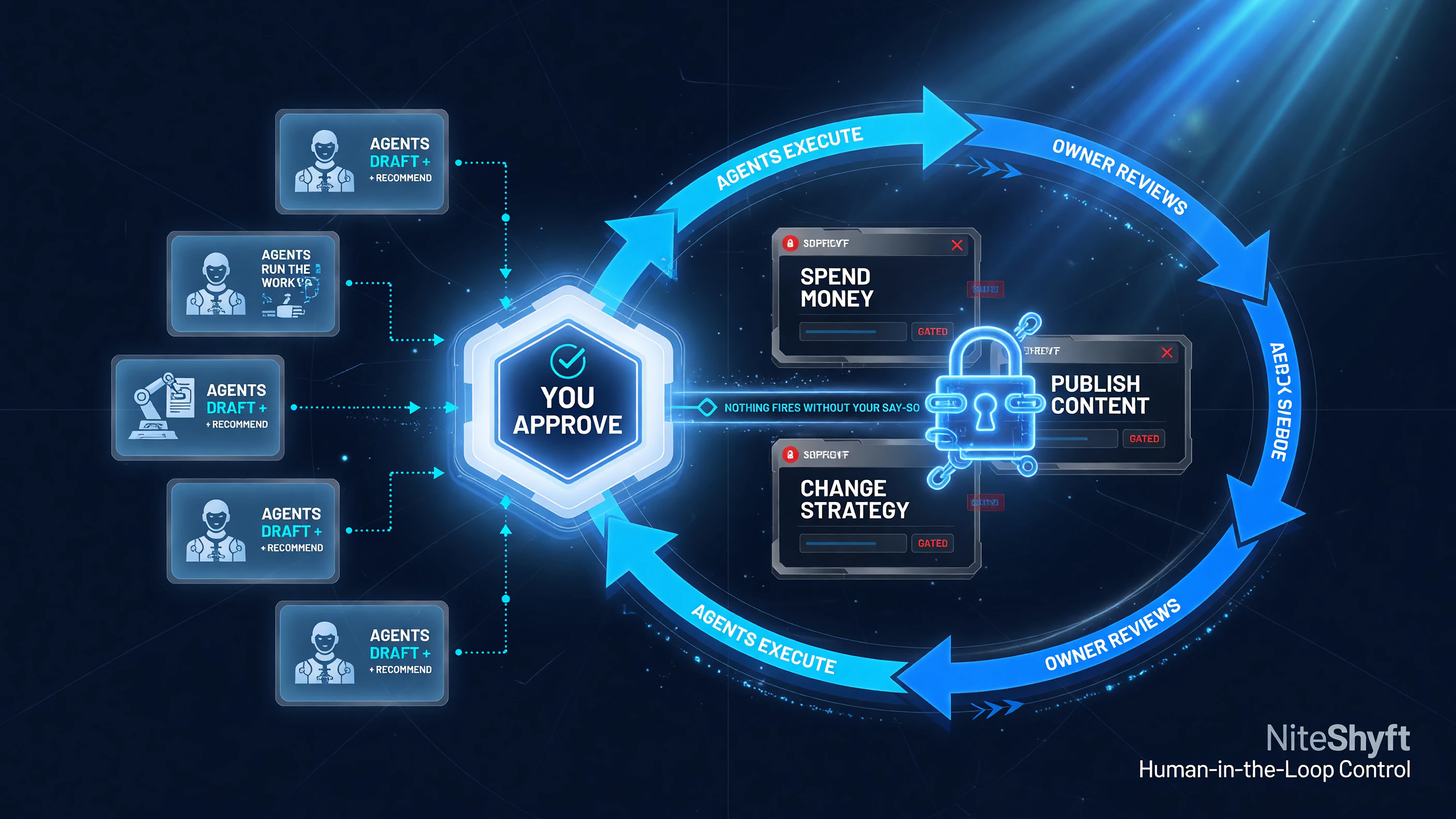
On NiteShyft, high-stakes actions — spending money, publishing content, and changing strategy — stay gated behind the owner's approval. Agents can draft and prepare, but nothing big fires without your say-so.
What the Early Numbers Actually Claim
In private testing, NiteShyft says its workforce completed more than 2,000 real business tasks. The company reports a median speed advantage of roughly 736× faster than a human benchmark capped at an eight-hour workday, and an aggregate compute cost of about $380 against an estimated $207,721 of equivalent freelance labor — a claimed saving in the vicinity of 99.8%.
| Metric | NiteShyft Reported | Headline Takeaway |
|---|---|---|
| Tasks completed in testing | 2,000+ real business tasks | Real workload, not toy examples |
| Speed vs. human benchmark | ~736× faster (median) | Benchmark capped at 8-hour day |
| Aggregate labor cost | ~$380 compute | vs. ~$207,721 freelance equivalent |
Those are striking numbers, and they are also vendor-reported numbers from a private test — not independently audited results. Treat the 736× figure the way you would treat any vendor speed claim: it is directional evidence that delegation can be far faster and cheaper than hiring out task by task, not a guarantee your business will see the same ratio. The honest read is that AI delegation of repetitive workflow is real and getting cheaper fast; the exact multiplier on your own books will depend on the tasks, the volume, and how much you hand over.
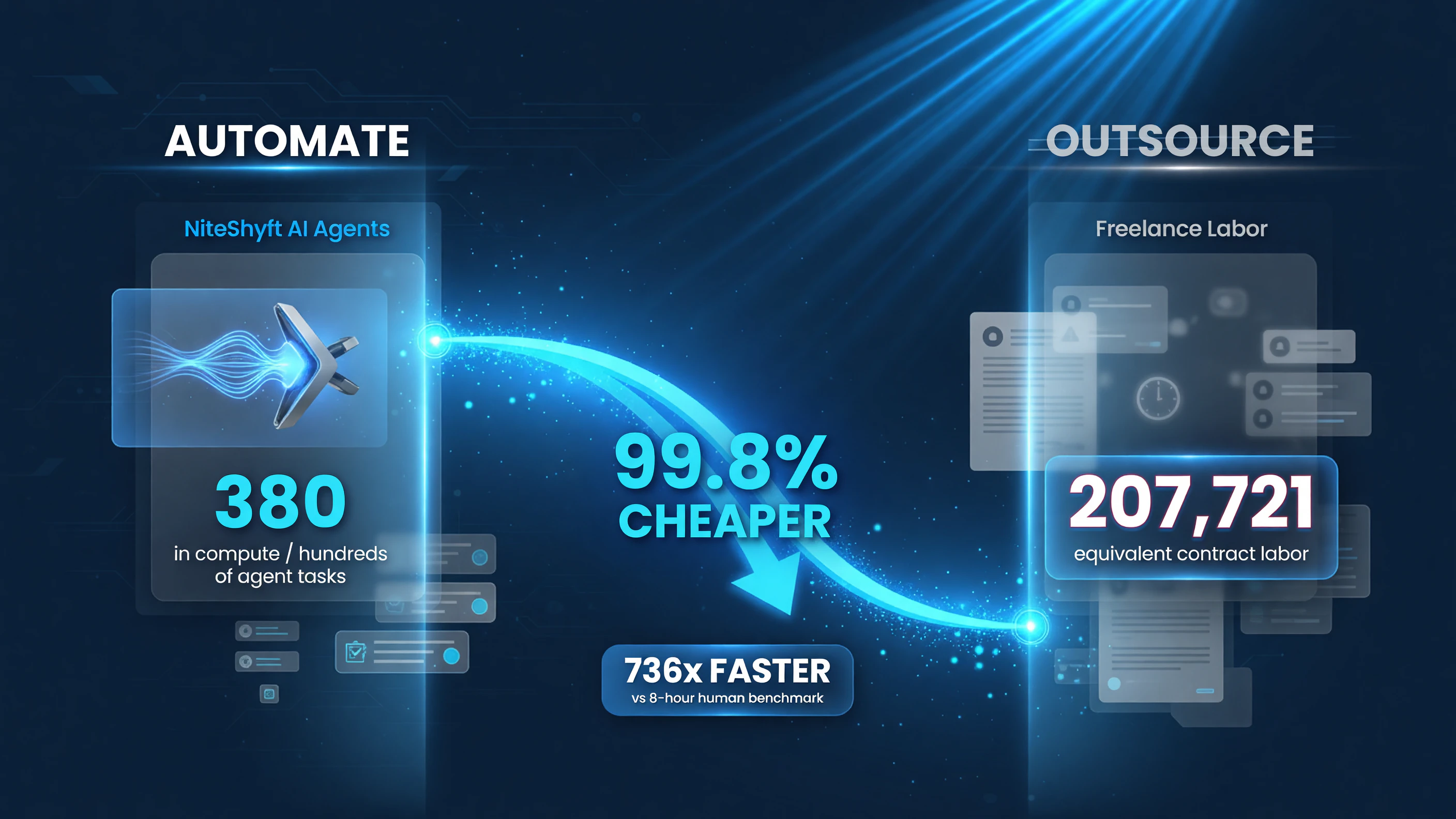
NiteShyft reports its autonomous agent workforce costs about $380 in compute against an estimated $207,721 of equivalent freelance labor — a claimed saving near 99.8%, at 736x the speed of an eight-hour human benchmark.
How NiteShyft Compares to What You Might Already Use
If you have already dipped into AI for your business, you have probably used an assistant or a point tool — and you may be wondering how NiteShyft is different. The distinction matters, because it tells you whether this is a new investment or just a repackaging.
| Factor | AI Assistant / Chatbot | NiteShyft (Operating Platform) |
|---|---|---|
| How you use it | You prompt, it answers, you execute | You set outcomes, agents execute in parallel |
| Scope | Single task or single function | Cross-functional workforce with shared context |
| Autonomy | You drive every step | Agents run tasks; you approve spend/publish/strategy |
| Who it replaces | A capable assistant | Span of routine back-office labor |
A chatbot answers well but leaves the grinding execution to you. NiteShyft’s pitch is that the grinding execution is exactly what it absorbs — the drafting, the scheduling, the follow-ups, the reporting — while you approve what matters. Whether it delivers on that at launch, in October 2026, is the open question. The design ambition is clearly in the right direction for where small-business AI is heading in 2026.
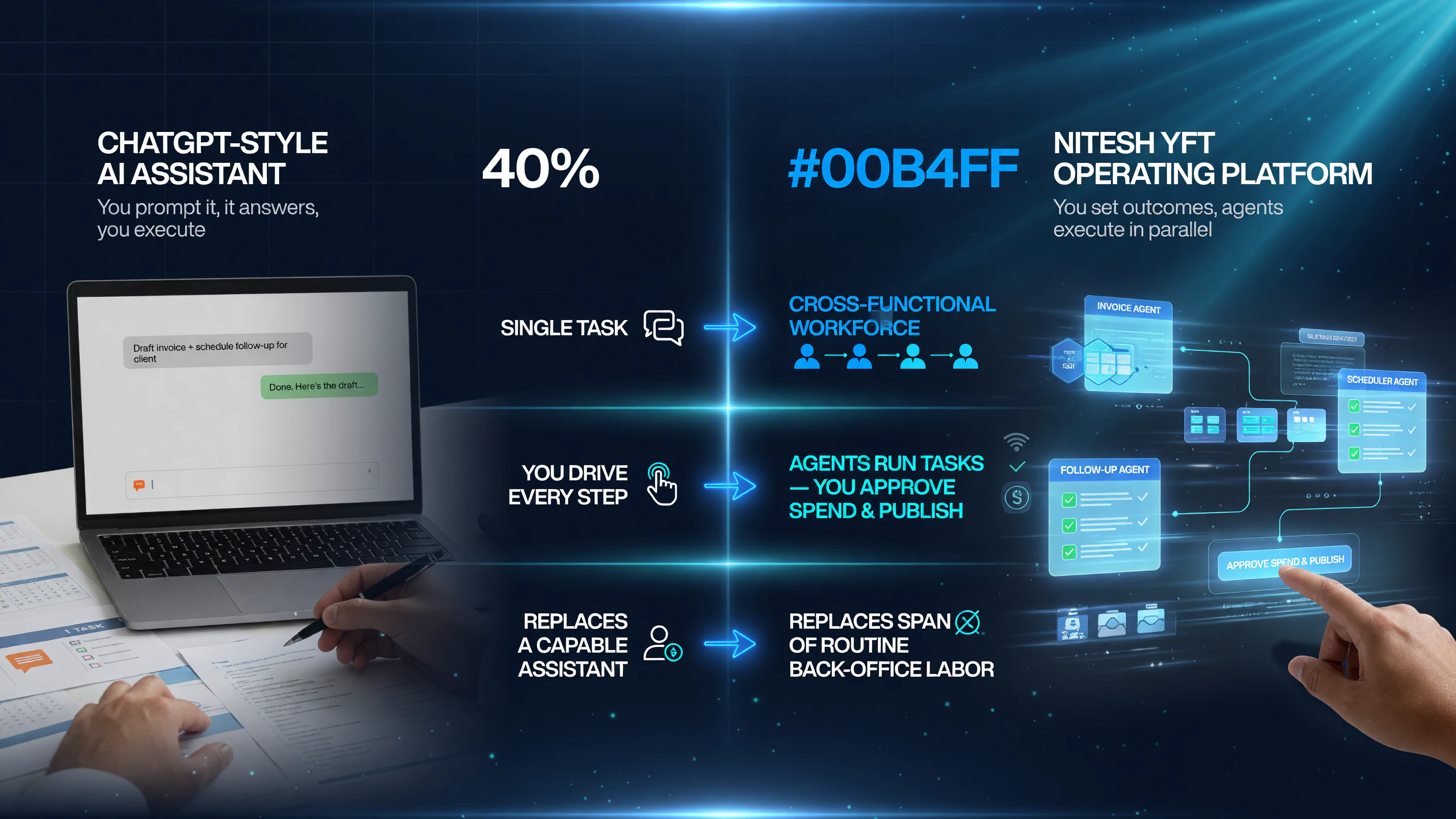
The core difference: a chatbot answers and you execute, while NiteShyft positions itself as an operating platform where autonomous agents run routine work in parallel and you approve the spend, published content, and strategic calls.
Cost and Availability Outlook
NiteShyft has not yet announced public pricing. The company has indicated it will release details alongside the October 2026 public launch. Given the claimed cost profile in testing and the tiered approach most business AI platforms take today, owners can reasonably expect plans to scale with the size of the operation and the number of agents or capabilities in use.
For US small businesses, the practical recommendation is straightforward: this is worth putting on your radar, and the October launch is when to evaluate it seriously. Because it is not yet publicly available, there is no hands-on test to run today — which is exactly why the framing of this review is about understanding the model and knowing what to examine when it ships, rather than pretending to have run a live trial of a product that is still behind a waitlist.
What to Watch When Barak Reviews It at Launch
When NiteShyft opens publicly in October 2026, a small business owner should check three specific things before trusting it with real work.
First, verify the autonomy boundaries. Test exactly what slips past the approval gate and what does not. The stated model — agents execute, owner approves spending, publishing, and strategy — is only valuable if the enforcement is real at every dollar and every published word. Set a low threshold and confirm it holds.
Second, run one real process end to end. Do not evaluate on a demo. Pick a genuine workflow you actually run — a weekly content pipeline, a sales follow-up cadence, a monthly reconciliation — and watch whether the agents complete it without you babysitting each step. That is the true measure of an operating platform.
Third, watch the quality bar on what goes out. Speed and low cost mean nothing if the drafts need so much editing that you might as well have done them yourself. The economics only work if the output is genuinely usable, not just generated quickly.
Final Verdict
NiteShyft is one of the clearest examples yet of where small-business AI is heading: away from assistants you prompt and toward workforces you delegate to, with the owner keeping final say over the decisions that matter. The reported speed and cost numbers are attention-grabbing, and the human-in-the-loop design for spend, publish, and strategy is the right call for independent operators.
It is not yet a product you can use — public launch is October 2026, and pricing is unannounced — so the honest verdict today is cautious optimism. If the October launch delivers even a meaningful fraction of what the private testing claims, with real autonomy boundaries and usable output, this is the shape of the back office for the small business owner who wants the leverage of a team without the payroll. Add it to your shortlist, and judge it on a real workflow the day it goes live.
Frequently Asked Questions
What is NiteShyft?
NiteShyft is a new AI business operating platform that deploys hundreds of autonomous agents to run tasks across research, marketing, content, sales, finance, and operations. It was announced September 9, 2026, with a public launch planned for October 2026.
Is NiteShyft just another AI chatbot?
No. The distinction is delegation: instead of asking a chatbot to answer and then doing the work yourself, NiteShyft’s agents execute tasks in parallel across multiple business functions, with the owner approving high-stakes actions like spending, publishing, and strategy changes.
How much does NiteShyft cost?
Pricing has not yet been announced. NiteShyft has said details will accompany its public launch in October 2026, and plans will likely scale with business size and agent usage.
When can I try NiteShyft?
NiteShyft is in a pre-launch waitlist phase with more than 2,800 businesses from 45+ countries. Public launch is expected in October 2026.
Is NiteShyft safe to let run my business tasks?
The platform is designed so the owner approves spending, publishing, and strategic changes, keeping human control over high-stakes actions. As with any AI tool handling real work, you should verify the autonomy boundaries in practice once it launches.

About Barak Schurr
Barak Schurr built and sold a major ticketing platform, ran global nightlife operations at Eventbrite, and now spends his time figuring out which AI tools actually move the needle for independent business owners — and which ones are just noise. No hype. No fluff. Just what works.
Email: [email protected]
More AI Resources for Your Business