Get The Solo Business OS — Free
The AI workflow that replaces a part-time employee for solo operators and small business owners.
ZeroClick Review 2026: How Small Businesses Sell to AI Agents
⚡ Expert Summary: ZeroClick turns any existing API or digital product into something AI agents can find, buy, and pay for — without rebuilding your stack. It costs $0 to set up, $0 per month, and takes 5% of agent transactions only when agents actually buy, with revenue settling to your own Stripe account. For most US small business owners, the honest verdict is this: it is not your tool yet, but it is the clearest early warning of how software gets purchased in 2027.
Here is a sentence that sounds like science fiction and is instead a line item on a real company’s dashboard: the next visitor to your website may not be a person. It may be an AI agent shopping on behalf of someone else — reading your pricing page, comparing you against three competitors, and either buying or leaving without you ever seeing a name in your analytics.
That is the market ZeroClick is built for. The company raised $55 million, sells a platform that makes any product purchasable by AI agents, and charges nothing until agents actually buy. It is a genuinely new category, and for a US small business owner in 2026 the useful question is not “should I sign up” but “what does this tell me about where buying is going.”
What ZeroClick Actually Does
Strip away the category language and ZeroClick does one job: it sits in front of your existing API as a paid proxy.
An AI agent sends the exact same request it would have sent you. ZeroClick intercepts it, prices it, collects the money, forwards the request to your server with a signature attached, and lets you serve the response. You keep your API, your pricing, and your customer relationship. ZeroClick handles the identity, payment, and proxy layer in front of it.
The only change on your side is a small “billing guard” — a snippet that verifies ZeroClick’s signature, checks the buyer’s allowance, does the work, and reports usage. With the official SDK that is one call plus one usage helper. Without it, it is two plain HTTP calls, one signature check, and three fixed response bodies.
For a small business, that distinction matters. This is not a migration. It is not a platform rebuild. It is a proxy layer bolted onto something you already run.
The Real Numbers: What It Costs and What It Claims
Pricing is refreshingly simple, and it is the strongest part of the pitch. ZeroClick charges a $0 setup fee, no monthly platform fee, and 5% of agent-transaction revenue that runs through your storefront. If agents never buy, you never pay. There is no seat license, no tiered plan, no “contact sales for enterprise pricing” wall.
| Cost Item | What ZeroClick Charges | What It Means for a Small Business |
|---|---|---|
| Setup fee | $0 | No capital risk to test whether agents buy from you |
| Monthly platform fee | $0 | Does not add to your existing software stack cost |
| Commission on agent sales | 5% of agent-transaction revenue | Only applies to agent purchases, never to your existing channels |
| Card payment minimum | $0.50 per charge | Card rails suit credits and plans, not one-cent lookups |
| Where the money lands | Your connected Stripe account | No crypto wallet required at any point |
The market data ZeroClick publishes is where the pitch gets loud. The company points to 100 million-plus settled transactions across the x402 and MPP payment rails, a projected $1.5 trillion in agentic commerce volume, and a claim that more than 57% of web traffic is now agentic.
Treat those numbers as directional, not settled. They describe a market that is forming, and ZeroClick itself states plainly that it does not guarantee any seller revenue. That honesty is worth noting — it is rare in a category where everyone is racing to declare the future already arrived.
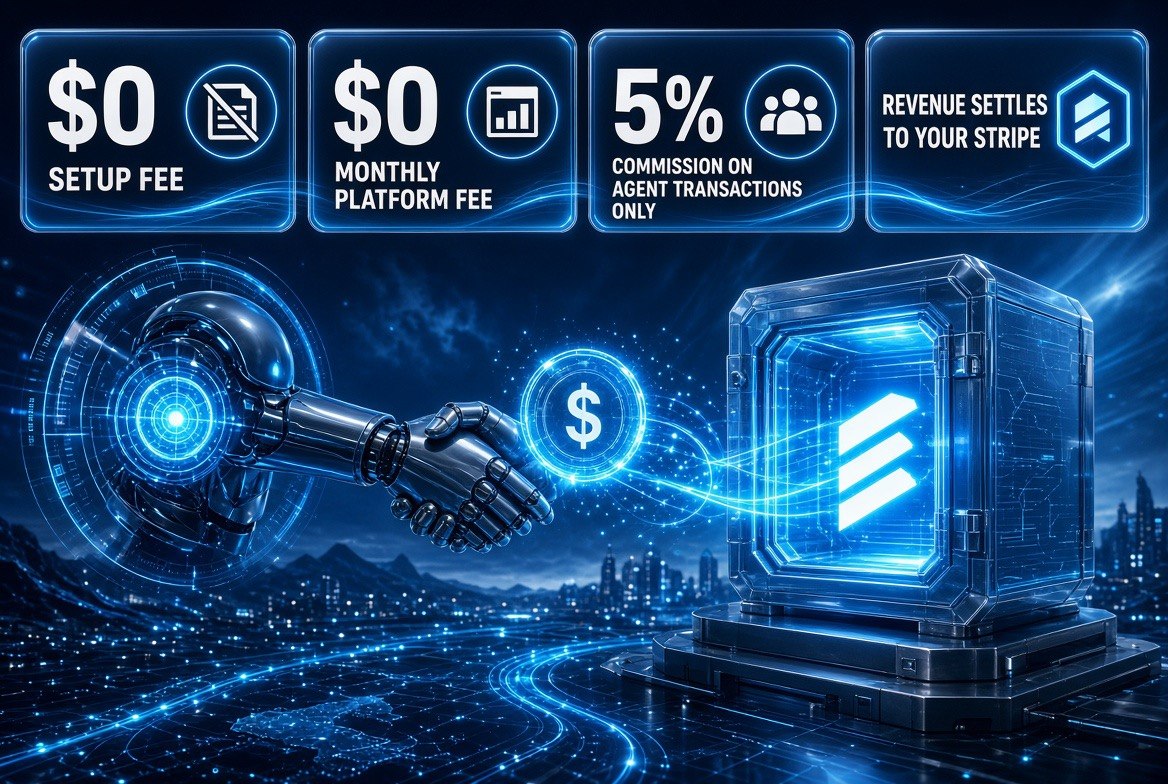
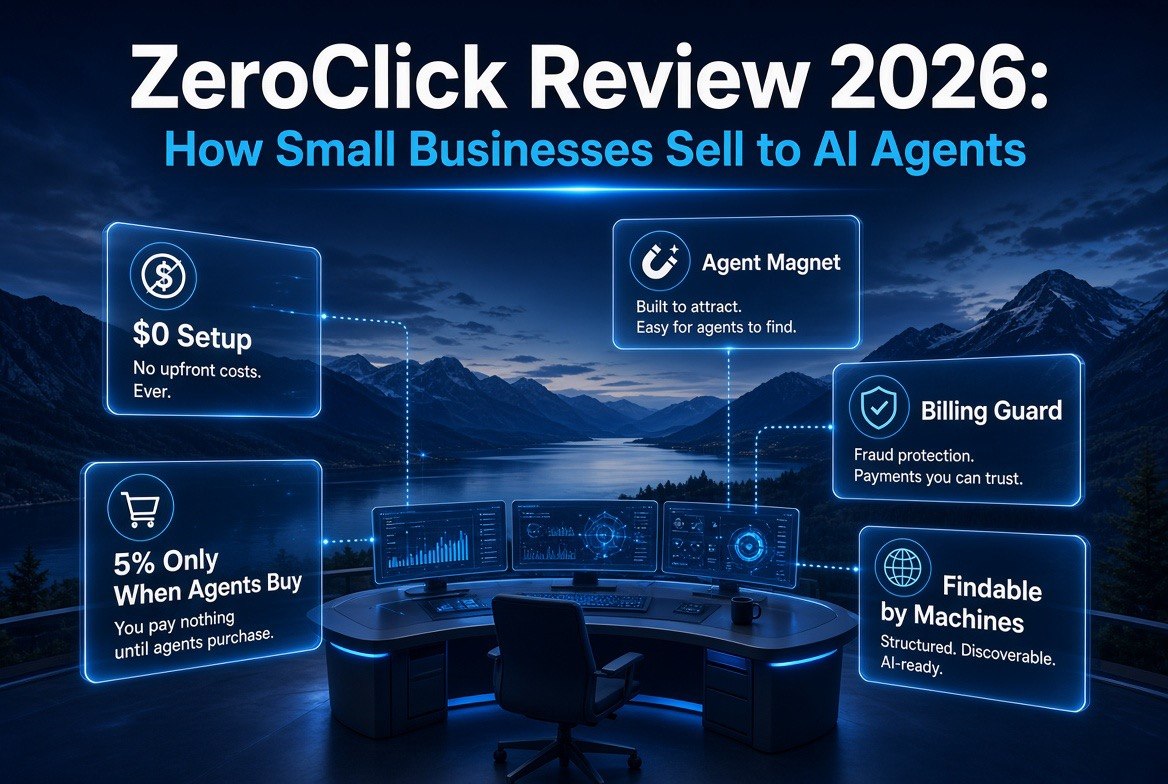
ZeroClick charges nothing to set up and nothing monthly — the 5% only applies when an AI agent actually completes a purchase, and revenue settles straight into the seller’s own Stripe account.
How AI Agents Find You: The Discovery Problem
Here is the part most small business owners have never thought about, and it is the part that should worry you.
Agents do not browse the way people browse. They do not run your JavaScript, they do not admire your hero image, and they do not scroll past your cookie banner. Many of them read your site as raw HTML, if they read it at all.
That means a meaningful share of the traffic arriving at your site in 2026 may be unable to understand what you sell, because your site was built for human eyes only.
ZeroClick addresses this with what it calls an Agent Magnet — a set of signals that route agents to a machine-readable storefront. Those signals include head tags, an agent callout, an entry in your llms.txt file, markdown served to agent fetchers, a Link header, and a badge.
| Discovery Signal | Which Agent Type It Reaches | Without It |
|---|---|---|
| llms.txt entry + Link header | Raw HTTP clients that fetch and parse text | Agent finds no machine-readable product listing |
| Negotiated markdown + callout text | Fetchers that convert HTML to markdown | Agent sees a page but no purchasable path |
| Head tags + badge | DOM-parsing agents running full render | Agent renders the page and still cannot transact |
| Index listings | Agents searching x402scan, mppscan, agentic.market | You are invisible in agent marketplaces entirely |
Each signal is stamped, so the storefront records which one routed each agent. That is genuinely useful analytics, and it is the kind of infrastructure thinking that separates a serious product from a demo.
ZeroClick lists storefronts on x402scan, mppscan, agentic.market, and zero.xyz once they go live. It recommends running the storefront on a subdomain you own, since listings point at the storefront’s address and agents behave more reliably with domains they recognize.
How Payments Actually Work for Agents
This is where a normal business owner’s eyes glaze over, so let us keep it concrete.
Agents pay per request, or they buy credits or a subscription. The rails are USDC over x402 on Base, MPP (Machine Payments Protocol) on Tempo, or a card as shared payment tokens over MPP. You get paid in fiat. Revenue settles to the bank account you connect during Stripe onboarding. You never run a crypto wallet.
Each paid call is two round trips. The agent’s first request gets a priced HTTP 402 response with the exact amount. The agent pays, retries, and ZeroClick forwards the signed request to your API.
An agent that arrives without a payment method can set one up on the spot, or hand its human a checkout page hosted by Stripe. A failed delivery debits nothing, and card payments refund automatically in full. Card charges carry a $0.50 minimum, which is why cards suit credits and plans rather than one-cent lookups.
A pre-existing Stripe account is not required, and which payment rails you get depends on where your business is established.
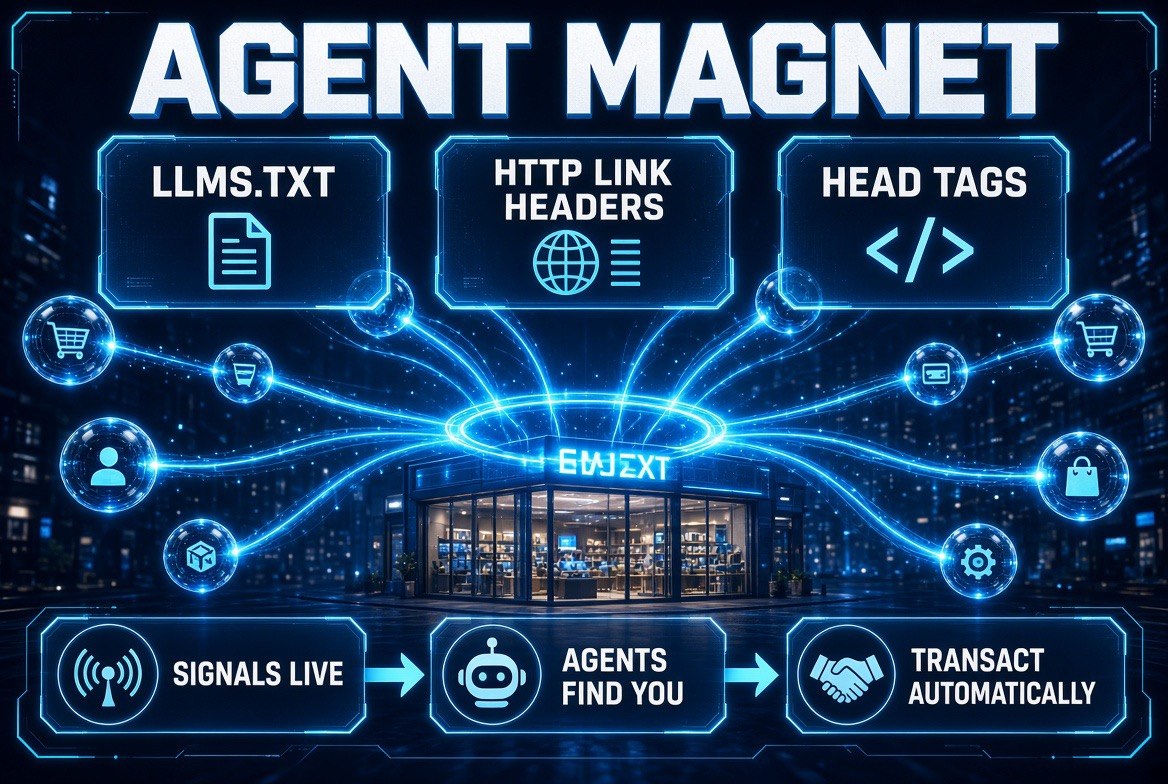
The Agent Magnet setup publishes three machine-readable signals — llms.txt, HTTP Link headers, and head tags — so shopping agents can find the catalog, read the terms, and complete a purchase with no human in the loop.
Who This Is Actually For — And Who It Is Not For
This is the section most reviews skip, and it is the only one that matters for a small business owner deciding whether to care.
ZeroClick fits you if you sell something delivered over an API that an agent can pay for per use or per plan. Data and enrichment lookups, market and publisher data, image generation, model inference, commerce data, specialized inference, real-world tasks, and software features all qualify. If you already sell API access, ZeroClick is a new sales channel that costs nothing until it produces revenue.
ZeroClick does not fit you yet if you sell physical products, run a service business, or make your money from human-delivered work. A plumber cannot have a billing guard bolted onto a van. A restaurant cannot proxy a burger through an HTTP 402 challenge. If your revenue comes from humans buying human things, this platform is not your tool in 2026, and anyone telling you otherwise is selling a category rather than a product.
There is one exception worth knowing. ZeroClick supports free actions as $0 transactions served to identified agents — booking a demo, capturing a lead, delivering a white paper, registering someone for a webinar. For a service business, the realistic play today is not selling through agents but being findable by them, so that when an agent researches your category on behalf of a buyer, your business shows up with clean, machine-readable information.
The strategic read: you do not need to sell to agents in 2026. You do need to not be invisible to them. Those are different decisions, and only one of them costs money.
How Long It Takes to Go Live
ZeroClick builds the storefront from your API reference and pricing. Your side is four dashboard wizard steps: custom domain, billing guard, agent traffic, and Stripe onboarding.
The documentation targets a first paid agent request in about ten minutes once the store is configured. ActionLayer, a live seller, says its side of the integration took a day. Timelines stretch when a backend needs rework — unusual routing, or products that provision accounts.
The storefront stays closed to orders until ZeroClick verifies that your guard answers with a correctly priced 402 response. Nothing sells until the plumbing is proven, which is the right order of operations for anyone who has ever shipped a broken checkout on a Friday.
Selling accounts, API keys, subscriptions, or credit balances is a separate, additive integration that ZeroClick sets up with you during onboarding. You build one HTTPS endpoint that provisions the account and mints the key, and ZeroClick hands the key to the buyer without storing it.

The ZeroClick go-live path runs four steps — connect Stripe, publish the Agent Magnet files, list products with structured data, and flip it live. No developer and no invoice; the whole setup is minutes, not weeks.
What Small Business Owners Should Do Right Now
You do not have to adopt this platform to learn from it. Three things are worth doing this month, in order of cost.
First, check whether your site is readable at all. Fetch a page as a text-only client and see what arrives. If an agent cannot parse what you sell and what it costs, you are invisible to a growing share of buyers — and fixing that costs nothing.
Second, decide which category you are in. If you sell digital services delivered over an API, book a walkthrough and see whether a storefront is worth a day of setup. If you sell physical goods or human services, put this down and revisit in six months.
Third, watch the pricing page, not the press coverage. A 5% take rate with zero fixed cost is a bet you can evaluate on your own numbers. If agents never buy, your cost is genuinely zero. That is an unusually good risk profile for testing a new channel, and it is the single best reason to keep ZeroClick on your radar rather than dismiss it as hype.
If you run anything in the AI tool stack, the deeper point is this: the discovery and purchase layer of the web is being rebuilt for machines, and the businesses that adapt their product information early will be found first. Read our breakdown of how AI tools are reshaping small business operations for the broader picture.
Frequently Asked Questions
What is ZeroClick and what does it do?
ZeroClick is a platform that makes any API or digital service purchasable by AI agents. It places a hosted, machine-readable Agent Storefront in front of your existing API, prices each request, collects payment through x402, MPP, or card, and forwards the signed request to your server. Revenue settles to your connected Stripe account.
How much does ZeroClick cost?
ZeroClick charges a $0 setup fee, no monthly platform fee, and 5% of agent-transaction revenue that runs through your storefront. The 5% applies only to payments made by AI agents through your storefront. Revenue from your existing sales channels is unaffected, and there is no charge if agents never buy.
Do I need to rebuild my API to sell to AI agents?
No. ZeroClick runs as a transparent paid proxy in front of your existing API. The agent sends the same request it would have sent you. The only change on your side is a small billing guard that verifies ZeroClick’s signature, checks the buyer’s allowance, serves the request, and reports usage. Official SDKs exist for TypeScript, Python, Go, and Ruby.
Is ZeroClick worth it for a small business owner?
Only if you sell something delivered over an API that an agent can pay for per use or per plan. If you sell physical products or human-delivered services, it is not your tool yet. Service businesses can still use the free-action feature — like demo booking and lead capture — as $0 transactions, but the primary value today is being findable rather than transacting.
How do AI agents find my storefront on ZeroClick?
Agents find a ZeroClick storefront three ways: your website routes visiting agents to it through the Agent Magnet (head tags, an agent callout, an llms.txt entry, markdown for agent fetchers, a Link header, and a badge); the storefront publishes machine-readable files agents read directly; and ZeroClick lists it on agent indexes including x402scan, mppscan, agentic.market, and zero.xyz.
Do I need a crypto wallet to get paid by AI agents?
No. Agents pay using USDC over x402 on Base, MPP on Tempo, or a card as shared payment tokens over MPP. You receive fiat, and revenue settles to the bank account you add during Stripe onboarding. You never run a crypto wallet yourself.

About Barak Schurr
Barak Schurr built and sold a major ticketing platform, ran global nightlife operations at Eventbrite, and now spends his time figuring out which AI tools actually move the needle for independent business owners — and which ones are just noise. No hype. No fluff. Just what works.
Email: [email protected]
More AI Resources for Your Business