Get The Solo Business OS — Free
The AI workflow that replaces a part-time employee for solo operators and small business owners.
OpenAI and America’s SBDC Just Made Free AI Training Available to Every US Small Business Owner
⚡ Expert Summary: America’s SBDC and OpenAI announced a national partnership to deliver free AI training to US small businesses through the SBDC’s existing network of advisers and locations. For an owner running a lean team, this is the first credible, no-cost path to actually learning what the tools do — and it changes the math on paid consultants. Here is what the partnership covers, what it does not, and how to use it without wasting the hours you do not have.
Most small business owners have already tried ChatGPT. The problem was never access — it was knowing which of the eighty things it can do actually matters for a business with four employees and a thin margin. That is the gap America’s SBDC and OpenAI say they are closing with a nationwide training initiative announced this week.
America’s Small Business Development Centers are not a startup. They are a federally supported network operating through universities, state agencies and local economic development organizations across the United States, offering free and low-cost advising to small businesses. Pairing that distribution with OpenAI’s product knowledge is the part worth paying attention to: training delivered by people who already sit across the desk from owners, not by a vendor’s sales team.
What OpenAI and America’s SBDC Actually Announced
The partnership brings AI training to small businesses nationwide through the SBDC network. In practice that means workshops, advising sessions and educational programming delivered through local SBDC offices, where an owner can already get help with a business plan, cash flow forecasting or loan preparation at no cost.
The significance is distribution. OpenAI does not need to build a training organization from scratch — the SBDC network already exists in every state, already has adviser relationships, and already has the trust of owners who are skeptical of anything that looks like a tech pitch. That is a genuinely different channel from a webinar or a YouTube tutorial.
For a US owner, the practical question is not whether this exists but whether it is worth a few hours. The honest answer depends on where you already sit.
| What the partnership covers | What it does not cover |
|---|---|
| Introductory and applied AI training sessions | Custom internal automation built for your business |
| Access through existing local SBDC offices | Software licences or paid OpenAI plans |
| No-cost access for participating businesses | Guaranteed results or measurable ROI |
| Guidance on practical, everyday use cases | Replacement for a consultant on a specific project |
Note what sits in the right column. Training is not transformation. A workshop teaches you what the tool can do; it does not wire the tool into your order intake, your quoting process or your follow-up sequence. Owners who expect the second thing from the first will be disappointed — and the disappointment will be their fault, not the program’s.
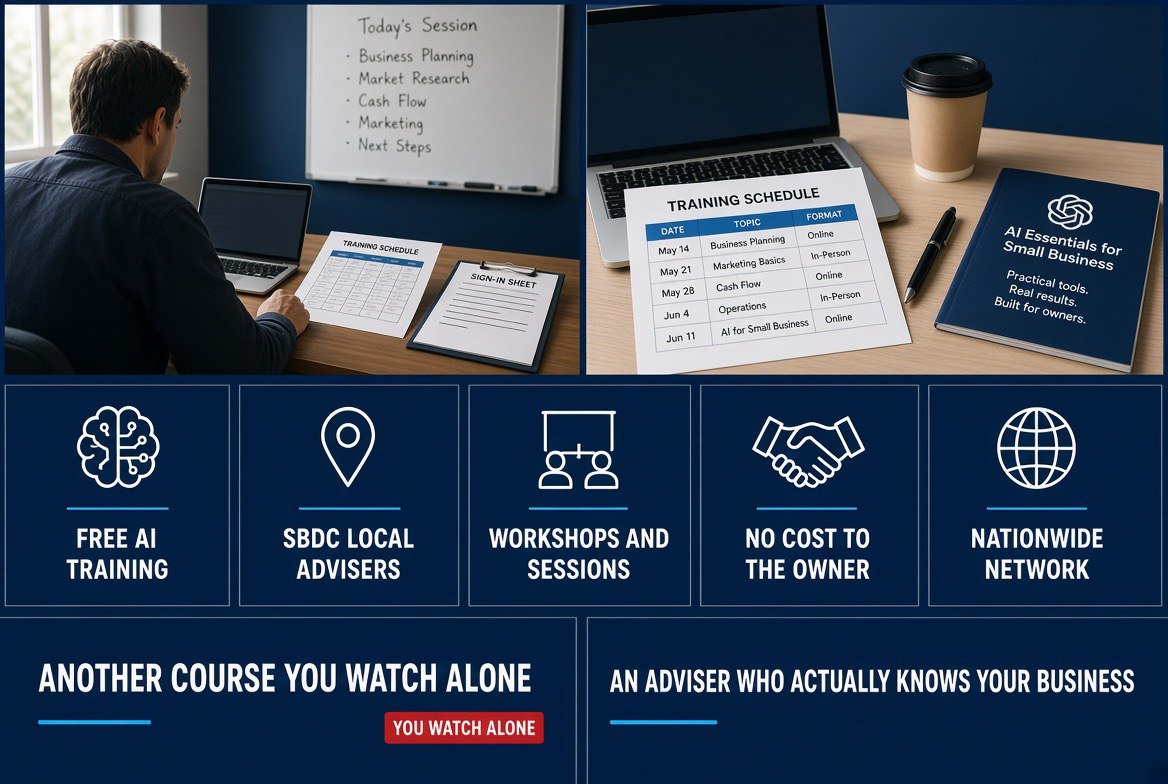
What the partnership actually looks like on the ground: an owner at a local adviser’s desk with a laptop open and a training schedule on the table — the difference between watching a course alone and getting help from someone who knows your business.
Why This Matters More Than Another AI Course
The market is drowning in AI education. Paid cohorts, template packs, gated communities, and a near-infinite supply of people selling the same twelve prompts. What almost none of them have is a physical, local presence that an owner already trusts and can walk into.
SBDC advisers sit on the operational side of the table. They help with working capital, hiring plans, and expansion decisions. When those same advisers start teaching AI, the framing changes — it stops being a technology topic and becomes a business operations topic. That is the correct frame for a small business.
There is also a competitive argument that owners tend to underrate. Larger competitors have already been adopting these tools internally for two years: faster proposals, quicker content, tighter customer response. A free national training program narrows that gap for owners who show up. Owners who do not show up widen it.
| Factor | SBDC & OpenAI training | Paid AI course or consultant |
|---|---|---|
| Cost | No cost to the business | Typically hundreds to thousands of dollars |
| Delivery | Local offices and established advisers | Online, or an external contractor |
| Depth | Broad, introductory to applied | Deep on one narrow problem |
| Builds your system | No — you implement | Sometimes, at a price |
| Best for | Owners starting from zero | Owners with a defined, stubborn problem |
The correct read of that table is not “free beats paid.” It is that free training solves the first problem — knowing what is possible — and paid help solves the second, which is building the thing. Most owners who struggle with AI are stuck on the first and mistakenly buy the second.
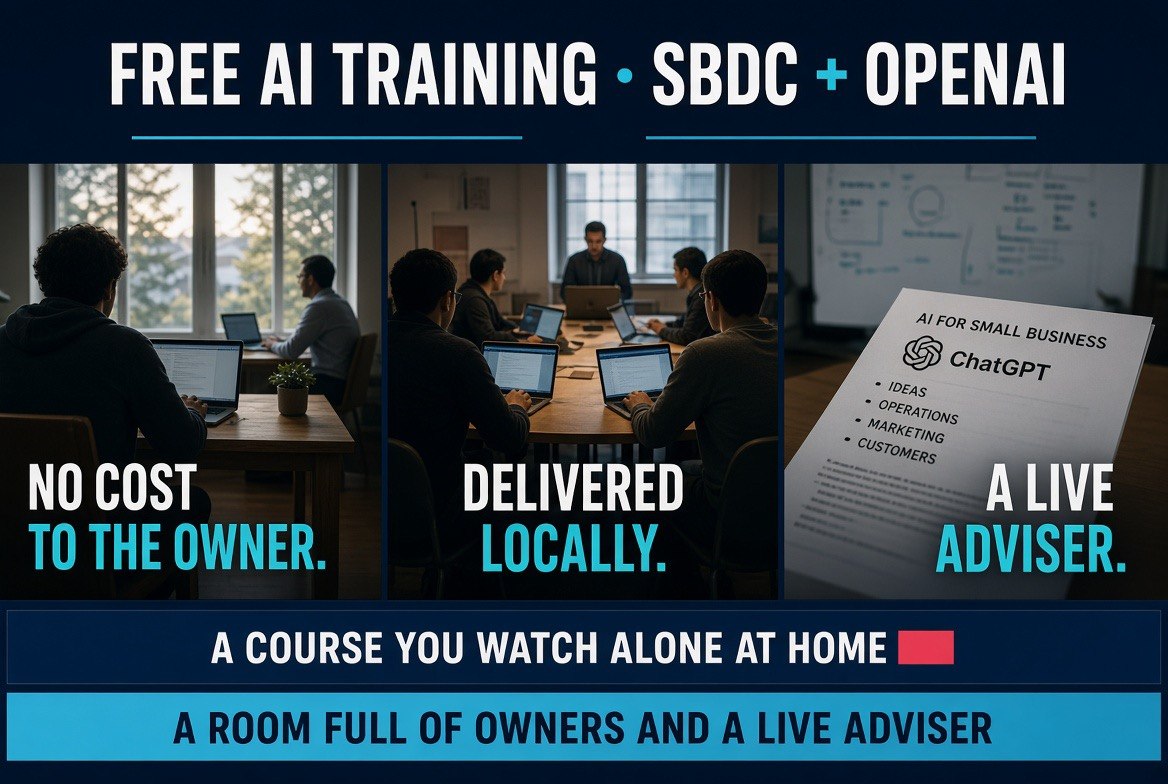
Three columns, one programme: no cost to the owner, delivered locally through SBDC advisers, with a live adviser who actually knows your business — the difference between a course you watch alone at home and a room full of owners.
What an Owner Should Actually Do With This
Three steps, in order, and none of them require a budget.
First, audit your own week before you attend anything. Write down the four tasks that consume the most time and produce the least value. Quoting, invoicing follow-up, content for the site, first-draft replies to enquiries — the list is usually similar across trades. Bring that list with you. Training becomes useful the moment it attaches to a real task you already hate.
Second, go with one task, not a curiosity. The failure mode at any free workshop is collecting ten interesting tools and implementing none. Pick the single highest-hour task on your list, learn the tool for that task, and build it that week. One implemented workflow beats ten understood ones.
Third, measure the hours you get back. Before you start, put a number on how long the task takes per week. Two weeks later, put the number again. If it has not moved, the implementation is wrong, not the tool.
That discipline is what separates owners who get compounding value from these tools and owners who collect subscriptions. The training programme lowers the barrier to entry; it does not lower the bar for effort.
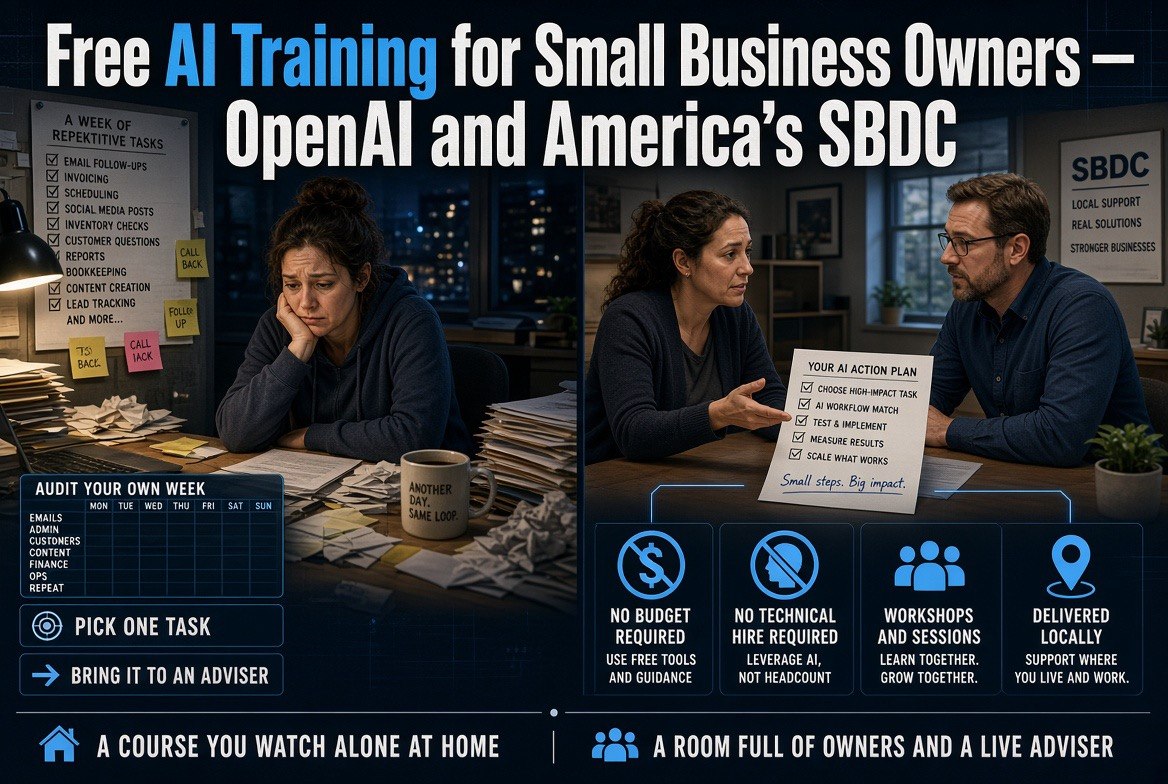
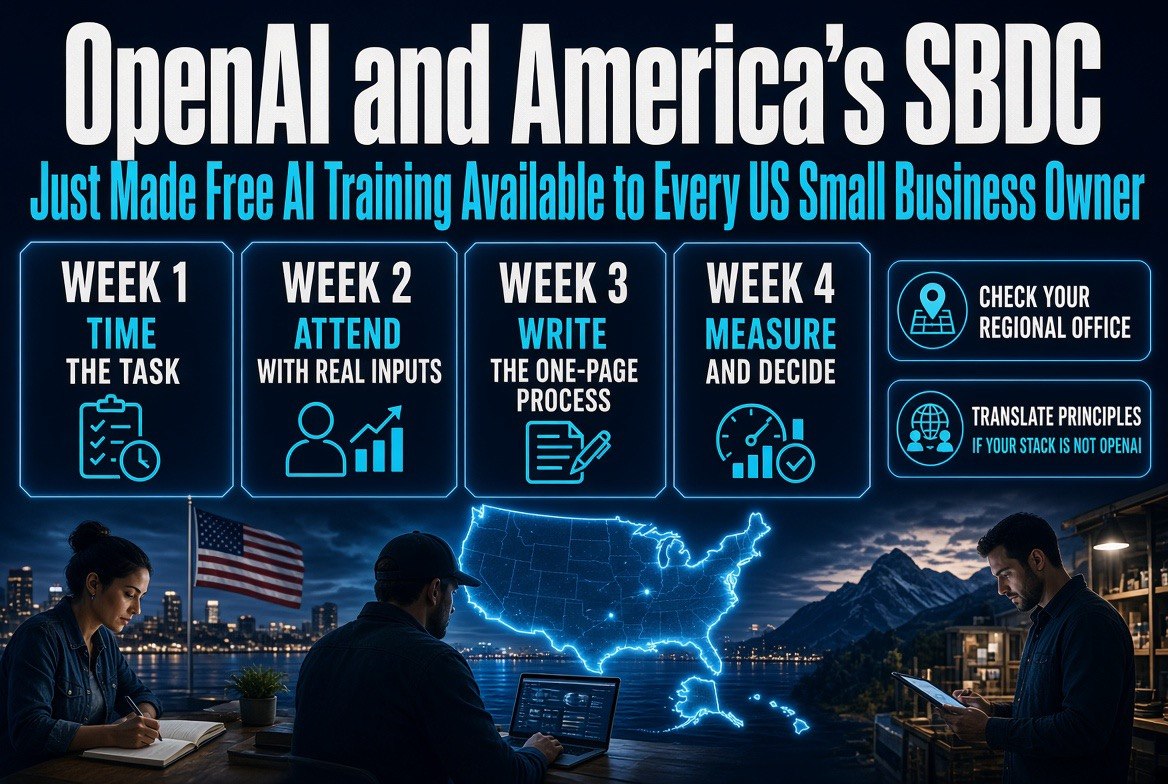
The first month, laid out plainly: audit where your week actually goes, choose one repetitive task, run it as a small workflow, then test, measure and scale only what works — no budget and no technical hire.
The Limits You Should Be Honest About
Two caveats worth stating plainly. First, this is an OpenAI partnership, so the training will centre on OpenAI’s products. That is not a conspiracy, it is how vendor partnerships work — but if your stack runs on something else, translate the principles rather than assuming the specific tool is the only answer.
Second, a national rollout does not arrive everywhere on the same day. Availability will vary by state and by local SBDC capacity. Check your regional SBDC office for what is scheduled near you rather than waiting for an announcement that may already have passed through your area.
Neither caveat changes the core value. Free, locally delivered, adviser-led training for small businesses is a genuinely useful development for any owner who has been meaning to get serious about AI and has not found the on-ramp.
What Free AI Literacy Is Actually Worth to a Small Business
Put a number on the alternative. A half-day workshop with a private AI consultant for a small team commonly runs into the high hundreds or low thousands of dollars, before any implementation. A paid course subscription adds a monthly cost on top. The SBDC programme removes that line item entirely, which matters most to the businesses that are furthest behind — the ones least able to gamble a few thousand dollars on training that may not apply to them.
That is the real shift. AI literacy used to be a purchase decision. Now it is an appointment. For an owner who has been circling the topic for eighteen months without acting, the barrier is no longer budget. It is an hour in a calendar.
Where Owners Usually Get Stuck
Three failure patterns show up repeatedly, and none of them are about intelligence or technical skill.
The blank prompt problem. An owner opens the tool, stares at an empty box, types something vague, gets something useless, and concludes the tool does not work. The fix is not a better tool — it is bringing a specific, real, ugly task and pasting in the actual context. Training solves this quickly because the trainer can see the vague request and show the specific one beside it.
The subscription graveyard. Owners buy three tools, use one twice, and cancel nothing. Each tool looks individually cheap. The aggregate is several hundred dollars a month funding shelfware. Working backwards from a task list, rather than forwards from an advertisement, is the only reliable cure.
The delegation gap. The owner learns the tool, then hands it to a team member with no written process. Quality collapses, the team resists, and the owner concludes AI does not scale in a small business. What did not scale was the undocumented process.
A local adviser who has watched hundreds of small businesses make the same three mistakes is worth more than another hour of product demonstration. That is the specific advantage the SBDC network brings to this partnership.
A Realistic First Month
What follows is a plain sequence an owner can run without a budget or a technical hire.
Week one — pick one task and instrument it. Choose the single most repetitive, time-consuming task you personally perform. Time it for five days and write the number down. Do not open an AI tool yet.
Week two — attend a session with that task in hand. Bring the actual inputs: the real enquiry, the real invoice template, the real product description. Ask the adviser to solve your specific case rather than demonstrate a generic one.
Week three — build the workflow and write it down. One page, numbered steps, including what the tool should never be trusted to do unsupervised. This page is the asset. The tool is replaceable; the process is not.
Week four — measure and decide. Re-time the task. If hours came back, keep the workflow and extend it to one more task. If nothing moved, change the approach before adding another tool.
Owners who run this loop four times in a year end up with four working workflows and a clear picture of where the technology genuinely fits their business. Owners who attend ten workshops and implement none end up where they started, minus the time.
Frequently Asked Questions
Is the SBDC and OpenAI AI training really free?
Yes — the training is delivered through the America’s SBDC network at no cost to participating small businesses. You are not required to buy an OpenAI subscription to attend.
Do I need any technical background to benefit?
No. The program is designed for owners and operators, not developers, and is framed around practical business tasks rather than technical implementation.
How do I find training in my area?
Contact your regional America’s SBDC office directly. Availability and scheduling vary by state and by local centre capacity, so the local office is the accurate source.
Will this replace hiring an AI consultant?
Not entirely. It gives you the literacy to know what is possible and to judge whether a proposed project is worth the money. For building a specific custom system, paid help still has a role.
What should I bring to a session?
A list of the four tasks that consume the most time in your business. Training attaches to specific problems; it does not stick when it is abstract.

About Barak Schurr
Barak Schurr built and sold a major ticketing platform, ran global nightlife operations at Eventbrite, and now spends his time figuring out which AI tools actually move the needle for independent business owners — and which ones are just noise. No hype. No fluff. Just what works.
Email: [email protected]
More AI Resources for Your Business