AI Agents Are Getting Blocked at the Front Door: What Small Business Owners Should Decide Now
⚡ Expert Summary: Agent traffic is here whether you opt in or not, and the current blocking is chaotic rather than strategic. The businesses that win the next two years will be the ones that decide deliberately which parts of their site agents may use, and set a policy before a customer’s agent fails in the middle of a purchase.
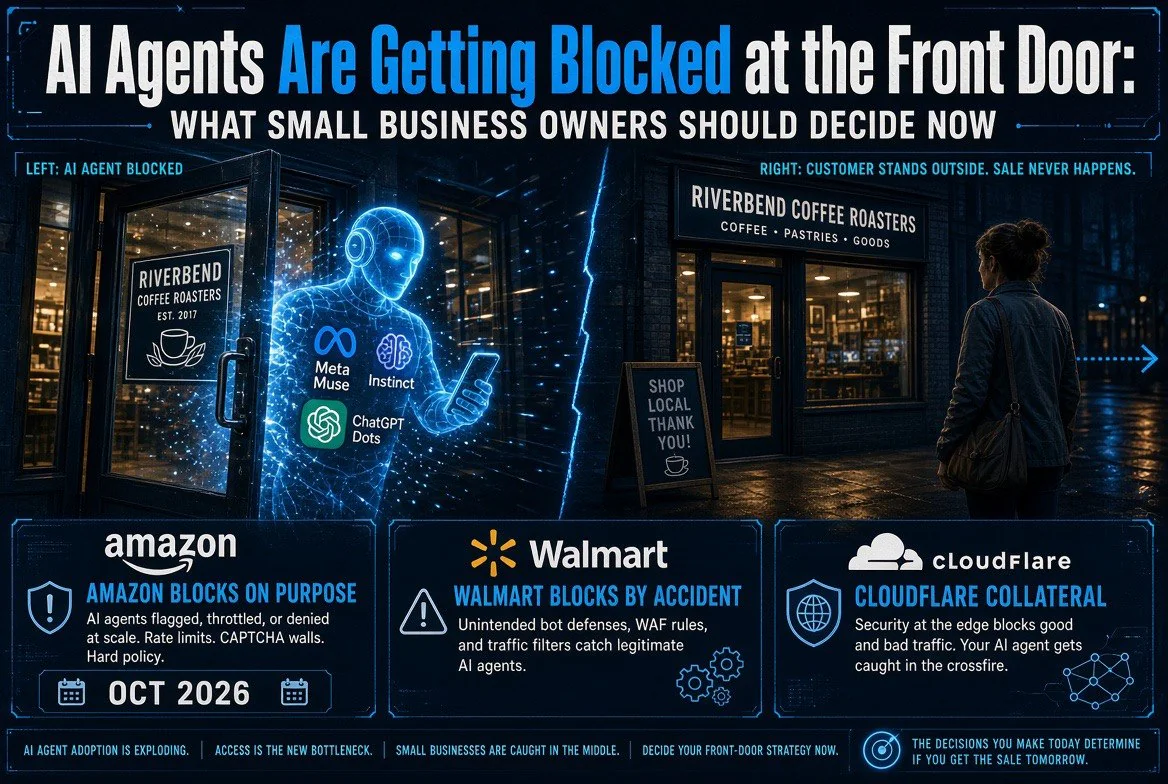
Your next customer may not be a person. It may be Meta’s Muse, Instinct, or ChatGPT’s Dots, an AI agent sitting inside someone’s phone, doing their shopping and their booking for them. That agent arrives at your website the same way a visitor does. And right now, a growing number of websites are slamming the door on it.
Amazon blocks Meta’s Muse on purpose. Walmart blocks it by accident. Airlines, marketplaces and review platforms are refusing agent traffic outright, often without saying so. For a small business owner this is a brand new decision you have never been asked to make: when an AI agent shows up on behalf of a paying customer, do you let it in?
What Actually Happened: The Consumer Agent Wave
For most of the last three years, AI in business has been something you used. You opened a chat window, you typed a prompt, you got an answer. Personal AI agents invert that relationship. The agent acts on your behalf, in the background, on other people’s systems.
Meta’s Muse, Instinct and OpenAI’s ChatGPT Dots are the leading consumer examples. They book flights, order groceries, reserve tables and make purchases. Because they operate on a consumer’s instruction, the person on the other end of the transaction is a real, paying customer. The agent is simply their hands.
That is where the trouble starts. When an agent tries to complete a purchase, the destination website often blocks it. TechCrunch documented the pattern in October 2026, and the list of brands reportedly affected includes Yelp, eBay, Zillow, Pizza Hut, Adidas and several airlines. eBay went as far as suspending some accounts over agentic AI use. Google reportedly kicked Instinct out of a user’s Gmail while it was cleaning their inbox.
Three Different Kinds of Blocking — And Only One Is a Decision
Owners tend to treat “the agent got blocked” as one problem. It is three, and they need different responses.
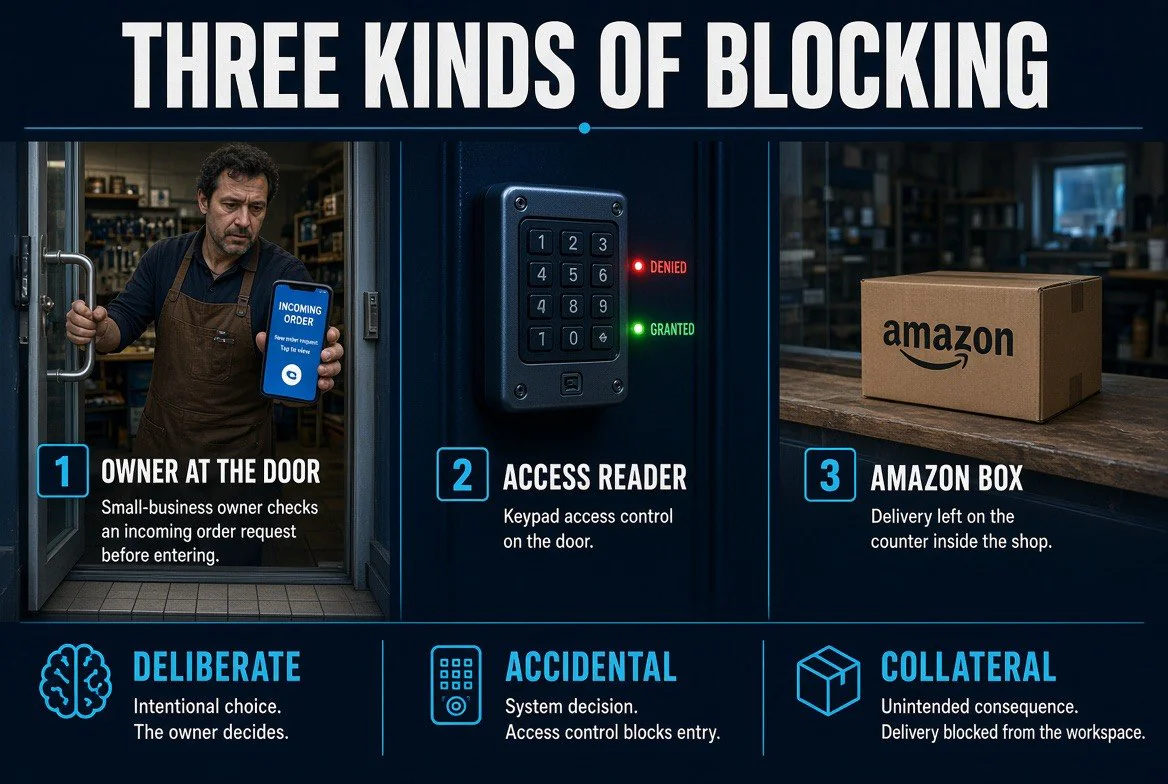
Deliberate blocking is a policy choice. Amazon is the clearest case: it decided Muse could not browse or buy from its catalogue. Delta told reporters it protects customers from unauthorised automated activity and would only open up with “security and the customer experience in mind.” United pointed to terms of use prohibiting automated devices without written permission.
Accidental blocking is the embarrassing one. Walmart is a Muse launch partner and publicly says it wants to be where its customers are. Yet customers complained Muse could not complete a Walmart purchase. The cause was Walmart’s own human-verification step: the site presents a button that must be clicked to prove the visitor is human, and when the agent’s session is interrupted, the check fails and the agent gets booted. A partner, blocking its own partner, by accident.
Collateral blocking is the biggest category and the one nobody controls. Traditional anti-bot defences exist to stop spam and scraping. They do not distinguish between a scraper and a personal agent acting for a customer. Cloudflare changed crawler defaults on 15 September 2026, which allowed site owners to block AI training while permitting other bots. Existing sites previously set to block AI bots for security reasons were shifted into blocking AI agents on any page carrying ads. Several observers blamed that change for the Muse failures, though Cloudflare said it had no specific data to share. That distinction matters: this is suspicion, not a confirmed causal link.
| Block Type | Where You See It | Your Lever | Customer Impact |
|---|---|---|---|
| Deliberate | Amazon, Delta, United, Yelp | Policy and terms — fully yours to set | High. The sale simply never happens |
| Accidental | Walmart human-verification button | Checkout and bot-check flow | High and invisible. Looks like a broken site |
| Collateral | CDN and anti-bot defaults | Your CDN and firewall settings | Variable. Often no error is surfaced |
Why This Hits Small Businesses Hardest
Large retailers can afford to negotiate. Yelp’s position is that it does not permit non-human traffic unless the agent has paid to access Yelp’s content through its data licensing programme. That is a commercial negotiation, and it works at scale.
An independent business has no data licensing department. If a customer’s agent cannot book a table, order a product or check availability, the owner usually finds out never. The customer blames the agent, the agent blames the site, and the owner sees a normal day with slightly fewer conversions and no idea why.
This is the same silent-failure problem that makes AI adoption so difficult for smaller operators. In our guide to automating a small business without code we make the point that automation only pays off when you can see it working. Agent traffic fails the visibility test badly: there is no dashboard line item called “customers turned away by our bot filter.”
What the New Standard Tries to Fix — And Why It Won’t Be Ready in Time
The industry has started responding. Meta, Walmart, Stripe, Sierra, Genesys, Rocket, NiCE and Decagon have begun work on an open standard governing how AI agents communicate with businesses, aimed at separating good bots acting for a user from bad bots acting against the site. The focus is agent-to-agent communication for commerce.
Meta’s framing is blunt and, for a business owner, correct: “Turning away a personal agent means turning away the customer behind it. We’d rather work with businesses to address the underlying concerns than see them lose that customer.”
The problem is timing. Standards take years. Agent traffic is arriving this quarter. Meanwhile Meta maintains a connector list inside the Muse app with named partners, so a partnered agent is welcome and an unpartnered one is not — which means access currently depends on whether your platform happens to be on somebody’s list.
A Decision Framework You Can Apply This Week
You do not need to wait for the standard. You need a policy. Here is the one we recommend to owners.
First, split your site by function, not by fear. Public information — hours, location, menu, service descriptions — has nothing worth protecting. Let agents read it. Logged-in, transactional surfaces — payments, account changes, cancellations — are where mistakes cost money. Keep those human-verified until you have a reason not to.
Second, find out whether you are blocking at all. Ask your hosting provider or CDN what their current bot policy is and whether agent traffic is being filtered. If you run a CDN with a default change in place, you may have started blocking things you never chose to block.
Third, make failure visible. Whatever you decide, you want to know when it breaks. A contact form that silently rejects submissions, a checkout that dies on a bot check, a booking flow that returns nothing — each of these is a revenue leak that looks like nothing at all.
Fourth, write it down. One paragraph in your operations notes: what agents may access, what they may not, who reviews it, and when. That single paragraph puts you ahead of most businesses, and it gives you something to hand a partner or a platform when they ask.
How Agent-Friendly Access Compares
The three broad strategies owners are choosing between are not equal, and the differences show up in who captures the transaction.
| Factor | Block Everything | Allow Everything | Tiered Access |
|---|---|---|---|
| Setup effort | None — it is the default | Low | Medium — a policy and a review |
| Customer agent can buy | Never | Always | On the surfaces you choose |
| Scraping exposure | Lowest | Highest | Contained to public pages |
| Fraud and chargeback risk | Low | Elevated without verification | Managed at the transaction layer |
| Revenue captured from agent users | None | All of it, with the risk | Most of it, with a guardrail |
What to Do About the Cloudflare Question
If you use Cloudflare or a similar CDN, the practical step is not to panic and not to assume. Their public data hub, Cloudflare Radar, shows overall bot activity but cannot separate good bots from bad ones, and Cloudflare itself said it had no specific data on the personal-agent blocking when asked.
So treat it as an audit item rather than a crisis. Log into the dashboard, find the crawler and bot controls, and read what your current settings actually say. Many owners will discover a setting they ticked during a spam scare two years ago that now quietly filters agent traffic. That is a five-minute check with real revenue attached.
Who Is Actually Blocking Agents Right Now
It helps to see the blocking as a spectrum rather than a switch. At one end are companies that have decided, publicly and deliberately. At the other are the businesses that have no idea it is happening to them at all.
The most explicit refusal so far came from Amazon, which stopped Meta’s Muse from browsing or purchasing from its catalogue. Airlines have been almost as firm. Delta told reporters it takes steps to protect customers from unauthorised automated activity, and that any opening to agents would have to be handled with security and customer experience in mind. United pointed to terms of use that prohibit automated devices without prior written permission.
Yelp’s answer is the most commercially interesting. It does not permit non-human traffic unless the agent has paid for access through its data licensing programme, which means agents trying to get a quote, join a waitlist or book a table will simply fail without a formal partnership. That is not a security decision dressed up as policy. It is a pricing decision, and it tells you where this is heading: access will eventually be sold, not argued about.
eBay took a middle path. It says it does not prohibit all third-party shopping agents, but its policies restrict unauthorised agents and actions such as automated scraping and model training. Several users reported account suspensions over agentic AI use, which suggests the distinction is enforced firmly in practice.
Then there is the largest group of all: businesses that are blocking without a decision. Nobody chose it. It arrived as a default, a checkbox, or a side effect of a protection tool doing its job slightly too well.
Why the Blame Usually Lands in the Wrong Place
When a customer’s agent fails, three parties can be blamed and only one of them can see the truth.
The customer blames the agent or the retailer. The agent provider blames the website. The website owner, in most cases, has no idea a request ever arrived, because a blocked automated request typically leaves behind nothing you would notice: no error page, no crash, no support ticket. It is an absence, not an event.
That asymmetry is what makes this expensive. A failed purchase is not a failed purchase in any report you will ever read. It appears as slightly softer traffic, a marginally lower conversion rate, a quiet week. Owners chasing those numbers will usually look at the wrong thing for weeks.
The Practical Audit: Five Checks That Take an Afternoon
None of this requires a developer or a budget. It requires an afternoon and a willingness to look at settings you probably have not opened since setup.
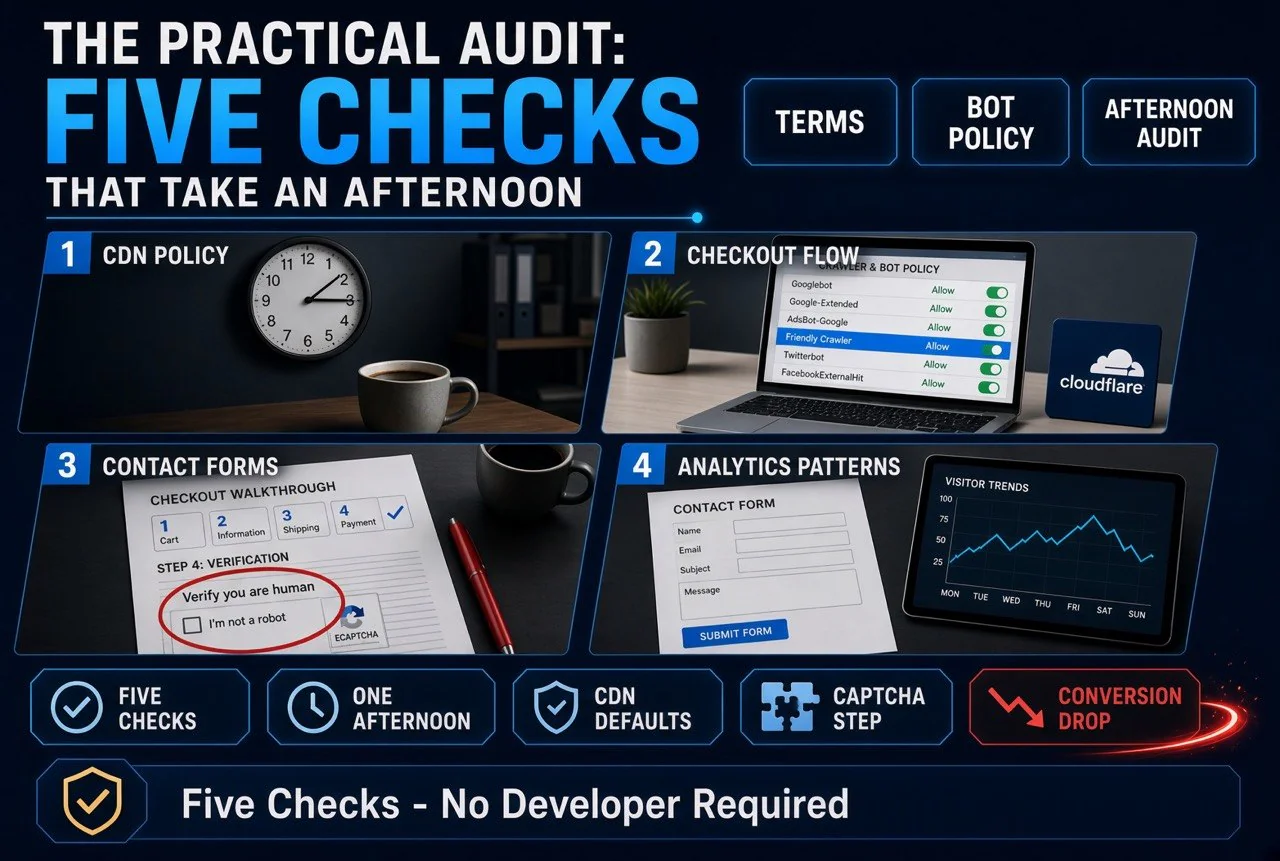
Check one: your CDN’s bot and crawler policy. Log in and read what is actually enabled. If a default changed under you, you will see it here. Anything you did not consciously choose should be treated as suspect until you understand it.
Check two: your checkout and booking flow. Walk through it as a stranger. If there is a human-verification step, a CAPTCHA, or a button that must be pressed to continue, ask what happens when a session is interrupted mid-step. That is exactly the Walmart failure, and it is entirely preventable with a fallback.
Check three: your contact forms. Submit one from an unusual device and see whether it arrives. Form-level spam filtering is one of the most common accidental blockers and one of the least monitored.
Check four: your analytics for odd patterns. A sudden drop in mobile conversions with steady traffic, or a rise in sessions that end at the same page, can be a filter doing something you did not intend.
Check five: your terms and your policy. Decide what you permit and write it down. If you have no position on automated traffic, you are in exactly the position a customer’s agent will discover by failing.
What Good Looks Like: A Tiered Access Policy
The practical answer most independents will land on is a tiered policy, and it is worth stating plainly because it is the piece owners usually skip.
Public-facing content should be open. Hours, location, services, pricing, availability summaries and product descriptions have nothing worth protecting and everything to gain from being readable by an agent acting for a customer. Restricting them protects nothing and costs you reach.
Transaction surfaces should be verified but not blocked. The goal is not to refuse an agent but to confirm that a real, authorised person stands behind the transaction. That is a verification problem, not a blocking problem, and getting it right keeps revenue you would otherwise never see.
Account and data surfaces should stay human-only until the standard arrives. Password changes, personal data exports, payment method edits and cancellation flows carry risk that no current framework prices correctly.
Finally, write the review date. Agent technology is moving faster than policy cycles. A policy with no review date becomes a setting nobody remembers, which is exactly how the current mess started.
How the Two Commercial Models Compare
Yelp’s licensing answer and Meta’s partnership answer are two versions of the same idea, and the difference matters for anyone negotiating access in future.
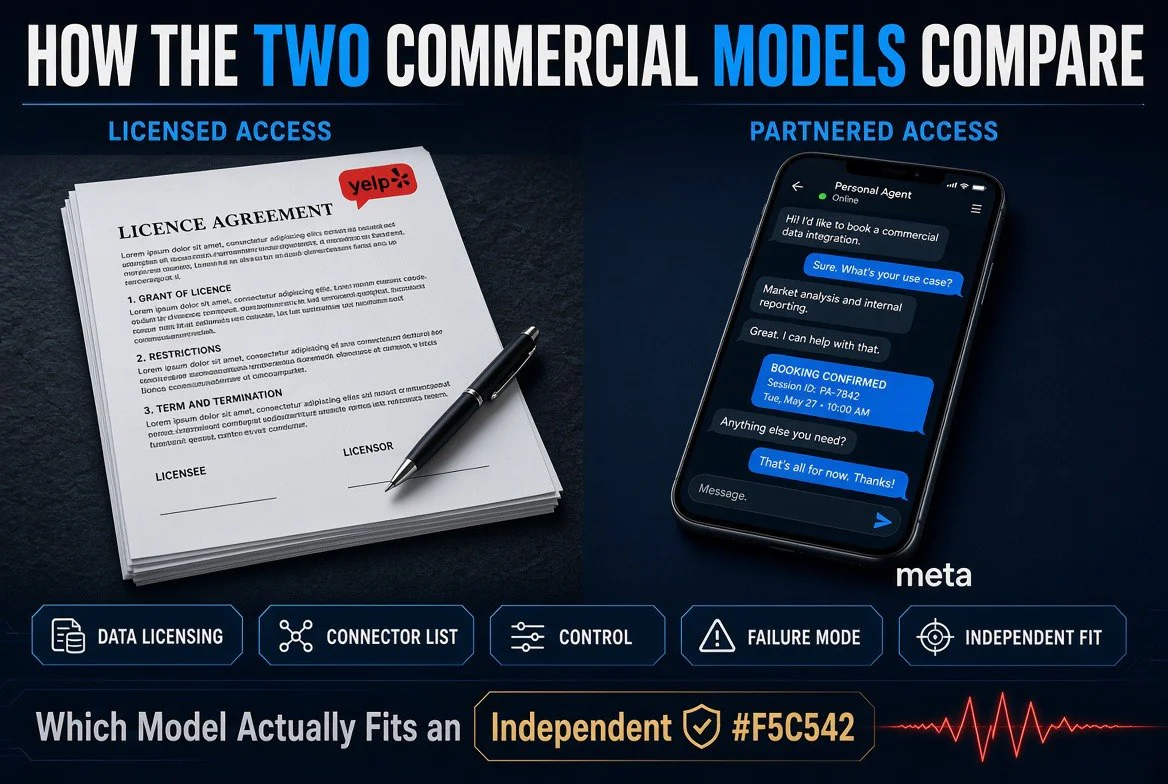
| Factor | Licensed Access | Partnered Access |
|---|---|---|
| Who it suits | Businesses with data worth selling — directories, marketplaces | Businesses that want agent customers without giving up data |
| Revenue model | Direct payment for access to content | No payment — you keep the transaction and its margin |
| Control over who gets in | High. Access is granted per licensee | Dependent on the platform’s connector list |
| Failure mode | Agents fail until a deal exists | Partner agents still fail on technicalities |
| Realistic for an independent | Rarely, unless you hold unique data | The practical target |
For an independent business the second column is the goal. You are not selling data and you do not want to be. You want the transaction, from whichever agent brings it, with enough verification that the money is real.
That is also why the technical work matters more than the commercial negotiation at this size. A partnership with a platform is not available to a restaurant with three locations, but a correctly configured checkout and a written access policy absolutely is.
The Cost of Getting It Wrong in Either Direction
Block everything and you turn away customers whose agents are simply doing what the customer asked. That revenue does not go elsewhere on your site; it goes to a competitor whose door is open. As Meta put it, turning away a personal agent means turning away the customer behind it.
Allow everything blindly and you inherit bot traffic, scraping and model training on your content, plus a transaction risk you have not priced. That is the trade the tiered policy exists to split.
The window to decide calmly is roughly now. Once agent traffic becomes a normal share of sessions, the choice will be made for you by whatever defaults are running in your stack at that moment.
What This Means for Your Business This Quarter
Agent-mediated commerce is not a future scenario. It is live, it is unregulated, and it is currently messy. Amazon protects its catalogue, Walmart trips over its own verification, Yelp sells access, and Cloudflare’s defaults decide the rest.
What you control is small but decisive: whether agents can read what is public, whether they can transact where money moves, and whether you would ever find out if they could not. Set that now, in one paragraph, and revisit it when the open standard lands. The owners who treat agent access as a policy question rather than an accident will capture customers the rest of the market is still turning away.
Frequently Asked Questions
What is a personal AI agent?
A personal AI agent is software that acts on a consumer’s behalf rather than simply answering questions. Meta’s Muse, Instinct and ChatGPT’s Dots are current examples. They browse, book and buy under the user’s instruction.
Why would a website block a customer’s AI agent?
Three reasons. Some do it deliberately to protect data or commercial interests, like Amazon and Delta. Some do it accidentally, when human-verification or checkout steps break the agent’s session, as at Walmart. Others block as a side effect of anti-bot and CDN defaults that cannot tell a customer’s agent from a scraper.
Will an AI agent still work on my site if I do nothing?
Maybe, and that is the problem. If your CDN or bot settings already filter automated traffic, agents may be blocked without your knowledge and without any error appearing to you.
Should I block AI agents from my small business website?
Not wholesale. Public pages are safe to expose and useful to agents. Restrict transactional and account surfaces until verification improves. Blanket blocking turns away real customers whose agent simply represents them.
What is the new agent standard?
Meta, Walmart, Stripe, Sierra, Genesys, Rocket, NiCE and Decagon are collaborating on an open standard for how AI agents communicate with businesses, focused on separating legitimate agents acting for users from malicious bots in commerce. It is in early development.
How do I check whether my site blocks AI agents?
Ask your hosting provider or CDN vendor what their current bot and crawler policy is, then check the settings yourself in their dashboard. If you use Cloudflare, review your crawler controls directly. Treat any setting you did not consciously choose as suspect.

About Barak Schurr
Barak Schurr built and sold a major ticketing platform, ran global nightlife operations at Eventbrite, and now spends his time figuring out which AI tools actually move the needle for independent business owners — and which ones are just noise. No hype. No fluff. Just what works.
Email: [email protected]
More AI Resources for Your Business