Get The Solo Business OS — Free
The AI workflow that replaces a part-time employee for solo operators and small business owners.
Instinct AI Agent Joins Group Chats: What It Means for Small Business
⚡ Expert Summary: Instinct, the AI agent now valued at $10 billion, has opened its agent to group chats — and it works even when the other people in the thread never signed up. For US small business owners, that single design choice is the story: agent access is decoupling from account ownership, and your team threads are about to become an agent surface whether you planned for it or not.
Instinct Just Put an AI Agent Inside Your Group Chat
Instinct announced on Monday that users can now add its AI agent to group chats with friends. The company described the practical uses in plain terms: planning travel, grabbing event tickets, running a fantasy football league, organizing carpools, or keeping track of who is bringing what to Thanksgiving dinner.
The feature starts rolling out to Instinct early access users immediately. The company says it will expand to all users “soon,” and current users can ask their agent to be added to the list.
But the headline is not the feature. The headline is who is allowed to participate in it.
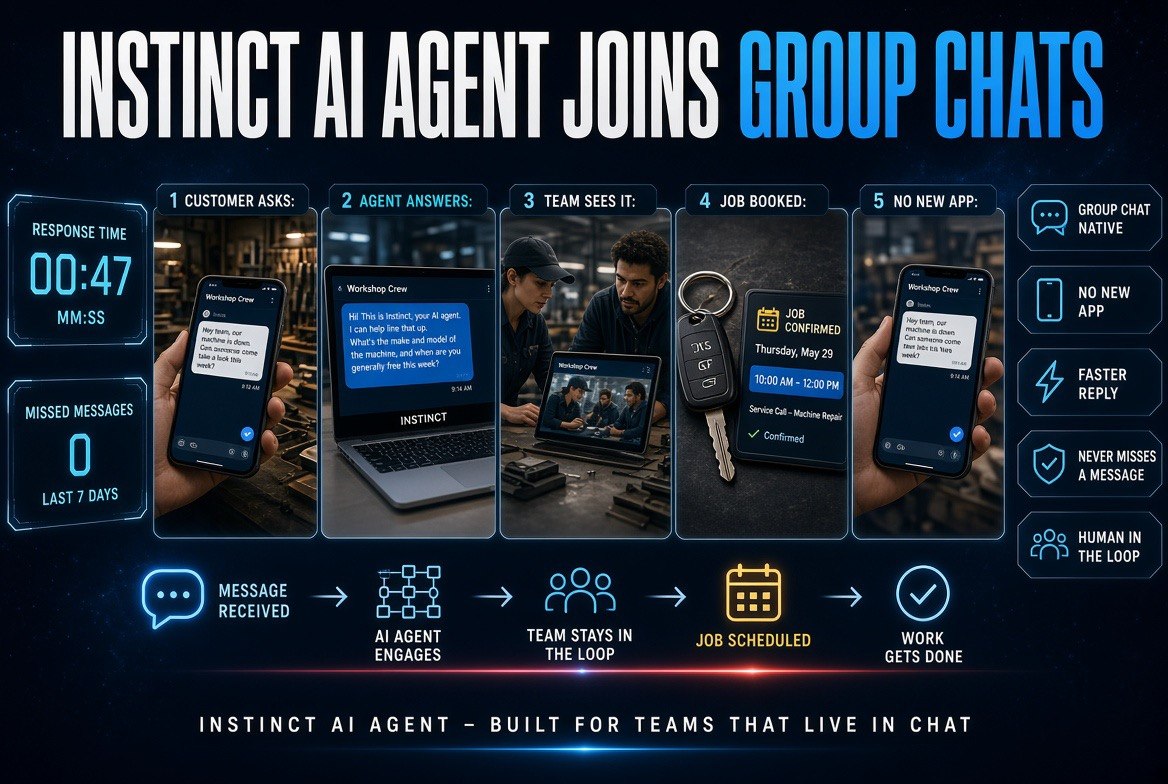
Instinct puts an AI agent directly inside the group chat your team already uses.
The Detail That Actually Matters for a Business Owner
Instinct confirmed a fact that deserves more attention than it got in the launch coverage: the group chat works even if a user’s friends have not joined Instinct.
Read that again from an operations perspective. An AI agent can now sit inside a shared conversation and act on behalf of one participant, while the other participants have no account, no software agreement, and no direct visibility into what the agent is doing or why.
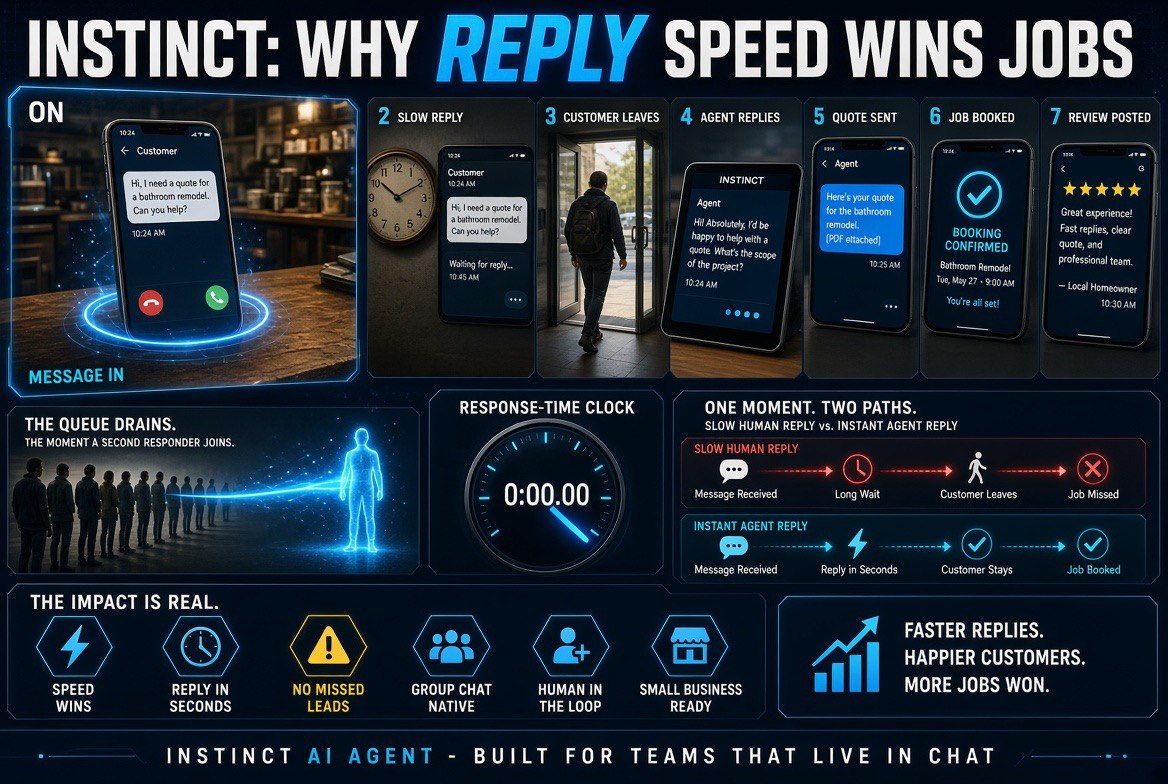
Reply speed decides the job – a message that waits is a customer shopping elsewhere.
If you are a US small business owner, you have almost certainly already done the manual version of this. You added a contractor to a group thread. You put a part-time bookkeeper in a chat with your supplier. You pulled a freelancer into a client conversation. Every one of those threads is now a candidate for an agent joining it — and the people on the other side may never have agreed to anything.
This is the same agent-trust question that has been building all year across the AI tools small businesses already pay for, but it has moved into a place most owners have not thought to check: the group chat.
What Instinct Says About Permission
Instinct founder Noah Shinn went on the record about how the company handles privacy and security inside group chats. His description is specific enough to be useful, and it is worth reading as a template rather than a press release:
- A user’s personal Instinct agent asks permission before connecting with the group’s Instinct agent.
- Users can choose which groups they trust, and can remove that trust at any time.
- The group’s Instinct is siloed from the user’s personal accounts and cannot access them.
- The personal agent always asks permission before sharing information or taking any action.
- If new members join the group, any pending replies from a personal agent are held before being shared with the group.
The fifth control is the one worth stealing. Most AI adoption policies at small businesses cover what the agent can read and what it can write. Almost none of them cover what happens when the audience of a conversation changes mid-thread. Instinct’s answer is to pause the agent. That is a design decision you can copy into your own internal rules this week, regardless of which tools you run.
How the Major Consumer Agents Compare Right Now
The consumer AI agent market has been consolidating around a handful of players, and the capabilities are close enough that the differences now come down to specific features rather than quality. Here is where the three most relevant agents stand as of the first week of October 2026.
| Capability | Instinct | Meta Muse | ChatGPT Dots |
|---|---|---|---|
| Group chat support | Yes — new | No, not yet | Via ChatGPT Spaces |
| Non-members can participate | Yes | No | No |
| Phone call capability | Yes — added recently | Yes — added recently | Not announced |
| Stated valuation | $10 billion | Not disclosed | OpenAI subsidiary product |
| Availability | Early access, then all users | Live | Live since last week |
Meta’s older app, Meta AI, can already be added to group chats on WhatsApp, Messenger, Instagram, and Facebook — but that is a different product from Muse, and the distinction matters if you are evaluating what Meta will offer business users next.
Why Agent Access Is Decoupling From Accounts
The pattern Instinct is establishing has a precedent in the tools small businesses already run. When cloud accounting moved to bank feeds, the software connected to an institution on the owner’s behalf without the bank ever having a user relationship with that tool. Agent access is following the same path, one layer higher up the stack.
The practical consequence is that consent now has two sides. The account holder consents by connecting the agent. The other participants in the thread never consent at all, because in most cases they are not asked. Industry analysts tracking enterprise AI adoption flagged this asymmetry through 2026 as one of the least understood risks in agent deployment, and it is arriving in consumer products first.
The Financial Exposure Nobody Is Pricing Yet
Consider what an agent in a group chat can actually trigger. Booking a flight. Reserving a table. Buying event tickets. Ordering a gift. Each of those is a transaction that commits the account holder to a payment. If the agent acts inside a thread where three other people can steer the conversation, the prompt surface is the entire chat, not a controlled interface.
IBM’s Institute for Business Value has published research across its 2026 AI adoption studies showing that organisations expect a meaningful share of operational decisions to be touched by agents, while a far smaller share say they have a tested process for revoking agent permissions. That gap between expectation and control is the exposure. A small business that adds an agent to a client thread has created a permission that nobody has agreed how to audit.
Gartner has similarly projected that a substantial portion of enterprise applications will carry agentic capabilities within the next few years, warning that governance functions typically lag deployment by several budget cycles. The translation for a US small business is blunt: the tools will arrive before the policy does, and the policy is your job.
A Practical Permission Checklist for Your Team
If you take nothing else from this announcement, take a written rule. The following five questions are the ones that surfaced in Instinct’s own design and in the wider governance research, and answering them takes an afternoon.
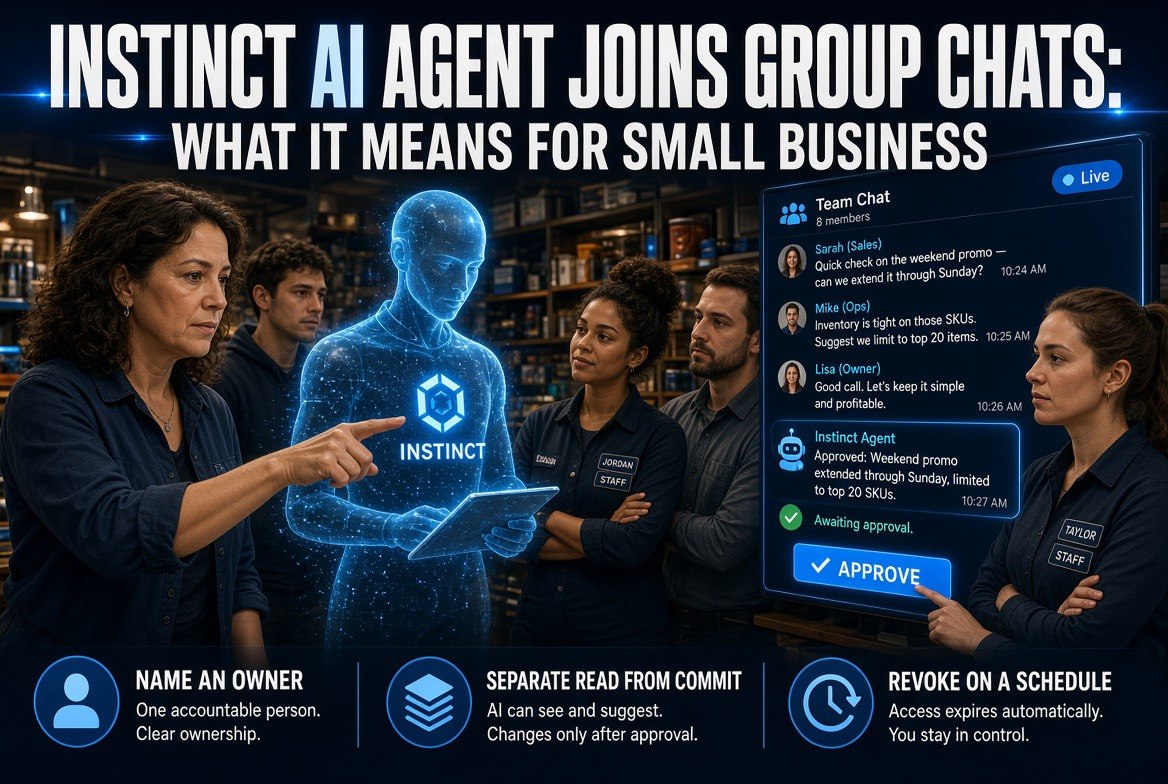
Who owns the agent? In a group thread, the agent belongs to one participant. Make sure your team knows that the data flows to the account holder, not to the business, unless the business owns the seat.
What can it commit to? Separate read access from commit access. An agent that can summarise a conversation is a very different risk from one that can pay for something.
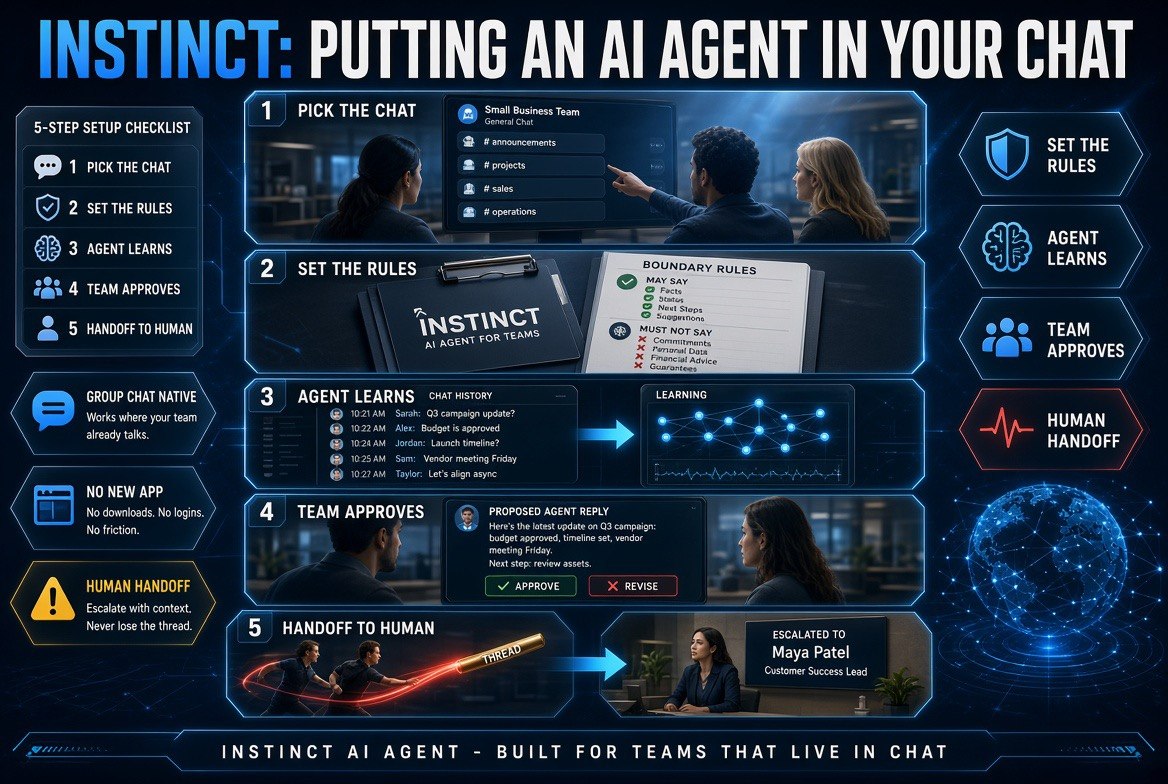
The rollout checklist: set the rules, let it learn, keep a human able to take over.
Who can steer it? In a shared thread, every message is an instruction candidate. Treat the whole chat as the input, not just the person who set the task.
How do you revoke it? Instinct’s trust list is the model. Make revocation a scheduled task, not an emergency response.
Where is the audit trail? If you cannot reconstruct what the agent did and who approved it, you do not have a control. You have a hope.
How Instinct Handles the Permission Problem
Instinct’s stated controls are worth comparing against what a small business can actually enforce today. The table below maps each control to the risk it addresses — and to the gap it leaves.
| Control | Risk it addresses | Gap to watch |
|---|---|---|
| Permission before connecting | Agent joining a thread you did not authorise | Does it re-ask for each new group? |
| Trust list per group | Blanket access across every conversation | Who audits the list over time? |
| Siloed from personal accounts | Group agent reaching calendars, files, inbox | Shared links may still leak context |
| Permission before each action | Silent booking, ordering, or messaging | Approval fatigue leads to blind yes |
| Hold replies on new members | Context shared with a late joiner | Applies to the agent, not to humans |
The fourth gap is the one small business owners will feel first in practice. An agent that asks for approval on every action trains the humans around it to approve reflexively. The control exists, but the behaviour it produces is the opposite of caution. If you deploy agents into shared workflows, rotate who reviews the approvals rather than letting one person click through them.
What This Means for Small Business Owners in the US
You do not need to use Instinct for any of this to matter to you. The pattern the launch establishes — agents joining conversations where other participants have no account — will show up in the tools you already pay for. Here is what to do now.
1. Audit which agents already sit in shared threads. Check your team chat, your client channels, and any group where a third party or contractor participates. If an AI assistant is present, you should be able to name who added it and when.
2. Write down who is allowed to add an agent. Instinct’s model asks the user for permission. Your policy should ask the business. Decide whether any employee can add an agent to a client thread, or whether it needs approval.
3. Decide your position on non-participant access. This is the genuinely new question. If an agent can act on behalf of one party while others have no account, your contracts and your client communications should say so.
4. Build a revocation habit. Instinct lets users remove trust from a group at any time. Almost nobody actually does this. Put a recurring review on the calendar — monthly is enough — and remove agents from threads that have gone quiet.
5. Treat approval prompts as a control, not a formality. The permission model only works if the person approving is actually reading. Assign that role deliberately rather than letting it land on whoever is fastest to click.
Frequently Asked Questions
What did Instinct actually launch?
Instinct added the ability to place its AI agent into group chats. The feature began rolling out to early access users on October 5, 2026, with a wider release described as coming soon.
Do the other people in the group chat need an Instinct account?
No. Instinct confirmed the group chat works even when the user’s friends have not joined the platform. This is the most consequential part of the announcement for business users.
How much is Instinct worth?
Instinct is valued at $10 billion as of its latest funding round. The valuation is company-reported and was cited in coverage of the launch.
How does Instinct compare with Meta Muse and ChatGPT Dots?
Instinct is the only one of the three with group chat support and the only one allowing non-members to participate. Meta’s Muse and OpenAI’s ChatGPT Dots do not currently offer that capability, though ChatGPT supports collaboration through Spaces.
What should a small business owner do about AI agents in group chats?
Audit which agents already have access to your shared threads, decide who may add one, agree a position on non-participant access, schedule regular revocation reviews, and make sure somebody genuinely reads the approval prompts.

About Barak Schurr
Barak Schurr built and sold a major ticketing platform, ran global nightlife operations at Eventbrite, and now spends his time figuring out which AI tools actually move the needle for independent business owners — and which ones are just noise. No hype. No fluff. Just what works.
Email: [email protected]
More AI Resources for Your Business