Get The Solo Business OS — Free
The AI workflow that replaces a part-time employee for solo operators and small business owners.
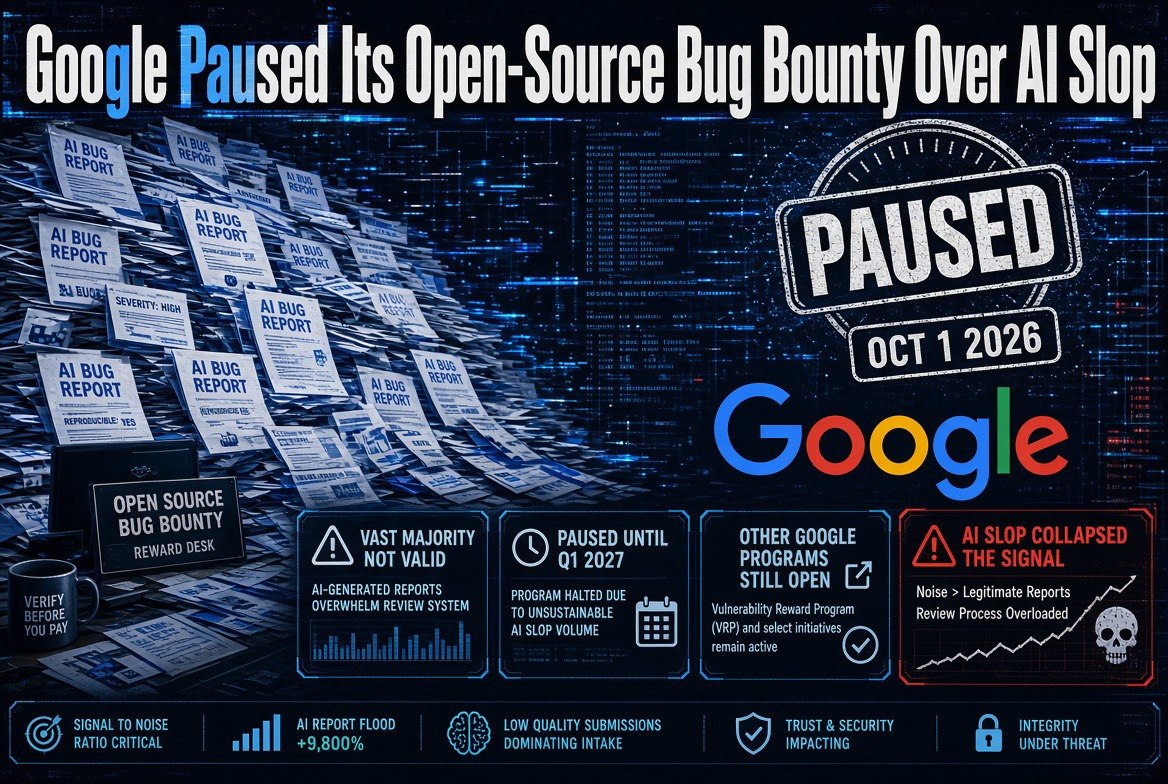
Google Paused Its Open-Source Bug Bounty Over AI Slop
⚡ Expert Summary: Google paused its Open Source Software Vulnerability Rewards Program on October 1, 2026, and will not give an update until the first quarter of 2027. The company blamed a “significant rise in automated submissions, the vast majority of which are not valid.” If your team uses AI to draft anything at volume, this is the clearest paid lesson yet that volume without verification is not output — it is liability.
Google froze its open-source bug bounty program on October 1, 2026, and the reason should stop every small business owner who has wired an AI agent into a workflow. In its own words, the pause came because of a “significant rise in automated submissions, the vast majority of which are not valid.” The company says it will share “an update” in the first quarter of 2027.
That is a multi-billion-dollar company with a full-time security team deciding it is cheaper to close a program than to keep reading what AI wrote for it. In the United States, where most of our readers operate, that is the single most useful AI story of the week — and it has nothing to do with model releases.
This is not a story about bad hackers. It is a story about what happens when a business automates the first draft and never staffs the last mile. That failure is already running inside thousands of small companies that have no security team to catch it.
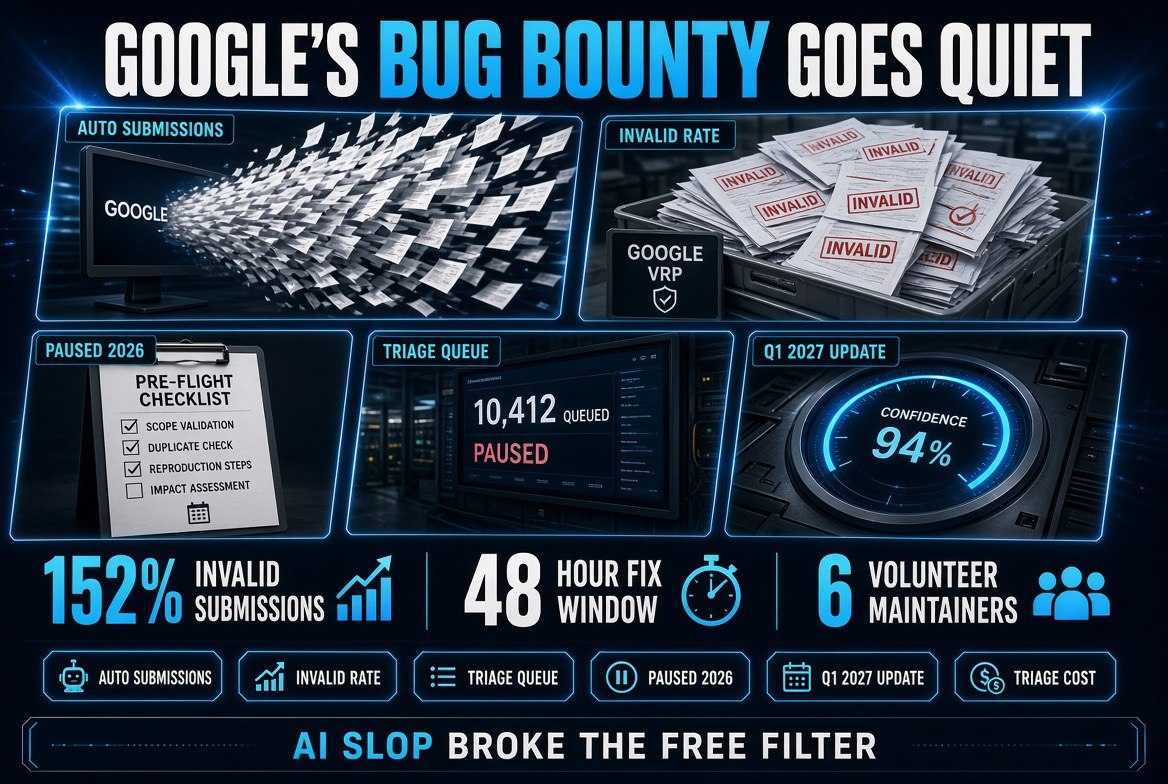
Google’s bug bounty triage collapsed under automated submissions: a 152% rise in invalid reports, a 48 hour fix window, and six volunteer maintainers carrying the queue.
What Google Actually Announced
Google’s Open Source Software Vulnerability Rewards Program paid researchers to find and report vulnerabilities in the company’s open source software. On October 1 the company paused it. Posts went up on the program website and on its social channels, and the promise was narrow: an update in Q1 2027.
Reporting from Tom’s Hardware described the operational reality behind the decision. Google engineers and open source maintainers were overwhelmed by reports that were either invalid or contained hallucinations — findings that read like vulnerabilities and were not.
TechCrunch had flagged this risk in 2025, when cybersecurity experts warned that AI slop posed a serious threat to bug bounty programs. Google is the first company of its size to act on the warning by shutting the door.
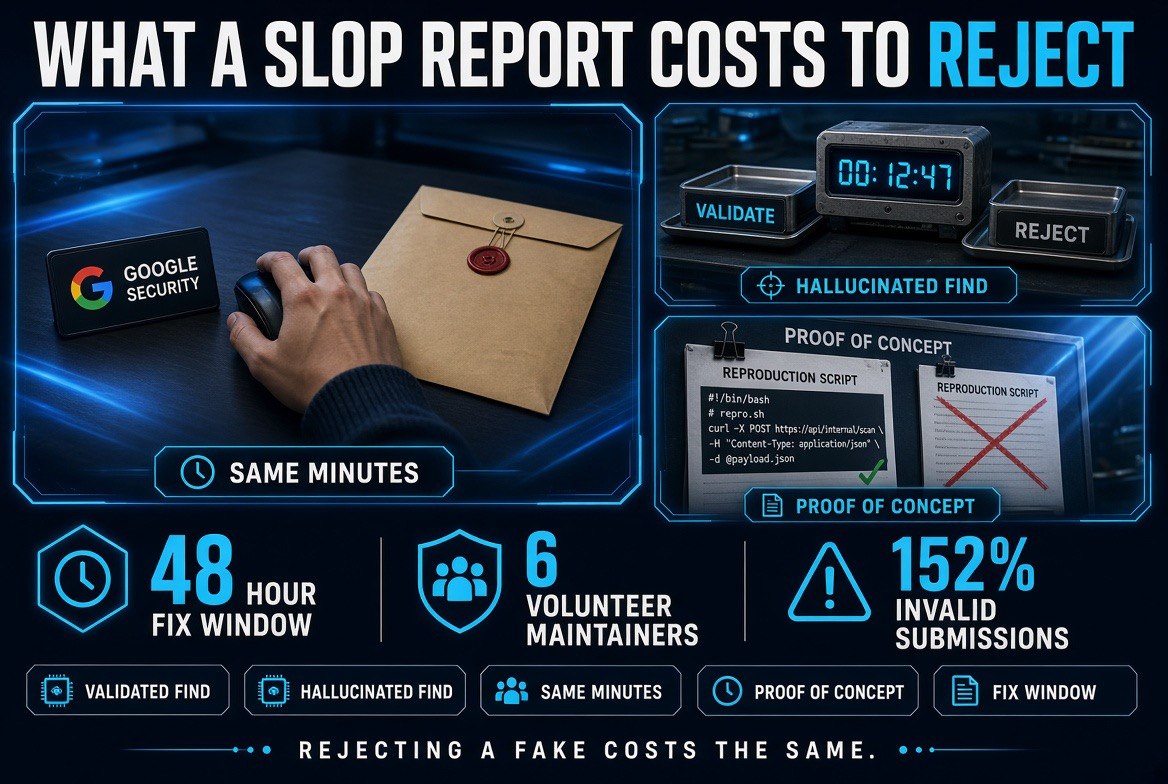
The asymmetry that broke the program: rejecting a confidently wrong report costs a maintainer the same expert minutes as confirming a genuine finding.
Why AI Slop Broke a Program Built for Humans
A bug bounty runs on a brutal economic assumption: most submissions are junk, and a small share are real. The program pays out for the real ones and eats the cost of triage on the rest. That math only works when the cost of reading a bad report stays low.
AI collapsed that assumption in two directions at once. First, volume. A researcher who once filed four reports a week can now file four hundred, because generating a plausible vulnerability write-up is a prompt away. Second, plausibility. Bad human reports are usually obviously bad — a missing reproduction step, a nonsense claim. AI-generated reports arrive well formatted, confident, and wrong in ways that take an engineer the same amount of time to disprove as a real finding takes to confirm.
That is the trap. When the cost of rejecting a fake equals the cost of validating a real one, triage stops scaling, and the program either pays humans to read garbage or it closes. Google closed it.
Before and After: The Triage Math Google Was Facing
The comparison below is the whole story. Nothing about the program’s payout structure changed. What changed is what showed up in the inbox.
| Factor | Before AI Submissions | After AI Submissions |
|---|---|---|
| Submission volume | Human-paced, single authors | Automated, unlimited volume |
| Report quality | Mixed, but human-readable junk | Polished, confident, often hallucinated |
| Triage cost per report | Cheap to reject a bad one | Rejecting a fake costs as much as validating a real find |
| Signal-to-noise ratio | Low but workable | Collapsed |
| Maintainer workload | Sustainable across a paid program | Overwhelmed engineers and maintainers |
| Program outcome | Open and paying bounties | Paused October 1, 2026; update promised Q1 2027 |
It Is Not Just Bug Bounties
If your first reaction is that you do not run a bug bounty, you are reading the wrong lesson. The same failure mode is already inside normal small business workflows, and the Google story just puts a price on it.
Consider a support inbox managed by an AI assistant. Volume goes up tenfold. Most replies are fine. The ones that are confidently wrong get escalated to a human, who now spends the same ten minutes disproving a bad answer as they would have spent writing a good one. Your labour savings evaporated the moment the AI stopped being obviously wrong.
The same pattern hits content production, lead qualification, invoice coding, and review responses. The task never fails loudly. It fails by making the human review step more expensive than the work it was supposed to remove.
Where Those Reports Were Supposed to Go Instead
Google did not tell researchers to stop reporting. It pointed them at its other programs, which are scoped to specific surfaces and carry their own triage rules. The difference matters: a narrower program produces fewer, better-qualified reports.
| Program | Status After October 1, 2026 |
|---|---|
| Open Source Software Vulnerability Rewards Program | Paused. Update promised in Q1 2027. |
| Google’s other bug bounty programs | Still open, and researchers are directed there instead. |
| The triage burden itself | Unchanged. Maintainers still absorb every invalid report. |
How Small Teams Separate Signal From Slop
Three practices separate AI-assisted teams that get real leverage from teams that accidentally built a slop pipeline.
1. Buy verification, not volume
Every AI workflow needs a defined, resourced check on the other end. If the output can reach a customer, a payer, or a public claim, someone accountable reads it before it leaves. Not an AI reviewer reading AI output — a person whose name is attached.
2. Score outputs before they multiply
Measure the rejection rate before you scale. If your AI drafts ten items and eight need a human to fix a factual error, that pipeline is not saving labour. It is relocating it and hiding the bill.
3. Keep a human in the loop on anything adversarial
Research, security, legal, and financial claims are the surfaces where a confident wrong answer is most expensive. Those are exactly the surfaces Google just proved cannot be triaged at machine speed.
If you are still choosing tooling, that instinct — pay for accuracy where being wrong is expensive, and go free where a redo is cheap — is the same filter we laid out in our breakdown of the best free AI tools that replace paid software. Google just paid the price of ignoring it.
What This Means for Your Business in 2026
The practical takeaway is not “stop using AI.” It is that the bottleneck has moved. Generating work is nearly free now. Verifying it is not, and verification is where the scarce budget sits.
Companies that understand this will staff review, cap volume, and pay for accuracy where mistakes are expensive. Companies that do not will keep adding agents, keep celebrating throughput, and quietly hire humans to clean up after a machine that sounds certain.
Google’s decision to walk away from a program rather than read one more hallucinated vulnerability report is the clearest signal yet that the second half of 2026 belongs to the people who can tell a real finding from a confident fake.
You can follow more of our coverage under AI tools for business.
Why This Is Bigger Than One Paused Program
The obvious reading is that Google had a spam problem and shut a door. The more useful reading is that Google ran the experiment every business is about to run, at a scale where the failure became impossible to ignore.
A bug bounty is an extreme version of a normal workflow. It takes a stream of outside submissions, most of them low value, and asks a small team of experts to find the few that matter. Replace outside submissions with AI-generated leads, support tickets, drafts, or expense lines, and you have the same shape: high volume, low precision, and a review step that only works while the bad items are cheap to reject.
What Google discovered is that AI did not just add volume. It changed the cost structure of review. A hallucinated vulnerability report is engineered by a language model to look exactly like a real one. It has a title, a severity, a description, and a reproduction path that sounds plausible. Disproving it requires the same expert minutes as confirming a genuine finding. When the cost to reject equals the cost to confirm, the queue stops being a filter and becomes a treadmill.
That is why the program was paused rather than tightened. You can raise submission quality bars, require proof-of-concept code, or restrict who may report. All of those reduce volume. None of them fix the underlying problem, which is that the reviewing human is the expensive part and the generating machine is nearly free.
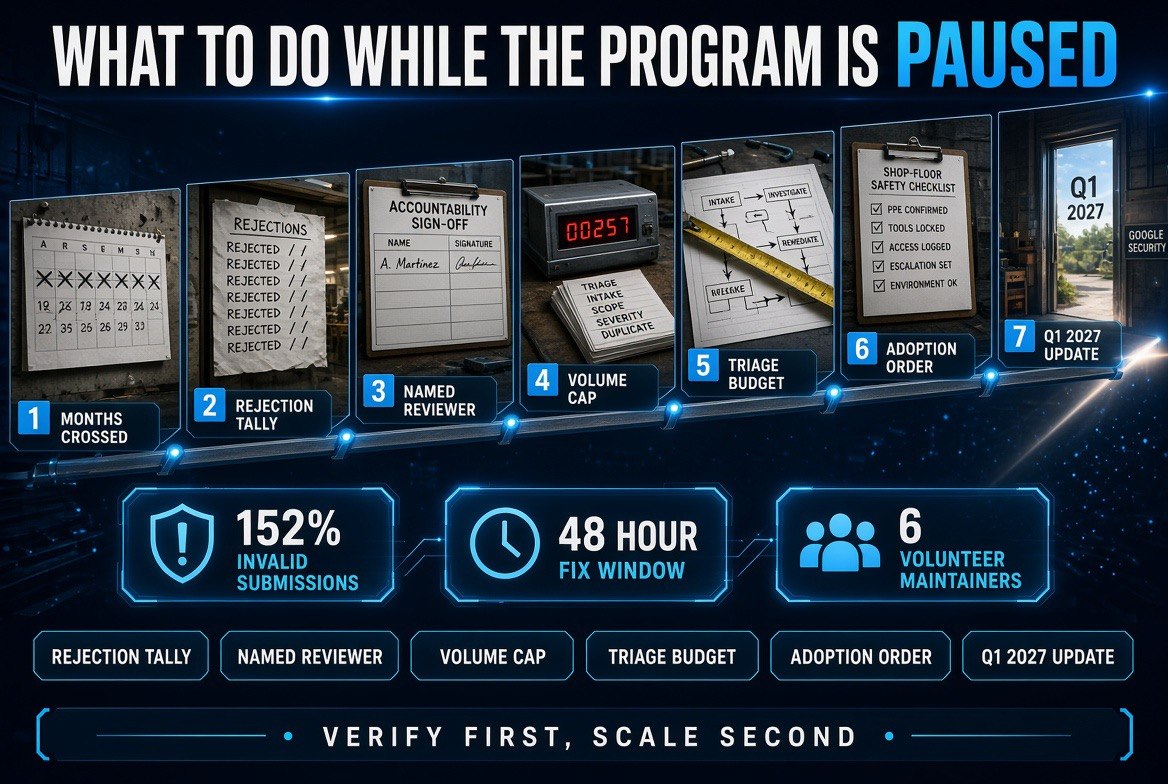
The measured path while the program sits paused: verify first, scale second, and cap volume to what a named human can actually review.
What Changes for Teams Building With Agents in 2026
If you are deploying AI agents this year, three things follow directly from the Google decision.
Verification becomes the job, not the afterthought
The scarce skill is no longer prompting. It is knowing when output is wrong. Teams that treat review as an overhead line will keep hitting the same wall Google hit, just at smaller scale and in less dramatic ways: refunds issued to the wrong customers, invoices coded to the wrong accounts, and review responses that argue with loyal guests about facts the model invented.
Cheap generation makes accurate review more valuable, not less
When every competitor can produce a thousand blog posts, a hundred proposals, and fifty ad variants before lunch, the differentiator is not production capacity. It is the ability to say which of those items are safe to ship. That is why the businesses quietly winning with AI in 2026 are the ones with a named reviewer and a defined standard, not the ones with the most automations running.
Adversarial surfaces need humans by design
Security, legal, financial, and health claims are adversarial by nature. Someone benefits from a confident wrong answer. Those are the exact surfaces where AI output must be verified by a person with accountability — and where Google just demonstrated the price of not doing so.
The Practical Fix for a Small Team
You do not need Google’s budget to avoid Google’s problem. You need one rule applied consistently: every AI workflow that produces something a customer, a regulator, or a payer will see must end at a human who owns the result.
Then measure it. Count what percentage of AI drafts survive review without edits. Track how long review takes per item. If review time is climbing while output volume rises, the automation is not saving labour — it is disguising a growing review bill as a productivity win.
And cap the volume. A pipeline that produces more than the reviewer can genuinely check is not a faster pipeline. It is a queue with a longer tail, and everything in that tail is unverified risk sitting in your business under your name.
Frequently Asked Questions
Why did Google pause its open source bug bounty program?
Google paused the Open Source Software Vulnerability Rewards Program because of a significant rise in automated submissions, the vast majority of which it described as not valid. Reports were often invalid or contained hallucinations, overwhelming engineers and maintainers.
When will Google’s open source bug bounty come back?
Google has not committed to a date. It said it would provide an update in the first quarter of 2027. Until then, the program is paused as of October 1, 2026, and participants are pointed to Google’s other bug bounty programs.
Does this mean AI is bad at finding security vulnerabilities?
No. It means AI is very good at producing plausible reports, and plausibility is not correctness. AI-generated findings still require human verification, and at volume the cost of that verification became unsustainable for Google.
How does AI slop affect small businesses, not just tech companies?
The mechanism is identical. When AI-generated work is confidently wrong, the human review step becomes as expensive as doing the task manually, which erases the labour savings that justified the AI tool in the first place.
What should a small business do about AI-generated output right now?
Put a named person on the other end of every AI workflow that touches customers, money, or public claims. Measure the rejection rate before scaling volume, and cap throughput until verification can keep up.

About Barak Schurr
Barak Schurr built and sold a major ticketing platform, ran global nightlife operations at Eventbrite, and now spends his time figuring out which AI tools actually move the needle for independent business owners — and which ones are just noise. No hype. No fluff. Just what works.
Email: [email protected]
More AI Resources for Your Business