Get The Solo Business OS — Free
The AI workflow that replaces a part-time employee for solo operators and small business owners.
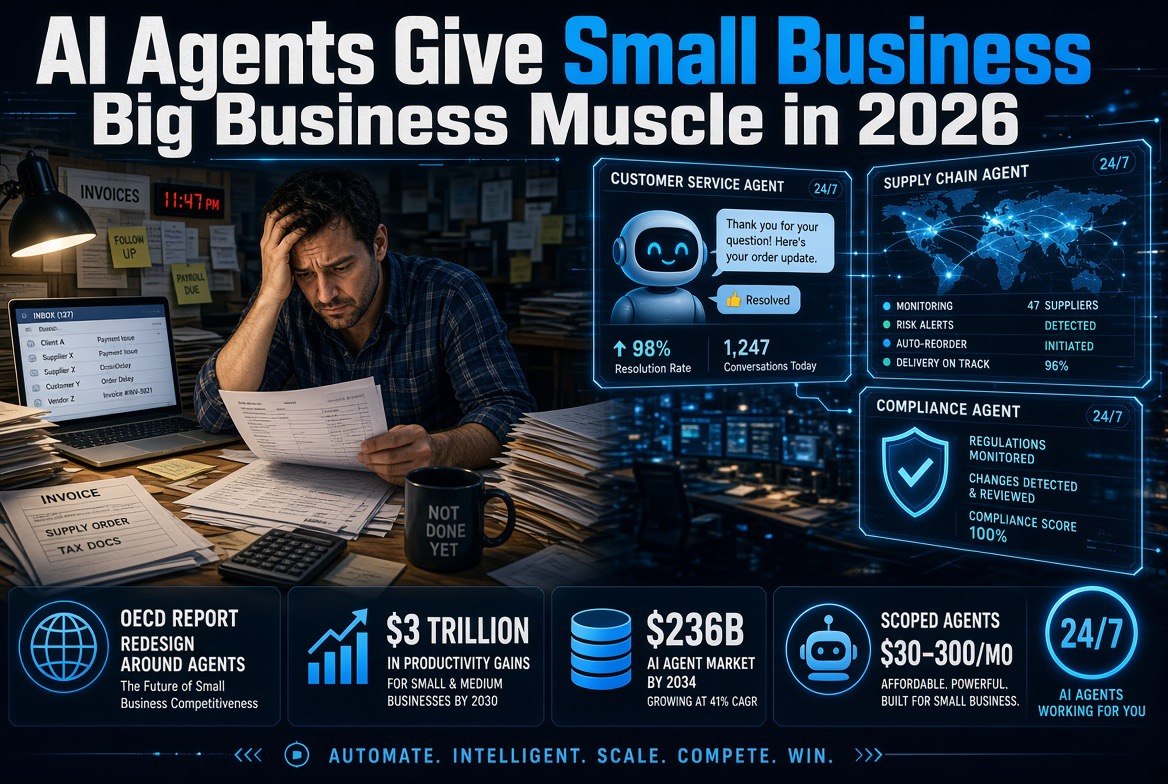
AI Agents Give Small Business Big Business Muscle in 2026
⚡ Expert Summary: The OECD finds small businesses are redesigning operations around AI agents rather than headcount, and the World Economic Forum projects agentic AI could unlock $3 trillion in global productivity gains over the next decade. The AI agents market is on track to hit $236 billion by 2034 — and a well-scoped agent with a spending limit is how a Main Street business gets there without a hiring spree. If you run a US shop with 1-50 people, this is the playbook.
There is a moment every owner of a US small business knows. It is 9pm, the shop is closed, and you are still doing the work that had no one else to do it. Invoicing. Chasing a supplier. Answering the customer who emailed at 4:47pm and expects a reply before morning. It has always been the same trade: you can grow, or you can sleep, but rarely both.
That trade is starting to break. Not because AI writes your emails faster — that was the last two years. It is breaking because AI agents are now doing whole jobs your headcount never had time to absorb, and the organizations that study small business are saying so with data, not hype.
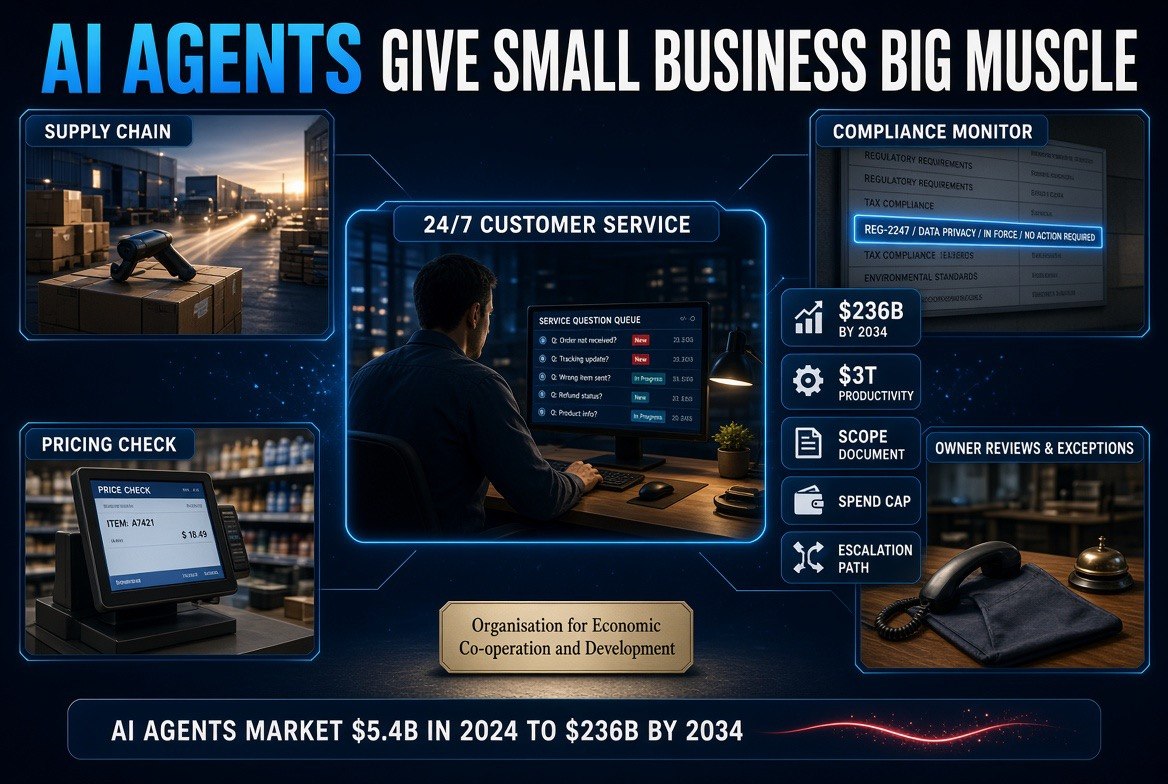
The agent stack in one frame: service questions, compliance notices, supply chain scans and pricing checks running on their own, with spend caps and an escalation path back to the owner.
What the OECD Found About Small Business AI Adoption
The Organisation for Economic Co-operation and Development (OECD) published a report on AI adoption across small and mid-sized enterprises (SMEs) in member countries, and one finding sits above the rest: small businesses deploying AI are not just automating individual tasks. They are redesigning how work gets done around agents rather than around headcount.
That is a different sentence than “AI saves time.” It means the org chart itself changes — a customer service function becomes an agent plus an escalation path, not three part-time hires.
The report maps SME AI maturity across four levels, from novice to champion, and finds that agility — not budget — lets small businesses experiment and deploy effectively without enterprise resources. The core functions where SMEs are already running agents in production: customer service, supply chain management, pricing, and customer discovery.
Two profiles in the report are worth knowing. A small UK biotech is using custom AI to underpin drug discovery — a function that would normally require a research department. A service-sector SME unified previously fragmented operations into a single intelligent system. Neither is a Fortune 500 story. Both are the size of business you probably run.
One use case the OECD flags as especially compelling for small operators: compliance monitoring. Fast-changing regulatory requirements impose a heavy burden on businesses with no legal department, and an agent that watches for regulatory changes and flags requirements in real time does a job no small business could staff.
The $236 Billion Market Nobody Is Handing You
A World Economic Forum article puts a number on the shift: agentic AI could deliver $3 trillion in corporate productivity gains globally over the next decade, with small businesses named as primary beneficiaries of an agent economy.
The market itself — AI agents — was valued at $5.4 billion in 2024 and is projected to reach $236 billion by 2034. That growth is driven by agents moving into core business functions that used to be accessible only at enterprise scale. Procurement. Scheduling. Service. The exact functions a 12-person company cannot staff.
The WEF framing goes one step further with agent-to-agent commerce. As more consumers deploy AI agents to handle purchasing, scheduling, and service interactions, small businesses that can receive and respond to those agents automatically gain a structural advantage over those that cannot. Translation: if your competitor’s booking agent can talk to a customer’s purchasing agent and yours cannot answer the phone, you lose the sale you never knew existed.
That opportunity comes with a trust problem the WEF names directly. A know-your-agent framework — built on top of existing know-your-customer standards — is needed so small businesses can participate safely and on equal terms with larger institutions.
The Comparison: Agents Versus the Hiring You Were About to Do
Here is the honest side-by-side. This is not “AI versus human” — it is “one scoped agent versus the part-time hire you were budgeting for.”
| Factor | Part-Time Hire | Scoped AI Agent |
|---|---|---|
| Cost to start | $1,800-$3,200/month loaded, plus onboarding | $30-$300/month in tooling; you define the scope |
| Hours covered | 20-25/week, one shift pattern | 24/7 within its defined scope |
| Time to productive | 3-6 weeks of training | 1-2 weeks of scoping, prompts, and testing |
| Failure mode | Quits; a shift goes uncovered | Does something outside its bounds unless you cap authority |
| Where it wins | Judgment, relationships, edge cases | Volume, consistency, never sleeping, never quitting |
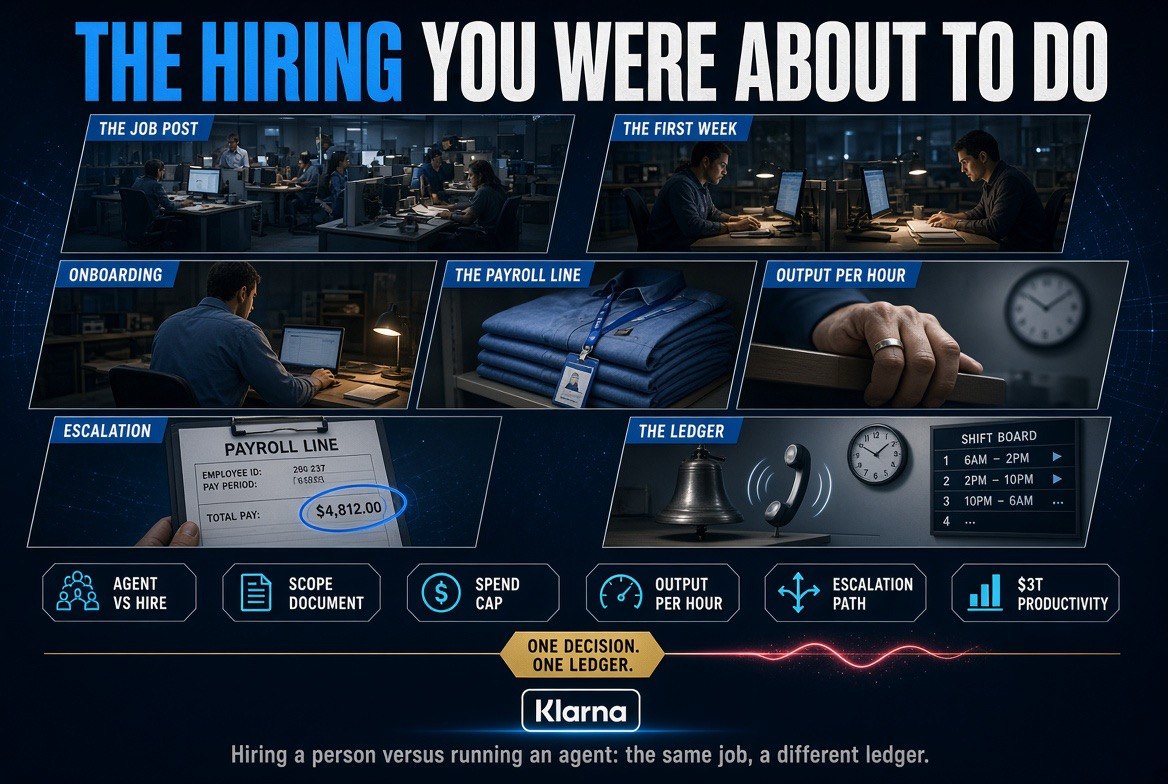
The same job, a different ledger: hiring runs through onboarding, payroll and a first week that costs real money, while an agent runs through a scope document, a spend cap and an escalation path.
Treat Your Agent Like a New Hire, Not a Software Install
Harvard Business Review published the most useful framing in this whole shift, and it is a mindset change rather than a technology one: treat AI agents like digital employees, not software installations.
A software install does not need a job description. An employee does. HBR’s list of what each agent needs reads exactly like an onboarding checklist:
- A defined identity — which role does this agent hold?
- Limited authority — what is it allowed to decide alone?
- Trusted information sources — what is it allowed to read?
- Clear execution controls — what can it actually do, and spend?
- Audit trails — can you explain retroactively why it did what it did?
The example HBR gives is the one that matters for any business handling money: a customer service agent should not be able to issue refunds above a certain threshold without a human in the loop — for the same reason a human employee would not have that authority on day one. Klarna handled a large share of customer service interactions autonomously while keeping immediate escalation paths for complex cases. The autonomy did not come first. The escalation path did.
That model scales down directly to a Main Street business. Start with one well-scoped use case. Define what the agent can and cannot do. Build a human escalation path for everything outside those bounds. The businesses that introduce autonomy gradually capture the benefits without exposing themselves to costly mistakes — and the ones that hand an agent the keys on day one are the ones writing the angry blog post six months later.
The Four Levels — Where Is Your Business Right Now?
The OECD report maps SME AI maturity across four levels from novice to champion. Most owners cannot place themselves, so here is the honest version of each stage and the practical move that gets you to the next one.
| Level | What It Looks Like | Your Next Move |
|---|---|---|
| Novice | You use a chatbot occasionally; no process is built on AI | Pick the single most repetitive task in your week |
| Explorer | One or two tools in use; results depend on whether you remember them | Write a one-page scope: role, limits, escalation |
| Practitioner | An agent runs a real function with a human checkpoint | Add audit logging and a spend cap |
| Champion | Multiple agents run core functions; you review exceptions, not work | Connect agents so they hand off to each other |
Most small businesses are Explorer and do not know it. The gap between Explorer and Practitioner is not budget — it is a written scope document, which costs you one hour.
US Small Business Reality Check
American small businesses are not waiting on this. Survey data through 2026 has consistently shown a majority of US small businesses now using AI in some form, with the real gap sitting between those who have deployed a tool and those who have redesigned a process around it. That second group is smaller, and it is the group capturing the productivity number the WEF is talking about.
The tax credit angle matters too. If you are investing in automation and AI tooling as a US business, several of those costs are deductible business expenses — not a reason to buy, but a reason not to wait if you were already going to.
Compliance Is the Underrated First Win
The OECD singles out compliance monitoring as one of the most compelling early use cases for SMEs, and it deserves its own section because it is the one nobody markets.
Fast-changing regulatory requirements are a heavy burden on a business with no legal department. An agent that watches for regulatory changes and flags the ones that touch you in real time is doing a job you never had the staff to assign. It is less glamorous than a sales agent and far less likely to embarrass you — because its failure mode is a missed flag, not a wrong promise to a customer.
If you are looking for the first place to put an agent where the downside is small and the upside is a real risk removed, compliance monitoring is it.
The Structural Advantage Most Owners Will Miss
The WEF’s agent-to-agent commerce point is the one worth reading twice. As consumers deploy their own agents to handle purchasing, scheduling, and service interactions, small businesses that can receive and respond to those agents automatically gain a structural advantage.
Read it as a deadline rather than an opportunity. Right now the customer who reaches your business is usually a human clicking a link. In the agent economy, a growing share of contact starts with a machine acting on someone’s behalf — checking availability, comparing pricing, requesting a slot. If your systems cannot answer a machine with the same speed they answer a human, you are invisible to that entire channel.
That is what the trust layer is for. The WEF calls for a know-your-agent framework built on existing know-your-customer standards, so a small business can verify that the agent on the other end is legitimate and participate on equal terms with larger institutions. When that standard lands, the businesses that already have agents capable of responding will be the ones with the plumbing in place.
How to Start This Week — Six Steps
This is the part where most articles tell you to “embrace AI.” Here is the actual sequence.
- Pick one function, not a strategy. Customer service, a supplier workflow, pricing checks, or compliance monitoring. One.
- Write the job description. Role, authority limit, information it may read, what it may execute, and where it must escalate.
- Set the money cap. A hard spending limit the agent cannot exceed without you. This is the single control that prevents the expensive story.
- Run it in parallel for two weeks. Do the work the old way at the same time. Compare. You will find the failure modes faster than any demo will show you.
- Turn on audit logging before you turn up autonomy. If you cannot explain what it did last Tuesday, you are not ready to widen its scope.
- Widen one notch at a time. Each expansion gets two weeks of review. Gradual autonomy is the whole method.
Two weeks of parallel running is the part owners skip, and it is the part that keeps the other five steps from becoming a mess.
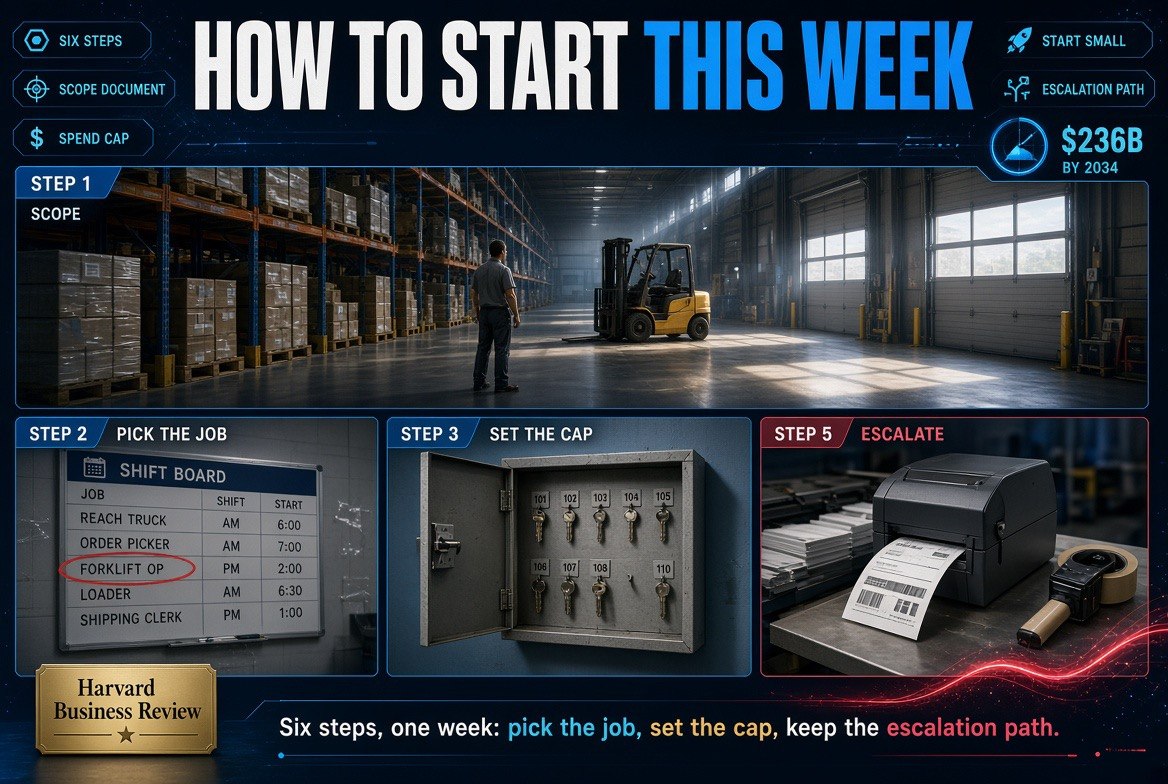
The six-step rollout in one frame: scope the job, pick the smallest task worth handing over, set the spend cap, and keep a human escalation path open the whole way.
What This Actually Changes for a 12-Person Business
Strip away the market projections and the productivity numbers and the honest version is this: the constraint that has always limited a small business — that you cannot afford specialists for every function — is loosening. A customer service function, a compliance watcher, a pricing check: work that used to require a hire now requires a scope document and a spending cap.
That does not make your people less important. It makes judgment the scarce resource again, which is the thing a small business owner has more of than any enterprise department. The agents handle volume. You handle the calls that need a human — which is the work you actually wanted to be doing.
The businesses that get this right will not be the ones that bought the most tools. They will be the ones that wrote the clearest job descriptions.
Frequently Asked Questions
What is an AI agent, in plain terms for a small business owner?
An AI agent is software that does a defined job end to end rather than answering one prompt. It reads information, makes routine decisions within limits you set, executes actions in your systems, and escalates anything outside its scope to a human. The difference from a chatbot is that it finishes the task.
How much does it cost a small business to deploy an AI agent in 2026?
Tooling typically runs $30 to $300 per month per agent depending on the platform and the volume, against $1,800 to $3,200 per month fully loaded for a part-time hire covering a similar function. The larger cost is the scoping time — roughly one to two weeks of your own hours to define the role, limits, and escalation path.
Is it safe to let an AI agent handle customer refunds or payments?
Only with a threshold. The Harvard Business Review framing is explicit: an agent should not be able to issue refunds above a set amount without a human in the loop, exactly as a new employee would not hold that authority. Set the cap, log every transaction, and require escalation above it.
What should a small business automate first?
Compliance monitoring is the strongest first candidate because the failure mode is a missed internal flag rather than a wrong customer-facing action. Customer service, supply chain workflows, pricing checks, and customer discovery are the other functions the OECD found SMEs running in production.
What is the $236 billion AI agents market projection based on?
The World Economic Forum cites a global AI agents market valued at $5.4 billion in 2024 and projected to reach $236 billion by 2034, driven by agents expanding into core business functions that were previously accessible only at enterprise scale. The same analysis projects $3 trillion in corporate productivity gains over the next decade.
Will AI agents replace small business employees?
Not in the way the headline implies. The OECD finding is that small businesses are redesigning work around agents rather than around headcount — which shifts what you hire for, toward the judgment and relationship work agents handle poorly. The functions being automated are usually ones you were not staffing at all.

About Barak Schurr
Barak Schurr built and sold a major ticketing platform, ran global nightlife operations at Eventbrite, and now spends his time figuring out which AI tools actually move the needle for independent business owners — and which ones are just noise. No hype. No fluff. Just what works.
Email: [email protected]
More AI Resources for Your Business