Get The Solo Business OS — Free
The AI workflow that replaces a part-time employee for solo operators and small business owners.
Amex”s AI Agent Commerce Rules: What Small Business Owners Need to Know
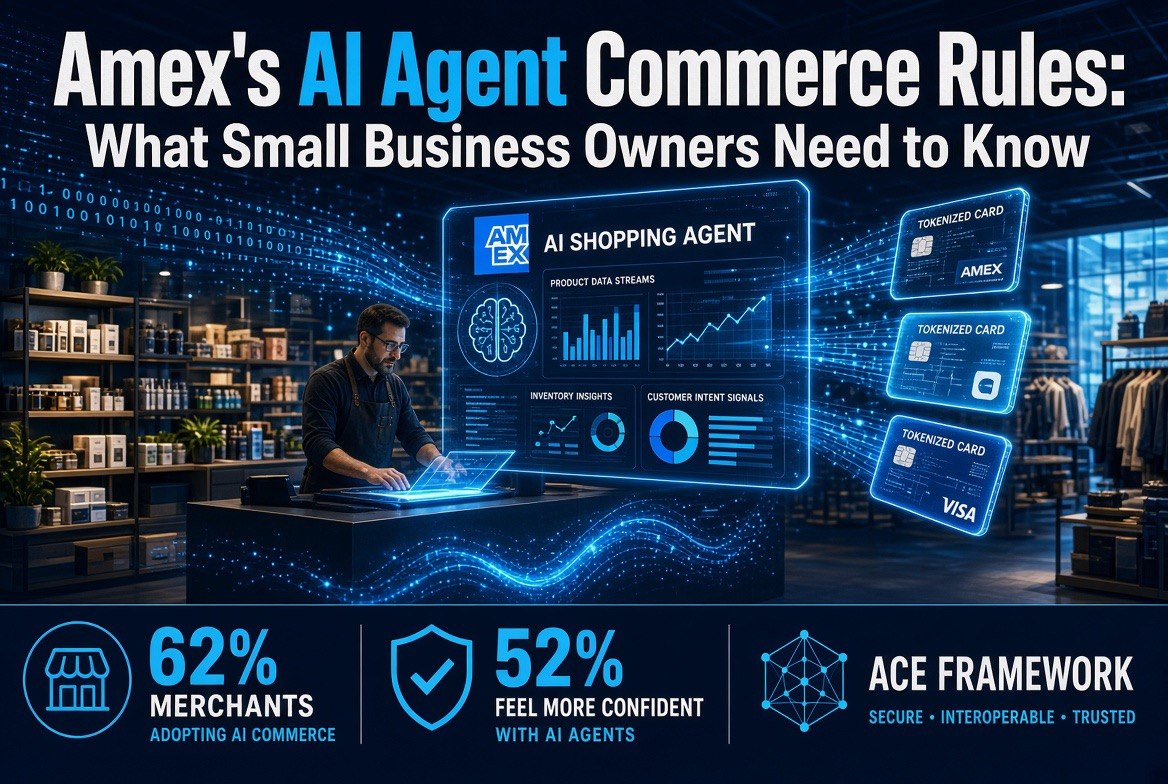
⚡ Expert Summary: American Express published its Intent Intelligence Framework on October 13, 2026 — the first big-card attempt to write the rules for AI agents that buy things on your customers” behalf. Amex”s own research found 62% of merchants expect AI shopping agents to meaningfully change their business within a year, and 83% call it an opportunity. But only 52% of consumers are comfortable letting an agent buy everyday items, dropping to 15% for electronics. If you run a US small business, this framework decides whether your store is visible, selectable, and payable when a bot does the shopping.
There is a new kind of customer walking into your store, and it is not a person. It is a software agent that a consumer pointed at the internet with a budget and a shopping list. It does not browse your homepage for the vibe. It does not get nostalgic about your window display. It reads structured data, compares three options, and checks out — or it leaves, and you never know it was there.
American Express spent October making that shift official, and whether you accept Amex or not, the rules it just published will shape how agent-driven commerce reaches Main Street. This is the piece of the AI story that lands on your checkout page rather than in your inbox.
[PENDING INLINE IMAGE 1]
What Amex Just Published — and Why It Matters to a Small Operator
On October 13, 2026, American Express published its Intent Intelligence Framework, a document aimed squarely at the question merchants have been asking since the first shopping bots started showing up in their analytics: when an AI agent spends someone”s money, who is responsible for what?
It is the second half of a push Amex started in April 2026, when it debuted its Agentic Commerce Experiences developer kit — known as ACE — and announced plans for Amex Agent Purchase Protection, which the company billed as an industry-first commitment to protect eligible Card Members and merchants from charges tied to errors made by registered AI agents.
The protection is deliberately narrow, and the narrowness is the story. Amex says it would apply when two conditions line up at once:
- The AI agent making the purchase is registered with Amex through the ACE developer kit.
- The Card Member”s purchase intent has been authenticated before checkout.
Miss either condition and the announced protection does not cover the error — a bot buys the wrong size, the wrong quantity, or something the customer never asked for, and the charge stands. That is a meaningful gap for anyone handing financial authority to an agent they do not fully control, and it is also precisely the point. Amex is not promising to cover every AI mistake. It is promising to cover the ones that happen inside its own verified system.
For an independent retailer, that has a practical translation: the payment network is now choosing which agents it trusts, and your integration choices decide whether you sit inside that trust boundary or outside it.
The Five-Chapter Playbook Amex Handed to Merchants
A week earlier, on October 6, 2026, Amex released the Amex Business Playbook for Agentic Commerce — a merchant guide organized into five chapters. Read as a to-do list, it is a fairly blunt description of what a business now needs to get right:
| Playbook Chapter | What It Actually Asks of You | Small Business Translation |
|---|---|---|
| What agentic commerce is | The baseline definition — software buying on a human”s behalf, with a budget. | Not a hypothetical. Assume it is already hitting your traffic. |
| Getting found and recommended by AI shopping tools | Being legible to the models that shortlist products. | Clean product data beats ad spend in this channel. |
| Making AI-driven transactions work | Payment-side plumbing for non-human buyers. | Your POS and gateway need to accept agent credentials. |
| Supporting trustworthy AI-assisted purchases | Verification that the agent is legitimate, not a scraper. | Fraud rules written for humans will misfire on agents. |
| Standing out once an algorithm narrows the choice to three | Winning the shortlist — the whole commercial contest. | Loyalty shifts from storefront to whatever signals the agent weighs. |
That last chapter is the uncomfortable one, and it is worth sitting with. If an AI agent is doing the comparison shopping, brand loyalty stops being about the storefront and starts being about whatever signals the agent has been trained or configured to weigh. Your thirty years of local goodwill does not appear in its scoring function. Your structured product data does.
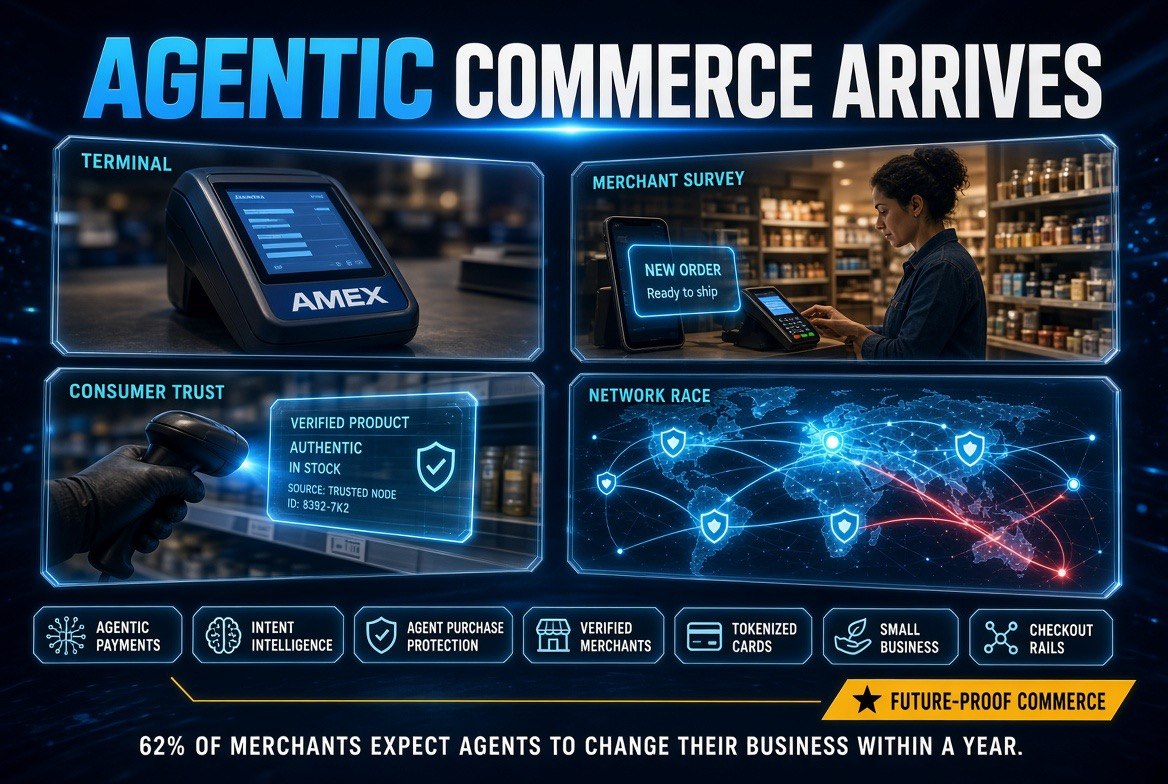
Amex’s Intent Intelligence Framework lands on a real counter: the terminal, the merchant reading an incoming agent order, and the trust gap between what merchants expect and what consumers have agreed to.
The Numbers Amex Is Publishing — and What They Tell You
Amex attached its own research to the playbook, and the merchant and consumer numbers diverge in a way every operator should notice.
On the merchant side:
- 62% of merchants expect AI agents shopping on behalf of customers to have a moderate or significant impact on their business within the next year.
- 83% of merchants view agentic commerce as an opportunity rather than a threat.
- 41% say they are already experimenting with it or actively implementing it.
On the consumer side, the picture is more cautious and clearly tiered:
- 52% of people are comfortable letting an AI agent buy everyday, low-cost items.
- That number collapses to 15% for high-value purchases like electronics and appliances.
Read those two blocks together and the shape of the next two years is legible. People will happily let a bot reorder paper towels, restock the office supplies, or refill a repeat prescription. They are far less willing to let it pick a laptop. That means the agentic channel arrives first in consumables, repeat orders, and low-stakes replenishment — which, conveniently, is exactly the category where an independent retailer”s margins are thinnest and where a bot”s price comparison bites hardest.
It also means the 41% already experimenting is not a rounding error. That is a fast adoption curve for a checkout behavior that barely existed a year ago, and a business still treating AI agents as a future problem is competing in 2027 with a data model built in 2024.
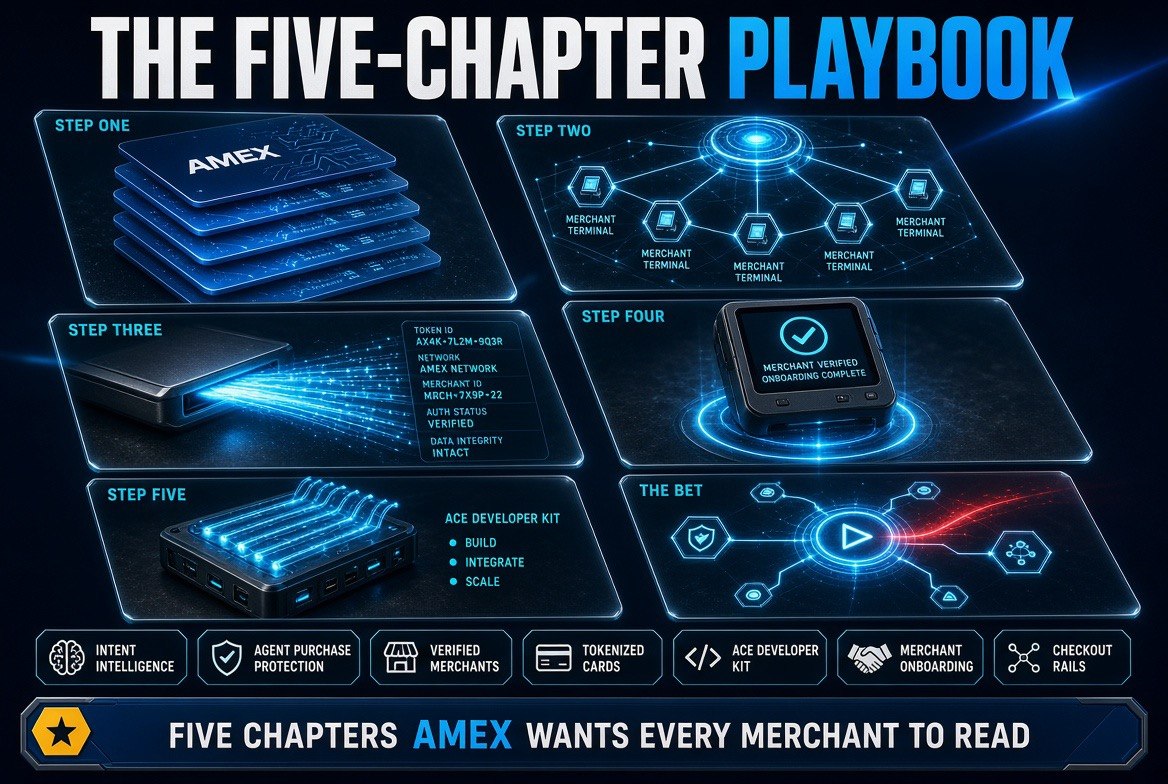
The five-chapter playbook Amex handed to merchants, read as a staircase: tokenized cards, merchant terminals, data verification, verified status, then the developer kit that ties it together.
Visa, Mastercard, and the Race Amex Is Trying to Win
Amex is not first to this problem, and the competitive picture explains why the framework landed when it did.
| Network | Agentic Commerce Play | Mechanism |
|---|---|---|
| Visa | Trusted Agent Protocol, introduced October 2025 | Lets merchants verify an AI agent is legitimate rather than a scraper or fraud bot. |
| Visa | Intelligent Commerce platform | Tokenized credentials and payment instructions so consumers set spending limits and conditions. |
| Visa + OpenAI | Partnership announced June 10, 2026 | Embeds Visa”s payment network inside ChatGPT, using tokenized credentials scoped to specific agents, spending limits, and merchant categories. |
| Mastercard | Agent Pay | Registered agents and agentic tokens keep AI payments tied to consumer control and authorization. |
| American Express | ACE developer kit + Intent Intelligence Framework | Registration plus authenticated purchase intent, inside a closed issuer-network-acquirer loop. |
What makes Amex”s pitch structurally different is not the contract language. American Express operates as issuer, network, and acquirer simultaneously — a closed loop that Visa and Mastercard do not have, since they sit on the network side while banks issue the cards. Amex”s argument is that end-to-end visibility across a transaction, from agent registration through to dispute resolution, gives it an edge in catching fraud and resolving errors quickly.
That is a real advantage on paper. Whether it holds depends entirely on how many merchants actually plug into ACE rather than building their own path around it.
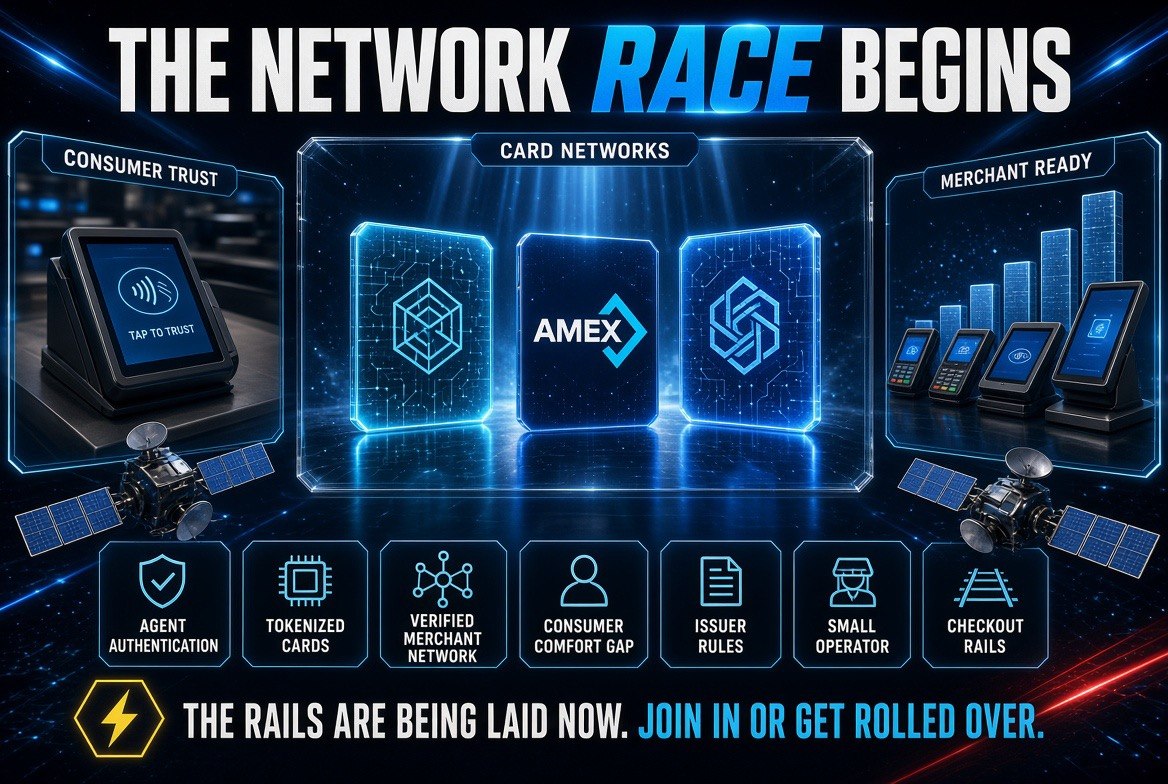
The network race in one frame: Amex lined up against the other card networks, a checkout terminal at close range, and a rising wall of merchant terminals showing who has to be ready first.
The Four-Step Agentic Readiness Checklist for a Small Business
You do not need to wait for the standards war to settle. Four moves cover the practical exposure, and none of them require an enterprise budget or a developer on staff.
1. Audit your product data as an agent would read it
Pull up your top twenty SKUs and read the listings the way a machine parses them: title, attributes, dimensions, stock status, price, variants. Agents select on structured fields, and an ambiguous size chart or a missing material field is not a design flaw — it is a disqualification. This is the single highest-leverage hour you can spend this quarter.
2. Decide your agent-payment posture before a customer forces it
Check whether your payment gateway and POS already support tokenized agent credentials, and whether your processor can tell an agent apart from a card-testing fraud bot. If the answer is “not sure,” that is your answer. Call the processor and ask the question directly.
3. Rework fraud rules that were written for human buying patterns
An agent that checks out in ninety seconds at 3am with a clean billing match is not inherently fraudulent — it is a well-behaved bot. Rules tuned entirely to human browsing rhythms will reject legitimate agent orders and quietly hand your revenue to a competitor. This matters most for high-volume, low-value consumables, which is precisely where agentic buying arrives first.
4. Compete on the shortlist, not the storefront
If the three-option shortlist is generated before a human ever sees your brand, then the competition is for the model”s ranking signals: complete attributes, accurate availability, competitive landed price, review volume and recency, and fast, predictable fulfillment. Build the business case for each of those the same way you would build a case for a sign on the front door.
What This Means for the Operator Who Never Wanted a Tech Problem
Here is the honest read. Most independent business owners did not ask for agentic commerce, and the framework Amex published is not written for their benefit — it is written for a payment network that wants its rails to be the default ones. But the shift is real, the adoption numbers are already substantial, and the compliance surface has arrived whether or not the demand has.
The businesses that come out ahead in this transition are not the ones that implement the cleverest agent strategy. They are the ones whose product data is clean enough to be machine-read, whose checkout can accept a credential that was not typed by a thumb, and whose fulfillment promises are boring in the best way. That is the entire game, and it is available to a five-person shop just as much as to a national chain.
The alternative is discovering in two years that a meaningful slice of your category”s purchasing moved to a channel you never joined, and that the shortlist had been decided without you for a year before anyone told you.
Frequently Asked Questions
What is Amex”s Intent Intelligence Framework?
It is a framework published by American Express on October 13, 2026 that sets out how the company intends to handle purchases made by AI agents acting on a cardholder”s behalf. Amex”s announced Agent Purchase Protection applies only when the agent is registered through its ACE developer kit and the cardholder”s purchase intent has been authenticated.
Does Amex”s Agent Purchase Protection cover every AI shopping mistake?
No. By design it is narrow. If the purchasing agent is not registered with Amex through ACE, or the cardholder”s intent was never authenticated, the announced protection does not apply — even if the bot bought the wrong size, the wrong quantity, or something the customer never requested.
How many consumers actually let an AI agent buy for them?
Amex”s own research found 52% of people are comfortable letting an AI agent purchase everyday, low-cost items, but that drops sharply to 15% for high-value purchases such as electronics and appliances. Consumption expectations are tiered by risk, and low-value replenishment is where adoption starts.
Do I need to accept crypto or some new payment type?
No. Agentic payments use tokenized payment credentials scoped to a specific agent, with spending limits and merchant-category restrictions — the same underlying card rails you accept today. The change is in verification and authorization, not in the currency.
What is the single most important thing a small business should do now?
Clean up your structured product data. Agents select on machine-readable attributes: accurate titles, dimensions, materials, availability, variants, and price. Incomplete data means the agent cannot confidently pick you, regardless of how good your actual product is.
What is the difference between Visa”s and Amex”s approach?
Visa entered earlier — Trusted Agent Protocol in October 2025 and the Intelligent Commerce platform — and focuses on letting merchants verify that an agent is legitimate. Amex”s structural difference is that it operates as issuer, network, and acquirer at once, giving it end-to-end visibility from agent registration through dispute resolution. Mastercard”s Agent Pay uses registered agents and agentic tokens tied to consumer authorization.

About Barak Schurr
Barak Schurr built and sold a major ticketing platform, ran global nightlife operations at Eventbrite, and now spends his time figuring out which AI tools actually move the needle for independent business owners — and which ones are just noise. No hype. No fluff. Just what works.
Email: [email protected]
More AI Resources for Your Business