Get The Solo Business OS — Free
The AI workflow that replaces a part-time employee for solo operators and small business owners.
Extend’s AI Receipt Agent: The Boring AI That Saves You Real Money
⚡ Expert Summary: New York-based spend management platform Extend launched its AI Receipt Agent this week, and the story is not the automation. It is the constraint. The agent reaches into an employee’s Gmail or Outlook, finds the receipt that matches a card transaction, and then stops — a finance team member reviews and approves every match. Extend’s CEO Andrew Jamison put it plainly: “In finance, trust is earned with the boring stuff first.” The company powers billions in transaction volume and counts more than 10,000 business customers. For a US small business with a bookkeeper who spends Friday afternoons chasing missing receipts, this is the first credible sign that agentic finance is arriving in the least glamorous place it could — and that is exactly why it will work.
Most AI product launches in 2026 are designed to be demoed. This one is designed to be audited.
That distinction matters more than it sounds, because the small business owner reading this is not shopping for a robot. They are trying to close last month’s books, and the missing piece is a pile of receipts that exist somewhere between an employee’s inbox and a card statement that was already paid. If you run a business with more than a couple of people putting expenses on a company card, you already know the ritual: the statement closes, the receipts do not all match, and somebody spends an afternoon on email archaeology instead of on customers.
Extend’s answer is an agent that does the archaeology. The interesting part is what it refuses to do afterward.
What the Extend AI Receipt Agent Actually Does
Strip the announcement language away and the product is three behaviors in sequence.
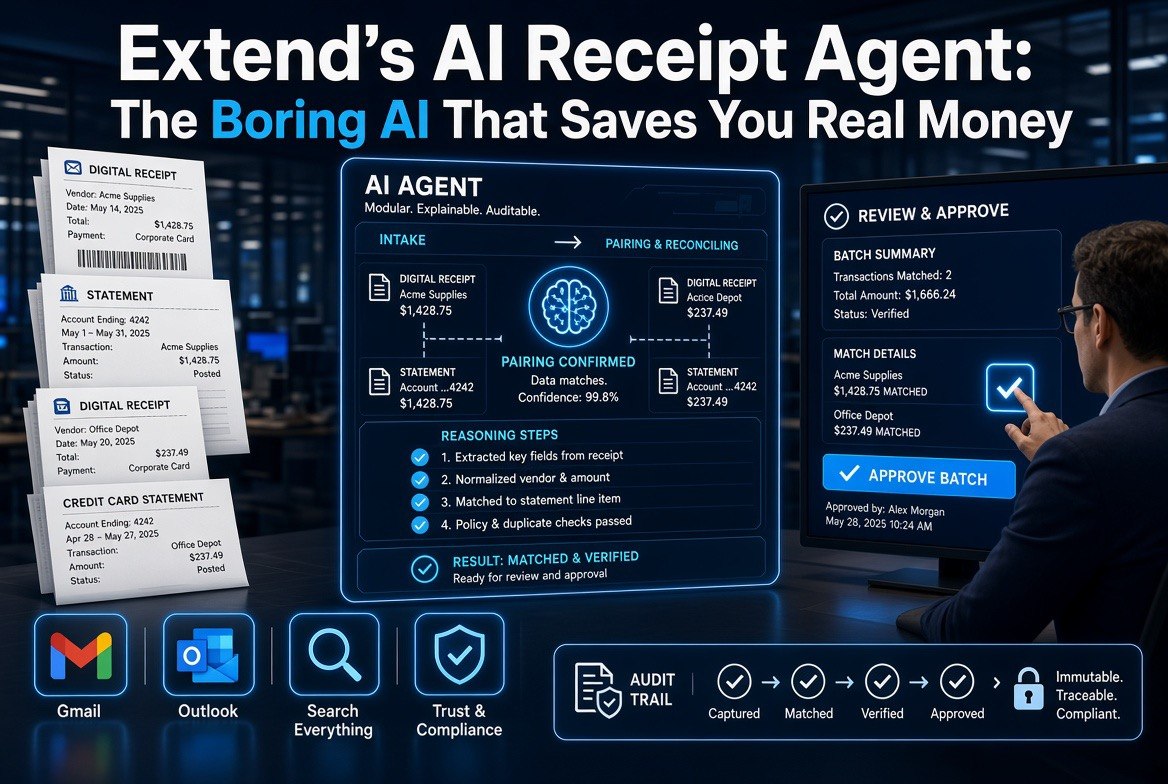
It searches. The agent retrieves receipts automatically from employees’ Gmail or Outlook accounts, using the same security and access controls that already protect the company’s spend data on the Extend platform. It is not asking employees to forward anything or photograph a paper slip. It reads the inbox where the receipt already landed.
It matches. Receipts get paired with the card transactions they correspond to, and every match is explainable — a finance team member can see what the agent matched and why.
It stops. Reviews and approvals stay with the finance team. The agent does not approve an expense, does not reclassify a transaction, and does not decide that a $340 dinner receipt is close enough to a $340 charge from a similarly named restaurant. It surfaces its work and hands it back for a human signature.
That third behavior is the one to pay attention to. Companies that sell AI into finance departments are competing on how much the model can be trusted, and Extend’s pitch is explicitly that less is more: automate the search, keep the judgment.
| Step | What the Agent Handles | What a Human Still Owns |
|---|---|---|
| Receipt retrieval | Automatic search of employees’ Gmail or Outlook accounts under existing access controls | Granting and revoking that mailbox access; deciding which roles are in scope |
| Transaction matching | Pairing receipts to card transactions and explaining every match it made | Correcting bad matches; adjudicating ambiguous cases with the employee |
| Review and approval | Nothing — the agent is designed to stop here | Every approval. Finance teams remain in control of each decision by design |
| Rollout | Deployed to bank partners; pilot spans small, mid-market, and enterprise businesses | Availability timeline; Extend expects expansion through the rest of the year |
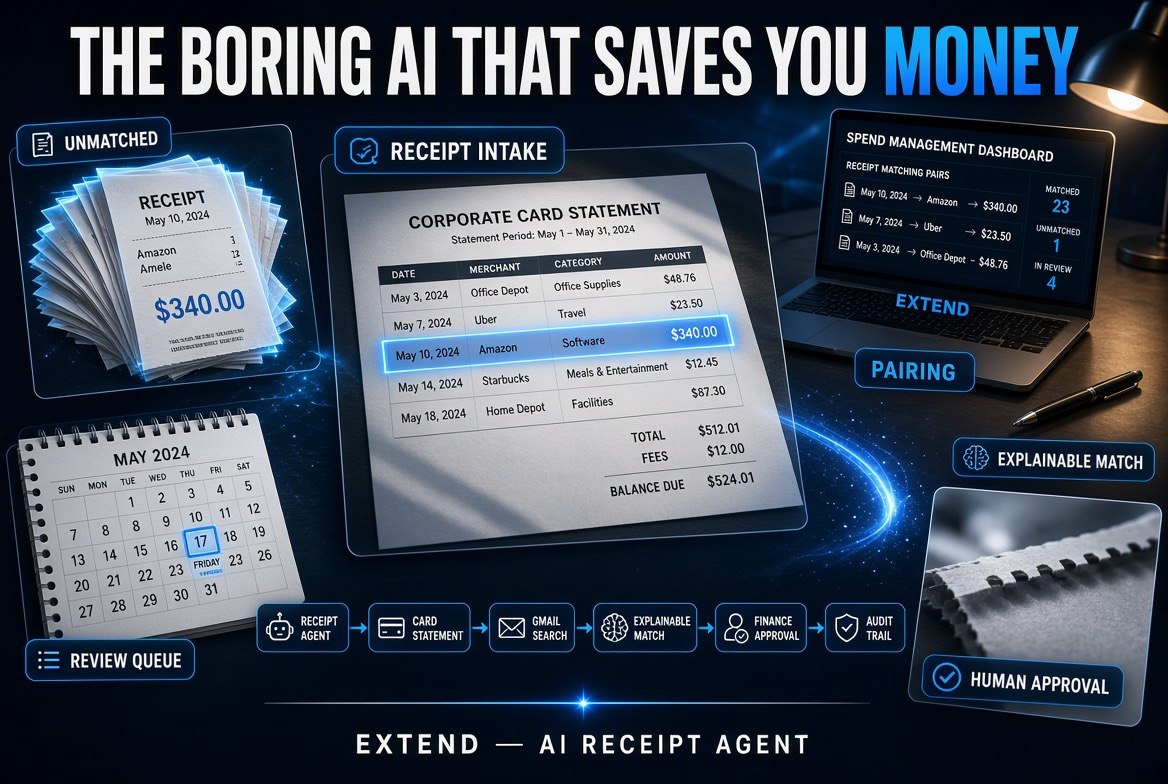
The Receipt Agent’s whole job in one frame: pull the receipt in, pair it to the card line, explain the match, then hand it to a human.
Why “Trust Is Earned With the Boring Stuff” Is the Real Headline
Jamison’s framing deserves a slow read, because it is a direct answer to the objection every owner has when an AI tool asks for inbox access.
“Every business owner we talk to wants AI to take the tedious work off their plate, and every one of them also wants to know exactly what it’s doing with their data,” he said. “We don’t think those two things are in conflict.”
Then the second half, which is the part most vendors skip: “As a small business ourselves, we want the same thing: tools that make the busywork disappear without creating new risk. That’s why we are building all of our AI agents to handle the routine work well and to show their work at every step.”
“Show their work” is a specific engineering commitment, and it is the opposite of how most automation is sold. A black-box matcher that is right 90% of the time creates a new job: auditing the robot. A transparent matcher that explains each pairing and lets you correct it removes the audit burden, because you can verify a handful of matches and trust the pattern.
Jamison’s closing line on the same theme is the philosophical position in one sentence: “In finance, trust is earned with the boring stuff first. The technology to automate far more of this work already exists. What’s harder is earning the right to be trusted with it. We would rather show our work and go slower than move fast and lose that trust, and we think that’s exactly the approach banks need as they bring AI to their business customers.”
For a small operator, that is a vendor telling you where it expects to be weak first, which is more useful than a vendor telling you it has no weaknesses at all.
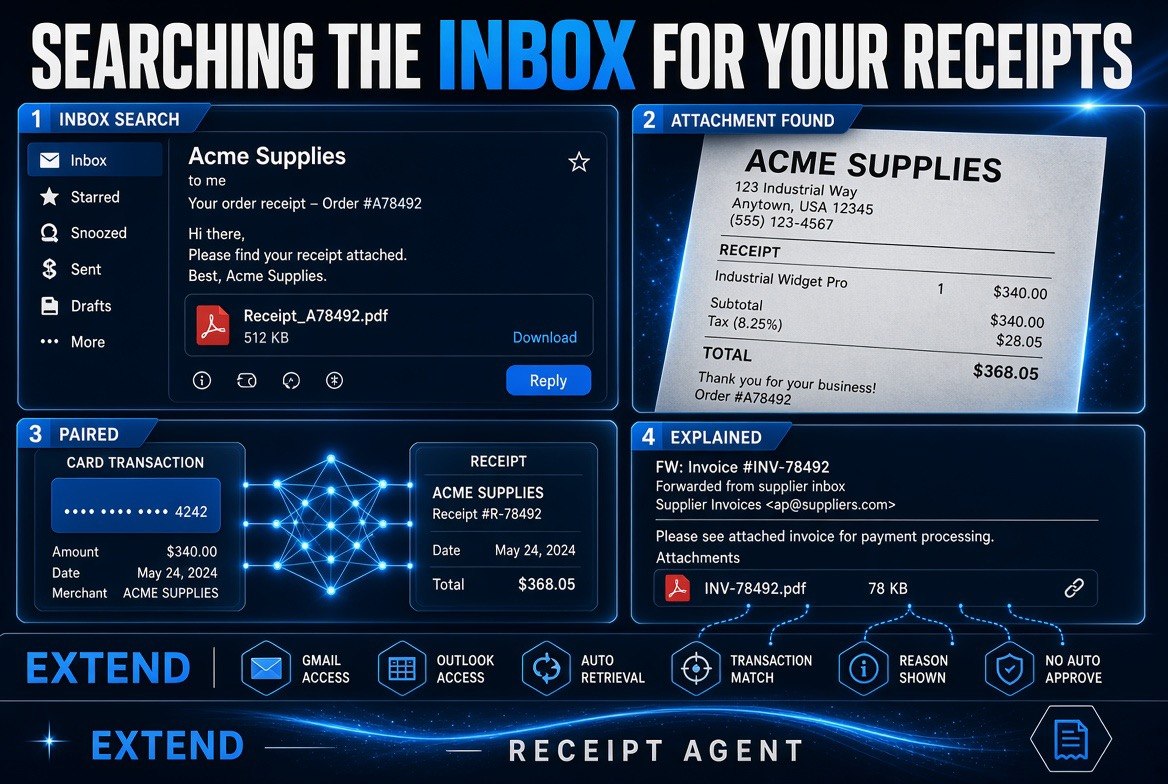
Search the inbox, find the attachment, pair it to the card line, and show the reasoning — the agent does the first three, your finance team owns the last word.
The Channels Question: Why This Ships Through Banks
The single most instructive detail in the announcement is not about receipts. It is about distribution.
Extend is not selling this to you directly. The AI Receipt Agent is an offering for the company’s bank partners, and the company says it will keep working with those partners to introduce AI capabilities into their business banking offerings, initially focusing on the areas where automation is most effective and easiest to verify.
Read that as a map of how agentic finance will arrive in your business. It will not show up as a standalone app you decide to install on a Tuesday afternoon. It will appear as a new line item inside a dashboard you already log into, attached to the corporate card you already use, administered by the bank relationship you already have.
That has three practical consequences for an American small business owner right now.
First, your bank is your installation channel, whether you wanted one or not. Before you evaluate any AI finance feature, it is worth asking your business banker what is in the pipeline. The features are coming through a relationship you already own.
Second, verification is the gating factor, not capability. The announcement is explicit that rollout concentrates first on work that is “most effective and easiest to verify.” Receipt matching qualifies because a match is objectively right or wrong — the receipt either says $340 or it does not. Expense coding and cash forecasting will follow more slowly, because those judgments depend on the business’s own conventions.
Third, scale is the whole point of the bank-channel model. A tool that fully automates reimbursements for a 20-person company is not a transformational business by itself. The same tool switched on for a bank’s entire business-banking customer base is a different conversation — which is why Extend counts more than 10,000 business customers and powers billions in transaction volume as the foundation of the pitch, not the pitch itself.
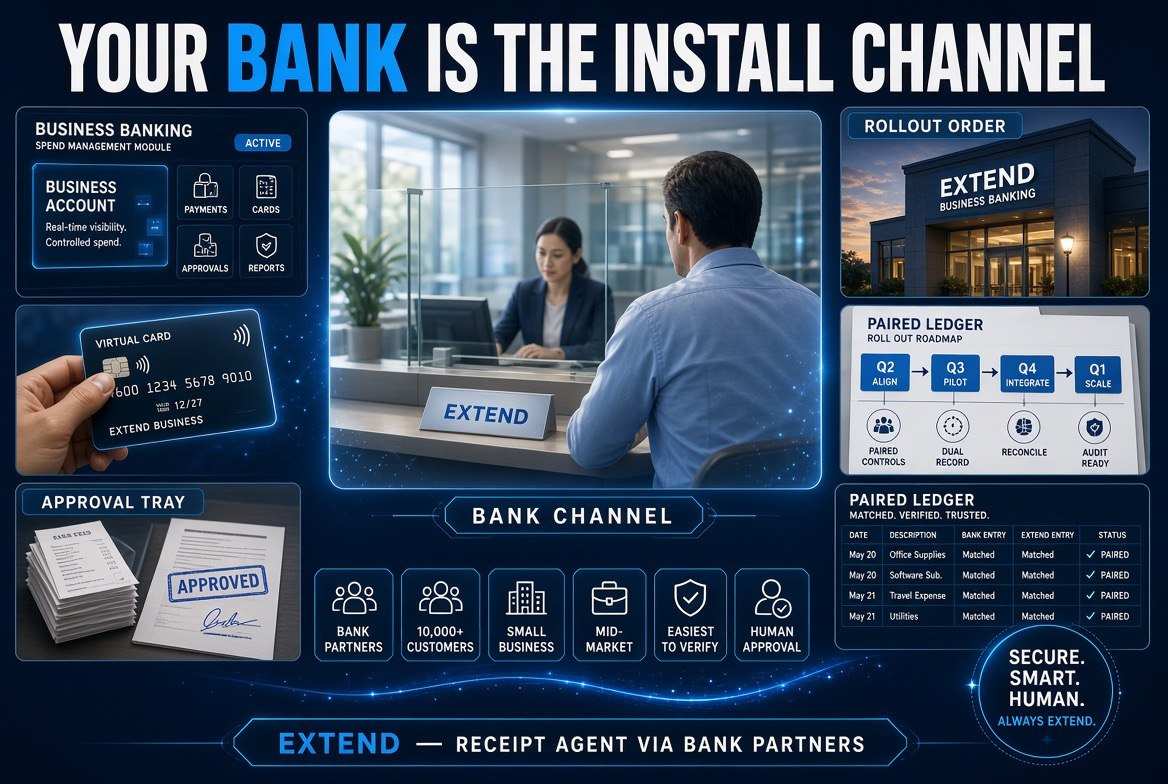
The install channel nobody advertises: the agent shows up inside the business-banking dashboard you already log into, not as an app you go find.
What Changed, and What Did Not
It is worth being precise about the size of this step, because there is a temptation to file it under “AI does everything now” and move on.
Three things genuinely changed with this launch. Automatic retrieval from Gmail and Outlook means the receipt no longer has to be a manual upload — the agent goes and finds it. Explainable matching means a finance team can verify the agent’s reasoning instead of accepting an opaque answer. And a pilot that spans small, mid-market, and enterprise businesses at once means the small end of the market is not waiting behind the enterprise deployment, which is unusual and worth noting.
Three things did not change. Approvals are still human. The agent still cannot classify an expense under a rule it was never given. And the underlying hard problem — hunting down a receipt that was never emailed in the first place, or was printed and handed to someone who has since left the company — is untouched by better search. An agent that looks in the inbox cannot find what was never in the inbox.
That last limitation is not a criticism. It is the honest boundary of the product, and knowing where it sits is how you decide whether the tool is worth turning on.
Build vs Buy vs Wait: What an Operator Should Actually Do
There is a real decision here, and it is not “should I adopt AI in finance.” It is which of three postures to take, based on the shape of your own bookkeeping.
| Factor | Build In-House | Buy / Adopt From Your Bank | Wait One Quarter |
|---|---|---|---|
| Who owns mailbox access | You, permanently — including the security burden and the audit trail | Your bank’s existing controls, the same ones already protecting spend data | Nobody, which is the point |
| Time to working | Weeks to months plus ongoing maintenance | Turned on inside a platform you already use | Zero now; still zero later unless you revisit |
| Best fit | Businesses with unusual workflows and technical staff to spare | Businesses with repeat card spend and several people submitting expenses | Businesses whose expense volume does not yet justify the change |
| Main risk | You built a matcher that is wrong quietly | You approve a match you never actually read | A competitor closes its books in a day and you never notice |
For most independent businesses, the second column is the answer, and the reason is unglamorous: the security and access controls already exist, and you are not adding a new vendor to your life. The work to do before you switch anything on is not technical.
1. Clean up who has a company card. An agent that matches receipts to transactions is only useful if the list of authorized spenders is current. Start there, this week, before any software question.
2. Decide your receipt policy in writing. The agent finds what exists in the inbox. If your team is not consistently getting receipts into email, the best matcher in the world still returns a blank. A one-paragraph rule — every purchase over a set amount gets a receipt emailed the same day — does more than any tool upgrade.
3. Ask your banker one specific question. Not “do you have AI features,” but “which AI finance capabilities are you rolling out to business banking customers, and in what order?” The answer tells you what is arriving on your dashboard and roughly when.
4. Keep the approval step human on purpose. The temptation after a month of clean matches is to let it auto-approve. Do not. The value of this design is that a person signs off, and that is also your protection if a match is wrong.
None of that requires a purchase. It requires deciding, in advance, what you are willing to hand over — which is the same question every AI tool in your business is quietly asking you.
Frequently Asked Questions
What is Extend’s AI Receipt Agent?
It is a tool from spend and expense management platform Extend that automatically finds receipts in employees’ Gmail or Outlook accounts and matches them to company card transactions, while leaving every review and approval decision with the finance team. It was announced on October 15, 2026, primarily as an offering for Extend’s bank partners.
Does the agent approve expenses on its own?
No, and that is deliberate. Extend positions the Receipt Agent as handling the searching and matching while finance teams remain in charge of reviews and approvals. Every match is explainable so a person can see what was matched and why, then correct it when needed.
Where does the agent get my receipts from?
From employees’ Gmail or Outlook accounts, using the same security and access controls that already protect the company’s spend data on the Extend platform. Employees do not need to forward or re-upload anything — the agent searches the inbox where most receipts already arrive.
Who can actually use this right now?
Availability is running through Extend’s bank partners. The pilot spans small, mid-market, and enterprise businesses alike, and the company expects to expand availability through the rest of the year. If you are a US small business owner, your most useful first step is asking your business banker what is in the pipeline.
Is this worth it for a business that only has a few card holders?
Probably not yet. If expense volume is low enough that reconciling takes a few minutes a month, the change is not worth the effort. It starts paying off when receipts regularly go missing across several people and someone is spending hours per month chasing them down.

About Barak Schurr
Barak Schurr built and sold a major ticketing platform, ran global nightlife operations at Eventbrite, and now spends his time figuring out which AI tools actually move the needle for independent business owners — and which ones are just noise. No hype. No fluff. Just what works.
Email: [email protected]
More AI Resources for Your Business