Get The Solo Business OS — Free
The AI workflow that replaces a part-time employee for solo operators and small business owners.
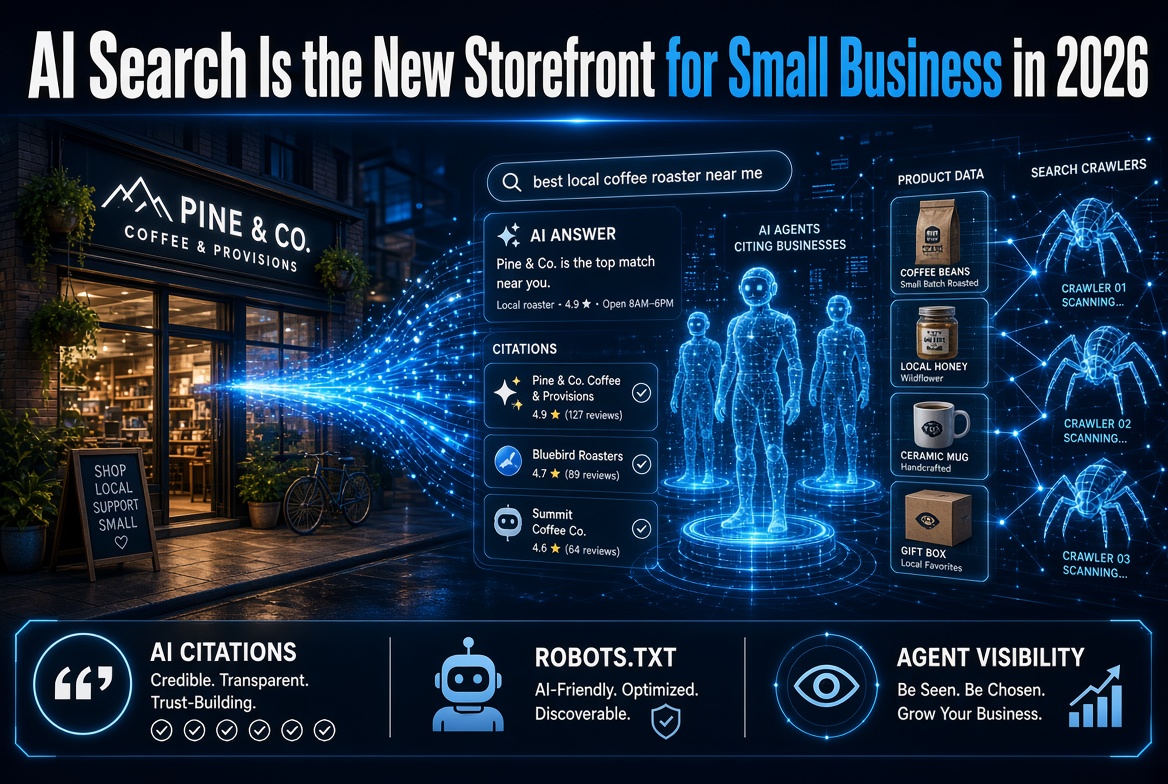
AI Search Is the New Storefront for Small Business in 2026
⚡ Expert Summary: The way customers find a business changed underneath the businesses themselves. AI assistants now answer the question that used to send someone to Google and then to a website — and behind that answer sits an invisible infrastructure decision most owners never noticed. On September 15, 2026, Cloudflare forced every AI company to declare whether its crawler exists to index search results or to train models, with publisher sites blocked by default if the crawlers stayed ambiguous. That deadline turned crawl access — a line in a text file — into a live business decision. This guide covers what actually changed, why being cited inside an answer is worth less than being linked but more than being invisible, and the exact steps a small business should take this week.
There is a version of search that most small business owners still carry around in their heads. Someone types “best plumber near me,” Google shows ten blue links, they click one, they call. The whole model of local marketing was built on that sequence — the ranking, the click, the visit, the conversion — and every dollar spent on SEO made sense inside it.
That sequence is being replaced by a shorter one. A customer asks an assistant a question, the assistant answers with a paragraph that names two or three businesses and links to fewer, and the customer calls whichever name sounded most authoritative. No ranking to check. No page visit to measure. No obvious way to know it happened.
What makes this moment worth writing about is not that AI search exists — it has existed in some form since 2023. What makes it worth writing about is that as of September 15, 2026, the plumbing underneath it became a decision that business owners are being forced to make, often without realizing there was a decision at all.
What Cloudflare Actually Changed on September 15
On July 1, 2026, Cloudflare announced a policy giving AI companies until September 15 to segregate their web crawlers by purpose. A crawler used to index pages for search results had to be declared separately from a crawler used to train a model or to power an autonomous agent. Any crawler that did not clearly declare itself would be blocked by default across the millions of publisher websites that sit behind Cloudflare’s network.
Cloudflare sits in front of a large share of the commercial web, including a substantial portion of small business websites. When Cloudflare changes a default, that default becomes the effective policy of every site that never configured an override — which is most of them.
The reasoning is straightforward once you separate the two jobs a crawler can do. Indexing a page so a user can find it and click through is a trade: you get visibility, the platform gets content to organize. Training a model on that same page is not a trade in the same sense — the page becomes training data, the model can then answer the same question without anyone visiting. Publishers were never given a clean way to say yes to the first and no to the second, because for years one bot did both.
September 15 offered that separation. It also created a new failure mode that has nothing to do with strategy and everything to do with neglect.
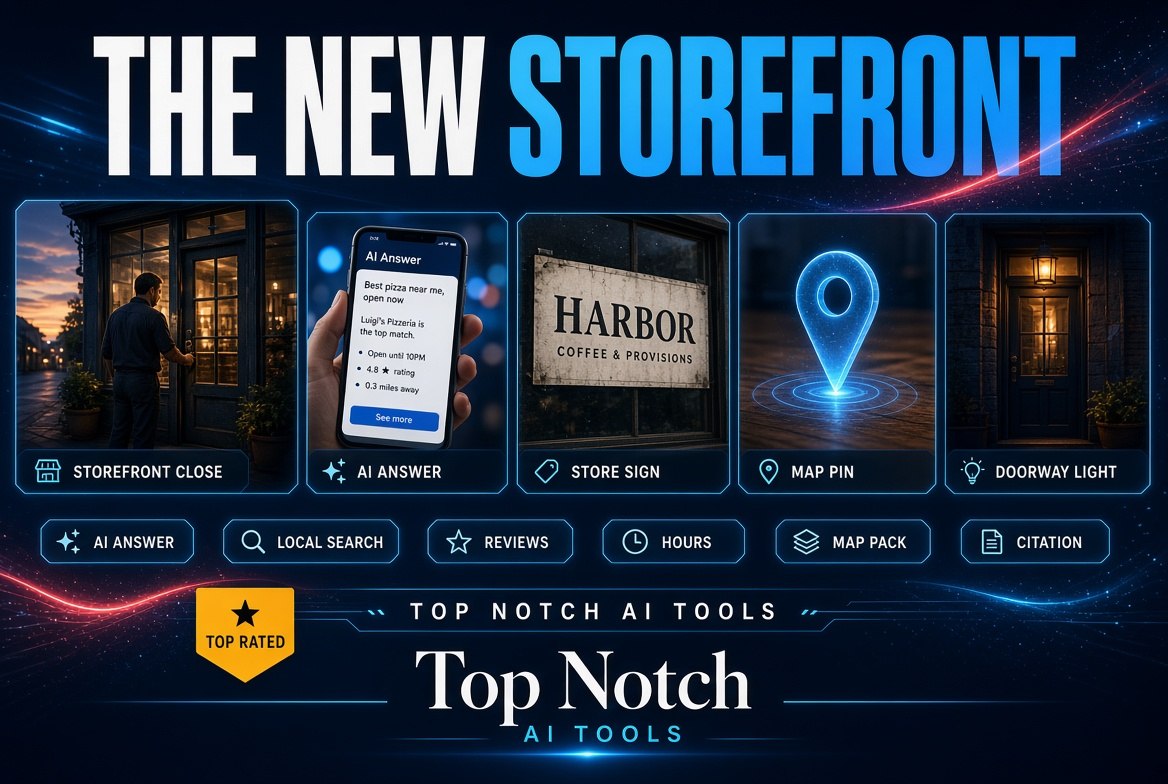
The Default Is Not Neutral
Here is the part that catches owners off guard. When crawl settings are left alone, the result is not a sensible middle ground. Depending on the platform, the plan, and the bot management configuration in place, a site can end up restricting exactly the crawlers it most wants access from — the ones powering the assistants customers actually use.
There is no notification. Nothing breaks. The site loads fine in a browser, ranks in Google as it always did, and looks completely healthy from the inside. The only symptom is an absence: fewer citations than a competitor, no referral traffic from AI assistants, and no data point that says so.
The pattern repeats in owner conversations. Someone discovers, months in, that their site has been invisible to a major assistant since some configuration change nobody remembers making. The fix is usually a toggle. The cost is measured in the traffic that never arrived.
[PENDING INLINE IMAGES]
Being Cited Is Not Being Linked
It is tempting to treat an AI citation as the new version of a search ranking. It is not, and the difference matters for how you spend money.
A search ranking produces a click. The click is the product — someone lands on your page, you get their attention, you can measure the visit, retarget them, and count the conversion. A citation produces a sentence. Your business appears inside an answer that the customer reads and acts on, sometimes without ever leaving the assistant.
That makes citation valuable but structurally weaker than a link. You are renting attention rather than owning it. The upside is that a citation carries borrowed authority — an assistant that names you is implicitly vouching for you, which is why a single confident mention can outperform a page-one ranking for some kinds of local intent.
The practical consequence: citation is a reach play, not a traffic play. Optimizing for it with the same dashboard you use for organic search will make you think it is failing when it is working.
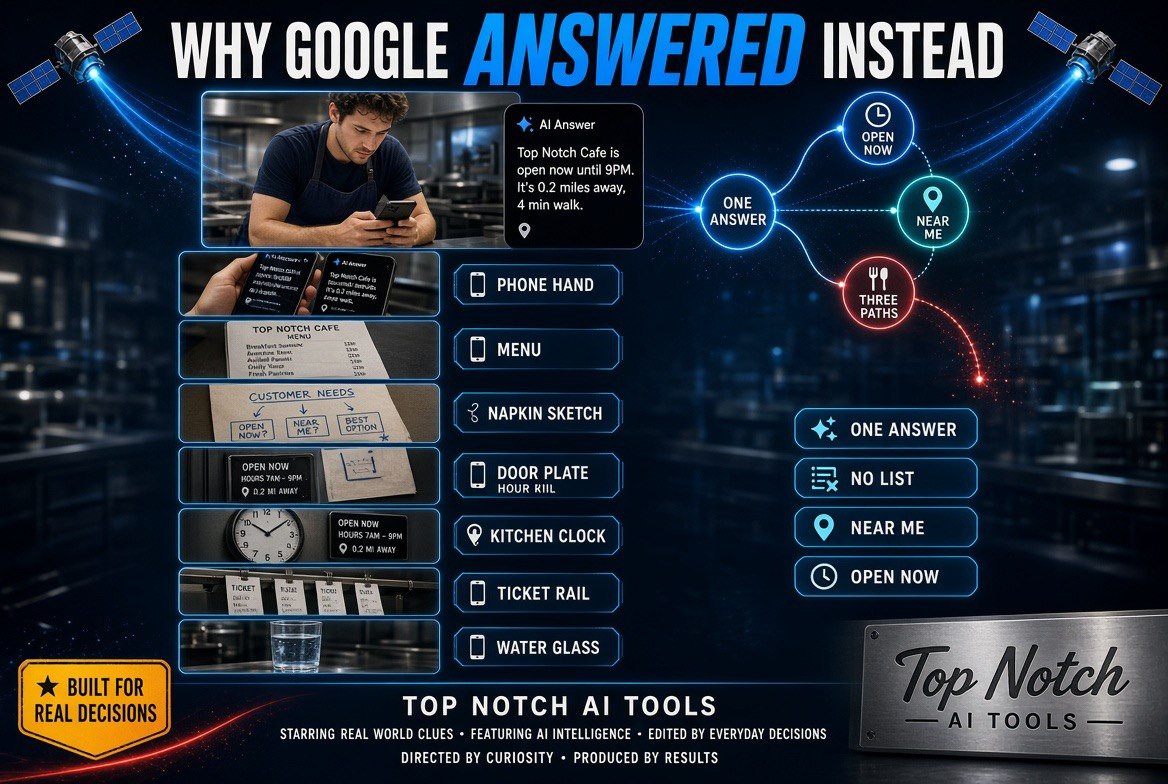
Four Crawler Types and What Each One Means for You
The word “AI crawler” collapses four different things that behave differently and deserve different answers.
| Crawler type | What it does | What you get | Sensible default |
|---|---|---|---|
| Search indexer | Fetches pages so an assistant can cite them in answers | Visibility inside responses | Allow |
| Answer fetcher | Retrieves a specific page when a user asks about it | A live citation on demand | Allow |
| Training crawler | Collects content for model training | Nothing direct; long-term market positioning | Judgment call |
| Agent crawler | Acts for a user — browsing, comparing, transacting | Inclusion in automated purchase decisions | Allow if you sell online |
Most owners answer all four with one toggle and wonder why results are inconsistent. The first two exist to send people to you. The third exists to reduce the need for people to come to you. The fourth depends entirely on whether your business can transact without a human in the loop.
Blocking, Allowing, and the Third Option Nobody Talks About
Public discussion has flattened into two camps — block the scrapers or let everything through — but the operators getting results are doing something less dramatic.
They allow the crawlers that produce citations, allow agent crawlers if they sell online, and treat training access as a separate commercial question rather than a moral one. It is not a position that generates headlines. It is a position that generates phone calls.
The blocking camp has a legitimate grievance. Content costs money to produce, and a model trained on it can answer the reader’s question without the reader ever arriving. Large publishers can afford that fight; they have legal teams and traffic they can afford to lose. An independent business with a five-page site and a service area has almost nothing to gain from a standoff it cannot win and a great deal to lose by being absent from the answers.
Which is the trap: the blocking strategy that makes sense for a national newsroom is actively harmful for a plumber in Ohio, and both are being discussed in the same breath.
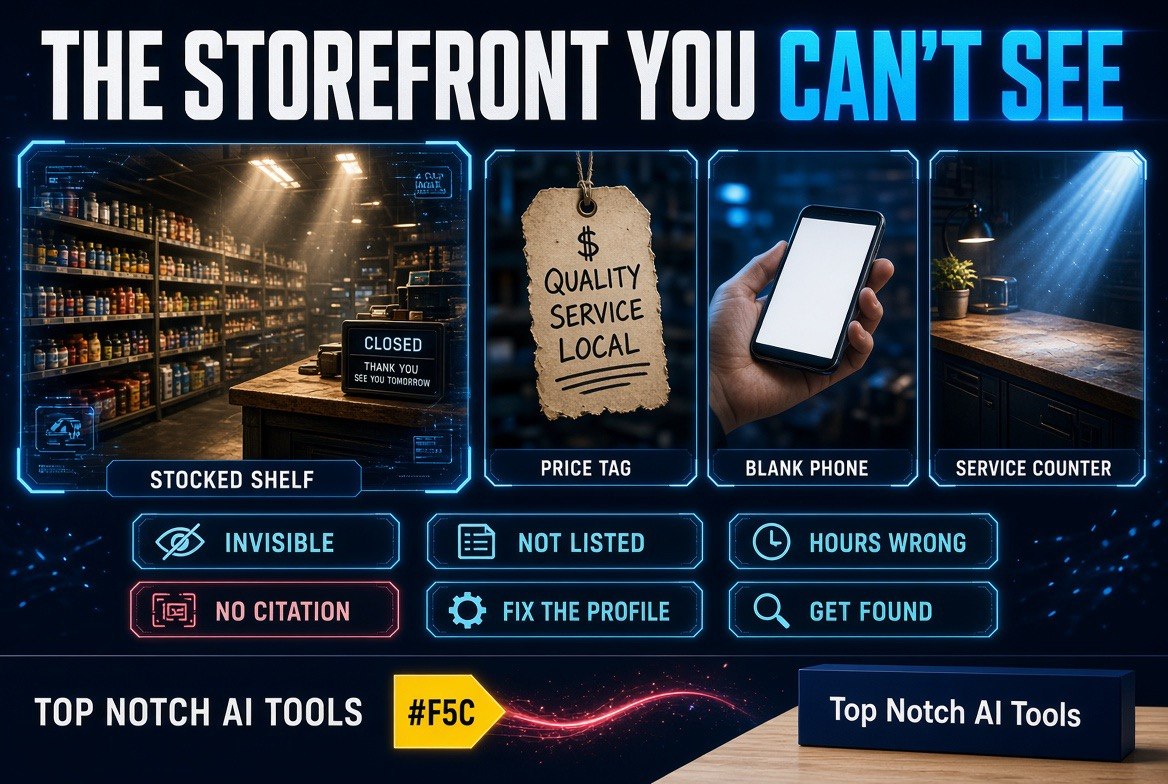
What to Check This Week
None of this requires a consultant. It requires an hour and a willingness to look at something you have never looked at.
Start with your robots.txt. Fetch it in a browser by adding /robots.txt to your domain. If there is a block that disallows a named AI crawler, you or a plugin put it there — and if you cannot explain why, that is the first thing to fix.
Then check your platform layer. If your site sits behind Cloudflare, the bot management and AI crawl control settings live in the dashboard. Look at each crawler’s state rather than assuming the default is what you want. Do the same if you use a host with a built-in security layer, since those increasingly ship with their own bot defaults.
Finally, verify from the outside. A crawler request that returns a block page is a crawled site that becomes an uncited one, and the only way to know is to ask your host to confirm the status or check the crawler analytics your platform exposes.
| Check | Where | What good looks like | Time |
|---|---|---|---|
| robots.txt | yoursite.com/robots.txt | No unexplained AI disallows | 2 min |
| Bot management | Cloudflare dashboard | Search crawlers set to allow | 10 min |
| Crawler analytics | Cloudflare or host panel | Requests arriving, not all blocked | 5 min |
| Referral source | GA4 or analytics | AI referrers tracked as a segment | 20 min |
The Measurement Problem That Will Bite You
If you fix your crawl settings tomorrow, your analytics will still tell you almost nothing. Most AI assistants strip the referrer, so the visit shows up as direct traffic or as nothing at all. A customer who found you through an answer and called your number leaves no trail.
This is a solvable problem, but not by staring at a dashboard. It is solved by asking. Add a question to your intake — “how did you hear about us” — and record the answer. Over a quarter, the pattern becomes visible: a slow rise in people who cannot name a source but describe a conversation they had with an assistant. That is the signal.
The alternative is what most businesses do, which is assume AI search is not working because it does not appear in the channel report, and then spend money on the channel that does.
Why This Is Harder for Small Business Than for Anyone Else
Enterprise companies have someone whose job includes reading the Cloudflare changelog. Independent businesses have someone who also does payroll, hiring, and the thing they actually sell.
That asymmetry is the real story. The infrastructure layer has complicated itself considerably, and the burden of understanding it has been distributed to people with the least time to spend on it. A default that a platform engineer would catch in ten minutes becomes, for a small operator, a year of invisible absence.
There is also a competitive angle nobody says out loud. Every business that leaves its crawl settings neglected is a slot in the answer that a competitor can occupy. Not because the competitor is smarter, but because someone at that company opened a settings page once.
The Play, Stated Plainly
Allow the crawlers that cite you. Keep the content that earns citations specific, structured, and answerable. Track the referrals you can and ask about the ones you cannot. Revisit the settings every quarter, because the defaults keep moving.
That is not a growth hack. It is the maintenance work of existing in a discovery channel that most businesses have not yet noticed they are part of. The owners who notice early will hold an advantage that looks like luck from the outside and was actually a Tuesday afternoon spent reading a settings page.
Frequently Asked Questions
Does blocking AI crawlers hurt my Google rankings?
Not directly. Google’s search indexer and Google’s AI training crawler are separate user agents, and blocking the latter does not remove you from search results. The risk is indirect: some AI answers are built on search indexes, so a broader block can reduce how often you surface in assistant responses.
Will allowing AI crawlers cost me traffic?
It can, in one specific scenario — if a model can reproduce your content well enough to answer the question without a visit. For local service businesses, this is largely theoretical, because what makes the customer call is proximity and trust rather than information. For publishers whose product is the article itself, the trade is real.
What did Cloudflare change in September 2026?
Cloudflare required AI companies to separate search-indexing crawlers from training and agent crawlers by September 15, 2026, with unclassified crawlers blocked by default across participating publisher sites. The practical effect was to force crawl access into an explicit decision rather than an inherited default.
How do I know if AI assistants are citing my business?
Ask the assistants directly. Run the questions your customers would ask and see whether you appear. Do it monthly, in the same way you would check a ranking — because that is what it is replacing.
Do I need a new tool for this?
No. Your robots file is a text document, and bot settings live in your hosting or CDN dashboard. Tools exist for tracking brand mentions in AI answers, but none of them are required to fix a blocking default that should not be there.
What if I do not have a website at all?
Then there is nothing for an assistant to cite, and this entire channel is closed to you. A minimal site with clear service descriptions, a service area, and contact details is the entry cost.

About Barak Schurr
Barak Schurr built and sold a major ticketing platform, ran global nightlife operations at Eventbrite, and now spends his time figuring out which AI tools actually move the needle for independent business owners — and which ones are just noise. No hype. No fluff. Just what works.
Email: [email protected]
More AI Resources for Your Business