Goldman Sachs Says 86% of Small Businesses Use AI. Almost None of It Is Wired In.
⚡ Expert Summary: Goldman Sachs surveyed US small businesses and found 86% of them now use AI. That number sounds like a victory lap. It is not. The same research shows very few of those tools are connected to anything that matters — the payroll system, the CRM, the books, the ordering stack — which means most owners are paying monthly fees for a chatbot that answers questions and then hands the work back to a human. The adoption war is over. The integration war has barely started, and the businesses that figure that out first will quietly eat the ones that don’t.
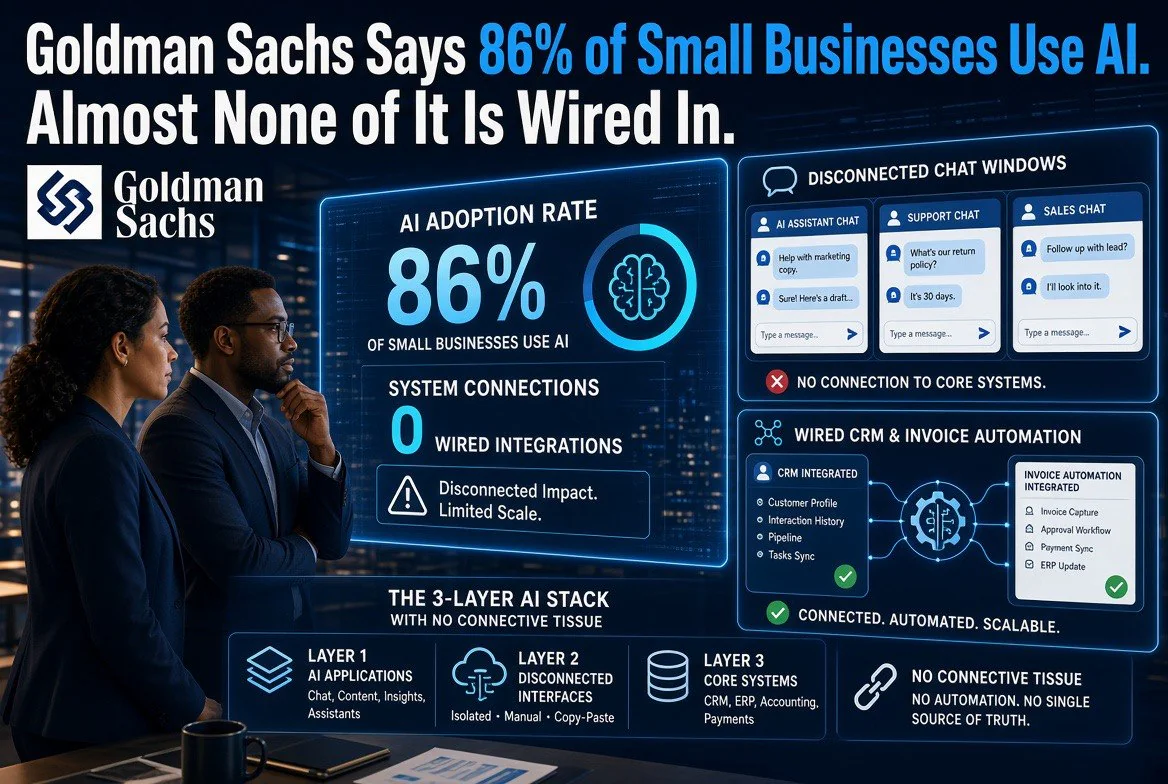
Here is a number that gets quoted in every vendor deck on Earth right now: 86%. That is the share of US small businesses using AI, according to Goldman Sachs research out this week. Reporters will write it up as the moment AI crossed over. Marketing teams are already screen-grabbing it.
Read the rest of the finding and it stops feeling like good news.
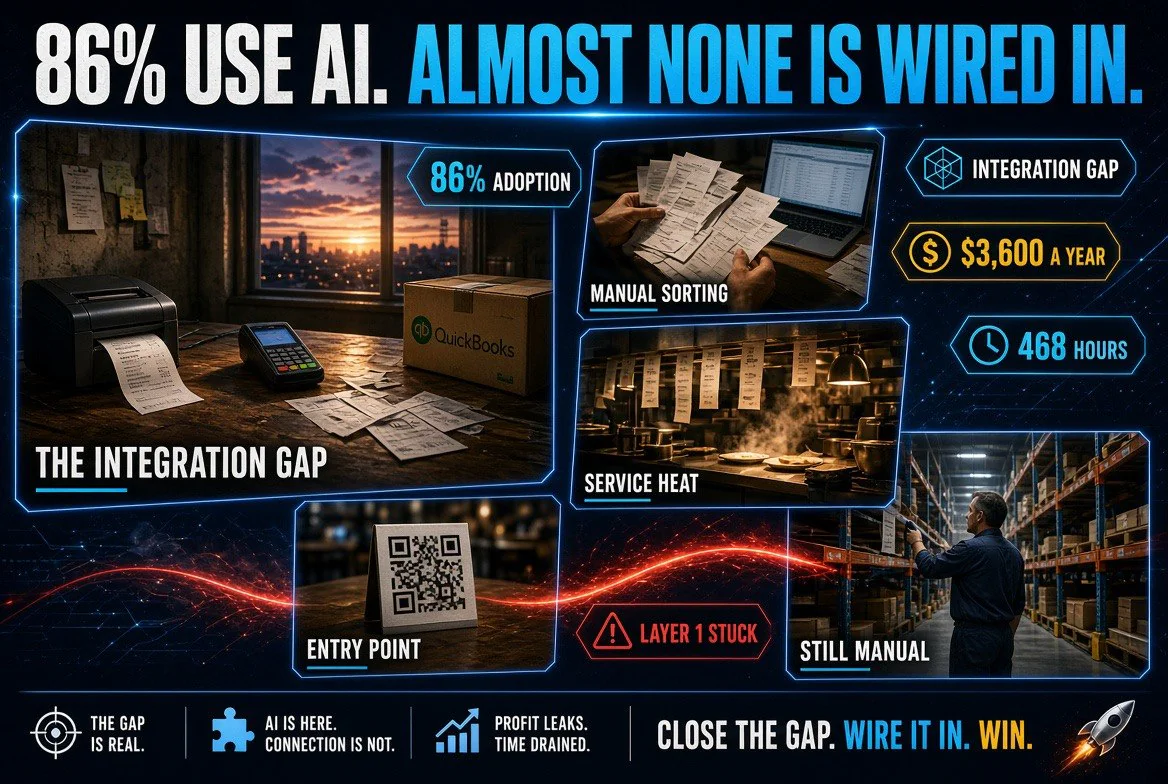
The same research describes a gap between using AI and operating with it. Owners have a ChatGPT tab open. They have a Grammarly subscription, a Canva plan, and probably three AI tools someone on the team signed up for and stopped touching in March. What they do not have — in the overwhelming majority of cases — is AI that is wired into the systems that actually run the business. No CRM enrichment. No invoice automation. No automated restock. No agent reading the support inbox and resolving the routine 60%.
That gap is the story. And if you run a small business in the US, it is the single most expensive thing in your business right now, because you are paying for capability you are not converting into hours or margin.
What “Wired In” Actually Means
The confusion comes from the fact that “using AI” describes about eight different things. A lawyer who pastes a contract into a chatbot is using AI. A distributor whose ERP proposes purchase orders from last quarter’s velocity data is also using AI. Both show up as a yes on a survey. Only one of them has changed how the company operates.
There is a practical test, and it takes about ten minutes. For each AI tool your business pays for, answer three questions:
1. Does it read real company data on its own? Not what you paste into it. What it can access by itself, on a schedule, without a human remembering to do it.
2. Does it write back? An AI that tells you what to do is a consultant. An AI that writes the record into your CRM, or posts the journal entry, or updates the stock level, is infrastructure.
3. If nobody opened it tomorrow, would the business notice by Friday? If the honest answer is no, it is a toy with a receipt attached.
Most small business AI stacks score zero on all three. That is the 86%-and-nothing-to-show-for-it problem in one sentence: enormous licenced capability, almost no connective tissue.
The Three Layers, and Why Almost Everyone Stops at Layer One
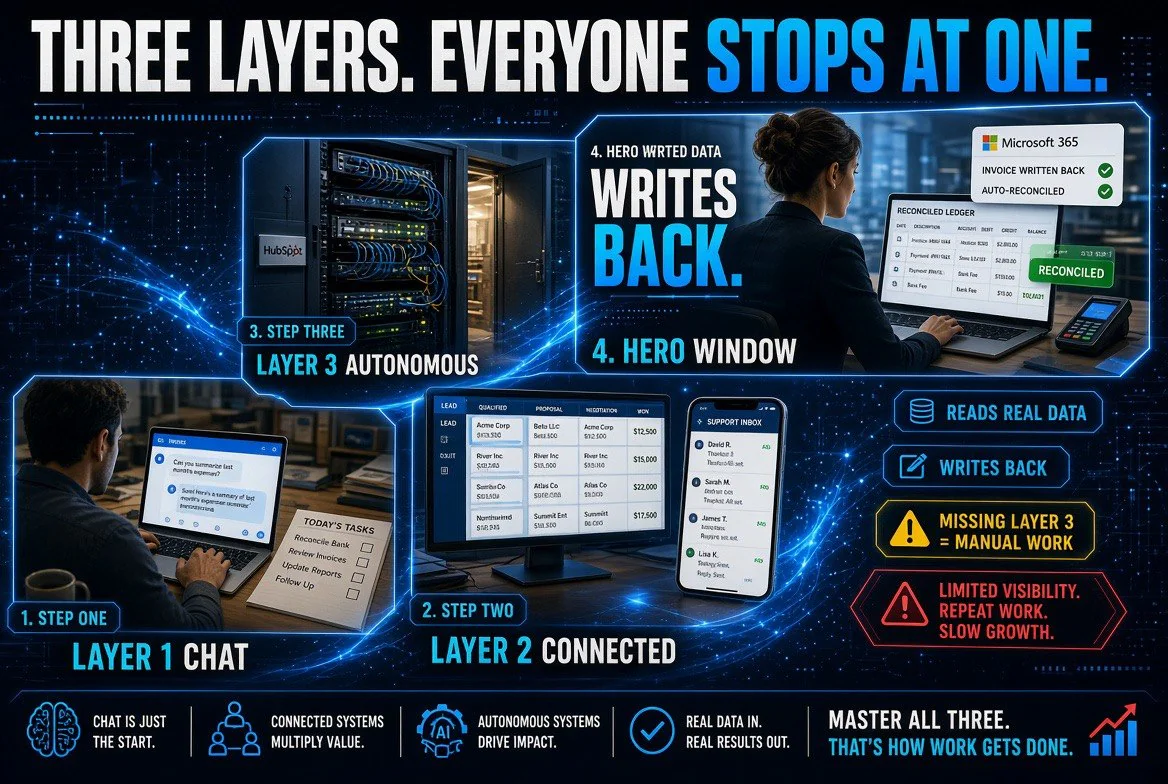
Every AI deployment in a small business lives in one of three layers. Each layer costs more to build than the one before it. Each layer is worth dramatically more than the one before it. And the jump between layer one and layer two is where most owners stall — which is precisely what the Goldman data is describing.
| Layer | What it looks like | What it costs | What it actually returns |
|---|---|---|---|
| 1. Chat | A browser tab. A person writes a prompt, copies the answer out. | $20–$30 per user per month | Faster drafting. Real, but capped by how much typing a human can do. |
| 2. Connected | AI reading from and writing to the systems of record — CRM, books, inventory, inbox. | $50–$500 per month in tooling, plus setup time | Hours back every week without anyone remembering to ask. |
| 3. Agentic | Multi-step work completed end to end, with checkpoints and escalation to a human. | $200–$2,000 per month, real engineering | A process that runs without a person in the loop for routine cases. |
| Reality check | Most small businesses are stuck in Layer 1 | They are paying Layer 1 prices | Which is why 86% adoption produces so little visible change |
Layer one is where the 86% lives. It is not worthless — a business that drafts proposals twice as fast is a better business. But layer one does not compound. You cannot stack four chat tabs and get an operation. The moment the person stops typing, the value stops.
Why Owners Get Stuck — It Is Not Laziness
The lazy explanation is that small business owners are slow adopters who fear technology. The Goldman finding does not support that at all. Eighty-six percent of them bought the thing. They are not resisting. They are stuck, and there are four real reasons why.
The systems don’t want to talk. A restaurant owner running a legacy POS, a separate payroll provider, and a bookkeeper’s QuickBooks file has three systems of record that were never designed to exchange data. Connecting AI to that requires either an integration layer or a mid-market replacement, and both cost money a five-person business does not want to spend on plumbing.
Nobody owns the integration. In a large company there is an IT department whose job is the connective tissue. In a small business, that job lands on the owner, who already has forty hours of actual work in the week. Setting up an API connection is a two-day project that competes with serving customers — so it never gets scheduled.
The failure is silent. A chatbot that gives a mediocre answer is obvious. An automation that quietly stops firing, or fires with the wrong field mapping, produces bad data with no alarm. Owners who have been burned once understandably go back to manual — except manual is the thing they were trying to escape.
Vendors sell seats, not systems. Most AI pricing is per-user subscription because that is easy to sell and easy to forecast. Nothing in that model rewards a vendor for making your tools talk to each other. You have to do that part, or pay someone to.
The Cost of Staying in Layer One
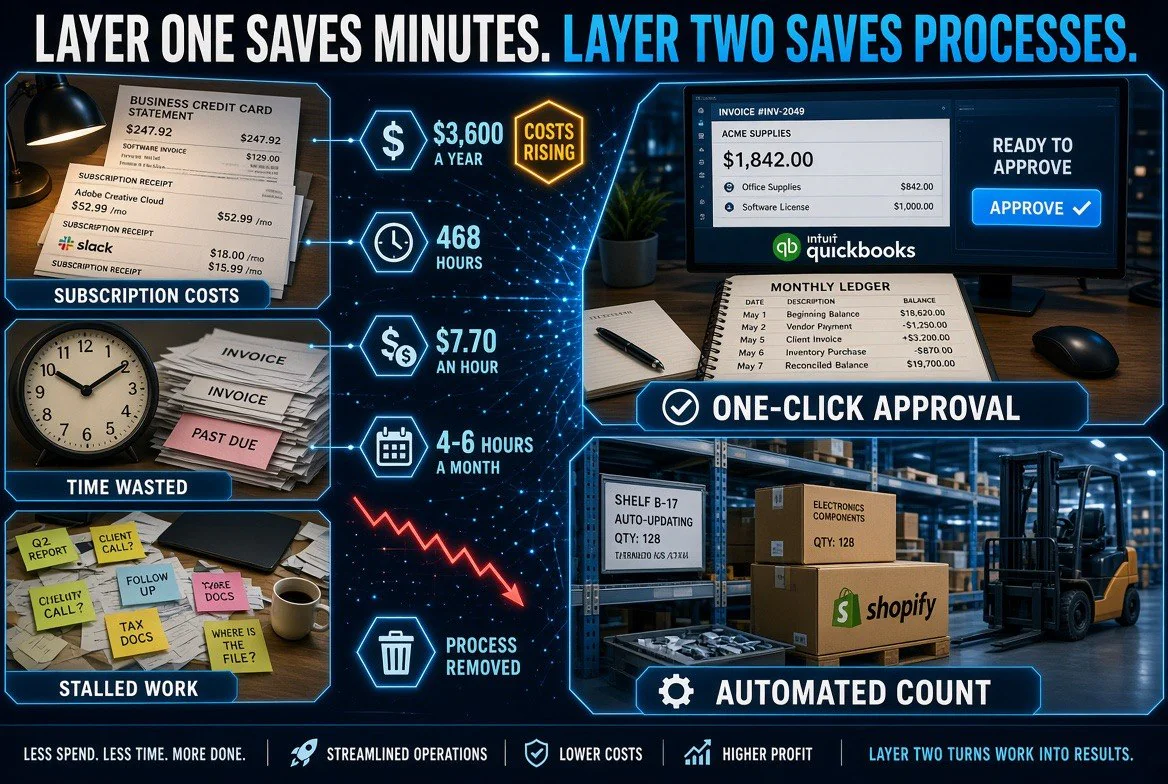
Here is the uncomfortable arithmetic. Say you pay for four AI tools at roughly $25 per seat across three people. That is $3,600 a year. If it saves each person two hours a week — a generous estimate for chat-only usage — you are buying 468 hours of efficiency a year at about $7.70 an hour. That is a fine hourly rate. It is also the ceiling.
Now move one process to layer two. Take invoicing: an AI that reads incoming vendor emails, extracts the amounts, and stages them in the books for a one-click approval. In a business issuing 150 invoices a month, that is four to six hours of clerical work eliminated, every month, with no human prompt required. The tooling might cost $100 a month. The return is not proportional to the fee — it is proportional to the process.
That is the asymmetry nobody puts in the deck. Layer one saves minutes. Layer two saves processes. And a small business does not scale on minutes saved, it scales on processes removed.
There is a competitive version of this too. If two competitors both report “AI adoption,” one of them has a chatbot and one of them has a system that quotes, invoices, and restocks without being asked. The survey can’t tell them apart. Their P&L can.
What To Do This Week — a 4-Step Wiring Plan
You do not need a digital transformation programme. You need one process, connected, this month. Here is the sequence that works for owner-operated businesses in the US.
Step 1 — Inventory what you already pay for. Pull the card statement and list every AI subscription by name and price. Most owners find at least two they forgot about. Cancel everything that fails the three-question test in the section above. That is free money and it funds the next step.
Step 2 — Pick one process that is boring, repetitive, and measurable. Not the most valuable process — the most countable one. Invoice entry, support triage, appointment confirmations, restock proposals. You want a process you can count before and after, in units, so improvement is not a feeling.
Step 3 — Connect it, with write access. This is the part people skip. The AI must write the result into the system of record, not into a document you then paste. If your tool of choice has a native integration to QuickBooks, HubSpot, Shopify, or your POS, use it — that is a hundred hours of engineering avoided for a checkbox. If it does not, a Zapier or Make layer over the API is usually enough for a single process.
Step 4 — Instrument the failure, not just the success. Set up one alert for when the automation stops. Almost every failed rollout in a small business dies from silent breakage discovered three weeks late, not from bad answers. A daily check that the job ran is worth more than a better prompt.
Four processes wired like that over a year will change a small business more than a hundred thousand chatbot prompts ever will. And unlike the prompts, the improvements stay after you stop pushing.
What the 86% Misses About the Next Twelve Months
The direction of travel is not subtle. Every major platform — QuickBooks, HubSpot, Shopify, Square, Toast, the whole stack — is shipping AI that assumes a connection to real business data and returns finished work rather than advice. Microsoft and Google are pushing agent platforms into productivity suites that small businesses already pay for. The “connect your data” button is appearing everywhere, usually as a checkbox next to the plan tier.
Which means the gap described in the Goldman research is not a permanent feature of the landscape. It is a window. For the next year or so, wiring your processes is an advantage — you will be doing something most of your competitors can’t be bothered to do. After that, it becomes table stakes, because the platforms will wire it for you and the differentiator disappears.
Businesses that use the window to learn how to connect, monitor, and repair an automated process will have built a muscle. Businesses that spend it in a chat tab will have a subscription and a story about how AI didn’t really deliver.
The 86% number is good news for AI vendors and a warning for owners. Using is no longer the interesting question. The interesting question is what you have wired.
Frequently Asked Questions
What did Goldman Sachs actually find about small business AI use?
Goldman Sachs research found that around 86% of US small businesses now use AI in some form, but that very few have integrated it into their core operating systems. The gap between using an AI tool and running a business on connected AI is the central finding — adoption is high, operational depth is low.
What counts as AI being “wired in” versus just used?
Wired in means the AI reads live company data on its own and writes results back into the systems of record, such as the CRM, books, or inventory. Used means a human opens a tool, types a prompt, and copies the answer out manually.
How much does it cost to connect AI to a small business’s systems?
For a single process with a native integration, typically $50–$500 per month in tooling plus a few days of setup. Processes without native integrations need an automation layer like Zapier or Make, or a developer, which pushes the cost to roughly $500–$2,000 for the initial build.
Which process should a small business connect first?
Pick the most countable repetitive process rather than the most valuable one — invoice entry, support triage, appointment confirmations, or restock proposals. A process you can measure in units before and after makes the return obvious in one month instead of one quarter.
Will AI eventually connect itself so this work is unnecessary?
Mostly, yes — major platforms including QuickBooks, HubSpot, Shopify, and Microsoft are shipping agents that assume access to real business data. That is exactly why the next twelve months matter: the advantage of wiring your own processes is temporary, and it becomes table stakes once the platforms do it for you.

About Barak Schurr
Barak Schurr built and sold a major ticketing platform, ran global nightlife operations at Eventbrite, and now spends his time figuring out which AI tools actually move the needle for independent business owners — and which ones are just noise. No hype. No fluff. Just what works.
Email: [email protected]
More AI Resources for Your Business