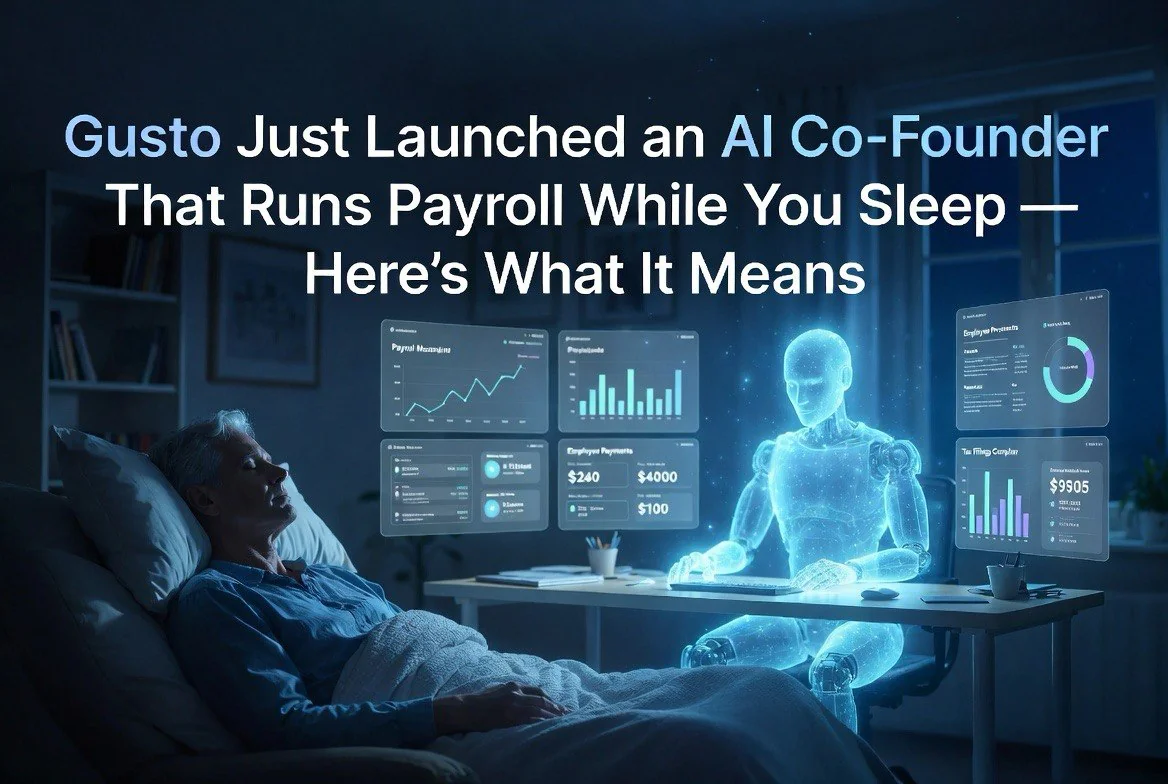
Gusto Just Launched an AI ‘Cofounder’ That Runs Payroll While You Sleep — Here’s What It Means
⚡ Expert Summary: Gusto launched “Cofounder” on June 2, 2026 — an AI agent built specifically for small business payroll, HR, and compliance. Unlike generic AI assistants, Cofounder comes pre-loaded with your business data, runs ~20 automated workflows (payroll runs, time-off approvals, expense reviews, compliance alerts), and integrates with Slack, Google Workspace, and Notion. Built by Gusto’s CTO Eddie Kim in nine weeks, it serves 500,000+ SMBs. Gusto’s own research found that AI-exposed SMBs grew revenue 2.3x faster in 2025. This isn’t a toy — it’s the payroll industry’s AI moment.
Gusto has been the quiet backbone of small business payroll for years. They’re not flashy. They don’t make headlines. They just process payroll for half a million businesses and do it well enough that most owners never think about it.
That changed yesterday.
Gusto Cofounder is an AI agent that doesn’t just answer questions — it takes actions. You text it “run payroll,” and it runs payroll. You ask “what’s my compliance risk this month,” and it surfaces issues before they become problems. It’s built on OpenAI’s foundation models, trained on Gusto’s decade of payroll and HR data, and integrated with 500,000+ business accounts from day one.
This is the biggest update to payroll software since payroll went online. And it’s happening because the AI market finally intersects with the boring-but-essential infrastructure that keeps small businesses running.
What Cofounder Actually Does
The key innovation is context. Most AI agents for business start from zero — they don’t know your company, your team, your payroll schedule, or your compliance obligations. Cofounder starts from your existing Gusto data. It knows how many people work for you. It knows when payroll runs. It knows which benefits you offer. It knows your state’s compliance requirements.
Gusto’s internal research found that 71% of small business owners spend at least 5 hours per week on administrative tasks they’d rather automate. Cofounder targets those 5 hours directly with about 20 pre-built automations that cover the most common workflows:
– Run payroll with a single text command
– Approve or deny time-off requests automatically based on policy
– Review flagged expenses for anomalies
– Generate labor cost reports on demand
– Surface compliance risks before they trigger penalties
– Send recurring headcount reports to management
Each of these is a task that currently takes an owner or manager 10-15 minutes of context switching — logging in, navigating menus, running reports, interpreting results. Cofounder collapses it into a message.
The Slack integration is particularly useful. You don’t open Gusto to approve time off. The request shows up in Slack, you approve it, and Cofounder updates the system. No app switching. No login. No friction.
How Cofounder Works Under the Hood
Cofounder isn’t a chatbot with a few payroll commands bolted on. The architecture is built specifically for agentic tasks in a regulated environment.
The system uses OpenAI’s foundation models for natural language understanding, but the critical layer is Gusto’s own action engine. When you type “run payroll,” the language model interprets the intent, but the actual payroll execution happens through Gusto’s existing, audited, SOC 2-certified infrastructure. The AI doesn’t touch the money directly. It triggers processes that already exist.
This separation matters for compliance. Payroll is heavily regulated at federal and state levels. Any error — incorrect withholding, missed deadline, wrong classification — can trigger penalties. Cofounder operates within Gusto’s compliance framework, which is already designed to handle 500,000+ businesses across all 50 states.
The permissioning system is also worth understanding. Cofounder respects the same role-based access controls that Gusto already uses. A manager who can approve time off in the dashboard can approve it through Cofounder. An employee who can only view their own paystubs gets the same limitation. No new access is granted — the AI is a new interface to existing permissions.
This is why Cofounder works where standalone AI agents fail. It doesn’t need to build trust from scratch. It inherits trust from the platform it’s built on.
Why This Matters for Small Business AI Adoption
The AI tools that stick are the ones that live inside software you already use. Not new platforms. Not separate logins. The features that survive are the ones that make existing workflows faster.
Gusto has 500,000+ small businesses already paying for payroll. Every single one of them has Gusto data — employee records, payroll history, benefit selections, compliance calendars. That’s not an integration problem. That’s a head start.
The OpenAI partnership gives Cofounder the language understanding to parse natural requests. But the real intelligence comes from Gusto’s data. Cofounder knows your business context before you type the first request. That’s a moat that generic AI tools can’t cross.
McKinsey’s 2025 research projected that generative AI could automate 60-70% of employee administrative tasks across payroll and HR functions. Cofounder is the first product to deliver on that projection with a real user base and real data.
The Integration Ecosystem Around Cofounder
Cofounder doesn’t live in isolation. Gusto has been building integrations for years, and Cofounder inherits all of them.
The Slack integration is the most visible, but the deeper value is in the connected workflow. Cofounder can pull data from connected time-tracking tools to verify hours before running payroll. It can sync approved time-off to your calendar through Google Workspace integration. It can log payroll summaries to Notion for your bookkeeper’s review.
The key is that these integrations are bidirectional. Cofounder doesn’t just read data from connected tools — it writes actions back. Approving time off in Slack updates the time-tracking tool. Running payroll automatically updates headcount reports in your connected analytics dashboard. Each action propagates through the ecosystem.
For small business owners managing multiple tools, this is the promise of AI agents done right. Not replacing your software stack. Making it work together without you playing middleman.
What Independent Owners Should Do Today
If you’re a Gusto customer, Cofounder is available in your account starting today. Open your Gusto dashboard, find the Cofounder settings, and enable it. Grant it the permissions it needs — you can start with read-only reporting and expand to action-taking as you build trust.
The smartest move is to start with one workflow: payroll execution. It’s the highest-risk, highest-reward automation. If Cofounder handles payroll correctly once, you’ll trust it with the rest. Run one manual cycle alongside it, verify the output, then hand over the keys.
If you’re not on Gusto, this is a strong reason to consider switching. Payroll is a commodity — every provider processes checks and files taxes. But Cofounder-level automation isn’t a commodity. It’s a competitive advantage that compounds over time.
At topnotchaitools.com, I review which AI tools actually deliver ROI for small businesses — and Gusto Cofounder is the most practical AI agent launch I’ve seen in 2026. Not because it’s flashy. Because it solves a real problem for a massive user base that was already paying for the platform.
What Cofounder Means for the Broader AI Agent Market
Gusto’s launch is important beyond the product itself. It validates a specific model for AI agents in business software: embed them in existing platforms with existing data, rather than building standalone AI tools that require separate onboarding.
The standalone AI agent market is crowded and confusing for small business owners. Dozens of startups offer “AI assistants for your business” — but none of them know your payroll schedule, your employee roster, or your compliance obligations. They start from zero every time. Gusto Cofounder starts from your complete business profile.
This is why platform-native AI agents will win over standalone ones. The data advantage is insurmountable. A startup building a payroll AI agent would need to integrate with every payroll provider, handle every API’s quirks, and still lack the deep compliance knowledge that Gusto has built over 15 years.
Gusto’s CTO Eddie Kim built Cofounder in nine weeks. That speed is only possible because the data infrastructure was already in place. Gusto didn’t build an AI model from scratch — they built an AI agent on top of data they already owned.
Expect to see every major SMB SaaS platform — QuickBooks, Shopify, Xero, Square — follow this playbook over the next 12 months. The question isn’t whether they’ll launch AI agents. It’s who will execute well enough that businesses actually use them.
Risks and Limitations You Should Know
Cofounder is impressive but it’s not magic. There are real limitations worth understanding before you hand over payroll access.
The AI handles standard workflows well. It struggles with exceptions. If an employee has an unusual compensation situation, a state-specific compliance requirement that falls outside common patterns, or a complex benefits scenario, Cofounder’s recommendations need human review. Gusto acknowledges this — the system flags edge cases rather than processing them silently.
The Slack integration is convenient but introduces a new attack surface. If someone gains access to your Slack account, they can instruct Cofounder to run payroll, approve time off, or access sensitive employee data. Gusto has implemented additional consent frameworks, but the risk profile is different from a password-protected web dashboard.
And finally, Cofounder works within Gusto’s ecosystem. It can’t help you with non-Gusto tasks. If you’re using separate tools for scheduling, inventory, or customer management, Cofounder doesn’t touch those. It’s a payroll and HR agent, not a business operating system.
None of these are dealbreakers. But they’re worth understanding before you text your first payroll command.
What This Means for the AI Agent Landscape
Gusto Cofounder is a template that other SMB software companies will copy. The playbook is clear: take a platform with existing data, add an AI layer that turns data into actions, and distribute it through channels users already have open (Slack, SMS, email).
The companies that execute this best will win the next phase of SMB software competition. The ones that wait for someone else to prove the model will scramble to catch up.
Gusto’s competitive advantage isn’t their AI — OpenAI provides that. It’s their data, their compliance infrastructure, and their 500,000-business distribution network. Those are moats that can’t be replicated in nine weeks.
The Bottom Line
Is Cofounder available for all Gusto plans?
Gusto is rolling Cofounder out across all tiers starting June 2026. Higher-tier plans (Concierge, Complete) get full action-taking capabilities. Basic plans start with reporting and advisory features.
Does Cofounder handle multi-state payroll compliance?
Yes. Gusto’s compliance engine covers all 50 states plus DC. Cofounder surfaces state-specific risks based on your business locations and employee residency.
Can I use Cofounder without giving it payroll execution access?
Yes. You can restrict Cofounder to read-only and advisory modes initially. Full action permissions are optional and configurable per workflow.
What happens if Cofounder makes a mistake?
All actions are logged with an audit trail. Cofounder requests confirmation before running payroll for the first few cycles. Gusto maintains the standard payroll accuracy guarantee.
Does Cofounder integrate with QuickBooks or Xero?
Currently integrates with Slack, Google Workspace, and Notion for commands. QuickBooks and Xero sync for accounting data remains available through Gusto’s existing integrations.

Barak Schurr
Barak Schurr built and sold a major ticketing platform, ran global nightlife operations at Eventbrite, and now spends his time figuring out which AI tools actually move the needle for independent business owners — and which ones are just noise. No hype. No fluff. Just what works.
More AI Resources for Your Business