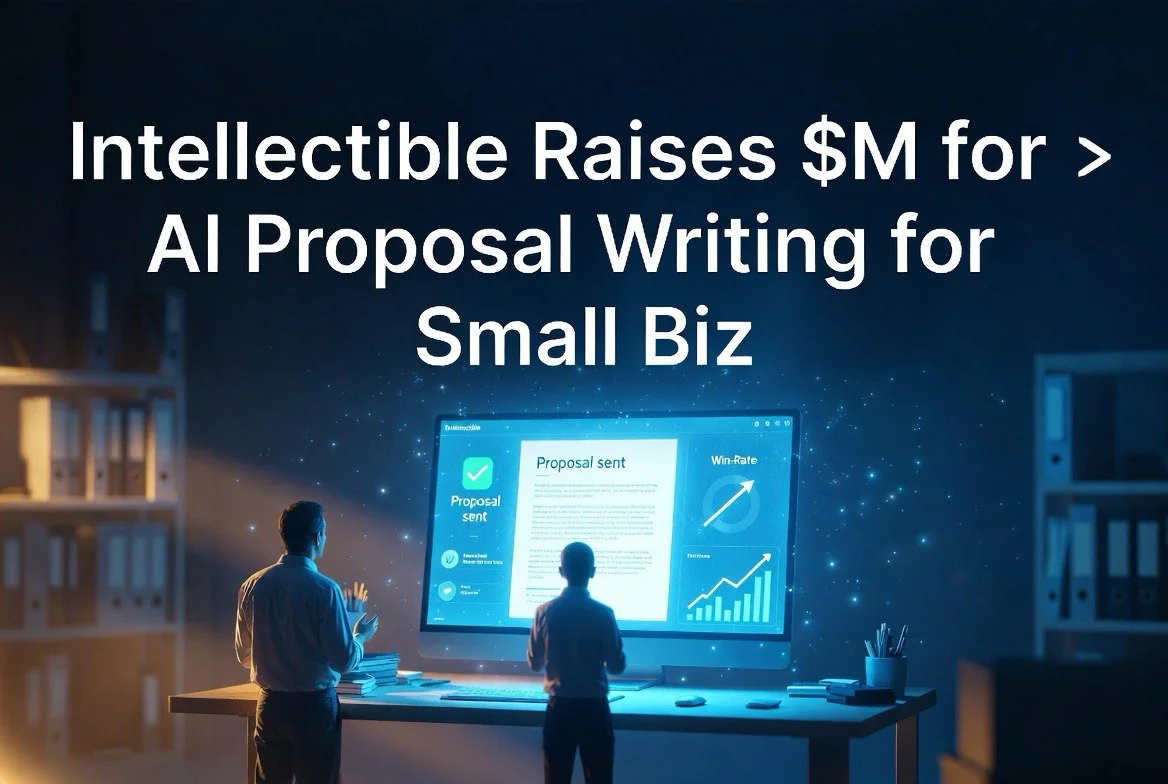
Intellectible Raises $3M for AI Proposal Writing: Small Biz
⚡ Expert Summary: Austin-based Intellectible raised $3M in seed funding (June 2026) for its AI-powered proposal writing platform that automates RFP responses, compliance matrices, and capture workflows. Backed by Anorak Ventures, Capital Factory, and Techstars, the platform uses retrieval-augmented generation (RAG) to draft proposals in your company’s voice from past documents, reducing draft time by up to 93%. For American small business owners who bid on contracts, this is a sign that AI proposal writing is moving from generic chatbots to specialized tools built for service providers.
If you’ve ever written a proposal for a government contract, a corporate RFP, or a large project bid, you know the pain: 60-page documents with compliance matrices, past performance narratives, technical approaches, and pricing schedules. Each one takes days. Each one is different enough that you can’t just copy-paste. And each one competes against firms that have dedicated proposal writers on staff.
For a small business owner, the math is brutal. A $200,000 contract bid might cost you 40 hours of proposal writing time. Win rate averages 30-40% for most small firms. That means for every three bids, you spend 120 hours and win one. At $150/hour billable rate, that’s $18,000 in lost opportunity cost to land one contract.
In June 2026, Austin-based Intellectible closed a $3 million seed round to build an AI platform specifically for this problem. It’s not another chatbot that vomits generic text. It’s a purpose-built proposal engine trained on your actual company documents, past proposals, and methodologies — and it’s the kind of specialized AI tool that small service businesses have been waiting for.
What Intellectible Actually Built
Intellectible (founded by Jesse Lozano, Rosie Higgins, and Reuben Carter) calls its platform an “AI-native workflow engine” — not a chat tool with a proposal template bolted on. It ingests your company’s existing documents, past proposals, resumes, technical articles, and reference materials, then uses them as the knowledge base for generating new proposal content.
The key distinction: most AI writing tools pull from their general training data. Intellectible pulls only from your uploaded content. When you need to respond to an RFP, it extracts the requirements from the solicitation document, builds a compliance matrix showing exactly what the RFP asks for and whether your proposal covers it, then drafts each section in your company’s voice using your past work as reference.
That’s the retrieval-augmented generation (RAG) approach — and it matters for proposal writing because accuracy and specificity are the difference between winning and losing. A generic AI proposal sounds like every other generic AI proposal. A proposal grounded in your actual past performance, team credentials, and technical methodology sounds like you.
The compliance matrix feature alone addresses a critical failure point. In government contracting, missing a single requirement in a 100-page RFP can disqualify your proposal before the evaluators even read your technical approach. Small businesses without dedicated proposal teams routinely lose bids not because their solution was worse, but because their response was incomplete. Intellectible’s AI agents extract every requirement, map it to your response, and flag gaps in your coverage.
Why $3M for Proposal Writing AI Matters for Small Businesses
The $3 million seed round — backed by Anorak Ventures, Capital Factory, Circadian Ventures, Plug and Play Tech Center, and Techstars — signals that investors see a real market in automating complex document workflows, not just simple content generation.
For small businesses, the signal is more practical: proposal writing software has historically been either too expensive or too generic. Enterprise bid management suites from companies like Responsive (formerly RFPIO) start at $10,000 per year. At the other end, a generic chatbot writes fluff that sounds like every other bidder. Intellectible sits in the middle — specialized enough to handle RFPs properly, but designed for service businesses that don’t have a dedicated proposals department.
The company claims its platform reduces time to create first drafts by up to 93%. Whether that number holds for your specific workflow depends on how much reference material you feed it, but the direction is clear: the 40-hour proposal cycle is shrinking to hours, not days.
For a small consulting firm submitting 15-20 proposals per year, the economics work. If each proposal takes 8 hours instead of 40, that’s 480 hours recovered annually — enough to bill an additional $72,000 at $150/hour. The platform pays for itself on the first few submissions.
How Small Business Owners Can Use AI Proposal Writing Today
The proposal writing workflow breaks into three phases, and AI tools handle each differently.
Phase 1 — RFP Analysis and Compliance. Reading a 100-page solicitation and extracting every requirement, deadline, and evaluation criterion is the most tedious part of proposal writing. Intellectible’s compliance matrix automation does this in minutes. For small firms that can’t afford a proposal manager, this alone is worth the price of entry. The AI identifies every “shall” statement, every evaluation factor, every page limit, and every format requirement — then cross-references them against your draft to ensure nothing is missed.
Phase 2 — Draft Generation. This is where the RAG system shines. It retrieves relevant content from your past proposals, matches it to each RFP requirement, and generates a section in your voice. The key rule: you still need to review and customize. The AI generates a first draft that’s 70-80% usable; the remaining 20% is judgment, nuance, and specific project knowledge that only you have. But 70% of a 60-page proposal written automatically means you start from draft page 42 instead of page 0.
Phase 3 — Review and Submission. The human-in-the-loop workflow means you approve every section before final output. Intellectible supports collaboration and version control, which matters when you’re coordinating with a small team across multiple submissions. You can assign sections to different team members, track changes, and maintain a single source of truth across versions.
The Intellectible Pitch vs. Generic AI for Proposals
It’s worth comparing Intellectible against the tools most small businesses already have access to.
A small business owner using ChatGPT for proposals can get decent first drafts, but the content is generic by design. ChatGPT doesn’t know your past performance, your team’s specific credentials, your proprietary methodology, or the language of your previous winning bids. It writes passable English that sounds like every other ChatGPT proposal.
A small business owner using Claude for proposals gets better reasoning and structure, but still lacks company-specific grounding. Claude can analyze an RFP and outline a response, but it can’t pull from your specific project history to demonstrate relevant experience.
Intellectible’s advantage is that it’s trained on your data. The RAG system retrieves your actual past performance narratives, adjusts them to match the current RFP’s evaluation criteria, and produces content that reads like your company — because it’s based on your company’s actual work.
For small businesses without a library of past proposals, Intellectible still works. You can upload resumes, technical articles, case studies, and methodology documents. The system builds its knowledge base from whatever you feed it. The more you feed it, the better it gets.
Is Intellectible Right for Your Small Business?
If you bid on government contracts, corporate RFPs, foundation grants, or any structured solicitation with evaluation criteria, Intellectible’s platform is directly relevant. The value increases with volume — if you submit 10+ bids per year, the time savings pay for the platform quickly.
If you write informal proposals for clients who just want a scope and price, a general AI tool like Claude or ChatGPT may be sufficient. Intellectible is overkill if you’re sending one-page quotes.
The company hasn’t publicly disclosed pricing for small businesses, but the seed funding positions it to develop tiered offerings. Given the investor lineup (Techstars, Capital Factory, Plug and Play), expect a product that scales from mid-market down to smaller firms — not an enterprise-only suite.
Real Proposal Workflow: Before and After Intellectible
Let’s put concrete numbers on this. A small IT consulting firm in the US bidding on a state government RFP for network infrastructure services faces a 90-page solicitation with 14 technical evaluation criteria, 8 compliance requirements, and a 60-page page limit.
Without AI: The owner spends 4 hours reading and annotating the RFP. Another 2 hours building a compliance matrix in Excel. 20 hours writing technical approach sections from scratch. 6 hours customizing past performance narratives. 4 hours on executive summary and cover letter. 4 hours on formatting, proofreading, and final review. Total: 40 hours spread across two weeks.
With Intellectible: Upload the RFP to the platform. The AI extracts all requirements and builds the compliance matrix in 5 minutes. Feed it your past proposals, resumes, and methodology documents. The AI generates first drafts of each technical section using your past work as reference, matched to the evaluation criteria. Total: 3 hours reading the AI draft, 3 hours customizing sections, 1 hour on final review. Total: 7 hours.
The difference between 40 hours and 7 hours is a work week. For a small firm billing $150/hour, that’s $4,950 in recovered billable time per proposal. Submit 10 proposals per year and you’ve recovered $49,500 in opportunity cost.
The Competitive Landscape for AI Proposal Tools
Intellectible isn’t the only AI proposal tool, but it’s the one that explicitly targets the compliance-heavy, RFP-driven workflow. Here’s how it compares to alternatives:
General AI assistants (ChatGPT, Claude): $20-200/month. Useful for drafts but lack company-specific knowledge. No compliance matrix. No integration with your past proposals. You’re starting from zero every time.
Enterprise bid management (Responsive, Loopio): $10,000+/year. Full-featured but priced for firms with dedicated proposal teams. Includes compliance tracking, content libraries, and collaboration, but the cost is prohibitive for most small businesses.
Proposal templates (Better Proposals, Qwilr): $20-80/month. Good for simple proposals and quotes. No AI generation, no compliance tracking, no RFP analysis.
Intellectible’s position in this landscape is the gap between enterprise bid management and generic AI — specialized enough for real RFPs, but built for businesses that don’t have a proposal department.
For American small businesses in consulting, construction, IT services, engineering, and government contracting, this is a tool to watch. The $3 million round validates that proposal AI is becoming a category, not a feature. The technology exists today to cut proposal writing time by 70-90% while improving compliance and accuracy. That’s the difference between bidding on three contracts in a month and bidding on ten.
For more AI tools that save small business owners time and money, check out our AI tools guide for US small business owners.
Frequently Asked Questions
Does Intellectible work for small business proposals or just enterprise RFPs?
Intellectible is built for service providers responding to structured solicitations, RFPs, and grants. Small businesses that bid on contracts or submit formal proposals can use it, though the platform’s strength scales with the complexity and volume of your submissions.
How does Intellectible protect my proposal content and company data?
The platform uses retrieval-augmented generation (RAG), which means it generates content only from your uploaded documents. Your proprietary methodologies, past performance data, and pricing are not shared with the model’s general training data.
What’s the difference between Intellectible and using ChatGPT for proposals?
ChatGPT generates content from its general training data and can produce generic-sounding proposals. Intellectible uses your past proposals, resumes, and reference materials as its knowledge base, producing content in your company’s specific voice with accurate compliance tracking.
How much does Intellectible cost?
Pricing hasn’t been publicly announced for small business tiers. The $3M seed round suggests the company is still developing its go-to-market pricing. Check intellectible.com for current plans.
Can Intellectible help with grant proposals?
Yes. The platform’s RFP engine works for any structured solicitation with evaluation criteria, including grants. The Colorado School of Mines piloted Intellectible for research grant proposals.
Who invested in Intellectible’s $3M seed round?
Anorak Ventures, Capital Factory, Circadian Ventures, Plug and Play Tech Center, and Techstars.

About Barak Schurr
Barak Schurr is the founder and former president of the nightlife ticketing platform Wantickets and former Global Director of Dance and Nightlife at Eventbrite. He currently focuses on AI research and writes about practical AI for independent business owners that actually moves the needle — no hype, no corporate fluff. More at topnotchaitools.com.
Contact: [email protected]
More AI Resources for Your Business