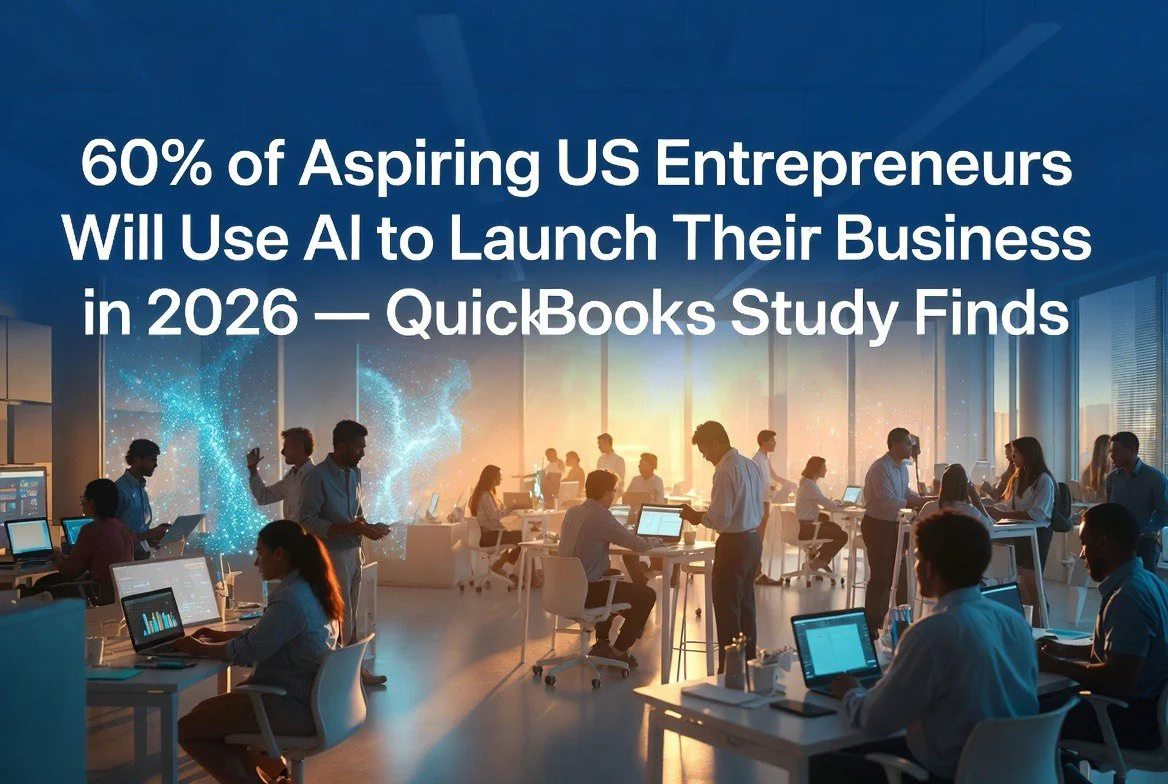
60% of Aspiring US Entrepreneurs Will Use AI to Launch Their Business in 2026, QuickBooks Study Finds
⚡ Expert Summary: Intuit QuickBooks’ 2026 Entrepreneurship Trends study surveyed over 3,000 US adults and found that 60% of aspiring entrepreneurs plan to use AI to launch their businesses. 33% of Americans intend to start a business or side hustle within the next 12 months — a 94% year-over-year increase. Millennials lead the AI charge at 75% adoption. Money remains the top barrier at 47%, but AI is rapidly becoming the primary enabler for new founders in the United States.
QuickBooks 2026 Entrepreneurship Study: The Key Numbers
Intuit QuickBooks released its 2026 Entrepreneurship Trends study in January 2026, based on a survey of over 3,000 US adults.[1] The headline finding: more than 60% of aspiring American entrepreneurs say they will use AI to help launch their business this year.
That number is staggering when you consider that three years ago, AI wasn’t even a consideration for most new founders. The shift from “AI is interesting” to “AI is how I’ll start my business” happened faster than most analysts predicted.
Other key findings from the study:
- 33% of US adults plan to start a business or side hustle in the next 12 months — a 94% increase compared to the previous year
- 47% cite money as the top barrier to starting, alongside low financial confidence
- 47% of Americans earned income from a side hustle in the past year
- 75% of millennials plan to use AI in their launch, with 40% saying they are “very likely” to do so
The trend is clear: AI is collapsing the time and cost required to go from idea to revenue, and Americans are responding by starting businesses at nearly double the rate of last year.
Why This Matters for Small Business and Entrepreneurship in the US
Let the numbers sink in. One in three American adults is currently planning to start a business — that’s roughly 85 million people.[1] In any other year, that figure would be the headline. But in 2026, it’s competing with an even bigger story: AI is the engine behind it.
Intuit’s Chief Data Officer told Business Wire that AI is “the biggest game changer for new businesses since the internet.”[2] That’s not marketing copy. When the company that processes payments and accounting for millions of US small businesses says they see a structural shift, it’s worth paying attention to the data behind it.
The 94% surge in entrepreneurial intent isn’t happening in a vacuum. It correlates directly with the availability of AI tools that reduce the friction of starting a business.
Traditionally, launching a business required:
- Legal setup (LLC, EIN, business bank account) — $500-2,000 in legal fees
- Website and branding — $1,000-5,000 if you hire someone
- Marketing materials — copywriting, design, ad creative
- Customer acquisition strategy — testing channels, building funnels
AI tools now handle significant portions of each. Legal AI can draft formation documents. AI website builders handle the design. AI copywriters and designers produce marketing materials. AI agents can run ad campaigns and test creative variations.
The QuickBooks data suggests this isn’t theoretical. The 60% who plan to use AI aren’t talking about ChatGPT for writing emails. They’re using AI to replace the functions that used to require hiring specialists — which is why more people feel equipped to start a business despite economic uncertainty.
Millennials Lead, But the AI Entrepreneur Gap Is Closing
The QuickBooks study reveals the most AI-forward generation isn’t the youngest — it’s the generation that remembers life before smartphones but built their careers alongside the app economy.
The generational breakdown from the study reveals a clear adoption curve:
Millennials (75% AI adoption): This group came of age during the social media and mobile revolutions. They’re the most comfortable weaving AI into every stage of business formation. 40% of millennial aspiring entrepreneurs say they are “very likely” to use AI — not just curious, but actively planning around it.
Gen Z (growing rapidly): The youngest cohort of potential founders grew up with AI-native tools. Their adoption rate is lower than millennials in the current study, but this is likely a function of life stage rather than reluctance. As Gen Z enters prime entrepreneurship years (late 20s to early 30s), their AI adoption will likely exceed every generation before them.
Gen X and Boomers (slower but accelerating): These groups report lower AI adoption for business formation. However, the 2026 data shows a significant year-over-year increase even among older demographics. Many are using AI to formalise side hustles they’ve been running manually for years.
The data suggests that within the next three years, the generational gap will narrow to the point where not using AI to start a business will be the exception, not the norm.
Money Is Still the Top Barrier. AI Is the Workaround
The QuickBooks study confirms what every aspiring entrepreneur already knows: money is the number one obstacle. 47% of respondents cited financial concerns as the primary barrier to starting a business.
But the study also reveals a shift in how people address that barrier. Instead of waiting until they have enough savings, aspiring founders are using AI to reduce the cost of entry.
Traditional startup costs that AI now makes cheaper:
- Market research: Previously required surveys, focus groups, or expensive data tools. Now AI can analyse trends, identify gaps, and validate ideas with public data.
- Branding and design: Logo design, colour palettes, and brand guidelines that cost $500-3,000 from a designer can now be generated in minutes with AI design tools.
- Content and copywriting: Website copy, social media content, email sequences — the work that used to cost thousands in agency fees or weeks of DIY effort.
- Customer service: AI agents and chatbots handle first-line support, freeing founders to focus on product and sales.
- Accounting and bookkeeping: QuickBooks itself has been integrating AI into its platform, automating categorisation, invoicing, and financial reporting.
The study’s 94% increase in entrepreneurial intent makes more sense when you view it through this lens. AI doesn’t eliminate the need for capital — but it dramatically lowers the threshold of what you need before you can launch.
Side Hustle Nation: 47% of Americans Already Earn on the Side
The side hustle economy in the United States is larger and more formalised than most people realise. Nearly half of all American adults earned income outside their primary job in the past year — and many of those side hustles are the testing ground for future full-time businesses.
The QuickBooks study found that 47% of Americans earned income from a side hustle in the past year. This aligns with broader US labour trends showing that the gig economy, freelance market, and side business culture are all growing simultaneously.
What’s new in 2026 is the AI layer. Side hustlers are using AI to:
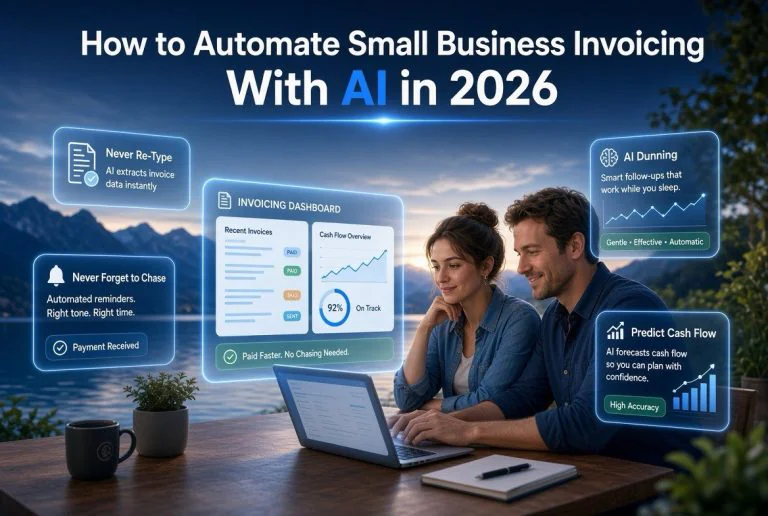
- Automate administrative work (invoicing, client communication, scheduling)
- Generate marketing content across multiple platforms
- Analyse which products or services are most profitable
- Scale delivery without hiring help
The AI-enabled side hustler can operate at a production level that previously required a full team. A single freelancer with AI tools can match the output of a 3-5 person agency in many categories.
This is the structural shift the QuickBooks study captures. The 47% side hustle figure isn’t just a labour market statistic — it’s the base of a new entrepreneurship pyramid where AI is the lever that turns side income into full-time business.
What This Means for the US Economy
The 94% year-over-year increase in entrepreneurial intent is not a minor trend. If even a fraction converts to actual business registrations, the next 12-24 months could see the highest rate of new business formation in US history.
A 94% year-over-year increase in entrepreneurial intent at the national level is not a minor trend. If even a fraction of that intent converts to actual business registrations, the next 12-24 months could see the highest rate of new business formation in US history.
This has downstream implications:
Business services will boom. Every new business needs accounting software, banking, legal compliance, and insurance. AI-native startups that can serve this wave of AI-native founders will be well-positioned.
AI tools will face a retention problem. Many aspiring entrepreneurs will try AI tools and fail to launch. Companies that provide onboarding, templates, and guided workflows — not just raw AI capability — will capture the long-term value.
Traditional small business lenders will need to adapt. When founders can launch with less capital, traditional loan products based on collateral and history may miss the market. Revenue-based financing and AI-scored credit products could fill the gap.
The Bottom Line
The QuickBooks 2026 Entrepreneurship Trends study documents a moment of structural change in American entrepreneurship. More people want to start businesses than at any point in recent history. More of them have a clear path to do so because AI reduces the friction and cost of entry.
The 60% who plan to use AI aren’t early adopters anymore. They’re the mainstream. And the 94% surge in entrepreneurial intent suggests that the next wave of US business owners will be the first generation for whom AI is not an advantage — it’s the baseline.
Frequently Asked Questions
What is the QuickBooks 2026 Entrepreneurship Trends study?
The study is a survey conducted by Intuit QuickBooks in December 2025 of over 3,000 US adults, focused on entrepreneurship trends, AI adoption, and the barriers to starting a business in 2026.
What percentage of aspiring entrepreneurs plan to use AI?
More than 60% of aspiring US entrepreneurs said they plan to use AI to help launch their business in 2026, according to the QuickBooks study.
Which generation is most likely to use AI for business?
Millennials lead at 75% adoption, with 40% saying they are “very likely” to use AI tools for launching their business.
How many Americans plan to start a business in the next year?
33% of US adults intend to start a business or side hustle in the next 12 months — a 94% increase year-over-year.
Is money still the biggest barrier to starting a business?
Yes, 47% of respondents cited money as the top barrier. However, AI tools are lowering the cost of entry, making it possible to launch with less capital than traditional business formation required.

About Barak Schurr
Barak Schurr is the founder and former president of the nightlife ticketing platform Wantickets and former Global Director of Dance and Nightlife at Eventbrite. He currently focuses on AI research and writes about practical AI for independent business owners that actually moves the needle — no hype, no corporate fluff. More at topnotchaitools.com. Contact: [email protected]
More AI Resources for Your Business