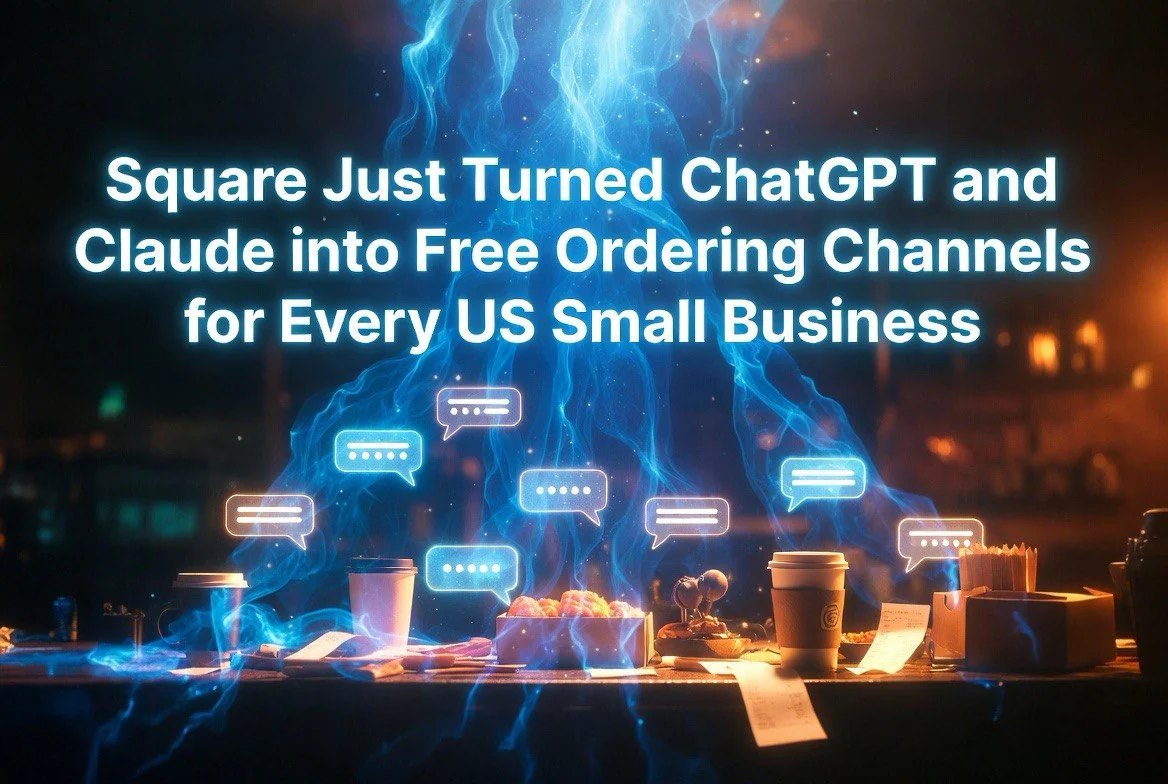
Square Just Turned ChatGPT and Claude Into Free Ordering Channels for Every US Small Business
⚡ Expert Summary: On July 1, 2026, Square automatically opted in every US Food & Beverage seller using Square Online Ordering to accept orders directly inside ChatGPT and Claude conversations. No setup. No APIs. No marketplace commissions — just standard processing fees. This is agentic commerce: AI assistants as the front door of your business.
On July 1, Square flipped a switch that turned every US restaurant using its payment platform into a storefront inside the world’s most popular AI chatbots. No enrollment form. No integration call. No new hardware. If you run a US food business on Square, customers — or more accurately, their AI agents — can now discover your menu, place orders, and pay without ever opening another app.
This is not another delivery marketplace. This is something structurally different.
The Mechanic: How Square’s AI Ordering Works
Square launched a ChatGPT app and a Claude plugin that plug directly into each platform’s interface. When a user (or their autonomous AI agent) decides to order food, the system pulls your live Square catalog — menu items, prices, modifiers, modifiers on modifiers, and real-time stock. The AI never offers something you’re out of.
Orders flow straight into your existing Square Online Ordering setup: POS, Kitchen Display System, reporting. The order source gets a clear label so you know it came through an AI channel. No data fragmentation. No extra portal to check.
Depending on how the customer’s AI tool is configured, they either complete checkout inside the chat window via “Order by Cash App,” or they get redirected to your standard online ordering page with their basket already populated. Either way, their intent arrives in your kitchen.
For business owners who want to audit their digital footprint: invoke the “@” symbol to pull up the Order by Cash App plugin inside ChatGPT, or connect it through the Claude extension directory. You’ll see exactly what your customers see.
Why Square’s Timing Matters: The Tipping Point for AI Commerce
The launch comes at a specific inflection point. According to PYMNTS, 22% of US consumers already use AI to choose where to eat, and 83% of restaurant locations are effectively invisible to these AI queries because they lack structured data that chatbots can parse. Square’s integration solves the invisibility problem on the supply side — any restaurant on Square now has structured, real-time menu data that ChatGPT and Claude can surface.
On the demand side, the behavior is already established. Consumers are increasingly starting their purchase decisions in AI chat interfaces rather than search engines or dedicated apps. A 2026 study cited by VentureBeat found that AI-native discovery — asking a chatbot for recommendations rather than googling — doubled in the first half of 2026 alone. Square’s integration captures that behavior at the precise moment it is accelerating.
The Numbers That Matter: AI Ordering vs. Delivery Apps
Here is where Square’s move shifts the economics of restaurant tech. Third-party delivery platforms have spent the last decade training customers to order through them — then charging restaurants 15% to 30% for the privilege.
DoorDash’s Basic plan takes 15% for delivery. Its Premier plan takes 30%. Uber Eats runs 20% to 30%. Grubhub ranges from 5% to 20% depending on the package. On top of those marketplace commissions, they still tack on payment processing fees around 2.5% to 3%.
For an independent restaurant clearing 3% to 9% net profit on a good day, handing over 25% to 30% on a $40 digital order means paying to feed someone. The food costs more than you make.
Square’s AI channel bypasses all of that. The cost: standard online transaction processing. For most Square merchants, that is 2.9% plus $0.30 per transaction on the standard plan — or 3.3% plus $0.30 on the basic plan. No marketplace commission. No 30% tax on discovery. No monthly platform fee for AI visibility.
What “Agentic Commerce” Actually Means for Small Business Owners
Square is calling this “agentic commerce,” and the label matters. Previous waves of digital commerce required the customer to open a specific app, visit a specific site, or make a specific decision. The funnel was pull-based: the customer chose to come to you.
Agentic commerce flips that. AI assistants now handle discovery, menu review, recommendations, and order placement during natural conversations on behalf of the customer. Your business gets found and transacted with inside the flow of an AI dialogue — without the customer ever consciously “going to your website.”
This is the same transition that happened when Google started answering questions directly in search results instead of sending traffic to pages. Businesses that optimized for the new channel won. Ones that ignored it lost visibility.
Square’s integration is the first mass-market deployment of agentic commerce for small business. And because it is opt-out rather than opt-in, every eligible Square seller is now participating — whether they know it or not.
Square’s Broader AI Strategy for Small Business
The ChatGPT and Claude integrations are not Square’s first AI move. The company has been building toward agentic commerce for months. Square already offers AI voice ordering for restaurants, Managerbot for operational insights, and AI-powered marketing tools for sellers.
But the ChatGPT/Claude play is the most significant because it solves the distribution problem. Small businesses do not have the marketing budget to be everywhere a customer might ask for a recommendation. AI chatbots are becoming the new starting point for consumer decisions — and Square just put every one of its sellers at that starting point.
According to VentureBeat, Square’s approach is designed so “eligible sellers are opted in automatically with no additional setup, no new APIs to build, and zero added marketplace fees.” The technical barrier is nonexistent.
How This Compares to Traditional Online Ordering Channels
The delivery aggregators built their businesses on a simple trade: we send you customers, you give us a percentage of every order. That model worked when customers typed “pizza near me” into Google. It works less well when they ask their AI assistant “what’s a good Italian place nearby that delivers?” and the AI answers without scrolling through paid placement.
AI chatbots do not surface the highest bidder. They surface the most relevant answer. For a small business, that means the quality of your Square listing — accurate menu, real-time availability, good reviews, clear description — determines whether an AI recommends you, not how much you spend on placement.
This flattens the playing field in a way the delivery app economy never did. A single-location taqueria with a complete Square profile has the same shot at AI discovery as a 200-location chain.
How to Verify Your Business Is Visible in ChatGPT and Claude
Because Square auto-enrolled eligible sellers, the default state is participation. But default does not mean optimized. Here is how to confirm your business is actually findable in AI chat channels:
Open ChatGPT. Use the “@” symbol to invoke the Order by Cash App plugin. Type a query for your type of food or your restaurant name. If your business appears with accurate hours, menu items, and pricing, you are live. Do the same through the Claude extension directory — connect the Square plugin and run a similar test.
If your business does not appear, the most likely reason is that your Square Online Ordering profile is not fully activated. Check your Square Dashboard under Online Channels. If Online Ordering is enabled and you do not see yourself in the AI tools, contact Square support — the auto-enrollment covers standard profiles, but edge cases with custom setups may require a manual sync.
Digital Commerce 360 noted that Square’s integration syncs “real-time data like menus, hours, and availability via the existing Square Dashboard,” meaning your updates propagate to AI channels within minutes. There is no batch processing delay or overnight sync window.
What Small Business Owners Should Do Right Now
Since Square auto-enrolled all eligible US Food & Beverage sellers, your business is already live inside ChatGPT and Claude. Here is what you need to verify:
1. Confirm your Square Online Ordering profile is active. If you accept payments through Square but never set up online ordering, the AI channel is dark. Activate it.
2. Audit your menu data. AI agents pull from your live catalog. If your menu has outdated prices, missing modifiers, or incorrect descriptions, that is what AI will display. Customers trust AI less when the data is wrong. Clean it up.
3. Set your hours and availability. Square syncs this automatically, but verify. Getting an AI-generated order at 9 PM when you close at 8 PM creates a bad experience for everyone.
4. Monitor your AI channel reporting. Square labels orders placed through ChatGPT and Claude in your dashboard. Track this as a separate channel. If it drives volume without the 30% marketplace tax, that changes your delivery strategy entirely.
5. Understand the delivery cost. For pickup orders placed through AI, the cost is Square’s standard processing fee. For delivery orders, Square uses a white-label dispatch network that charges a flat courier fee (typically $7 to $10 depending on distance) rather than a percentage of basket size. Restaurants can absorb this or pass it to the customer — but it is transparent and capped, unlike the variable percentage model of traditional delivery apps.
What Comes Next
Square is starting with US Food & Beverage sellers, but the company has indicated this is the first phase of a broader push into agentic commerce. The same infrastructure that lets AI agents order food can extend to retail, services, and any business using Square for payments.
For small business owners, the strategic question is not whether to participate — participation is automatic. The question is whether you optimize for a world where AI agents do the discovery and ordering work on behalf of customers, or whether you let your competitors figure it out first.
The restaurant industry learned the hard way that ignoring delivery apps meant losing 30% of your revenue to the ones that did. The AI ordering channel costs 2.9% instead of 30% — and it is already live.
Frequently Asked Questions
Do I need to sign up or install anything to accept orders from ChatGPT and Claude?
No. If you are a US Square merchant with an active Square Online Ordering profile, you were automatically opted in. No setup, no APIs, no new contracts.
What fees does Square charge for AI-generated orders?
Standard online transaction processing fees only: approximately 2.9% plus $0.30 per transaction (or 3.3% plus $0.30 on basic plans). No additional marketplace commissions.
How do AI orders appear in my restaurant?
Orders flow into your existing Square POS and Kitchen Display System, just like any other online order. They are labeled by source so you can track AI channel performance.
Can customers place delivery orders through ChatGPT and Claude?
Yes. For delivery, Square uses a white-label dispatch network. The restaurant pays a flat courier fee ($7-$10 depending on distance) rather than a percentage of the order value.
Is this available for non-restaurant businesses on Square?
Currently the integration is available for US Food & Beverage sellers. Square has announced plans to expand agentic commerce to other verticals.

About Barak Schurr
Barak Schurr is the founder and former president of the nightlife ticketing platform Wantickets and former Global Director of Dance and Nightlife at Eventbrite. He currently focuses on AI research and writes about practical AI for independent business owners that actually moves the needle — no hype, no corporate fluff. More at topnotchaitools.com.
Contact: [email protected]
More AI Resources for Your Business